Bolides: Fireballs Going Boom
Why in News?
Recently, a meteor exploded over the northeastern United States, producing a bright fireball and loud sonic booms heard across several states. NASA estimated that the object fragmented at an altitude of about 64 km while travelling at more than 120,000 km/h, releasing energy equivalent to nearly 300 tonnes of TNT.
| UPSC Relevance: GS-3 Science and Technology: Astronomy and Space Technology Prelims: Asteroid, Meteoroid, Meteor, Fireball, Bolide |
What is a Bolide?
- A bolide is an exceptionally bright meteor that explodes or fragments violently in Earth’s atmosphere, producing a powerful flash of light and often a shockwave.
- In simple terms:
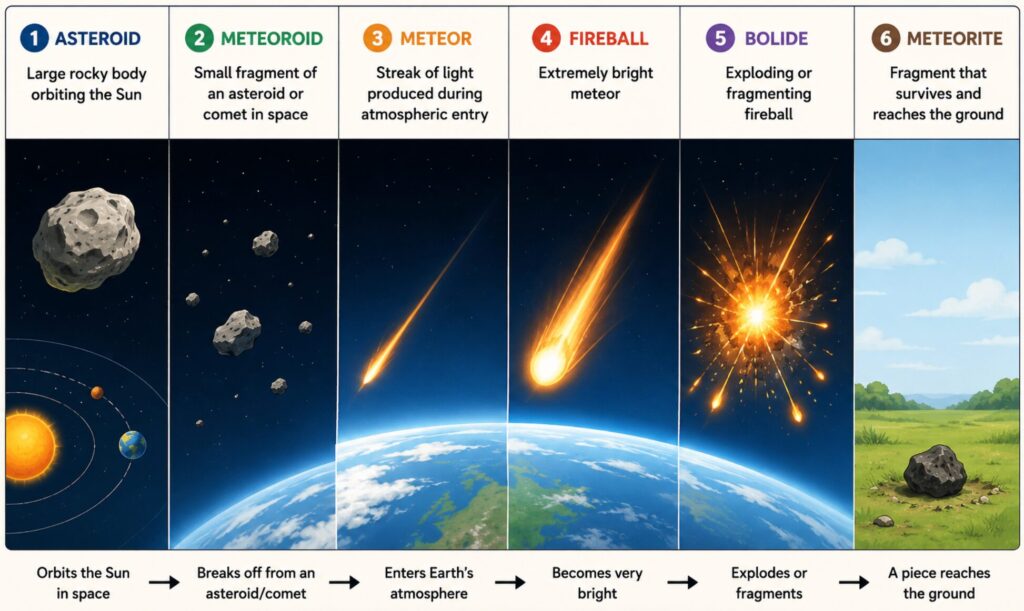
- Meteoroid: A small rocky or metallic object travelling through space.
- Meteor: The streak of light produced when a meteoroid enters Earth’s atmosphere.
- Fireball: An unusually bright meteor, brighter than the planet Venus.
- Bolide: A fireball that explodes or breaks apart dramatically in the atmosphere.
All bolides are fireballs, but not all fireballs are bolides.
NASA’s fireball classification:
A meteor brighter than magnitude -4 (brighter than Venus) is generally classified as a fireball. A bolide is a fireball that undergoes a significant atmospheric explosion or fragmentation.
How does a Bolide form?
- Origin in Space: Most bolides originate from fragments of asteroids. Some may also originate from cometary debris. These objects orbit the Sun until their paths intersect with Earth’s orbit.
- Atmospheric Entry: When the object enters Earth’s atmosphere:
- It travels at extremely high speeds (typically 11–72 km/s).
- Air in front of it is compressed rapidly.
- Compression generates intense heat, causing the object to glow.
- A bright streak of light becomes visible across the sky.
- Explosion: As atmospheric pressure increases, internal stresses build up. The object may fragment violently. The sudden release of kinetic energy creates an airburst, producing shockwaves and loud booms.
Why are the Booms so Loud?
- The sound is not caused by burning. Instead, the meteor travels faster than the speed of sound. It generates a shockwave, similar to a supersonic aircraft.
- When the shockwave reaches the ground, people hear a loud boom and may feel vibrations. This phenomenon is called a sonic boom.
- A famous example is the Chelyabinsk bolide, which exploded over Russia in 2013, generating a powerful shockwave that damaged buildings and injured more than a thousand people.
Difference between Asteroid, Meteoroid, Meteor, Fireball and Bolide:
Significance:
Bolides help scientists:
- Understand the composition of asteroids and meteoroids.
- Estimate the frequency of near-Earth impacts.
- Improve planetary defence systems.
- Assess risks posed by larger Near-Earth Objects (NEOs).
- Study atmospheric shockwave physics.
UPSC PYQ 2023
Q. Consider the following pairs:
Objects in space Description
- Cepheids: Giant clouds of dust and gas in space
- Nebulae: Stars which brighten and dim periodically
- Pulsars: Neutron stars that are formed when massive stars run out of fuel and collapse
How many of the above pairs are correctly matched?
(a) Only one
(b) Only two
(c) All three
(d) None
Answer: (a)