Border States flag illegal migrants on voter rolls and rising drone smuggling
Why in News?
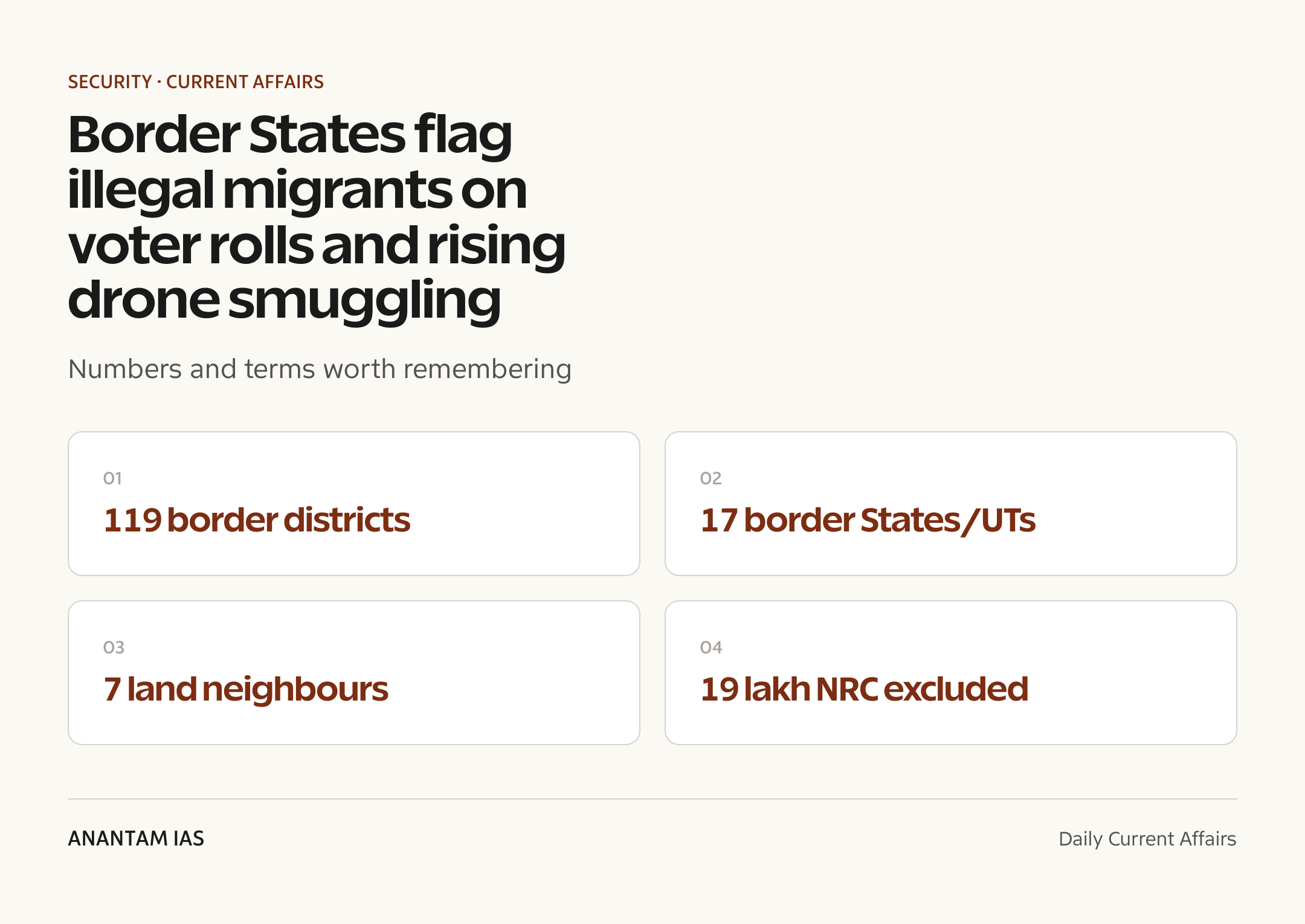
At the first-ever Land Border Districts’ Superintendents of Police Conference 2026, held on July 9 and addressed by the Home Minister, police chiefs from 119 border districts flagged a cluster of internal-security concerns along India’s land frontiers, according to The Hindu.
The states raised the presence of illegal migrants on electoral rolls, a sharp rise in drone-enabled smuggling of weapons and narcotics across the Pakistan border, misuse of encrypted apps by criminal and terror networks, and the emptying-out of border villages for want of infrastructure and jobs.
The conference marked a shift toward treating district police as a frontline layer of border management, sitting alongside the central armed police forces that actually man the fence, and toward feeding grassroots intelligence on demographic change up to national decision-makers.
Border management is a recurring GS Paper 3 theme, tying together infiltration, the narco-terror nexus, technology on the frontier, and border-area development, so the concerns discussed map directly onto the syllabus.
- First-ever conference of SPs of 119 border districts, held on July 9 in New Delhi.
- Attended by the Union Home Secretary, Director of the Intelligence Bureau, and DGPs of 17 States and Union Territories with land borders.
- Covers frontiers with Pakistan, Nepal, Bangladesh, Bhutan, China and Myanmar.
- Five sessions spanned transborder terrorism, organised crime, border-guarding challenges, financial crimes, demographic change and community engagement.
- States to submit suggestions by December; a quadrangular security grid linking border communities and local police to be finalised over the next one and a half years.
The development matters in the context of:
- India shares roughly 15,000 km of land borders with seven neighbours, guarded mainly by the BSF, SSB and ITBP.
- Border management sits squarely in GS Paper 3 internal security: infiltration, cross-border smuggling, technology on borders, and the linkages between organised crime and terrorism.
UPSC Relevance
Prelims Relevance
- Border-guarding forces: BSF (Pakistan and Bangladesh), SSB (Nepal and Bhutan), ITBP (China), Assam Rifles (Myanmar).
- Comprehensive Integrated Border Management System (CIBMS) and technology-led surveillance on the frontier.
- Vibrant Villages Programme for development of border villages.
- Anti-drone / Anti-Rogue Drone systems and drone-forensics laboratories.
- Constitutional and legal basis of the electoral roll and Special Intensive Revision (SIR).
- National Register of Citizens (NRC) in Assam and its exclusions.
- Intelligence and coordination bodies: Intelligence Bureau, MHA’s border-management division.
- Encrypted communication apps used for smuggling and the challenge of lawful interception.
Mains Relevance
GS Paper 3
- Security challenges and their management in border areas; linkages of organised crime with terrorism.
- Role of technology (drones, anti-drone systems, CIBMS) and border-area development in a comprehensive border-management strategy.
Essay
- Security and development are two sides of the same coin at the border.
Background and Context
The conference and who was in the room
The meeting brought district-level policing to the centre of border management for the first time, complementing the work of the central armed police forces.
- The Land Border Districts’ SP Conference 2026 was the first gathering of its kind, held on July 9 in New Delhi.
- It was attended by SPs of 119 border districts, the Union Home Secretary, the IB Director, and DGPs of 17 border States and UTs.
- Five sessions were held on transborder terrorism, insurgency and organised crime, challenges in border guarding, financial crimes and illegal flow of funds, changes in demography and habitation, and community engagement for border development.
- The Home Minister asked SPs to report abnormal population growth in border areas up the chain of command at the earliest.
Illegal migration and the electoral roll
The states raised how forged documents can let illegal migrants slip onto voter lists, a governance and security concern rather than a partisan one.
- Assam Police presented a case study of an illegal migrant from Bangladesh who obtained a forged school-leaving certificate, allotted parents to fake lineage, then a passport and voter card, and was not excluded from the roll.
- The Special Intensive Revision (SIR) of electoral rolls, carried out elsewhere, was not undertaken in Assam because the state’s National Register of Citizens (NRC), finalised in 2019, is yet to be published.
- More than 19 lakh of Assam’s 3.29 crore applicants were excluded from the register.
- The Chief Election Commissioner noted the revision is meant to include eligible voters and exclude the ineligible.
Drones and encrypted apps: the new smuggling toolkit
The frontier fight has moved into the air and into encrypted channels, stretching conventional border-guarding.
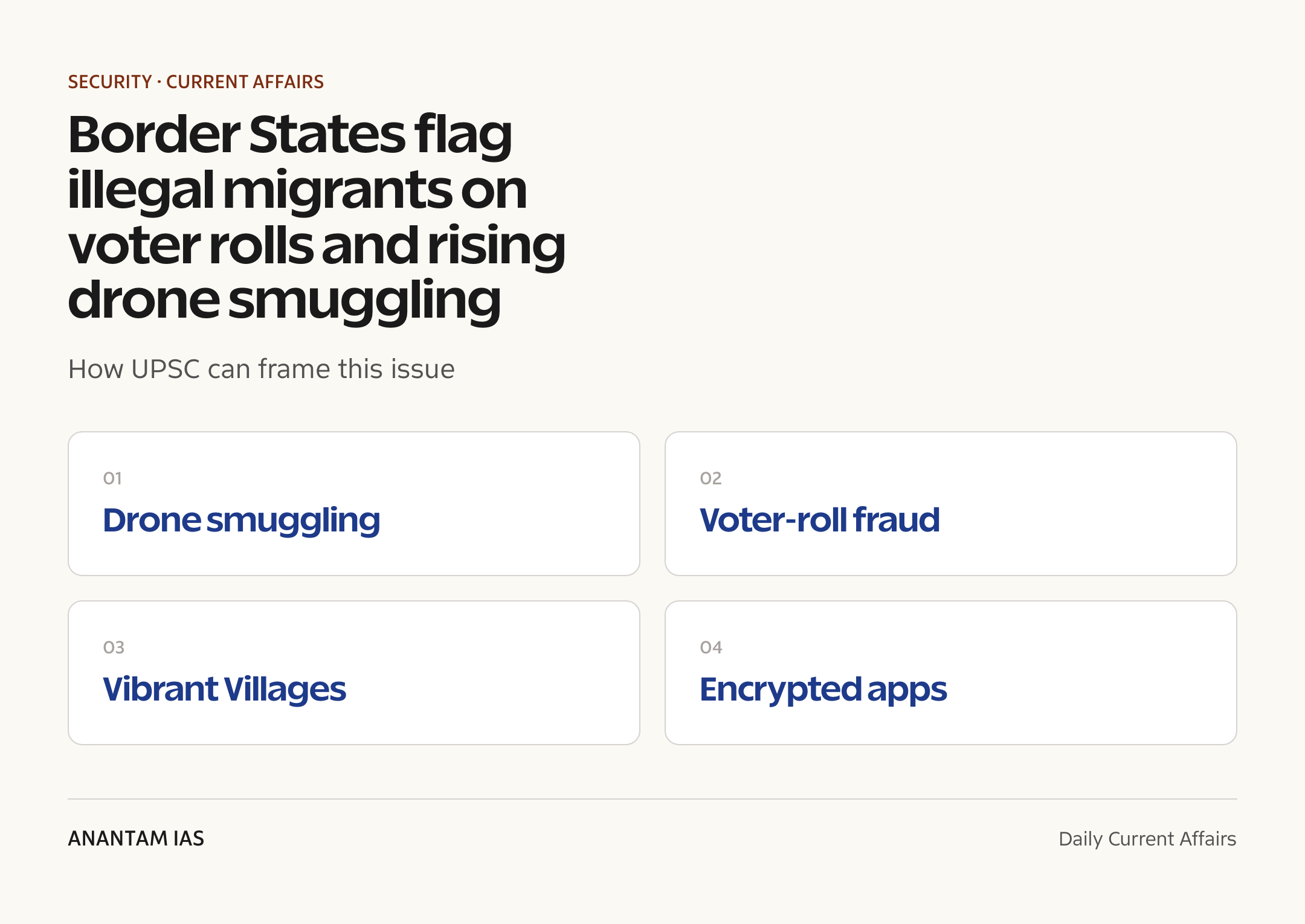
- A rise in drones along the Pakistan border to drop weapons and narcotics was flagged.
- Officers suggested making more drone laboratories operational to forensically study the flight path of unmanned aerial objects sent from across the border.
- Drone forensics aims to recover the flight log, launch coordinates and payload signature of a recovered craft, helping trace handlers and smuggling corridors.
- Criminals and terror groups were reported using encrypted apps such as WhatsApp, Skred and Zangi, which officers described as difficult to break into.
- The threat has pushed India toward Anti-Rogue Drone Technology and counter-UAS grids that use radar, radio-frequency jamming, spoofing and laser or net-based interception to detect and neutralise hostile drones.
- The narco-terror nexus in Punjab and Jammu shows the danger: drone drops feed drug trafficking, and the proceeds finance arms supply and terror modules, blurring the line between organised crime and terrorism.
Emptying border villages and demographic change
Depopulated border hamlets weaken the country’s first line of surveillance, which is why development is treated as a security measure.
- Officials warned that border villages cannot be left to border-guarding forces and police alone.
- Migration out of border villages, driven by a lack of infrastructure and jobs, was flagged as a security concern.
- The Vibrant Villages Programme (VVP) was listed among initiatives to reverse this hollowing-out.
- VVP is a centrally sponsored scheme to develop villages along the northern border with road connectivity, drinking water, electricity, mobile and internet links, tourism and livelihood support, so residents stay and act as the eyes and ears of the security grid.
- A second phase has been extended to cover villages along other international borders, widening the model beyond the China frontier.
- Concerns over shifting demography were raised for Murshidabad in West Bengal and a reported growth of mosques near the Pakistan border in Rajasthan; the open Nepal border was cited as a route misused by pro-Khalistani elements to enter Punjab.
India's border-management architecture
The concerns map onto an existing framework of forces, fencing and technology that GS3 aspirants must know, with one lead force designated for each frontier under the one-border-one-force principle.
- The Border Security Force (BSF) guards the borders with Pakistan (about 3,300 km) and Bangladesh (about 4,100 km), the two longest and most fenced stretches.
- The Sashastra Seema Bal (SSB) guards the open and largely un-fenced borders with Nepal (about 1,750 km) and Bhutan (about 700 km).
- The Indo-Tibetan Border Police (ITBP) guards the high-altitude border with China (about 3,488 km) along the Line of Actual Control.
- The Assam Rifles guards the border with Myanmar (about 1,640 km), the terrain of insurgency and the earlier Free Movement Regime.
- India’s land borders are of four broad types: fenced and settled (much of the Pakistan and Bangladesh borders), open (Nepal and Bhutan), high-altitude and disputed (China), and forested and porous (Myanmar), each needing a different mix of guarding.
- The Comprehensive Integrated Border Management System (CIBMS) layers thermal imagers, ground sensors, radars, cameras and command-and-control centres over riverine and unfenced gaps, backed by laser walls and smart-fencing pilots on stretches where physical fencing is hard.
- The Ministry of Home Affairs runs border-infrastructure and border-area development schemes, and anti-narcotics coordination bodies, to knit hard security with local welfare.
The road mapped at the meeting
The conference set a concrete follow-up mechanism rather than ending with a list of grievances.
- States were asked to submit their suggestions by December.
- A quadrangular security grid involving border communities and local police is to be finalised over the next one and a half years.
- The design reflects a shift toward bottom-up intelligence, feeding grassroots inputs to national decision-makers.
- It positions district police as an active partner alongside the central armed police forces on the frontier.
Way Forward
Close the document-fraud loop
- Tighten verification of birth and school certificates and link identity issuance to auditable trails so forged lineage cannot reach the electoral roll.
- Coordinate the Election Commission, police and civil registration so revisions add eligible voters and remove the ineligible without excluding genuine citizens.
Scale counter-drone and forensic capacity
- Make more drone laboratories operational and expand anti-rogue drone coverage on the most-hit stretches of the Pakistan border.
- Invest in lawful-interception and analytics capacity for encrypted-app abuse, within legal and privacy safeguards.
Make development a security tool
- Accelerate the Vibrant Villages Programme so roads, connectivity and livelihoods keep border populations rooted.
- Operationalise the quadrangular security grid to turn residents into partners in surveillance and early warning.
Conclusion
The concerns aired at the first Land Border Districts’ SP Conference, as reported by The Hindu, cut across identity fraud, air-borne smuggling, encrypted crime and the quiet hollowing-out of frontier villages.
A durable answer blends hard capability, better forces, drone forensics, tighter documents, with soft power at the border, roads, jobs and rooted communities, so that security and development reinforce each other rather than compete.
UPSC Practice Questions
Prelims MCQ 1
With reference to India’s border-guarding forces, consider the following statements:
- The Border Security Force guards India’s borders with both Pakistan and Bangladesh.
- The Sashastra Seema Bal guards the India-Nepal and India-Bhutan borders.
- The Indo-Tibetan Border Police guards the India-Myanmar border.
How many of the above statements are correct?
(a) Only one (b) Only two (c) All three (d) None
Answer: (b) Only two
Explanation:
The BSF guards the Pakistan and Bangladesh borders, and the SSB guards the Nepal and Bhutan borders, so statements 1 and 2 are correct. The ITBP guards the India-China border; the India-Myanmar border is guarded by the Assam Rifles, so statement 3 is wrong.
Prelims MCQ 2
The ‘Vibrant Villages Programme’, in the news in the context of border management, is primarily aimed at:
(a) Deploying anti-drone systems along the western border (b) Developing infrastructure and livelihoods in border villages to check out-migration (c) Revising electoral rolls in border districts (d) Setting up drone-forensics laboratories
Answer: (b) Developing infrastructure and livelihoods in border villages to check out-migration
Explanation:
The Vibrant Villages Programme is a Union scheme to provide roads, connectivity, livelihoods and amenities in border villages so that populations stay rooted, strengthening the first line of surveillance. Anti-drone systems, roll revisions and drone labs are separate measures.
UPSC Mains Questions
- Depopulating border villages weaken national security as much as any external threat. Examine, with reference to India’s border-area development initiatives.
- Drone-enabled smuggling and encrypted communication have redefined the challenge of border management. Discuss the technological and institutional responses India needs.
Source: The Hindu.
Frequently Asked Questions
What was the Land Border Districts’ SP Conference 2026?
It was the first-ever conference of Superintendents of Police from India’s land-border districts, held on July 9, 2026 and addressed by the Home Minister, to discuss border-security concerns. The Hindu reported that SPs of 119 border districts attended.
Why is illegal migration on electoral rolls a security concern?
When illegal migrants obtain forged documents and reach the voter list, it points to gaps in identity verification and can distort local demography and governance in sensitive border areas. Assam presented a case study of such document fraud at the conference.
How are drones used for smuggling across the Pakistan border?
Small unmanned aircraft are flown across to drop weapons and narcotics, feeding a narco-terror nexus. Officers suggested more drone laboratories to forensically trace the flight paths of these objects.
What is the Comprehensive Integrated Border Management System (CIBMS)?
CIBMS is a technology-led surveillance system that layers sensors, radars, cameras and command-and-control centres over vulnerable border stretches to detect intrusion, supplementing physical fencing and patrolling.
Which forces guard India’s different land borders?
The BSF guards the Pakistan and Bangladesh borders, the SSB the Nepal and Bhutan borders, the ITBP the China border, and the Assam Rifles the Myanmar border, all under the Ministry of Home Affairs.
What is the proposed quadrangular security grid?
It is a follow-up mechanism discussed at the conference that links border communities with local police, to be finalised over about a year and a half, aimed at bottom-up intelligence and community engagement in border security.