BrahMos and Akashteer for the UAE: India’s Pivot from Defence Buyer to Exporter
Why in News?
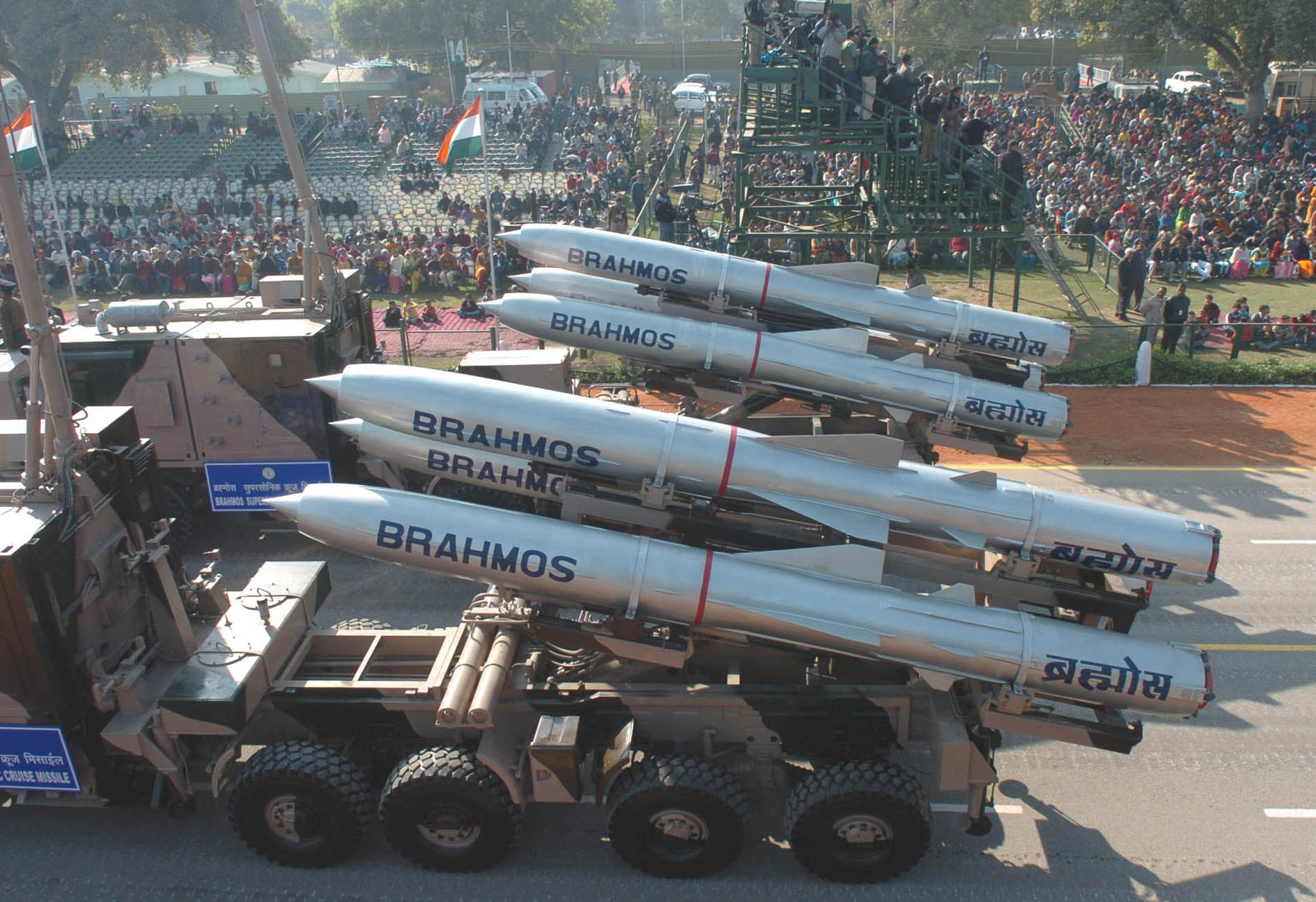
India and the UAE are reportedly in talks over the potential sale of key Indian defence platforms, led by the BrahMos supersonic cruise missile and possibly the Akashteer air-defence control network. StratNews Global, citing four Indian sources and Reuters inputs, reports that Abu Dhabi is shopping for arms after being heavily struck during the recent Middle East conflict and wants to harden its ability to protect the Strait of Hormuz, a vital energy chokepoint. The discussions are described as being at an initial stage but moving fast.
The story matters far beyond one deal. It tracks India’s transformation from the world’s largest arms importer into a credible exporter under Atmanirbhar Bharat. The same report notes that any BrahMos sale would first need Russia’s nod, since the missile is a joint India-Russia venture — a clean illustration of how co-development shapes export sovereignty. If concluded, the UAE would become the first Gulf buyer of BrahMos, opening a new regional market for Indian arms in a part of the world long dominated by American, French and Italian suppliers. For aspirants, the episode bundles defence indigenisation, missile-control regimes, West Asia diplomacy and energy security into a single, exam-ready case.
- India is reportedly in talks to sell the BrahMos supersonic cruise missile to the UAE, with the Akashteer air-defence network also discussed.
- Trigger: the UAE is rebuilding its defences after being struck during the recent Middle East war and wants to secure the Strait of Hormuz.
- A BrahMos sale would require Russia’s approval, as the missile is a joint India-Russia development; sources say Moscow-Abu Dhabi ties make this unlikely to be a hurdle.
- If finalised, the UAE would be the first Gulf buyer of BrahMos; the only completed export so far is the Philippines (2022).
- The talks sit against India’s defence exports crossing over $4 billion in the year ending March 2026.
The development matters in the context of:
- Treat the deal as reported and in talks, not signed — figures and platforms are drawn from media sourcing, not an official Indian contract announcement.
- Earlier reporting flagged BrahMos sale deals or interest involving Vietnam and Indonesia, plus expressions of interest from Thailand, South Africa, Brazil and Chile.
UPSC Relevance
Prelims Relevance
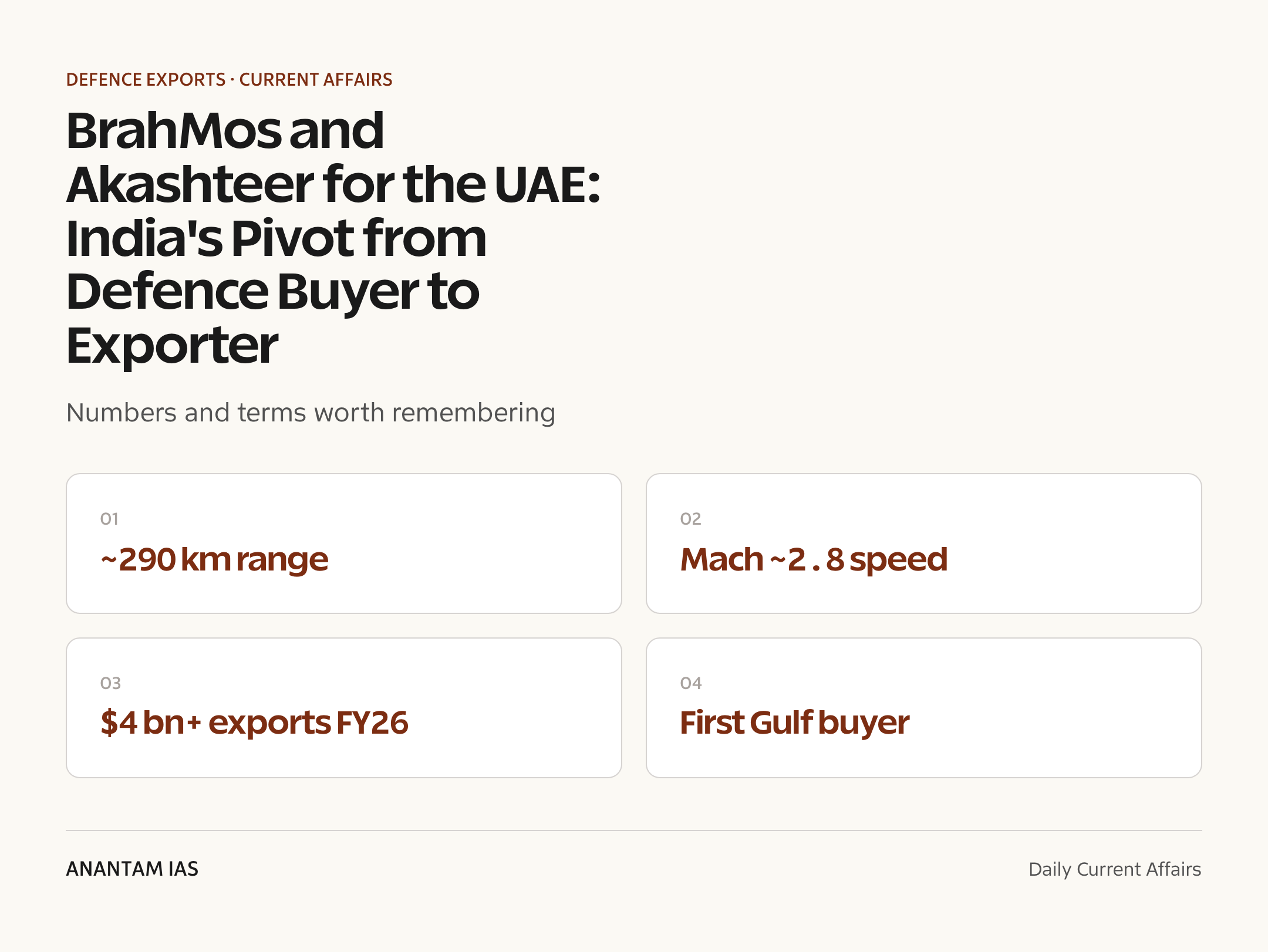
- BrahMos is a joint venture between India’s DRDO and Russia’s NPO Mashinostroyeniya; the name fuses the Brahmaputra and Moskva rivers.
- BrahMos is a supersonic cruise missile cruising at roughly Mach 2.8, with the standard export variant ranged at about 290 km; extended-range variants reach farther for domestic use.
- BrahMos can be launched from land, sea and air platforms (mobile launchers, warships, and the Su-30MKI fighter).
- The Missile Technology Control Regime (MTCR) capped jointly-built missile exports at ~290 km; India’s 2016 MTCR membership enabled longer-range development.
- Akashteer is an automated air-defence control and reporting system built by Bharat Electronics Ltd (BEL) with the Indian Army, integrating radar and sensor data into a common air picture.
- India’s defence exports reached over $4 billion (year ending March 2026), up from about $7.26 million in 2013-14, per the Indian government.
- The Philippines became the first foreign BrahMos buyer in 2022 (a shore-based anti-ship variant for its Marine Corps).
- India and the UAE signed a CEPA (Comprehensive Economic Partnership Agreement) that entered into force in 2022, anchoring the broader strategic partnership.
Mains Relevance
GS Paper 3
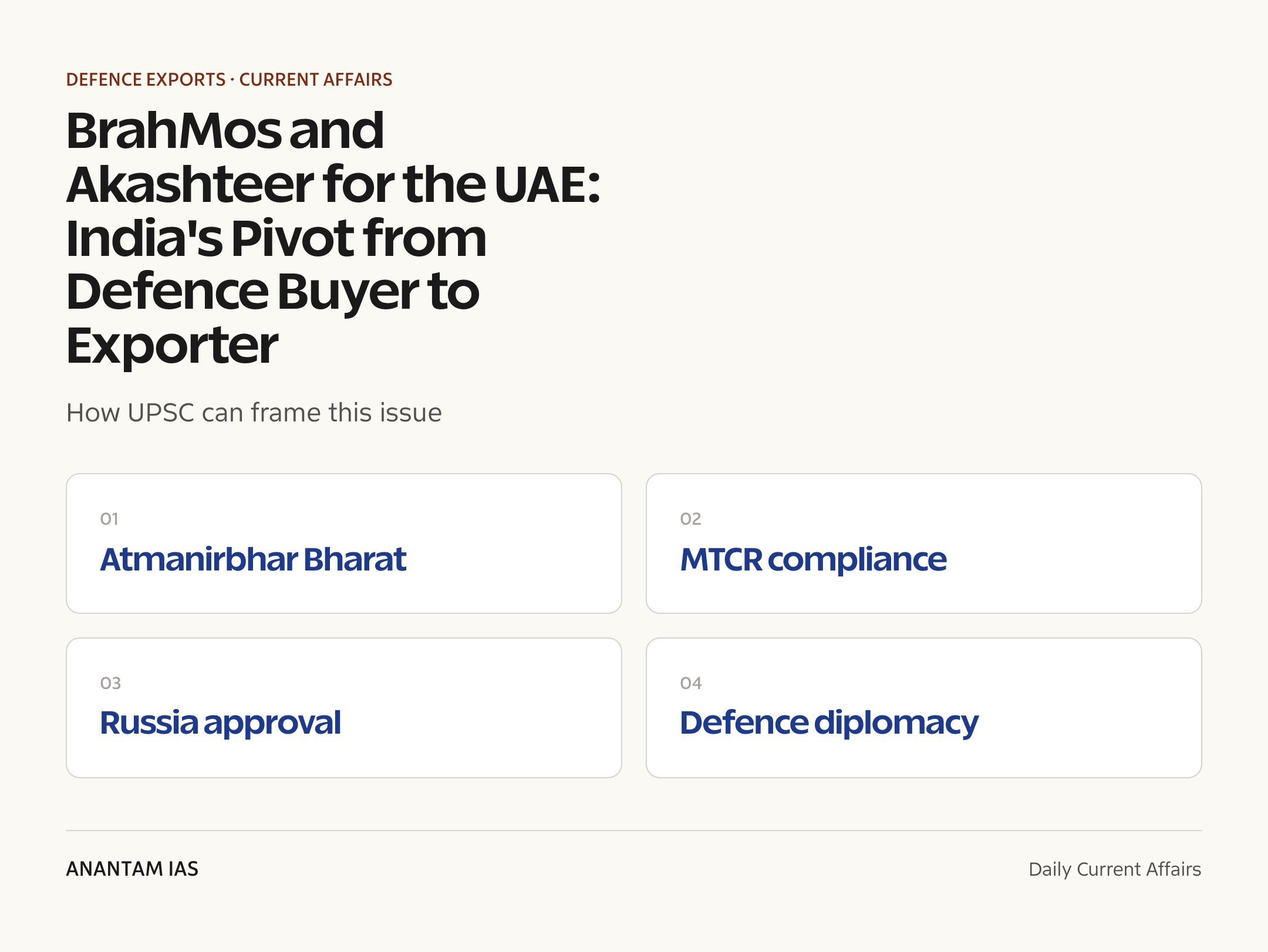
- Use as a live case for Atmanirbhar Bharat in defence: the shift from import-dependence to export capability, and the role of DRDO-BEL-private sector.
- Discuss defence indigenisation targets and how export orders sustain the domestic industrial base and R&D.
- Analyse technology-sovereignty constraints: co-developed platforms like BrahMos require partner (Russia) clearance, limiting autonomous export decisions.
- Link to internal and external security economics — export revenue, jobs and strategic leverage from arms diplomacy.
GS Paper 2
- Frame as defence diplomacy deepening the India-UAE strategic partnership and India’s West Asia outreach.
- Examine the balancing act with Russia (co-development) while courting Gulf partners aligned with the West.
- Connect to energy security — a stable Gulf and a protected Strait of Hormuz serve India’s import lifeline.
- Position India as a net security provider in the wider Indian Ocean and West Asian neighbourhood.
Essay
- Self-reliance themes: “From buyer to builder — the economics of strategic autonomy.”
- Arms trade and ethics: the responsibilities that accompany a rising defence exporter.
Background and Context
BrahMos: the flagship export platform
BrahMos is the showpiece of India’s missile diplomacy — fast, accurate, and battle-marketed.
- A joint venture of India’s DRDO and Russia’s NPO Mashinostroyeniya, named after the Brahmaputra and Moskva rivers.
- A supersonic cruise missile flying at around Mach 2.8, far faster than subsonic rivals like the Tomahawk, which compresses an adversary’s reaction time.
- Standard export range is about 290 km; it is a true land-sea-air weapon fired from mobile launchers, ships and the Su-30MKI.
- Its precision and speed make it a credible anti-ship and land-attack deterrent for coastal states.
Akashteer: the silent force-multiplier
If BrahMos is the sword, Akashteer is the nervous system that decides when to strike.
- An automated air-defence control and reporting system developed by BEL with the Indian Army.
- It fuses inputs from radars and sensors into a single, real-time air picture, helping commanders track and engage aerial threats faster and with fewer errors.
- Defence experts cited in the reporting note it would knit together information from other devices to counter incoming threats.
- The UAE already fields U.S. THAAD and Patriot systems and the MGM-168 ATACMS; an integrating command-and-control layer like Akashteer is the missing glue across them.
- Such a layer raises the value of any missile sale, since speed of decision often matters more than the number of interceptors.
MTCR and the range question
Export range is set as much by treaty as by engineering.
- The MTCR is a voluntary regime restricting transfer of missiles capable of carrying a 500 kg payload beyond 300 km.
- That logic kept the jointly-built BrahMos export variant pegged near 290 km.
- India’s 2016 entry into the MTCR opened the path to extended-range BrahMos versions for its own forces.
- Export customers typically receive the treaty-compliant range, keeping deals diplomatically clean.
India's defence-export drive
The numbers tell a steep, deliberate climb.
- Defence exports crossed over $4 billion in the year ending March 2026, up from about $7.26 million in 2013-14.
- Government targets an exports run-rate of roughly Rs 50,000 crore by 2029, part of the wider self-reliance push.
- The Philippines (2022) remains the only completed BrahMos export; reporting cites further BrahMos interest from several states.
- Export orders give DRDO, BEL and private firms the scale and revenue to fund the next generation of systems.
The Russia-approval nuance
Co-development is a strength and a leash at once.
- Because BrahMos is jointly developed, any sale needs Russia’s clearance — a limit on India’s independent export decisions.
- One source quoted by StratNews said Moscow’s close ties with Abu Dhabi make approval unlikely to be a hurdle.
- The episode underlines why India is pursuing fully indigenous systems where export freedom is total.
- It is a textbook example of how technology partnerships shape strategic autonomy.
India-UAE: a thickening partnership
Defence talk sits atop years of trade, energy and tech deals.
- A CEPA in force since 2022 has lifted bilateral trade and investment sharply.
- The two sides have a pact to jointly develop military hardware, signalling intent beyond one-off purchases.
- The UAE’s wider arms diversification includes a reported $35 billion+ defence-cooperation MoU with South Korea.
- A protected Strait of Hormuz serves both Abu Dhabi’s exports and India’s energy security.
Way Forward
Convert interest into orders by offering full-package solutions — missiles plus the Akashteer command layer, training and lifecycle support — rather than standalone hardware.
Deepen indigenous content so future flagship systems carry no third-country veto, widening India’s export freedom.
Pair sales with maintenance, ToT and co-production offers to build durable strategic relationships, as with the India-UAE hardware pact.
Keep exports MTCR-compliant and end-use safeguarded to protect India’s standing as a responsible supplier.
Conclusion
The reported BrahMos and Akashteer talks with the UAE capture a larger story: India is graduating from the world’s biggest arms importer toward a maker and seller of high-end systems. A first Gulf customer would be a marquee win for Atmanirbhar Bharat and for arms diplomacy in West Asia.
The caveats matter. The deal is in talks, not signed, and the Russia-approval clause is a reminder that co-development trades some export sovereignty for shared cost and capability. For aspirants, the case ties together defence indigenisation, MTCR, energy security and India’s role as a net security provider — a rich, multi-paper anchor.
UPSC Practice Questions
Prelims MCQ 1
With reference to the BrahMos missile, consider the following statements: 1. It is a supersonic cruise missile jointly developed by India and Russia. 2. Its standard export variant has a range of about 290 km. 3. It can be launched only from naval platforms. Which of the statements given above are correct?
1 and 2 only 2 and 3 only 1 and 3 only 1, 2 and 3
Answer: 1 and 2 only
Explanation:
BrahMos is an India-Russia supersonic cruise missile with a ~290 km export range. It is a land-sea-air weapon, fired from mobile launchers, ships and the Su-30MKI — not only from ships, so statement 3 is wrong.
Prelims MCQ 2
Consider the following statements about India’s defence cooperation: 1. Akashteer is an automated air-defence control and reporting system associated with Bharat Electronics Ltd. 2. The Philippines was the first foreign country to buy the BrahMos missile. 3. India joined the Missile Technology Control Regime (MTCR) in 2016. Which of the statements given above are correct?
1 and 2 only 2 and 3 only 1 and 3 only 1, 2 and 3
Answer: 1, 2 and 3
Explanation:
Akashteer is a BEL-Army automated air-defence control system; the Philippines became the first BrahMos export customer in 2022; and India joined the MTCR in 2016, enabling extended-range development. All three are correct.
UPSC Mains Questions
- India’s defence exports have surged from a few million dollars to over $4 billion in a decade. Examine the drivers of this rise and the structural challenges that could constrain India’s ambition to become a major arms exporter. (250 words)
- “Co-development of strategic platforms enhances capability but can dilute export sovereignty.” Discuss with reference to the BrahMos missile and India’s pursuit of self-reliance in defence. (250 words)
- Defence diplomacy has become a key instrument of India’s West Asia policy. Analyse, with examples, how arms cooperation advances India’s strategic and energy-security interests in the Gulf. (150 words)
Sources: StratNews Global and The New Arab.
Frequently Asked Questions
What is the India-UAE BrahMos news about?
India is reportedly in talks to sell the BrahMos supersonic cruise missile, and possibly the Akashteer air-defence network, to the UAE. The discussions are at an early stage; no contract has been signed.
Why does the UAE want these systems?
The UAE is rebuilding its defences after being struck during the recent Middle East war and wants to better protect the Strait of Hormuz, a vital energy chokepoint. It is sourcing arms from India and others.
Why does a BrahMos sale need Russia’s approval?
BrahMos is jointly developed by India’s DRDO and Russia’s NPO Mashinostroyeniya, so exports require Russia’s clearance. Sources say Moscow’s close ties with Abu Dhabi make approval unlikely to be a hurdle.
What is Akashteer?
Akashteer is a fully automated air-defence control and reporting system built by Bharat Electronics Ltd with the Indian Army. It fuses radar and sensor data into a single real-time air picture to track and counter aerial threats.
Who has bought BrahMos before?
The Philippines (2022) is the only completed export so far. Reporting also points to BrahMos deals or interest involving Vietnam, Indonesia, and other countries. A UAE deal would make it the first Gulf buyer.
How big are India’s defence exports now?
India’s defence exports crossed over $4 billion in the year ending March 2026, up from about $7.26 million in 2013-14, with a target of roughly Rs 50,000 crore by 2029.