BRICS Cross-Border Payments: Linking Domestic Systems Without a Common Currency
Why in News?
Ahead of the New Delhi summit, BRICS officials are exploring links among domestic payment systems and central bank digital currencies to make cross-border payments faster and less costly.
- Finance ministry and central bank representatives discussed payments cooperation and wider use of national currencies in Jaipur in August.
- The discussion covers direct links between domestic payment systems and a possible platform using wholesale central bank digital currencies.
- BRICS has adopted neither a common currency nor an operating independent settlement network; the present exercise concerns feasibility and design.
- Project Nexus offers a useful comparison, but it is a separate BIS-origin initiative rather than a BRICS project.
- Cheaper settlement could support trade and tourism among members without requiring every payment to pass through long intermediary chains.
- Payment connectivity concerns infrastructure and interoperability; it should not automatically be read as an agreement to replace the US dollar.
- Any multilateral design must reconcile national laws, foreign-exchange markets, compliance requirements, governance and technical standards.
UPSC Relevance
Prelims Relevance
- SWIFT primarily carries secure financial messages; the transfer and settlement of funds occur through separate banking arrangements.
- A correspondent bank provides payment services for another bank, often through accounts held with each other.
- A vehicle currency bridges two currencies that lack a sufficiently liquid direct market.
- A wholesale CBDC is central-bank money intended for transactions among eligible financial institutions, unlike a retail CBDC used by the public.
- Payment-versus-payment settlement makes the two currency legs conditional on each other, limiting foreign-exchange settlement risk.
Mains Relevance
GS Paper 2
- BRICS cooperation and India’s role in shaping practical institutions for the Global South
- Strategic autonomy without overstating de-dollarisation or political consensus
GS Paper 3
- Digital public infrastructure, payment interoperability and central bank digital currencies
- Trade facilitation, financial stability and cyber-resilient settlement systems
Essay
- Shared infrastructure succeeds when technical interoperability is matched by trust, rules and accountable governance.
Background and Context
Why Cross-Border Payments Remain Costly
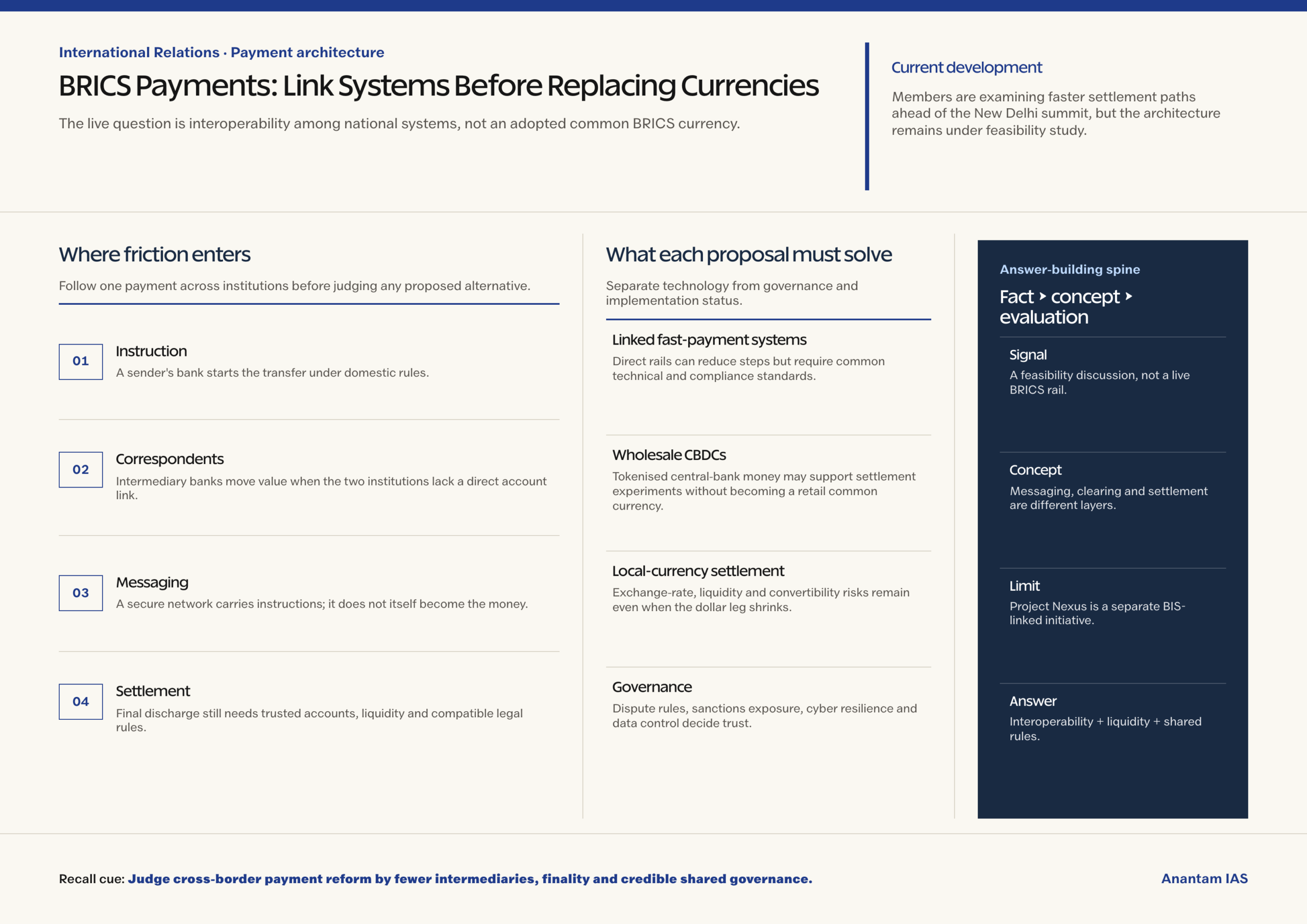
A cross-border transfer is a chain of messages, account movements and currency exchanges rather than one direct movement of money.
- When the payer’s bank lacks a direct relationship with the recipient’s bank, one or more correspondent banks bridge the transaction through accounts they maintain.
- Each intermediary performs screening, updates records and may charge a fee; different operating hours and incomplete information can add delay or require manual repair.
- If the two national currencies lack a liquid direct market, both may be exchanged through a vehicle currency, creating two conversion legs and extra foreign-exchange spreads.
- SWIFT standardises secure messages among financial institutions, but it does not itself hold customer funds or replace the banks that execute settlement.
- The problem is consequently broader than messaging: reform must address settlement assets, foreign-exchange liquidity, compliance, access and coordination across several legal jurisdictions.
Two Architectures Under Discussion
BRICS discussions point to interoperability, but alternative architectures solve different parts of the payment chain and remain proposals.
- One route links domestic instant-payment systems, allowing users of one national system to reach another without building a fresh bilateral connection for every participant.
- The UPI-PayNow link shows how two domestic systems can support remittances, while a multilateral hub could reduce the complexity created by many separate bilateral links.
- A second route would use wholesale CBDCs as settlement assets on a shared platform, enabling participating banks to exchange central-bank money across currencies.
- With payment-versus-payment, both currency legs settle together or neither settles, reducing the risk that one party delivers funds before receiving the counter-payment.
- These routes do not require a single BRICS currency: each country can retain its own unit while agreeing on connectivity, conversion, messaging and settlement rules.
Proposal, Pilot and Operating System Are Different
The central exam trap is to treat exploratory language, tested technology and an adopted multilateral institution as equivalent stages.
- The 2024 Kazan Declaration supported discussion and a feasibility study of BRICS Clear; this language did not establish an independent BRICS settlement system.
- India’s reported proposal to connect members’ CBDCs for trade and tourism is likewise a design option, not proof that common rules or live cross-border settlement exist.
- Project Nexus standardises connections among domestic instant-payment systems through one platform; participating central banks are moving it toward live implementation after BIS-led development.
- Nexus is institutionally separate from BRICS, so its blueprint can illustrate a hub model without serving as evidence that BRICS has adopted or operates that network.
- Implementation still requires decisions on governance, participation, legal finality, exchange-rate pricing, liquidity, consumer protection, sanctions exposure, anti-money-laundering controls, data protection and cyber resilience.
Way Forward
Build Interoperability in Verifiable Stages
A credible path should move from agreed standards to limited corridors before any claim of a common network.
- Define common technical standards while allowing each central bank and payment operator to retain authority over domestic access and risk controls.
- Test limited corridors with transparent measures for cost, speed, failed transactions, foreign-exchange spreads and complaint resolution before widening participation.
- Create joint rules for AML/CFT screening, data minimisation, cyber incident response, operational continuity and allocation of losses.
- Separate public communication about payment efficiency from unsupported claims about a common currency, full de-dollarisation or an already independent BRICS financial system.
Conclusion
- BRICS payment cooperation is best understood as a search for interoperable rails connecting national systems and currencies, not as an adopted common currency or functioning alternative financial order.
- A balanced answer should explain the correspondent-banking problem, distinguish instant-payment links from wholesale-CBDC settlement, and judge feasibility through governance, liquidity, compliance and cyber-risk requirements in equal measure.
UPSC Practice Questions
Prelims MCQ 1
With reference to cross-border payment systems, consider the following statements:
- SWIFT is primarily a secure financial messaging network rather than the institution that settles every payment.
- Payment-versus-payment can reduce settlement risk by making two currency legs conditional on each other.
- Project Nexus is an independent settlement system established and operated by BRICS.
How many of the above statements are correct?
(a) Only one (b) Only two (c) All three (d) None
Answer: (b) Only two
Explanation:
Statements 1 and 2 are correct. Project Nexus originated with the BIS Innovation Hub and participating central banks; it is separate from BRICS.
Prelims MCQ 2
What best distinguishes a wholesale central bank digital currency from a retail central bank digital currency?
(a) It can be issued only by commercial banks (b) It is necessarily a common currency shared by several countries (c) It is intended mainly for settlement among eligible financial institutions (d) It operates without central bank liabilities
Answer: (c) It is intended mainly for settlement among eligible financial institutions
Explanation:
Wholesale CBDC is central-bank money designed for eligible institutional settlement, while retail CBDC is intended for use by the wider public.
UPSC Mains Questions
- BRICS cross-border payment proposals seek efficiency without necessarily creating a common currency. Explain the proposed mechanisms and the principal implementation challenges. (250 words)
- Interlinking domestic payment systems is as much an institutional challenge as a technological one. Discuss with reference to governance, liquidity, compliance and cyber resilience. (250 words)
Sources: The Hindu Explained and Bank for International Settlements.
Frequently Asked Questions
Has BRICS adopted a common currency?
No. BRICS discussions concern payment connectivity, wider use of national currencies and possible CBDC links. They do not establish an adopted common currency or a functioning independent settlement system.
Does SWIFT itself settle cross-border payments?
SWIFT chiefly transmits standardised, secure financial messages. Banks and payment infrastructures separately move funds, convert currencies and settle obligations through accounts and correspondent relationships.
How could wholesale CBDCs reduce settlement risk?
A shared platform could use payment-versus-payment, under which both currency legs settle together or neither does. This reduces the risk of one party paying before receiving the counter-payment.
Is Project Nexus a BRICS initiative?
No. Nexus began as a BIS Innovation Hub project to standardise links among domestic instant-payment systems. Participating central banks are taking it toward implementation outside the BRICS framework.
Why are correspondent banks used in cross-border payments?
Banks without a direct account relationship use intermediary institutions that maintain relevant accounts and currency access. The chain enables reach but can add fees, screening steps and delays.