BRICS Foreign Ministers Meeting 2026: India’s Chair, Jaishankar’s Pitch, and the Global South Agenda
The Bharat Mandapam convention centre in New Delhi has hosted many diplomatic moments since it opened, but the BRICS Foreign Ministers Meeting 2026 stood out for a simple reason. It was the first major BRICS gathering after the bloc’s expansion, the first under India’s 2026 chairship, and the first to take place against the backdrop of a hot regional conflict in West Asia. External Affairs Minister S Jaishankar opened the two-day conclave on 14 May 2026 with a phrase that set the tone: international relations are in considerable flux.
The BRICS Foreign Ministers Meeting 2026 brought together delegations from the now eleven-member grouping, partner countries, and the rotating chairs of regional organisations India had invited as guests. The agenda packed in five demanding files: AI governance for development, reformed multilateralism, climate finance for the Global South, expansion and partner country protocol, and the response to the Iran Israel situation. India is in the chair for the calendar year and will host the BRICS Summit in 2026.
This article unpacks what the BRICS Foreign Ministers Meeting 2026 delivered, why India’s chairship matters for the Global South narrative, and what UPSC aspirants need to track on the multilateral diplomacy syllabus.
Quick Facts
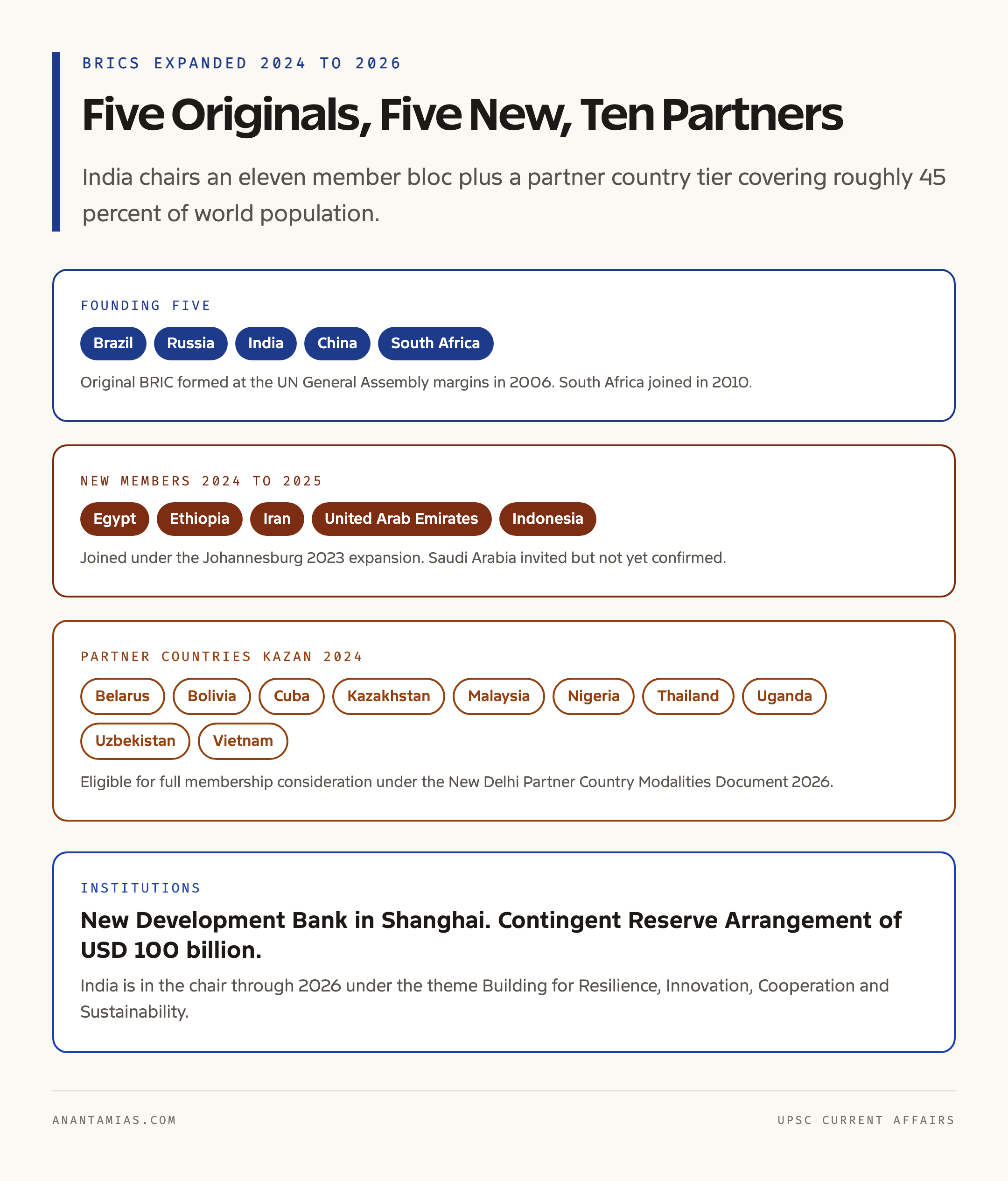
- Dates: 14 to 15 May 2026, Bharat Mandapam, New Delhi.
- Chair: India, under the 2026 chairship of the BRICS grouping.
- Theme: Building for Resilience, Innovation, Cooperation and Sustainability, captured in the acronym BRICS.
- Chair: External Affairs Minister S Jaishankar chaired the ministerial session.
- Members present: Brazil, Russia, India, China, South Africa, Egypt, Ethiopia, Iran, United Arab Emirates, Indonesia, and Saudi Arabia as an observer.
- Partner countries: Belarus, Bolivia, Cuba, Kazakhstan, Malaysia, Nigeria, Thailand, Uganda, Uzbekistan and Vietnam attended in the new partner country format.
What Just Happened
The BRICS Foreign Ministers Meeting 2026 formally opened on the morning of 14 May 2026. Jaishankar welcomed delegations including Russian Foreign Minister Sergey Lavrov, Brazilian Foreign Minister Mauro Vieira, Iranian Foreign Minister Abbas Araghchi, Indonesian Foreign Minister Sugiono and South African Foreign Minister Ronald Lamola. China was represented at the Vice Foreign Minister level.
In his opening remarks, Jaishankar argued that the global economy was being battered by the use of sanctions as a routine policy tool, by disruptions in major shipping lanes, and by attacks on energy infrastructure in West Asia. He called for reformed multilateralism, repeated India’s longstanding case for permanent membership of the United Nations Security Council, and announced three Indian deliverables for the year: a BRICS AI for Development Cooperation Framework, a Climate Finance Roadmap for the Global South, and a Partner Country Modalities document that defines the rights of the ten newly inducted partner states.
The first day ended without a joint communique because of an open Iran United Arab Emirates exchange on the conflict in West Asia. Iran accused the UAE of supporting Israeli military operations. The UAE rejected the charge. Jaishankar moved the BRICS Foreign Ministers Meeting 2026 past the dispute through bilateral consultation and the joint outcome was issued the next day with a softened West Asia paragraph.
Background and Historical Context
BRICS began as an acronym. The economist Jim O’Neill coined BRIC in 2001 to describe Brazil, Russia, India and China as the four economies that would dominate global growth in the new century. The first BRIC Foreign Ministers meeting was held in New York in September 2006 on the margins of the United Nations General Assembly. The first BRIC Summit followed in Yekaterinburg in 2009. South Africa joined in 2010, turning BRIC into BRICS.
From BRIC to BRICS Plus
The grouping spent its first decade focused on coordination among emerging economies. Key institutional outputs included the New Development Bank in 2014 and the Contingent Reserve Arrangement of 100 billion dollars to support balance of payments. The Johannesburg summit in 2023 took the most consequential decision in the bloc’s history: invite six countries to join in January 2024. Saudi Arabia held back. Argentina, after a government change, declined. Egypt, Ethiopia, Iran and the UAE joined. Indonesia joined in early 2025. By 2026 the bloc has eleven members in practice and ten partner countries in a second tier.
India is now serving its third BRICS chairship after 2012 and 2021. The 2026 chairship comes at a moment when the bloc’s character is being redefined. The original five had broadly similar concerns about Western financial dominance. The eleven member configuration includes oil producers, regional rivals like Iran and the UAE, and democracies like India and Brazil that resist any anti Western posture. The BRICS grouping covers around 45 percent of global population, 35 percent of global GDP in purchasing power parity terms, and 40 percent of crude oil production.
Key Outcomes of the BRICS Foreign Ministers Meeting 2026
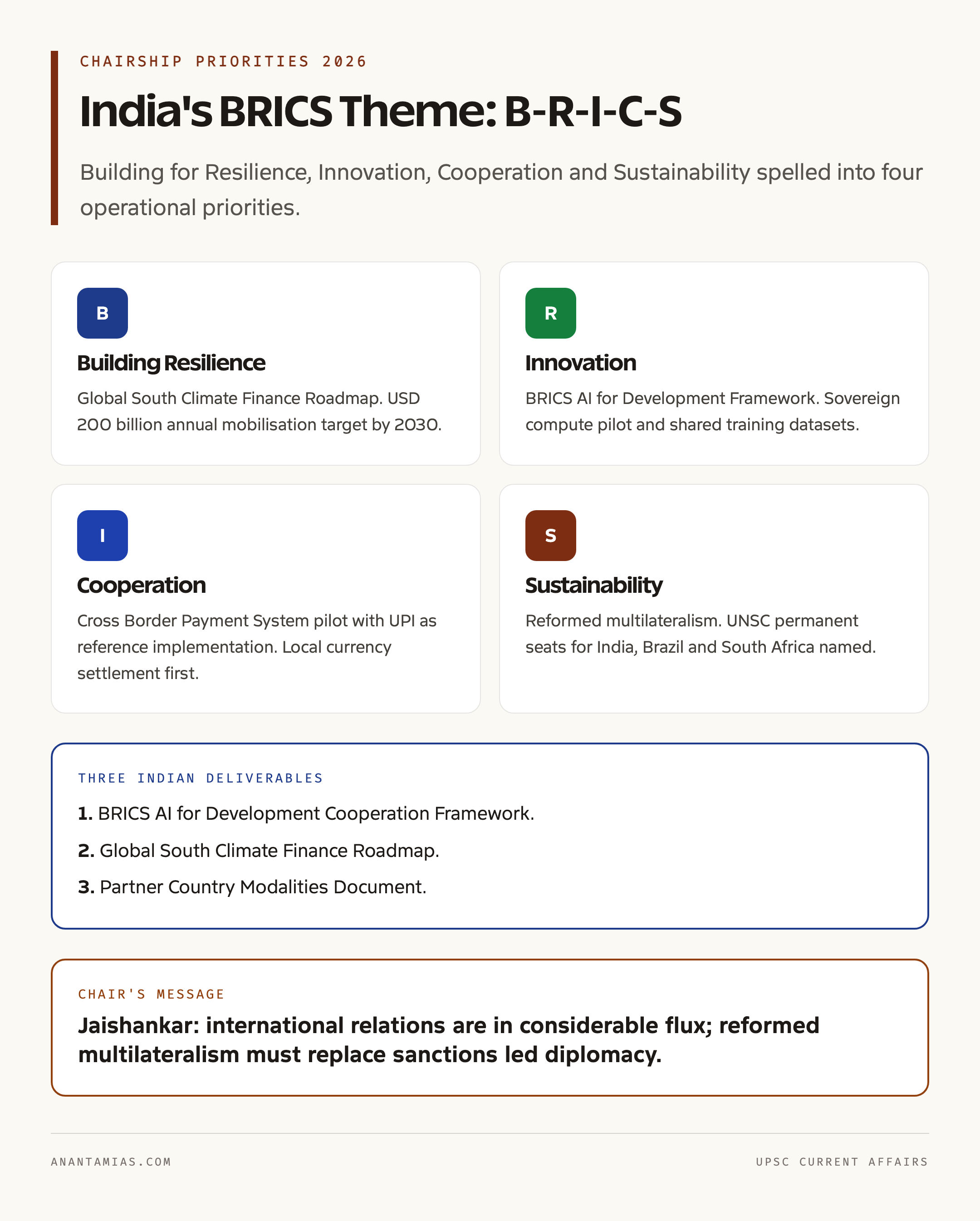
The 15 May 2026 outcome document, called the New Delhi Chair’s Statement, packaged the meeting’s takeaways into six baskets.
- AI for Development: Endorsement of an AI cooperation framework that will pool training datasets in BRICS official languages, run a model risk assessment task force, and explore a BRICS sovereign AI compute facility.
- Climate finance: A Global South Climate Finance Roadmap proposing a 200 billion dollar annual mobilisation target by 2030, with BRICS coordinated positions for COP31 in Brazil.
- Reformed multilateralism: Reaffirmation of UN Security Council reform with explicit reference to permanent representation for India, Brazil and South Africa.
- Expansion and partner countries: Approval of the Partner Country Modalities Document and an Action Plan to graduate selected partners into full membership over the 2027 to 2028 cycle.
- Trade and currency: Pilot of a BRICS Cross Border Payment System linking national payment networks, with India offering UPI as a reference implementation.
- West Asia and conflict resolution: A softened consensus paragraph calling for de-escalation, freedom of navigation through the Strait of Hormuz, and resumed diplomacy through the United Nations.
Why It Matters
The BRICS Foreign Ministers Meeting 2026 matters for India in three concrete ways. It anchors India’s claim to leadership of the Global South at a moment when the G20 process has thinned out. It gives Indian companies in fintech, digital public infrastructure and renewable energy a multilateral platform to scale. It also stress tests the proposition that India can chair a bloc that includes both Russia and Iran without alienating the United States and the European Union.
For the Global South, the meeting is significant because BRICS is becoming the venue where reformed multilateralism is most actively debated. The G20 has slowed under the weight of geopolitical splits, and the United Nations General Assembly has become a venue for speeches rather than decisions. BRICS, with the New Development Bank and now a cross border payments pilot, offers something more concrete.
For the international system, the meeting offered an early test of whether the expanded BRICS can produce outcomes despite internal contradictions. The Iran UAE exchange showed how thin the consensus can be. The softened joint statement showed that the chair can still move the bloc forward if it focuses on functional baskets rather than political quarrels.
Detailed Analysis
The first thread worth pulling is reformed multilateralism. India has used every chairship since 2012 to press for UN Security Council reform. The Delhi outcome document repeated this in stronger language than the 2024 Kazan declaration, naming India, Brazil and South Africa as candidates for permanent seats. Whether China and Russia will support text that names specific candidates at the United Nations remains an open question, but the BRICS Foreign Ministers Meeting 2026 created a paper trail.
The second thread is the Global South Climate Finance Roadmap. Developed economies have repeatedly missed the 100 billion dollar climate finance commitment first made at COP15 in 2009. The BRICS roadmap calls for a doubling of that target by 2030 and tasks the New Development Bank with mobilising at least 30 billion dollars of the total. The roadmap also flags concessional finance for adaptation, not just mitigation, which has been a long standing Global South demand.
The third thread is the careful management of expansion. The Partner Country Modalities Document grants partner states observer rights, access to BRICS working groups, and a clear path to full membership through merit-based criteria. The document was drafted by India and reflects a preference for measured expansion rather than the rapid enlargement Russia and China had advocated.
The fourth thread is currency. BRICS does not propose a common currency, contrary to commentary in some Western media. The 2026 chair’s statement explicitly clarifies that the immediate priority is settlement in local currencies and a cross border payment messaging layer. UPI’s offer to act as a reference implementation strengthens India’s voice in this debate. Russia’s earlier push for a BRICS Pay currency has been deferred.
Comparative Perspective
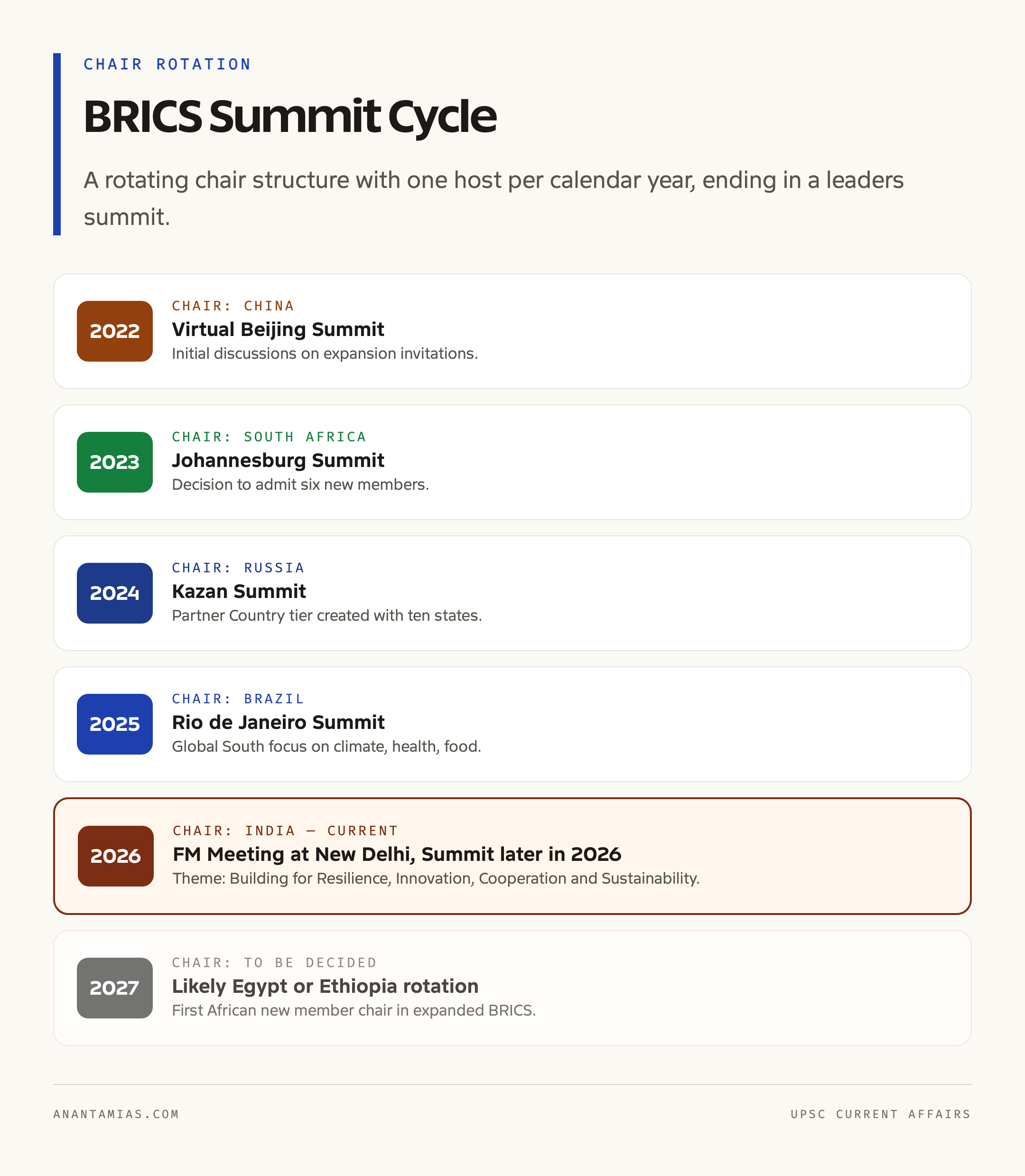
The BRICS Foreign Ministers Meeting 2026 sits between two earlier benchmarks. The 2024 Russia chairship at Nizhny Novgorod and the Kazan Summit produced a heavily Russia centric agenda focused on settlement bypass and political coordination against the West. The 2025 Brazil chairship at Rio produced a Global South focused agenda heavy on climate, health and food security. India’s 2026 chairship combines elements of both while adding AI for Development, digital public infrastructure and reformed multilateralism as distinctly Indian themes.
The Group of Twenty, which India chaired in 2023, offers a useful contrast. The G20 is broader, includes the West, and operates with a strict consensus rule. BRICS Plus is narrower, excludes the West, and increasingly operates with rotating chair leadership rather than full consensus. Each grouping has its advantages. India’s diplomacy is now built on the assumption that both will run in parallel for the foreseeable future.
Challenges Ahead
The BRICS Foreign Ministers Meeting 2026 surfaced challenges that the bloc will have to manage through the rest of India’s chairship year. Internal rivalry between Iran and the UAE could derail the West Asia paragraph at the summit. China prefers a more anti Western posture than the Delhi outcome reflects. Russia continues to use BRICS as a sanctions bypass platform, which makes Brazil and India uncomfortable.
Cohesion is a structural challenge. The bloc now spans regimes from democratic Brazil and India to authoritarian Russia and clerical Iran. Setting common positions on human rights, terrorism or freedom of navigation requires careful drafting. The new BRICS Cross Border Payment System will only succeed if member central banks cooperate on technical standards, which historically has been slow.
Resourcing is another constraint. The New Development Bank’s lending capacity is far smaller than the World Bank or the Asian Development Bank. The proposed AI compute facility and the Climate Finance Roadmap need investment that the bloc has yet to commit. Without resources, the BRICS agenda risks becoming a Communique heavy exercise.
Prelims Pointers
- Founding year: First BRIC Foreign Ministers meeting in 2006; first summit in 2009.
- Members: Brazil, Russia, India, China, South Africa, Egypt, Ethiopia, Iran, UAE, Indonesia. Saudi Arabia is yet to confirm membership.
- Partner Countries 2025: Belarus, Bolivia, Cuba, Kazakhstan, Malaysia, Nigeria, Thailand, Uganda, Uzbekistan, Vietnam.
- Institutions: New Development Bank in Shanghai, Contingent Reserve Arrangement of 100 billion dollars.
- Indian chairship: Third Indian chairship after 2012 and 2021.
- Theme: Building for Resilience, Innovation, Cooperation and Sustainability.
Mains Practice Questions
- GS Paper 2: Discuss the significance of India’s BRICS chairship in 2026 for the Global South narrative and reformed multilateralism. (250 words)
- GS Paper 2: Critically examine how the expansion of BRICS has affected the coherence and agenda setting capacity of the grouping. (250 words)
- GS Paper 3: What are the implications of the proposed BRICS Cross Border Payment System for India’s digital public infrastructure and financial sovereignty?
- GS Paper 2: Compare and contrast the G20 and BRICS as platforms for India’s foreign policy in the present international system.
Way Forward
India’s chairship runs until the end of 2026 and culminates in the BRICS Summit later in the year. Three deliverables will define whether the chairship is remembered as substantive. The AI for Development framework must move from a paper concept to a working compute pilot. The Climate Finance Roadmap must produce a credible mobilisation pathway with the New Development Bank as anchor. The Partner Country Modalities Document must be ratified at the summit so the bloc has a transparent enlargement playbook.
The BRICS Foreign Ministers Meeting 2026 has set the table. The summit later in the year will tell us whether the eleven member bloc can convert process into outcomes. For UPSC aspirants, this is one of the cleanest case studies of multilateral diplomacy on the current syllabus, and the New Delhi outcome document is essential reading.
Frequently Asked Questions
What is the BRICS Foreign Ministers Meeting 2026?
The BRICS Foreign Ministers Meeting 2026 is the annual ministerial conclave of the BRICS grouping. It took place on 14 and 15 May 2026 at Bharat Mandapam, New Delhi, under India’s 2026 chairship and was chaired by External Affairs Minister S Jaishankar.
Why is India chairing BRICS in 2026?
The BRICS chair rotates annually among member states. India chaired in 2012 and 2021. The 2026 chair returned to India under the standard rotation, with Russia having chaired in 2024 and Brazil in 2025.
What is the theme of India’s BRICS chairship?
The theme is Building for Resilience, Innovation, Cooperation and Sustainability, with the first letters spelling BRICS. The theme frames India’s priority areas including AI for Development, climate finance, reformed multilateralism, and partner country integration.
Who are the new BRICS members after expansion?
Egypt, Ethiopia, Iran and the United Arab Emirates joined in January 2024. Indonesia joined in 2025. Saudi Arabia was invited in 2023 but has not formally accepted. Argentina, also invited, declined after its 2023 government change.
What are BRICS partner countries?
Partner countries are a second tier announced at the Kazan Summit in 2024. They include Belarus, Bolivia, Cuba, Kazakhstan, Malaysia, Nigeria, Thailand, Uganda, Uzbekistan and Vietnam. They attend BRICS meetings, participate in working groups and can be considered for full membership.
What is the BRICS Cross Border Payment System?
It is a pilot framework agreed at the 2026 Foreign Ministers Meeting to link member national payment networks. India has offered UPI as a reference implementation. The system is designed to support local currency settlement and does not propose a common BRICS currency.
How did the West Asia situation affect the meeting?
Iran and the United Arab Emirates exchanged sharp statements during the meeting over Iran’s claims of UAE support for Israeli military operations. The dispute delayed the joint statement by a day. India as chair worked through bilateral consultation to produce a softened West Asia paragraph in the New Delhi Chair’s Statement.
What is the New Development Bank?
The New Development Bank, headquartered in Shanghai, is a BRICS owned multilateral development bank set up in 2014. It funds infrastructure and sustainable development projects in BRICS and other emerging economies.
Will BRICS adopt a common currency?
No common BRICS currency is on the table. The 2026 Chair’s Statement explicitly limits cooperation to local currency settlement and a cross border payment messaging layer. Russia’s earlier push for a common currency has been deferred.
How does BRICS support India’s Global South agenda?
BRICS gives India a platform to coordinate with major emerging economies on UN Security Council reform, climate finance, food and health security, and digital public infrastructure. India uses the BRICS chair year to push Global South priorities into multilateral negotiations including COP and the United Nations.