BRICS Indore Declaration: A Farmer-Centric Roadmap for Global Agriculture
Why in News?
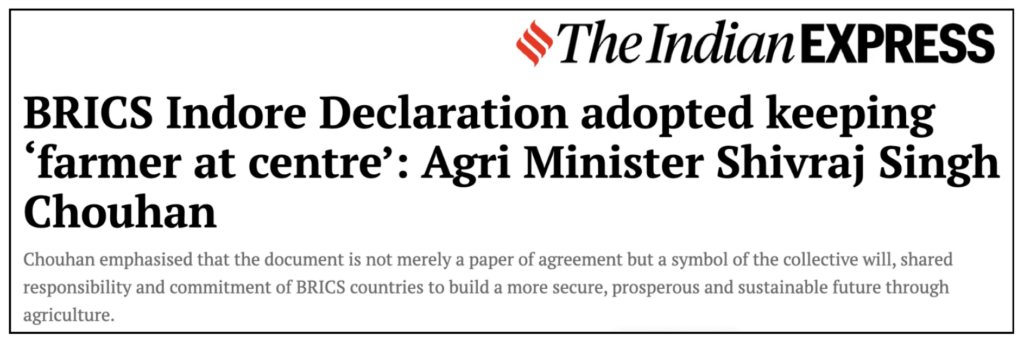
Under India’s BRICS Presidency, the 16th BRICS Agriculture Ministers’ Meeting at Indore (Madhya Pradesh) unanimously adopted the Indore Declaration on 13 June 2026 — a shared, farmer-centric roadmap for food security and sustainable agriculture across BRICS nations.
It is the first such meeting to bring together both member and partner countries, with around 100 delegates, and to launch four new cooperation networks anchored in Indian research institutions.
- Hosted by Union Agriculture Minister Shivraj Singh Chouhan at Indore, 12-13 June 2026, under India’s 2026 BRICS chairship.
- Outcome: a consensus Indore Declaration covering food and nutritional security, agricultural trade, climate-resilient farming, and technology partnerships.
- Four new platforms launched — on agro-ecology, digital agriculture, farmers’ rights in seed systems, and an agri-inputs/ genetic-resources network (BRICS AgriN).
- A dedicated dialogue, ‘Small Farmers, Women and Youth’, centred on smallholder access to credit, inputs, markets and remunerative prices.
- Chouhan reaffirmed India’s input support — urea held at Rs 266/bag and DAP at Rs 1,350/bag despite rising global costs.
The development matters in the context of:
- Slots into India’s wider BRICS-2026 theme of resilience, innovation and a ‘Humanity First’ approach, with food security as a flagship priority.
- Advances South-South cooperation by pooling research and digital tools among the Global South’s largest food producers.
UPSC Relevance
Prelims Relevance
- BRICS — bloc of major emerging economies; original five (Brazil, Russia, India, China, South Africa) plus the 2024-25 expansion.
- India holds the 2026 BRICS Presidency (its fourth); the 18th Summit is slated for New Delhi.
- New Development Bank (NDB) — BRICS-led multilateral lender, Shanghai HQ, founded 2014/2015.
- Indore Declaration adopted at the 16th BRICS Agriculture Ministers’ Meeting.
- ICAR-IIFSR, Modipuram, coordinates the BRICS agro-ecology Centres-of-Excellence network.
- PPV&FRA — Protection of Plant Varieties and Farmers’ Rights Authority, anchor for the seed-rights forum.
- BRICS member vs partner countries distinction: ten partner states, including Belarus and Uzbekistan.
- India’s administered prices: urea Rs 266/bag, DAP Rs 1,350/bag.
Mains Relevance
GS Paper 2
- BRICS as a vehicle for India’s middle-power diplomacy and South-South cooperation
- Plurilateral groupings, food diplomacy and India’s role in shaping a multipolar order
GS Paper 3
- Climate-resilient and sustainable agriculture; smallholder welfare and food security
- Agricultural research, digital public infrastructure and technology transfer
Essay
- Cooperation, not competition: the Global South’s search for food security
- From green revolution to a regenerative one — farming for a warming planet
Background and Context
What BRICS is and how it has grown
The bloc has evolved from a five-nation grouping into an enlarged Global-South coalition.
- BRICS began as BRIC (2009) and added South Africa (2010); the acronym stands for Brazil, Russia, India, China and South Africa.
- The 2024-25 expansion brought in Egypt, Ethiopia, Iran, the UAE and Indonesia, widening the bloc to a Global-South majority of food producers and energy suppliers.
- A second tier of partner countries — including Belarus, Bolivia, Cuba, Kazakhstan, Malaysia, Nigeria, Thailand, Uganda, Uzbekistan and Vietnam — was created to broaden engagement without full membership.
- The New Development Bank (NDB), headquartered in Shanghai, is the bloc’s flagship institution, financing infrastructure and sustainable-development projects across members.
The Indore Declaration — core commitments
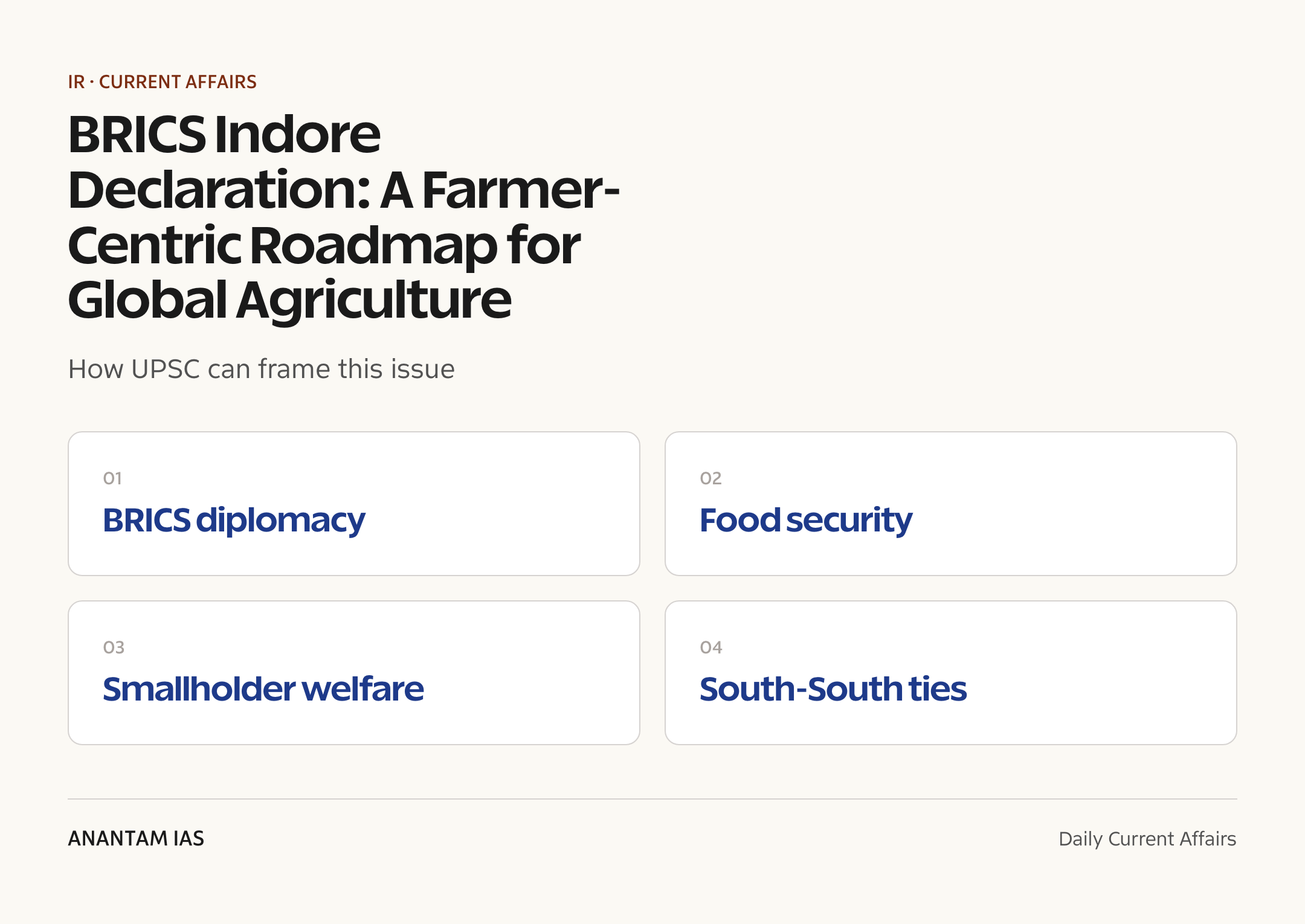
The declaration frames a shared roadmap built around four priority areas.
- Food and nutritional security — coordinated action to protect supply chains and affordable access amid global volatility.
- Agricultural trade — easing barriers and building resilient, predictable trade flows among members.
- Climate-resilient and sustainable farming — promoting natural, organic and regenerative systems to cut emissions and protect soils.
- Innovation and technology partnerships — joint research, digital tools and capacity-building across BRICS institutions.
- The text is explicitly farmer-centric, recognising smallholders and family farmers as central to food security and rural development.
Four new cooperation networks
The meeting institutionalised cooperation through four India-anchored platforms.
- BRICS Network of Centres of Excellence on Agro-Ecology and Regenerative Agriculture, coordinated by ICAR-IIFSR, Modipuram, for research and knowledge-sharing in organic and regenerative farming.
- Network on Digital Agriculture, coordinated by IIT Delhi, covering artificial intelligence, geospatial technologies, digital public infrastructure and data-driven solutions.
- Global Forum on Farmers’ Rights in Seed Systems, anchored by PPV&FRA in New Delhi, to safeguard farmers’ rights and traditional knowledge.
- BRICS AgriN (agro-inputs and genetic-resources network) for information-sharing, technical cooperation and capacity-building on seeds and inputs.
The farmer-centric core and India’s pitch
India used the platform to foreground small and marginal farmers.
- A dedicated session, ‘Small Farmers, Women and Youth: Shaping the Future of Food Security’, focused on access to inputs, credit, remunerative prices and markets.
- Minister Shivraj Singh Chouhan said the meeting sent a message of ‘hope, trust and collective responsibility’, and framed agriculture as the path to a more secure and prosperous future.
- India reaffirmed input affordability, holding urea at Rs 266/bag and DAP at Rs 1,350/bag despite rising international fertiliser prices.
- The approach echoes India’s millets legacy — its push for the International Year of Millets (2023) showcased climate-hardy, smallholder-friendly nutri-cereals as a food-security model.
Why it matters for India and the Global South
The declaration deepens India’s food diplomacy within a plurilateral frame.
- It positions India as a norm-setter on sustainable agriculture and farmers’ rights within BRICS, complementing its G20 food-security agenda and wider international relations playbook.
- South-South cooperation lets the Global South pool research, genetic resources and digital tools rather than depend on Western technology transfer.
- Anchoring networks in ICAR institutes and IIT Delhi gives Indian science a continuing coordinating role across the bloc.
- It strengthens India’s domestic food-security architecture — the National Food Security Act, minimum support prices and the PDS — linking the wider Indian economy to a cooperative platform.
BRICS vs G20 — the framing
India works in both forums, but they serve different ends.
- The G20 is a North-South bridge of major economies where India shaped a development-and-digital agenda during its 2023 presidency.
- BRICS is a Global-South-weighted bloc emphasising reform of global governance and alternatives like the NDB.
- On agriculture, BRICS lets India build deeper, like-minded coalitions on smallholder welfare and regenerative farming than the broader G20 consensus allows.
- India’s challenge is to keep the BRICS issue-based and non-bloc-ist, avoiding an anti-West framing while advancing concrete cooperation.
Way Forward
Operationalise the networks
- Move the four platforms from declaration to delivery with funded work plans, host institutes and measurable milestones.
- Use the agro-ecology and digital-agriculture networks to pilot joint field trials and shared data standards.
Centre the smallholder
- Translate the farmer-centric language into concrete access to credit, inputs, markets and crop insurance for small and marginal farmers.
- Protect farmers’ rights over seeds and traditional knowledge through the new seed-systems forum.
Keep the agenda issue-based and inclusive — engaging partner countries and avoiding a polarising anti-West posture so that food security, not geopolitics, stays the headline. Link BRICS cooperation back to India’s domestic food-security architecture and its millets and natural-farming push for credibility.
Conclusion
The Indore Declaration converts India’s BRICS chairship into a usable agriculture agenda — farmer-centric in language and institutional in design, with four India-anchored networks giving it staying power beyond the summit.
Its real test is delivery: whether smallholders across the Global South see better access to inputs, credit, technology and markets, and whether the platforms outlast the presidency that created them.
UPSC Practice Questions
Prelims MCQ 1
With reference to the BRICS Indore Declaration (2026), consider the following statements:
- It was adopted at the 16th BRICS Agriculture Ministers’ Meeting hosted by India.
- It launched a Network on Digital Agriculture coordinated by IIT Delhi.
- It was the first BRICS agriculture meeting to include both member and partner countries.
How many of the above statements are correct?
(a) Only one (b) Only two (c) All three (d) None
Answer: (c) All three
Explanation:
All three are correct. The Indore Declaration came out of the 16th BRICS Agriculture Ministers’ Meeting at Indore under India’s presidency; one of its four networks on digital agriculture is coordinated by IIT Delhi; and per PIB it was the first such meeting to bring member and partner countries together.
Prelims MCQ 2
Which institution is the designated coordinator of the BRICS Network of Centres of Excellence on Agro-Ecology and Regenerative Agriculture?
(a) IIT Delhi
(b) ICAR-Indian Institute of Farming System Research (IIFSR), Modipuram
(c) Protection of Plant Varieties and Farmers’ Rights Authority
(d) National Bank for Agriculture and Rural Development
Answer: (b) ICAR-Indian Institute of Farming System Research (IIFSR), Modipuram
Explanation:
ICAR-IIFSR, Modipuram, coordinates the agro-ecology and regenerative-agriculture network. IIT Delhi leads the digital-agriculture network, and PPV&FRA anchors the farmers’ rights seed-systems forum.
UPSC Mains Questions
- The Indore Declaration positions agriculture at the centre of BRICS cooperation. Examine how plurilateral groupings like BRICS advance India’s food diplomacy and South-South cooperation, and the limits of such platforms. (250 words)
- Climate-resilient and farmer-centric agriculture is now a recurring theme in India’s multilateral engagements. Discuss the role of agro-ecology, digital agriculture and farmers’ seed rights in securing food security for the Global South. (250 words)
- Compare India’s use of BRICS and the G20 to pursue its agricultural and food-security interests. What strategy should India adopt to keep the BRICS issue-based and effective? (150 words)
Sources: PIB, Ministry of Agriculture & Farmers Welfare and The Hindu.
Frequently Asked Questions
What is the BRICS Indore Declaration?
It is a joint declaration adopted at the 16th BRICS Agriculture Ministers’ Meeting held in Indore, Madhya Pradesh, on 12-13 June 2026 under India’s presidency. It sets a farmer-centric roadmap covering food and nutritional security, agricultural trade, climate-resilient farming and technology partnerships across BRICS member and partner countries.
Which four cooperation networks did it launch?
It launched a Network of Centres of Excellence on agro-ecology and regenerative agriculture (ICAR-IIFSR, Modipuram), a Network on Digital Agriculture (IIT Delhi), a Global Forum on Farmers’ Rights in Seed Systems (PPV&FRA), and BRICS AgriN for agri-inputs and genetic resources. Together they institutionalise research, digital tools and seed-rights cooperation.
Why is the declaration called farmer-centric?
It explicitly recognises smallholders and family farmers as central to food security and rural development. A dedicated session on small farmers, women and youth focused on their access to inputs, credit, remunerative prices and markets, and the new networks aim to protect farmers’ rights over seeds and traditional knowledge.
Who are the BRICS members in 2026?
After the 2024-25 expansion, BRICS includes Brazil, Russia, India, China, South Africa, Egypt, Ethiopia, Iran, the UAE and Indonesia, alongside a tier of partner countries such as Belarus and Uzbekistan. India holds the 2026 presidency, its fourth, with food security as a flagship priority.
How does this link to India’s millets push?
India’s farmer-centric, climate-resilient framing builds on its earlier advocacy for millets, which led to the United Nations declaring 2023 the International Year of Millets. Millets are hardy, low-input nutri-cereals well suited to smallholders, making them a natural model for the food-security cooperation the declaration promotes.
How is BRICS different from the G20 for India?
The G20 is a North-South forum of major economies where India shapes broad development and digital agendas. BRICS is a Global-South-weighted bloc focused on reforming global governance and building alternatives like the New Development Bank. On agriculture, BRICS lets India form deeper coalitions on smallholder welfare and regenerative farming.