BRICS National Security Advisers’ Meeting: India Hosts the Conclave on Non-Traditional Threats
Why in News?
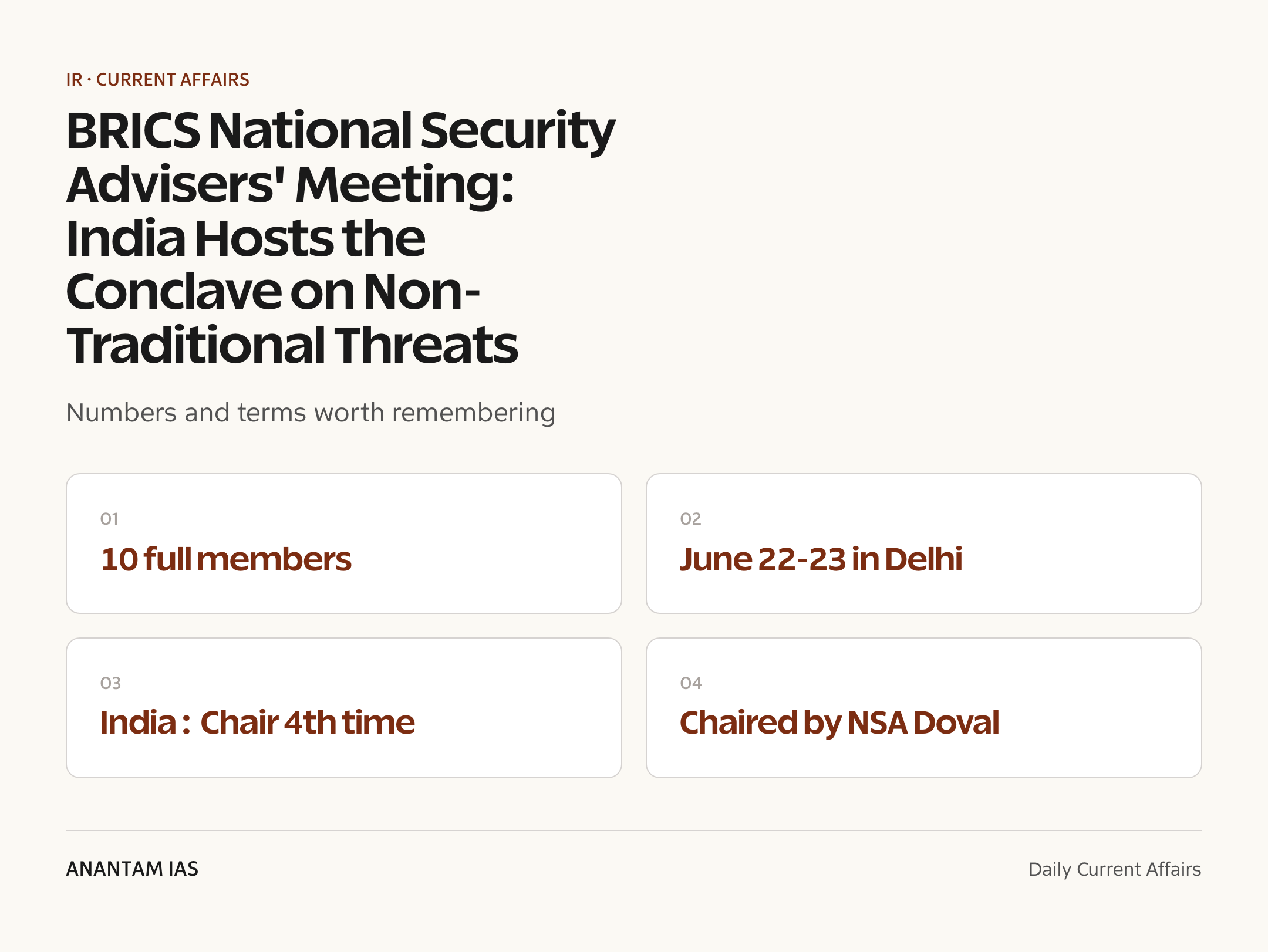
India is hosting the BRICS National Security Advisers’ (NSA) Meeting in New Delhi on June 22-23, 2026, with the conclave chaired by India’s NSA Ajit Doval. The Ministry of External Affairs (MEA) confirmed that the gathering brings together NSAs and Heads of Delegation from BRICS member states around the theme Non-Traditional Security Challenges Confronting the World Today.
The meeting is one of the flagship security-track events of India’s 2026 BRICS Chairship and prepares the ground for the leaders’ 18th BRICS Summit, which India will host in New Delhi later in the year.
- Chinese Foreign Minister Wang Yi and Russian Security Council Secretary Sergei Shoigu are among the senior delegates expected in New Delhi, per news reports.
- Agenda priorities flagged by the MEA include counter-terrorism, security of information and communication technologies (ICT) and cyberspace, and the security implications of emerging technologies.
- Iran’s Supreme National Security Council deputy secretary is also reported among the participants, reflecting the bloc’s 2024-25 expansion.
- India holds the BRICS Chair for the fourth time (after 2012, 2016 and 2021), steering the agenda through 2026.
The development matters in the context of:
- Matters in the context of India’s multi-alignment diplomacy — engaging BRICS while deepening Quad and Western partnerships.
- Matters for internal security, as counter-terrorism and cyber security feature prominently on the BRICS agenda.
- Matters for the debate on reform of global governance and a multipolar world order pushed by the expanded bloc.
UPSC Relevance
Prelims Relevance
- BRICS founding members: Brazil, Russia, India, China (BRIC, 2009) plus South Africa (joined 2010, making it BRICS).
- 2024 expansion: Egypt, Ethiopia, Iran and the UAE joined as full members on January 1, 2024.
- Indonesia became a full member in January 2025 — the first Southeast Asian member.
- BRICS now has a partner-country category (announced at the 2024 Kazan Summit) distinct from full membership.
- India is the 2026 BRICS Chair and will host the leaders’ summit in New Delhi.
- The NSA mechanism is a security-track dialogue, separate from the leaders’ summit and Sherpa channels.
- Ajit Doval is India’s National Security Adviser and chairs the 2026 NSA meeting.
- BRICS works by consensus; it has no founding treaty or permanent secretariat.
- BRICS institutions include the New Development Bank (NDB) and the Contingent Reserve Arrangement (CRA).
- The grouping’s name traces to a 2001 term coined by economist Jim O’Neill.
Mains Relevance
GS Paper 2
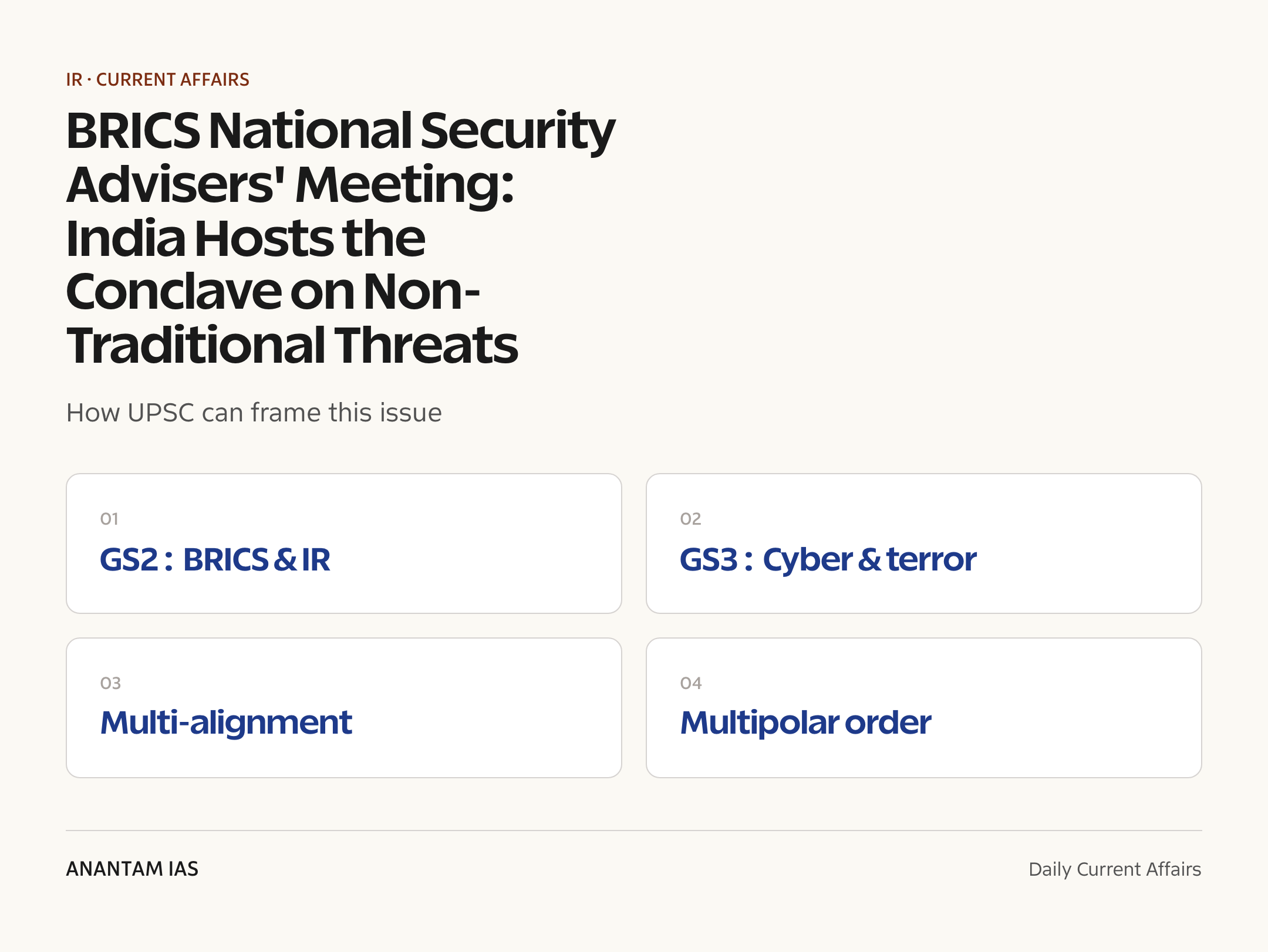
- BRICS in India’s foreign policy: how a non-Western plurilateral grouping serves India’s pursuit of a multipolar order and reform of global governance.
- India’s balancing act — co-existing with China and Russia inside BRICS while sustaining Quad and Western strategic ties (multi-alignment).
GS Paper 3
- Non-traditional security threats — terrorism, ICT/cyber security and misuse of emerging technologies — and the scope for BRICS counter-terrorism cooperation.
Essay
- The shift from a unipolar to a multipolar world and India’s role as a bridge between blocs.
- Security in the age of emerging technologies: opportunity, vulnerability and the need for cooperative governance.
Background and Context
What BRICS is and how it grew
BRICS is a plurilateral grouping of major emerging economies that has expanded sharply since 2024.
- Began as BRIC (Brazil, Russia, India, China) in 2009; South Africa joined in 2010 to form BRICS.
- Egypt, Ethiopia, Iran and the UAE became full members on January 1, 2024.
- Indonesia joined as a full member in January 2025, taking the membership into double figures.
- The bloc operates by consensus, with no founding charter, treaty or permanent secretariat.
- A new partner-country tier lets interested states join meetings and projects without full voting rights.
The NSA mechanism and this year's meet
The National Security Advisers’ meeting is BRICS’s dedicated security-track dialogue.
- Brings together NSAs and Heads of Delegation of member states ahead of the leaders’ summit.
- The 2026 edition runs June 22-23 in New Delhi, chaired by NSA Ajit Doval.
- Theme: Non-Traditional Security Challenges Confronting the World Today, per the MEA.
- Senior participants reported include China’s Wang Yi and Russia’s Sergei Shoigu.
- Outcomes feed into the leaders’ 18th BRICS Summit India hosts later in 2026.
India's 2026 Chairship
India is steering the BRICS agenda for the fourth time.
- India has chaired BRICS in 2012, 2016, 2021 and now 2026.
- The Chair sets the calendar of ministerial, Sherpa and security-track meetings through the year.
- India’s priorities stress counter-terrorism, cyber and ICT security and technology governance.
- Hosting lets India shape the bloc’s tone amid sharp geopolitical tensions among members and partners.
- The Chairship dovetails with India’s broader push for a reformed, multipolar global order.
Why the security agenda matters
The 2026 agenda is dominated by threats that cut across borders and sectors.
- Counter-terrorism — a long-standing Indian priority, including action against cross-border and state-sponsored terror.
- ICT and cyber security — protecting critical infrastructure and data from cyber attacks and misuse.
- Security risks from emerging technologies such as artificial intelligence and dual-use tools.
- Other non-traditional threats — organised crime, drug trafficking and financial security.
- A shared security narrative helps a diverse bloc find common ground despite internal frictions.
BRICS in India's strategic calculus
BRICS is one strand of India’s wider, deliberately diversified diplomacy.
- Anchors India’s pursuit of a multipolar world and a stronger voice for the Global South.
- Requires careful management of the India-China relationship within a shared platform.
- Complements rather than replaces ties such as the Quad and partnerships with the West (multi-alignment).
- Backs reform of bodies like the UN Security Council, IMF and World Bank.
- Supports financial alternatives via the New Development Bank and local-currency trade discussions.
Challenges and limits
Expansion has widened BRICS’s reach but also its internal contradictions.
- A larger, more diverse membership makes consensus harder to reach.
- Strategic rivalries — notably India-China tensions — constrain deep security integration.
- Members hold divergent positions on the dollar, sanctions and the West.
- The bloc lacks a permanent secretariat, limiting institutional follow-through.
- Critics question whether BRICS can move from declarations to concrete delivery.
Way Forward
Institutionalise the security track
- Build durable working groups on counter-terrorism and cyber security with measurable deliverables.
- Create channels for rapid information-sharing on terror financing and cyber threats.
Keep the agenda focused
- Prioritise issues with genuine convergence rather than overloading an already diverse bloc.
- Use the Chairship to push India’s counter-terrorism and technology-governance priorities.
Preserve strategic autonomy
- Engage BRICS without diluting partnerships with the Quad and the West.
- Manage the China relationship pragmatically while protecting core security interests.
Conclusion
The BRICS NSA meeting positions India at the centre of a non-Western security conversation at a moment of acute global tension. By chairing talks on counter-terrorism, cyber security and the risks of emerging technologies, India steers the bloc toward the agenda it has long championed.
The harder test is converting a widening, diverse membership into cooperation that delivers. For India, BRICS remains one carefully managed strand of a multi-aligned foreign policy aimed at a more balanced and multipolar world order.
UPSC Practice Questions
Prelims MCQ 1
With reference to BRICS, consider the following statements:
- Egypt, Ethiopia, Iran and the UAE became full members of BRICS in January 2024.
- Indonesia became a full member of BRICS in January 2025.
- BRICS functions through a founding treaty and a permanent secretariat based in Shanghai.
How many of the above statements are correct?
(a) Only one (b) Only two (c) All three (d) None
Answer: (b) Only two
Explanation:
Statements 1 and 2 are correct — the 2024 expansion added Egypt, Ethiopia, Iran and the UAE, and Indonesia joined in 2025. Statement 3 is wrong: BRICS works by consensus and has no founding treaty or permanent secretariat.
Prelims MCQ 2
Which of the following best describes the BRICS National Security Advisers’ (NSA) Meeting?
(a) A treaty-based military alliance with a joint command (b) A security-track dialogue of NSAs and Heads of Delegation that feeds into the leaders’ summit (c) A trade-negotiation body under the New Development Bank (d) A UN Security Council subsidiary mechanism
Answer: (b) A security-track dialogue of NSAs and Heads of Delegation that feeds into the leaders' summit
Explanation:
The NSA meeting is BRICS’s security-track dialogue; it is not a military alliance, a trade body or a UN organ. Its discussions prepare the ground for the leaders’ summit.
UPSC Mains Questions
- BRICS has expanded rapidly since 2024, yet its growing diversity may dilute its coherence. Critically examine the opportunities and limits the enlarged grouping presents for India’s foreign policy. (250 words)
- Non-traditional security threats such as terrorism, cyber attacks and the misuse of emerging technologies increasingly dominate plurilateral security agendas. Discuss how India can leverage its 2026 BRICS Chairship to advance cooperation on these challenges. (250 words)
Sources: MEA and Business Standard.
Frequently Asked Questions
What is the BRICS NSA meeting?
It is the security-track dialogue of BRICS, bringing together the National Security Advisers and Heads of Delegation of member states. The 2026 edition is held in New Delhi on June 22-23 and is chaired by India’s NSA Ajit Doval, focusing on non-traditional security challenges.
Who are the members of BRICS in 2026?
The full members are Brazil, Russia, India, China and South Africa, plus Egypt, Ethiopia, Iran and the UAE (which joined in January 2024) and Indonesia (which joined in January 2025). BRICS also has a separate partner-country category for states that participate without full voting rights.
Why is India chairing BRICS in 2026?
Chairship rotates among members each year. India holds it in 2026 for the fourth time, after 2012, 2016 and 2021. As Chair, India sets the calendar of meetings, shapes the agenda and hosts the leaders’ summit later in the year.
What is on the 2026 NSA meeting agenda?
The theme is Non-Traditional Security Challenges Confronting the World Today. Priorities flagged by the MEA include counter-terrorism, security of information and communication technologies and cyberspace, and the security risks posed by emerging technologies such as artificial intelligence.
How does BRICS take decisions?
BRICS works by consensus and has no founding treaty or permanent secretariat. This keeps it flexible but makes agreement harder as membership widens. Its main institutions are the New Development Bank and the Contingent Reserve Arrangement.
Does BRICS membership conflict with India’s other partnerships?
Not necessarily. India follows a policy of multi-alignment, engaging BRICS alongside the Quad and partnerships with the West. New Delhi treats BRICS as one strand of a diversified diplomacy aimed at strategic autonomy and a multipolar world order.