Building Collapses in India: Nearly 8,000 people died due to the collapse of structures in 5 years
Why in News?
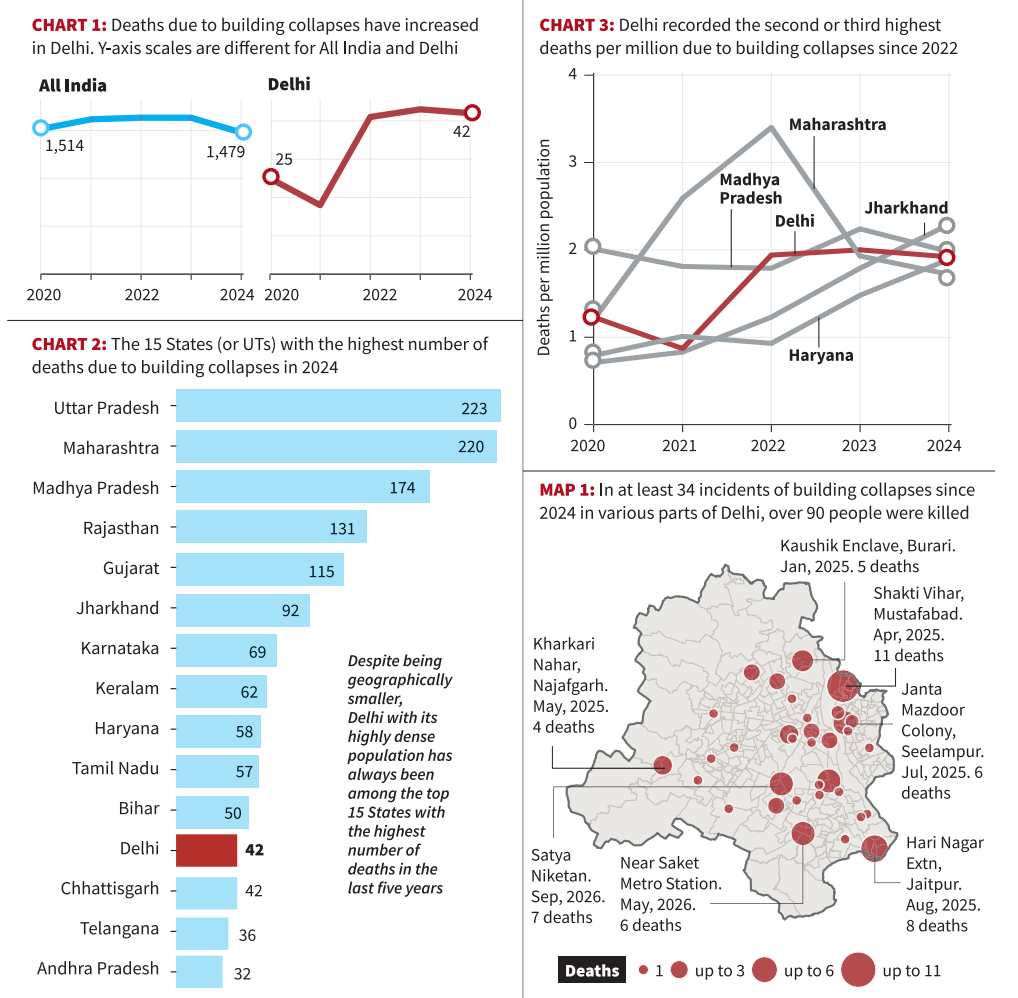
The collapse of a building accommodating students in Delhi’s Satya Niketan has highlighted persistent failures in enforcing building-safety norms. As per NCRB, over 7800 people died during 2020-2024 under selected structural-collapse categories, excluding bridges and dams.
These recurring losses indicate an enduring problem of unsafe construction, maintenance failures and weak enforcement.
| UPSC Relevance: GS-1 Indian Society: Urbanisation; GS-2: Urban Governance; GS-3 Disaster Management: Man-made disasters; Infrastructure resilience. Mains: Disaster management and infrastructure resilience. |
Why is building safety a disaster-management issue?
- Building collapses demonstrate how hazards interact with exposure and vulnerability:
- Rainfall, earthquakes or excavation can trigger failure
- Weak foundations, unauthorised floors and deterioration increase vulnerability
- Dense occupancy increases potential casualties.
- The Disaster Management Act, 2005 explicitly recognises disasters arising from accidents or negligence, subject to their severity and the affected community’s coping capacity. Thus, preventing unsafe construction falls within disaster-risk reduction.
Policy framework: Important provisions and their relevance:
- Local authorities have a preventive obligation: Section 41(1)(c) of the Disaster Management Act requires local authorities to ensure that construction within their jurisdiction conforms to disaster-prevention and mitigation standards laid down by disaster-management authorities. Building safety therefore forms part of their statutory disaster-management responsibility.
- Technical standards already exist: The National Building Code, 2016, covers structural design, fire safety, construction practices and maintenance. However, it is a model code which requires adoption through applicable regulations. National standards must translate into enforceable local requirements.
- Structural audits depend on local enforcement: Model Building Bye-Laws, 2016 address structural safety. In a 2026 parliamentary reply, MoHUA reiterated that periodic structural audits, inspections and compliance requirements fall within the domain of States/UTs and urban local bodies. The implementation challenge lies in consistent inspection and follow-up.
- Builder liability extends beyond possession: Under Section 14(3) of the Real Estate (Regulation and Development) Act, 2016, specified defects, including structural defects, reported within five years of possession must be rectified without further charge within 30 days, failing which compensation is available. This protection applies within RERA’s scope; it does not replace municipal oversight of older or informal buildings.
- Urban disaster institutions need operationalisation: The 2025 amendment enables constitution of Urban Disaster Management Authorities (UDMAs) in State capitals and municipal-corporation cities, excluding Delhi and Chandigarh. As of early 2026, only Karnataka had reported constituting one for Bengaluru, illustrating the gap between enabling legislation and institution-building.
Why do disasters persist?
- Regulatory collusion undermines safeguards: In Supertech Ltd. v. Emerald Court Owner Resident Welfare Association (2021), the Supreme Court upheld demolition of the unauthorised twin towers and identified collusion between the developer and NOIDA officials. The case illustrates how compromised approvals can defeat building regulations.
- Inspections fail to track actual construction: Additional floors, removal of structural members or changes in occupancy can alter a building’s safety after approval. In 2024, the Supreme Court directed periodic construction inspections and action even against deviations discovered after completion certification.
- Regularisation can weaken deterrence: Expectations that violations will eventually be legalised encourage non-compliance. In 2024, the Supreme Court had cautioned against routine regularisation and emphasised accountability for officials failing to discharge statutory duties.
- Post-disaster drives substitute for sustained prevention: The MCD has announced to seal illegal buildings of five storeys and above after the collapse. Such action addresses visible violations, but structural danger also depends on foundations, age, maintenance, alterations and occupancy.
- Affordable-housing shortages sustain unsafe demand: Students, migrants and poorer households may accept risky accommodation because alternatives are unavailable. The Affordable Rental Housing vertical of PMAY-U 2.0 offers a relevant policy instrument for expanding affordable accommodation; its implementation should be linked with building-safety objectives.
- Maintenance receives insufficient attention: Approval at construction does not guarantee lifelong safety. The NDMA’s earthquake guidelines emphasise strengthening and retrofitting existing buildings, particularly critical infrastructure.
Way Forward:
The Sendai Framework for Disaster Risk Reduction, 2015-2030, provides a practical structure: understand risk, strengthen governance, invest in resilience, and improve preparedness and recovery.
- Understand risk: Prepare ward-level building inventories; prioritise structural screening of ageing buildings, altered structures, PG accommodation, schools and hospitals. Follow preliminary screening with detailed engineering audits where necessary.
- Strengthen risk governance: Implement the Supreme Court’s directions on inspections and completion/occupation certificates. Assign each unsafe-building notice a responsible officer, deadline and verified outcome; investigate professional and official negligence.
- Invest in resilience: Create dedicated municipal repair and retrofitting programmes, with technical assistance and affordable finance for vulnerable households. Integrate safe rental housing with PMAY-U 2.0 and institutional hostel provision.
- Improve preparedness: Include collapse scenarios in district and city disaster plans. Use the India Disaster Resource Network, an inventory of equipment and skilled personnel, to identify rescue resources in advance. Ensure structural assessment, temporary supports, utility isolation and medical triage during response.
- Build Back Better: Combine evacuation with temporary accommodation and tenant support. Publish technical failure investigations and ensure reconstruction corrects the original structural and regulatory weaknesses.
India’s building-safety challenge is the conversion of existing standards into continuous, accountable prevention. Safer cities require enforceable regulations, maintained buildings and affordable housing options, supported by institutions that act before warning signs become casualties.
Practice Mains Question:
Q. “Recurring building collapses in Indian cities highlight the need to shift from reactive enforcement to disaster prevention.” Examine the governance failures responsible and suggest measures to integrate disaster-risk reduction into urban planning and building regulation.