Cabinet extends SARTHAK-PDS scheme for 5 years
Why in News?
The Union Cabinet approved the five-year extension of the ‘SARTHAK-PDS’ scheme with a Rs 25,530 crore outlay through March 2031, aiming to overhaul the public distribution infrastructure through technology-led reforms.
| UPSC Relevance: GS-2 Governance; GS-2 Social Justice: Food Security Prelims: SARTHAK-PDS Scheme. Mains: Technology adoption in the PDS scheme. |
What is the SARTHAK-PDS Scheme?
SARTHAK-PDS is an umbrella scheme that merges two existing programmes into a single administrative framework:
1. Assistance to State Agencies for Intra-State Movement of Foodgrains and FPS Dealers’ Margin under NFSA, which provided financial support to states for transportation, handling charges, and margins of Fair Price Shop (FPS) dealers.
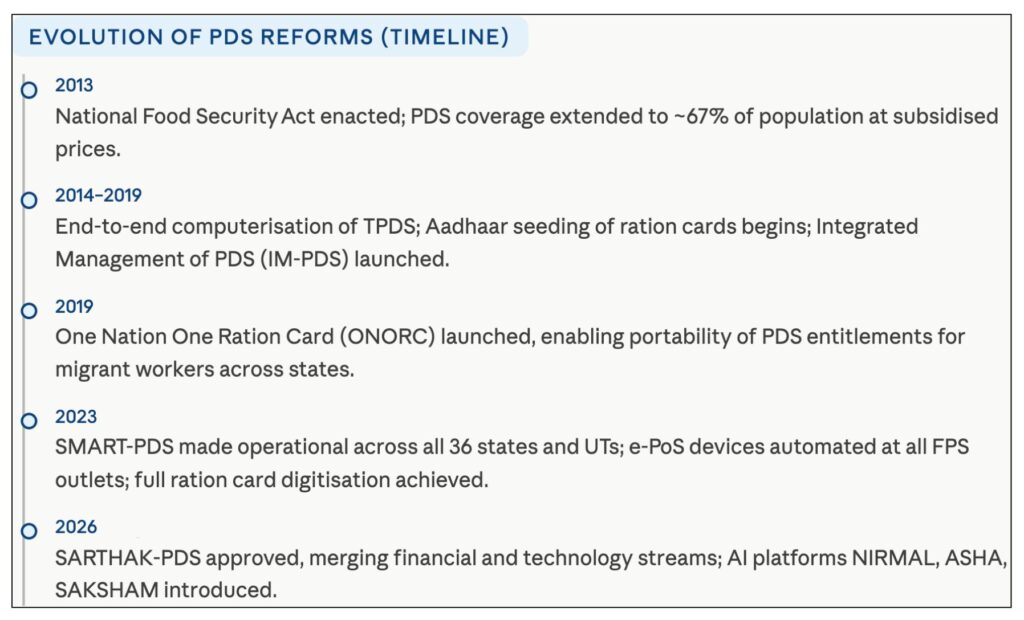
2. SMART-PDS (Scheme for Modernisation and Reforms through Technology in PDS), which drove end-to-end digitisation of ration cards, Aadhaar seeding, e-PoS automation, and supply-chain computerisation across all 36 states and UTs since April 1, 2023.
The merged scheme carries a dual mandate: assured financial support for intra-state movement and FPS dealer margins on one hand, and building a unified, citizen-centric, intelligent and interoperable PDS architecture on the other.
Key Features & Technology Architecture:
The scheme deploys AI, Machine Learning (ML), Natural Language Processing (NLP), and Blockchain across the entire PDS value chain. Three AI-powered platforms form its core:
- NIRMAL: AI-driven beneficiary registry that identifies and removes duplicate and ghost beneficiaries. Uses QR-coded grain bags for tamper-proof tracking from warehouses to FPS outlets.
- ASHA: Multilingual AI grievance assistant that handles beneficiary complaints in their preferred regional languages, leveraging NLP for accessible redressal.
- SAKSHAM: AI supply-chain platform providing vehicle GPS tracking, demand forecasting, and route optimisation to reduce logistical inefficiencies and transportation distances.
Other deliverables include State Command Control Centres for real-time data-driven oversight, standardised architectures with unified databases, and ISO-certified process frameworks for transparency and operational sustainability.
Significance & Rationale:
- Food security commitment: SARTHAK-PDS is anchored to the government’s legal obligation under the National Food Security Act, 2013 (NFSA), which guarantees subsidised foodgrains to 81.35 crore persons, covering about 67% of India’s population.
- Addressing systemic leakages: Approximately 28% of allocated food grains fail to reach intended beneficiaries under the existing PDS, translating to nearly 19.69 million metric tonnes annually. Ghost beneficiaries, diversion to black markets, and fraudulent ration cards remain pervasive, making AI-driven beneficiary management critical.
- Financial relief to states: State governments faced significant difficulty bearing intra-state transportation costs. SARTHAK-PDS provides assured central funding for these costs, and also enhances FPS dealers’ margins to improve last-mile engagement.
- Environmental dividend: Route optimisation through SAKSHAM is projected to reduce carbon emissions by 36% by shortening transportation distances, aligning PDS reform with India’s climate commitments.
- Administrative consolidation: Merging two schemes reduces fragmentation in governance, improves fund utilisation, and brings technology and financial assistance under a unified framework.
Concerns & Critical Dimensions:
- Technology exclusion: Aadhaar-based biometric authentication has historically led to exclusion errors: genuine beneficiaries denied rations due to biometric failures, network outages, or data mismatches. Technology-first reforms must account for digital exclusion.
- Nutritional adequacy: NFSA and PDS are predominantly calorie-focused (rice and wheat). Micronutrient needs and dietary diversity (pulses, fortified items) remain inadequately addressed by the current framework.
- Outdated beneficiary data: NFSA coverage remains capped at 2011 Census projections, meaning population growth since then leaves many genuinely food-insecure households outside the legal quota.
- Implementation risk: Past evidence suggests technology alone does not eliminate leakages: Tamil Nadu’s leakage rate rose from 12% (2011-12) to 25% (2022-23) despite Aadhaar integration, underscoring the need for institutional accountability alongside digital tools.
SARTHAK-PDS represents a structurally important leap in PDS governance, but its success will depend on three factors:
- First, ensuring that AI-driven exclusions do not deprive genuine beneficiaries
- Second, revisiting NFSA beneficiary ceilings in light of updated census data
- Third, expanding the nutritional mandate of PDS to address India’s ongoing challenges with hidden hunger and protein deficiency.
The NFSA’s legal framing of food as a right, combined with the scheme’s 81.35 crore coverage and its alignment with SDG 2 (Zero Hunger) and SDG 12 (Responsible Consumption), makes this a strong example of rights-based governance meeting techno-administrative reform.
Practice Question:
Q. Discuss how SARTHAK-PDS seeks to bridge the gap between the promise of the National Food Security Act and its last-mile delivery challenges.