CAG-Israel Audit MoU: AI and Data Analytics Enter Public-Sector Auditing
Why in News?
On 24 June 2026 the Comptroller and Auditor General (CAG) of India, K. Sanjay Murthy, and Israel’s State Comptroller and Ombudsman, Matanyahu Englman, signed a Memorandum of Understanding (MoU) to strengthen cooperation in public-sector auditing. As reported by The Tribune and ANI, the pact frames a structured exchange of professional knowledge, audit methodologies, technical expertise, training and best practices between the two Supreme Audit Institutions.
The engagement leaned heavily on technology. Englman delivered a lecture titled “Artificial Intelligence in Public Sector Auditing,” stressing how AI, data analytics and digital audit tools can sharpen the effectiveness, efficiency and impact of audit. For aspirants, the development is a ready hook to revise the CAG’s constitutional position under Articles 148-151 and to track how analytics is reshaping performance and compliance audit.
- The CAG of India and Israel’s State Comptroller and Ombudsman signed an MoU on 24 June 2026 on public-sector auditing cooperation.
- Signatories were K. Sanjay Murthy (CAG of India) and Matanyahu Englman (State Comptroller of Israel), per The Tribune and ANI.
- The MoU covers exchange of methodologies, technical expertise, training and best practices, with bilateral seminars held alternately in both countries.
- Its technology core is the use of Artificial Intelligence, data analytics and digital audit tools to strengthen public oversight.
- Both institutions reaffirmed a shared commitment to transparency, accountability and good governance in public administration.
The development matters in the context of:
- The CAG is the Supreme Audit Institution (SAI) of India; Israel’s parallel body is its State Comptroller, also functioning as the national Ombudsman.
- SAIs worldwide coordinate through INTOSAI (International Organisation of Supreme Audit Institutions), which has been pushing technology-led audit standards.
- The pact sits within the broader India-Israel cooperation, here extended into governance and audit institutions rather than defence or agriculture.
UPSC Relevance
Prelims Relevance
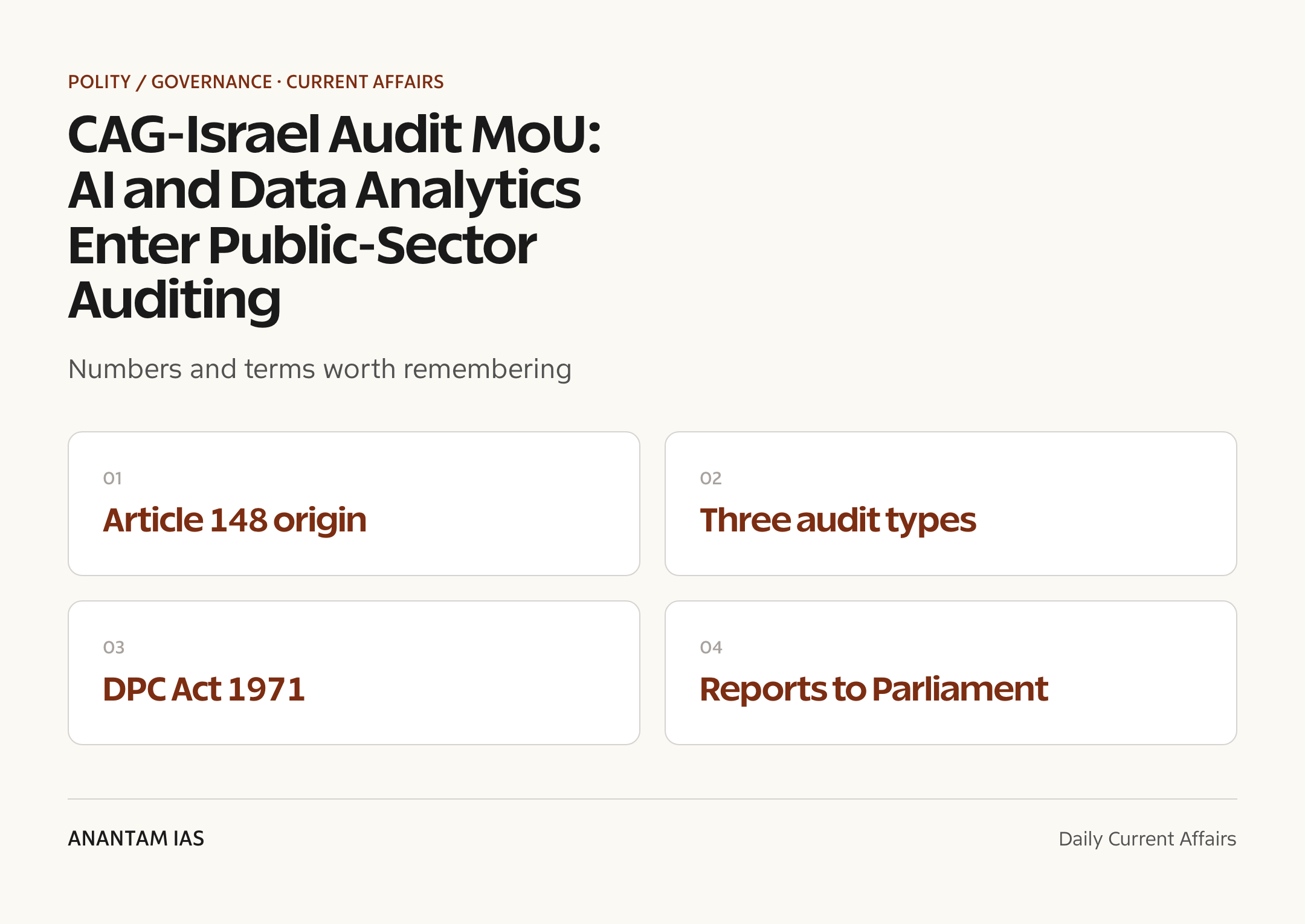
- The CAG is established under Article 148; the office is a constitutional, not statutory, body.
- Article 149 lays down the duties and powers of the CAG; Article 150 concerns the form of accounts of the Union and States.
- Article 151 requires CAG reports on Union accounts to be laid before Parliament and State reports before the respective legislature.
- The CAG is appointed by the President and can be removed only in the manner and on the grounds of a Supreme Court judge (proved misbehaviour or incapacity).
- The detailed mandate flows from the CAG’s (Duties, Powers and Conditions of Service) Act, 1971 (DPC Act).
- The CAG conducts three broad audits: financial, compliance and performance audit.
- CAG reports are examined by the Public Accounts Committee (PAC) of Parliament; the CAG acts as a “friend, philosopher and guide” to the PAC.
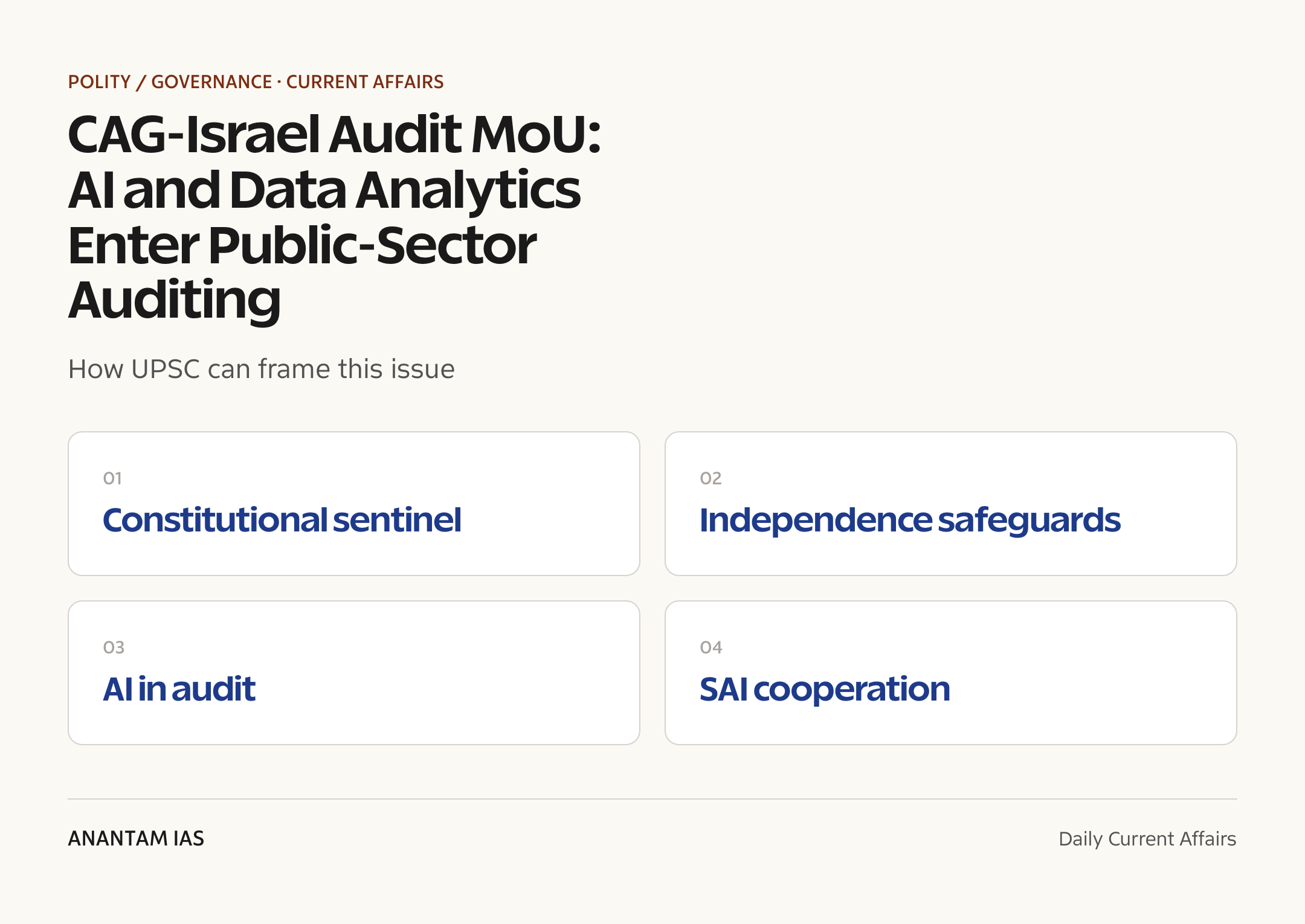
- Salary and service conditions of the CAG are charged on the Consolidated Fund of India, an independence safeguard.
- INTOSAI is the global body of Supreme Audit Institutions; the CAG of India has chaired several INTOSAI working groups.
- Continuous auditing and red-flag analytics are emerging AI-enabled techniques to detect anomalies in large data sets in near real time.
Mains Relevance
GS Paper 2
- Examine the CAG’s constitutional role under Articles 148-151 and the safeguards that protect its independence from the executive.
- Assess how the PAC-CAG relationship operationalises legislative control over public finance and executive accountability.
- Evaluate the institutional value of SAI-to-SAI cooperation (such as the India-Israel MoU) for capacity building and audit modernisation.
- Discuss whether the shift from financial and compliance audit toward performance audit strengthens outcome-based governance.
GS Paper 3
- Analyse how AI and data analytics can improve fraud detection, anomaly flagging and continuous auditing in public expenditure.
- Weigh the risks of algorithmic audit, including data quality, bias and auditor accountability, against efficiency gains.
Essay
- Accountability is the price a democracy pays for the trust it places in those who spend public money.
- Technology widens the auditor’s vision but cannot replace the auditor’s judgement.
- Independent institutions, not louder slogans, are the real guardians of public integrity.
Background and Context
The CAG as a constitutional sentinel
The office is designed to audit the public purse without fear of the government it scrutinises.
- Established under Article 148, the CAG is appointed by the President and holds a fixed tenure (six years or up to age 65, whichever is earlier).
- Removal mirrors that of a Supreme Court judge — only by Parliament, on proved misbehaviour or incapacity — insulating the office from arbitrary dismissal.
- B. R. Ambedkar called the CAG the most important officer under the Constitution, on par with the judiciary in guarding constitutional government.
- After demitting office, the CAG is barred from further office under the Union or State governments, reducing the temptation of post-retirement reward.
Independence safeguards
Several structural guarantees keep the auditor free of executive pressure.
- Salary and administrative expenses are charged on the Consolidated Fund of India, so they are not subject to annual vote.
- Service conditions cannot be varied to the CAG’s disadvantage after appointment.
- Audit staff and the Indian Audit and Accounts Department work under the CAG, not under the executive being audited.
- Reports go directly to the legislature under Article 151, bypassing executive gatekeeping.
The three audits and the DPC Act
The CAG’s mandate is statutory in detail though constitutional in origin.
- The CAG’s (DPC) Act, 1971 spells out duties, powers and conditions of service flowing from Article 149.
- Financial audit verifies that accounts fairly present the financial position.
- Compliance audit checks whether spending followed rules, laws and sanctions.
- Performance audit asks the harder question of economy, efficiency and effectiveness — whether public money achieved value for money.
The MoU and AI in audit
The India-Israel pact turns audit cooperation toward digital tools.
- Signed on 24 June 2026 by CAG K. Sanjay Murthy and Israel’s State Comptroller Matanyahu Englman, per The Tribune and ANI.
- It frames exchange of methodologies, technical expertise, training and best practices, with seminars held alternately in both countries.
- Englman’s lecture on AI in public-sector auditing highlighted analytics for detecting anomalies and lifting audit impact.
- Continuous auditing and red-flag analytics can scan entire transaction populations rather than the small samples traditional audit relied on.
Why it matters for governance
Audit modernisation feeds directly into accountability outcomes.
- Data-driven audit can shorten the gap between an irregularity and its detection, strengthening the deterrent value of oversight.
- SAI-to-SAI learning builds capacity that no single institution can develop alone.
- It dovetails with the work of the PAC, which depends on sharp, timely CAG findings to question the executive.
- Adopting AI also raises new accountability questions about data quality, model bias and auditor responsibility for machine-flagged findings.
Way Forward
Build in-house data analytics capacity within the Indian Audit and Accounts Department so AI tools augment, not outsource, the auditor’s judgement.
Adopt clear protocols on data quality, model validation and auditor sign-off so machine-flagged anomalies are independently verified before they reach reports.
Use SAI partnerships to shorten reporting cycles and move further toward real-time, continuous performance audit of large schemes.
Strengthen the PAC’s capacity to act on data-rich CAG findings, since detection without legislative follow-up blunts accountability.
Conclusion
The India-Israel audit MoU is a small administrative agreement with an outsized teaching value: it pins the durable syllabus on the CAG’s constitutional role under Articles 148-151 to a live, current peg about technology in governance.
The deeper lesson is that independence and innovation must travel together. AI can scan more, faster, but the constitutional design that makes the CAG fearless still does the heavy lifting; the tool sharpens the sentinel, it does not replace it.
UPSC Practice Questions
Prelims MCQ 1
With reference to the Comptroller and Auditor General (CAG) of India, consider the following statements: 1. The CAG is appointed by the President and can be removed in the same manner as a judge of the Supreme Court. 2. The CAG’s reports relating to the accounts of the Union are laid before Parliament under Article 151. 3. The salary of the CAG is charged on the Consolidated Fund of India. Which of the statements given above are correct?
1 and 2 only 2 and 3 only 1 and 3 only 1, 2 and 3
Answer: 1, 2 and 3
Explanation:
The CAG is appointed by the President (Article 148) and removable only like a Supreme Court judge; reports on Union accounts go to Parliament under Article 151; and the salary is charged on the Consolidated Fund of India as an independence safeguard. All three statements are correct.
Prelims MCQ 2
Which of the following best describes a ‘performance audit’ as conducted by the CAG?
An audit confirming that accounts fairly present the financial position An audit checking whether expenditure complied with applicable rules and sanctions An audit assessing the economy, efficiency and effectiveness with which public resources were used An audit verifying the authenticity of vouchers and receipts only
Answer: An audit assessing the economy, efficiency and effectiveness with which public resources were used
Explanation:
Performance audit evaluates value for money — the economy, efficiency and effectiveness of programmes. The first option describes financial audit and the second describes compliance audit.
UPSC Mains Questions
- The Comptroller and Auditor General has been called the most important officer under the Constitution. In light of Articles 148-151, examine the safeguards that secure the independence of the CAG and assess whether they remain adequate. (250 words)
- Discuss how Artificial Intelligence and data analytics are reshaping public-sector auditing. What governance benefits and accountability risks does algorithmic audit carry? (250 words)
- Supreme Audit Institutions increasingly cooperate across borders. Evaluate the significance of SAI-to-SAI partnerships, such as the India-Israel audit MoU, for strengthening accountability in public administration. (150 words)
Sources: The Tribune and ANI.
Frequently Asked Questions
Under which Articles is the CAG of India established and governed?
The CAG is established under Article 148. Article 149 sets out duties and powers, Article 150 deals with the form of Union and State accounts, and Article 151 requires CAG reports to be laid before Parliament or the State legislature.
Who signed the India-Israel public-sector auditing MoU and when?
It was signed on 24 June 2026 by K. Sanjay Murthy, Comptroller and Auditor General of India, and Matanyahu Englman, State Comptroller and Ombudsman of Israel, as reported by The Tribune and ANI.
How is the independence of the CAG protected?
The CAG is appointed by the President, can be removed only like a Supreme Court judge, has salary and expenses charged on the Consolidated Fund of India, cannot have service conditions varied to disadvantage, and is barred from further government office after retirement.
What are the three types of audit conducted by the CAG?
Financial audit checks that accounts fairly present the financial position, compliance audit checks adherence to rules and sanctions, and performance audit assesses the economy, efficiency and effectiveness of public spending.
What role do AI and data analytics play in the new audit cooperation?
The MoU emphasises AI, data analytics and digital audit tools to improve audit effectiveness. Techniques such as continuous auditing and red-flag analytics let auditors scan entire transaction populations and detect anomalies faster than traditional sampling.
What is INTOSAI and how does it relate to the CAG?
INTOSAI is the International Organisation of Supreme Audit Institutions, the global body that frames audit standards and shares best practices. The CAG of India is an active INTOSAI member and has led several of its working groups.