Railway Station Amenities Audit: CAG Finds Systemic Passenger-Facility Gaps
Why in News?
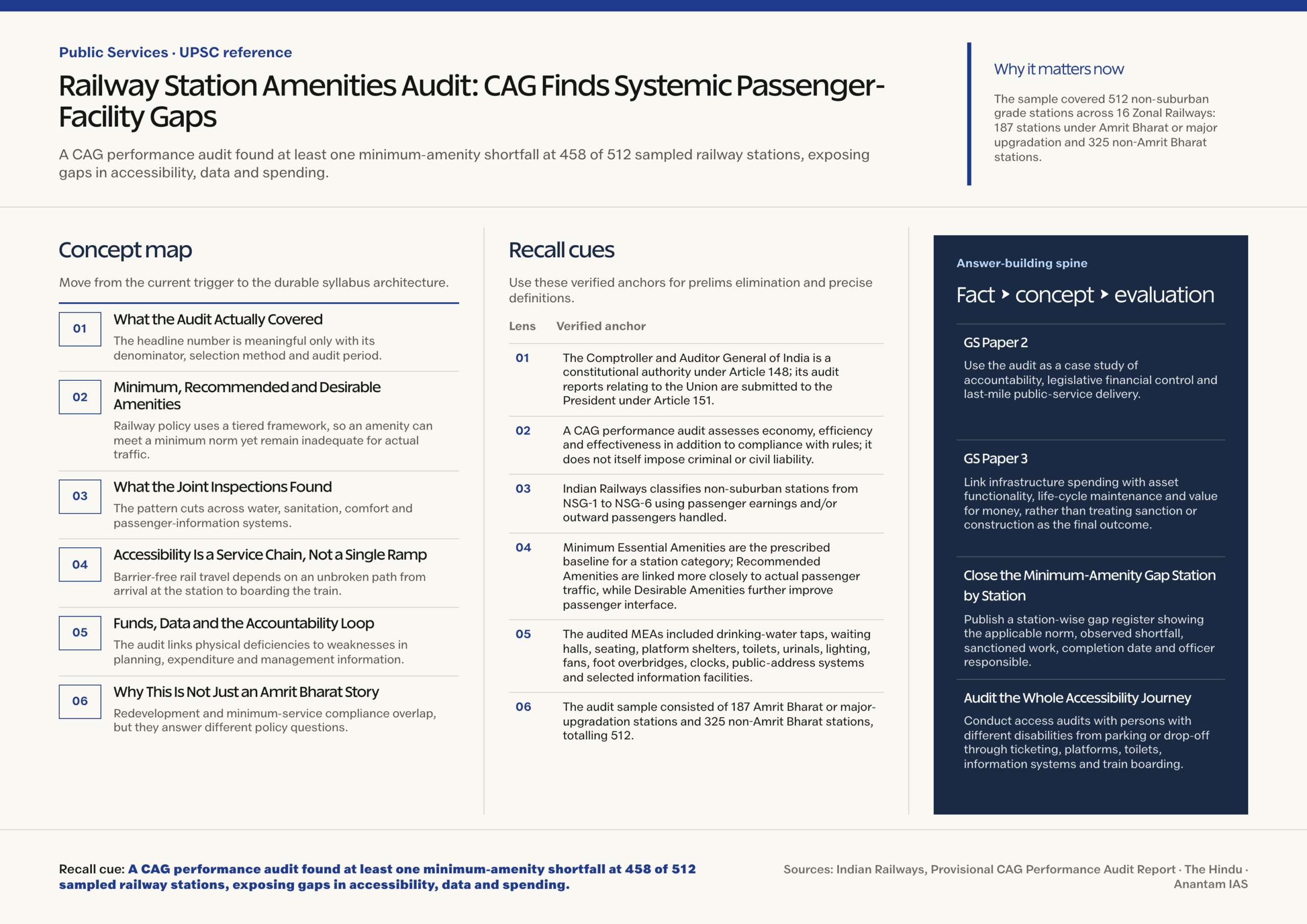
A performance audit on passenger amenities and sanitation found that only 54 of 512 sampled non-suburban railway stations had no shortfall in the Minimum Essential Amenities checked.
- The sample covered 512 non-suburban grade stations across 16 Zonal Railways: 187 stations under Amrit Bharat or major upgradation and 325 non-Amrit Bharat stations.
- The 512 stations represented 8.66% of 5,908 NSG stations recorded as of 31 March 2023. The result must not be generalised as if 458 stations meant all Indian railway stations.
- Joint inspections found that 54 sampled stations, or 11%, had no shortfall in the MEAs checked; the remaining 458 had one or more shortfalls.
- First inspections recorded shortfalls at 147 stations for drinking-water taps, 122 for urinals, 114 for fans in one covered-platform category and 129 of the 240 relevant stations for water coolers.
- Accessibility checks found missing standard ramps with railings at 246 of 512 stations in the first inspection and missing priority seating at 490 of 512 stations under a separate February 2020 standards check.
- Railway stations are a test of everyday State capacity: rules, budgets and schemes matter only when water, toilets, shelter, information and barrier-free movement are available at the point of use.
- The report follows earlier CAG scrutiny and Railway Ministry assurances, so repeated deficiencies raise questions about corrective-action loops, not merely first-time asset creation.
- The audit separates three questions that are often collapsed in public debate: whether an amenity exists, whether it is adequate for traffic and whether it is functional and accessible.
UPSC Relevance
Prelims Relevance
- The Comptroller and Auditor General of India is a constitutional authority under Article 148; its audit reports relating to the Union are submitted to the President under Article 151.
- A CAG performance audit assesses economy, efficiency and effectiveness in addition to compliance with rules; it does not itself impose criminal or civil liability.
- Indian Railways classifies non-suburban stations from NSG-1 to NSG-6 using passenger earnings and/or outward passengers handled.
- Minimum Essential Amenities are the prescribed baseline for a station category; Recommended Amenities are linked more closely to actual passenger traffic, while Desirable Amenities further improve passenger interface.
- The audited MEAs included drinking-water taps, waiting halls, seating, platform shelters, toilets, urinals, lighting, fans, foot overbridges, clocks, public-address systems and selected information facilities.
- The audit sample consisted of 187 Amrit Bharat or major-upgradation stations and 325 non-Amrit Bharat stations, totalling 512.
Mains Relevance
GS Paper 2
- Use the audit as a case study of accountability, legislative financial control and last-mile public-service delivery.
- Connect constitutional audit with outcome monitoring: Article 148 gives institutional independence, while Article 151 enables legislative scrutiny of audit findings.
GS Paper 3
- Link infrastructure spending with asset functionality, life-cycle maintenance and value for money, rather than treating sanction or construction as the final outcome.
- Use the distinction between baseline amenities and station redevelopment to argue for service-level indicators alongside capital-project milestones.
Essay
- Public infrastructure earns legitimacy through ordinary reliability: a working tap, accessible toilet or safe pathway may reveal more about governance than a prominent inauguration.
Background and Context
What the Audit Actually Covered
The headline number is meaningful only with its denominator, selection method and audit period.
- The audit examined 512 selected NSG stations, not every station in the Indian Railways network. They were drawn across all 16 zones and categories NSG-1 to NSG-6.
- Selection included the highest-footfall stations within categories, representation of divisions and limits of up to 12 Amrit Bharat and 20 non-Amrit Bharat stations per zone. It was a structured audit sample, not a simple nationwide census.
- Of the 512 stations, 187 were Amrit Bharat or major-upgradation stations and 325 were non-Amrit Bharat stations. This allowed the audit to examine baseline amenities across both redevelopment and ordinary operational contexts.
- The auditors conducted joint inspections with railway officials, reviewed records and revisited selected non-Amrit Bharat stations after roughly two to three months to test whether observed deficiencies were isolated.
- Feedback was collected from 7,511 passengers, another 2,507 passengers in waiting rooms and 374 persons with disabilities. These responses supplemented, rather than replaced, physical and documentary verification.
Minimum, Recommended and Desirable Amenities
Railway policy uses a tiered framework, so an amenity can meet a minimum norm yet remain inadequate for actual traffic.
- Minimum Essential Amenities are the category-linked baseline expected when a station is constructed or brought to the prescribed standard. They include fundamental passenger facilities such as water, seating, shelter, toilets and lighting.
- Recommended Amenities address whether the scale of provision is commensurate with actual passenger volume. This matters because the same numerical minimum may serve a quiet NSG-6 station differently from a heavily used NSG-1 station.
- Desirable Amenities go beyond the baseline to improve passenger satisfaction and interface. Railway instructions allow their provision based on need and importance rather than waiting for every recommended amenity to be completed.
- The audit noted that Railway Board norms for the quantum of several basic amenities changed little between 2003 and 2018 even as traffic conditions evolved. Good governance requires periodic revision of standards, not only compliance with.
- The Railway Board had directed that revised MEAs be provided by 31 August 2018. Persistent gaps years later show a failure of implementation and follow-up, not an absence of a formal deadline.
What the Joint Inspections Found
The pattern cuts across water, sanitation, comfort and passenger-information systems.
- During first inspections, shortfalls against MEA norms were observed at 147 stations for drinking-water taps, 122 for urinals, 69 for latrines, 78 for seating and 68 for platform shelters.
- Among the 240 sampled NSG-1 to NSG-4 stations for which two water coolers on each platform were prescribed, 129 stations showed a shortfall in the first inspection.
- Fan provision fell short at 114 stations for covered platforms six to nine metres wide and at 214 stations for covered platforms wider than nine metres under the applicable norm.
- The second-inspection figures improved only modestly for several basic amenities: drinking-water shortfalls fell from 147 to 138 stations, urinals from 122 to 111 and latrines from 69 to 59.
- Only one NSG-1 station in the sample was among the 54 stations with no MEA shortfall checked. The audit’s PAMS analysis also found that only five of 22 NSG-1 stations across the network recorded all MEAs.
Accessibility Is a Service Chain, Not a Single Ramp
Barrier-free rail travel depends on an unbroken path from arrival at the station to boarding the train.
- Railway instructions since 1999 have included short-term facilities such as ramps with railings, reserved parking, non-slippery walkways, visible signs, accessible water taps and at least one accessible ground-floor toilet.
- First inspections found no standard ramp with railing at 246 of 512 sampled stations. At the second inspection the number was still 243.
- Under the April 2018 requirements, all 297 relevant sampled stations lacked the specified drinking-water tap suitable for persons with disabilities on alternate water booths at each platform.
- A separate check against February 2020 accessibility standards found shortfalls in priority seating at 490 of 512 stations, coach-position displays at 343, announcements about the accessible coach at 273 and accessible toilets at 134.
- Tactile pathways existed at some stations but did not connect to foot overbridges, lifts or subways; an incorrectly placed tactile path near a platform edge was recorded at Madurai Junction. A disconnected asset can create a.
Way Forward
Close the Minimum-Amenity Gap Station by Station
- Publish a station-wise gap register showing the applicable norm, observed shortfall, sanctioned work, completion date and officer responsible.
- Prioritise water, sanitation, shelter, safe circulation and passenger information before aesthetic additions.
- Group repeated small deficiencies into zonal procurement and maintenance packages where this shortens delivery without weakening local accountability.
- Use repeat joint inspections and random passenger verification to confirm that a repaired asset remains functional after handover.
Conclusion
- The sharpest lesson is not that 458 railway stations are deficient in the abstract.
- Indian Railways needs both ambitious redevelopment and dependable basics.
UPSC Practice Questions
Prelims MCQ 1
With reference to the CAG performance audit on passenger amenities at railway stations, consider the following statements:
- The audit’s joint-inspection sample consisted of 512 non-suburban grade stations.
- The finding on 458 deficient stations refers to all railway stations in India.
- The sample included both Amrit Bharat or major-upgradation stations and non-Amrit Bharat stations.
How many of the above statements are correct?
(a) Only one (b) Only two (c) All three (d) None
Answer: (b) Only two
Explanation:
Statements 1 and 3 are correct. The audit jointly inspected 512 selected NSG stations, including 187 Amrit Bharat or major-upgradation stations and 325 non-Amrit Bharat stations. Statement 2 is incorrect because 458 is the number with at least one shortfall within that sample, not across every station in India.
Prelims MCQ 2
Which one of the following best distinguishes Recommended Amenities from Minimum Essential Amenities in Indian Railways’ passenger-amenity framework?
(a) Recommended Amenities are judicially enforceable, while Minimum Essential Amenities are voluntary (b) Recommended Amenities are linked to actual passenger traffic, while Minimum Essential Amenities provide a category-based baseline (c) Recommended Amenities apply only to suburban stations, while Minimum Essential Amenities apply only to non-suburban stations (d) Recommended Amenities are funded only through CSR, while Minimum Essential Amenities are funded only through MPLADS
Answer: (b) Recommended Amenities are linked to actual passenger traffic, while Minimum Essential Amenities provide a category-based baseline
Explanation:
Minimum Essential Amenities set the prescribed baseline for each station category. Recommended Amenities consider whether provision is adequate for the actual passenger traffic handled. Desirable Amenities form a further tier intended to improve passenger satisfaction and interface.
UPSC Mains Questions
- The gap between sanctioned infrastructure and usable public services is often a problem of State capacity rather than policy absence. Discuss with reference to the CAG audit of passenger amenities at railway stations. (250 words)
- Accessible transport requires an unbroken service chain, not isolated compliant assets. Examine this proposition in the context of railway stations and suggest an outcome-based monitoring framework. (250 words)
Sources: Indian Railways, Provisional CAG Performance Audit Report and The Hindu.
Frequently Asked Questions
Did the CAG find that 458 of all Indian railway stations lacked amenities?
No. The audit jointly inspected a sample of 512 non-suburban grade stations. Only 54 had no shortfall in the Minimum Essential Amenities checked, so 458 sampled stations had at least one shortfall. The denominator is the 512 audited stations, not.
What are Minimum Essential Amenities at railway stations?
They are the category-based baseline facilities prescribed for stations, including drinking water, waiting space, seating, platform shelter, toilets, urinals, lighting and other basic passenger services. Recommended Amenities respond more closely to actual passenger traffic, while Desirable Amenities further improve the.
How is this audit different from Amrit Bharat Station Scheme coverage?
The Amrit Bharat Station Scheme concerns long-term station development and master planning. This performance audit tested whether amenities and sanitation were provided, maintained and funded according to rules. Its sample included 187 Amrit Bharat or major-upgradation stations and 325 non-Amrit.
What were the main accessibility concerns found by the audit?
The audit found gaps in ramps, accessible water taps, toilets, priority seating, coach-position information and inter-platform movement. Some tactile paths did not connect to lifts, foot overbridges or subways. These findings show why accessibility must be assessed as a continuous.
What did the audit say about customer-amenity funds?
Underutilisation of budget grants under the Customer Amenities plan head ranged from 36% to 44% annually during 2019-20 to 2023-24. Railway administrations cited delayed work, tender and contractor problems, late bills and site constraints, pointing to execution and project-management weaknesses.