Captive and Commercial Coal Mines: Output Growth and Energy Security
Why in News?
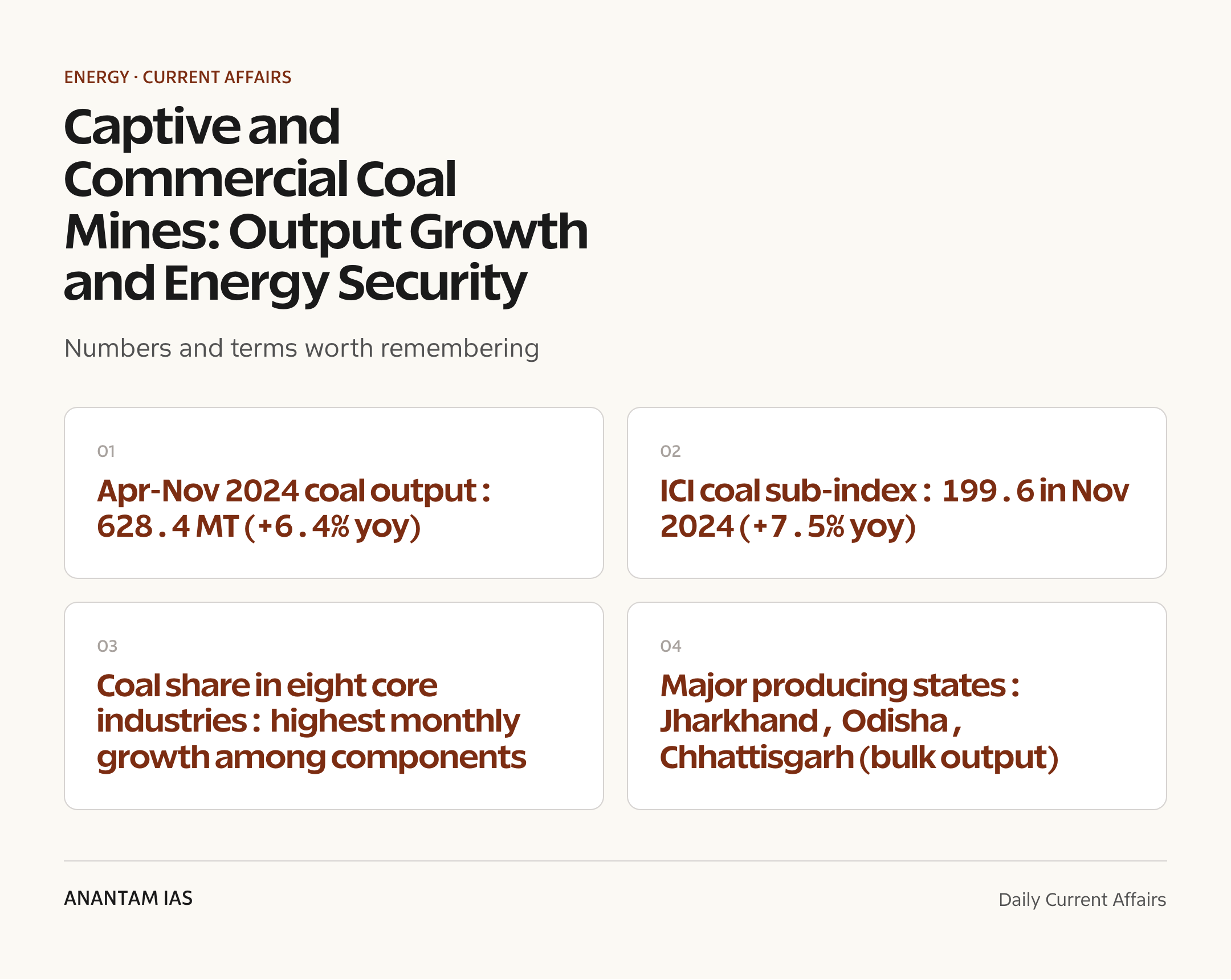
Ministry of Commerce and Industry ICI data and Ministry of Coal releases report higher coal output and a 7.5% growth for the coal industry in November 2024, with output of 628.4 MT in Apr-Nov 2024 up 6.4% year on year.
- Output growth: Coal sector ICI at 199.6 points for Nov 2024, up 7.5% over Nov 2023; Apr-Nov 2024 coal production 628.4 MT, up 6.4% year on year.
- Energy security: Higher domestic supply lowers near-term pressure on coal imports that affect forex and strategic stockpiles.
- Industrial impact: Availability of coal influences costs for steel, cement and heavy industries reliant on captive mines.
- Policy signal: Growth underlines success of reforms around commercial mining, e-auctioning and operationalisation of captive blocks.
- Transition debate: Output expansion raises questions on balancing fossil fuel supply with decarbonisation commitments and energy transition planning.
The development matters in the context of:
- What the numbers cover: ICI measures combined performance of eight core industries; the coal sub-index reported the strongest growth among the eight cores in Nov 2024.
- Components of coal supply: Domestic supply comprises commercial production (public and private), captive mining for user industries and imports for shortfalls or quality needs.
- Recent policy changes: Commercial mining opened to private and foreign investment since 2020; auctions and allocation processes have increased private participation and capacity additions.
- Demand drivers: Thermal power generation remains the largest coal consumer; heavy industries and cement also consume captive and commercial coal.
- Import dynamics: India imports both steam and coking coal when domestic quality or proximity does not meet demand; imported volumes fluctuate with domestic output and international prices.
- Logistics and bottlenecks: Railway offtake, pithead connectivity, loading infrastructure and environmental clearances influence the pace at which mined coal reaches consumers.
UPSC Relevance
Prelims Relevance
- Index of Eight Core Industries (ICI) and its components.
- Distinction between captive and commercial coal mines under Indian law and policy.
- Basic trends in India’s coal production and import dependence for energy security.
Mains Relevance
GS3 Economy
- Discuss linkages between coal production and industrial growth, energy security and external sector.
- Evaluate the impact of commercialisation of coal mining on resource allocation, competition and regulatory oversight.
- Assess the challenges in balancing short-term supply needs with India’s long-term net zero and transition commitments.
Essay
- Topics on energy security, industrialisation, role of fossil fuels in development and sustainable transition pathways.
- Arguments on growth versus environment, and India’s development priorities in the near to medium term.
Background and Context
Structure of India's coal sector
Understanding actors, mine types and end users clarifies how output changes affect the economy.
- Public sector dominance historically: Coal India Limited (CIL) has been the major producer, with state subsidiaries supplying most commercial coal.
- Captive mines: Allocated to industrial users to supply their own plants; they reduce dependence on external suppliers and give cost certainty.
- Commercial mines: Mines that sell coal in the market to utilities, traders and industries; opened to private players after reforms.
- Private participation: Reforms since 2014 and 2020 have enabled private and foreign entities to bid in commercial auctions and operate mines.
- Importers and traders: Private trading houses and government agencies supplement domestic supply through imports.
Policy reforms and timelines
Recent policy actions expanded access and aimed to boost production rapidly.
- Liberalisation steps: Commercial mining permissions, auction frameworks and streamlined clearances seek to mobilise private capital.
- Coal linkage reforms: Shift from administrative allocation to market mechanisms for certain segments to improve efficiency.
- Ease of doing business: Changes in forest and environmental clearance processes and faster clearances at central and state levels have shortened lead times.
- Production targets: Government has set higher production goals to reduce imports and supply growing demand of power and industry.
Production trends and statistics
Recent data signals a recovery and expansion in domestic coal output.
- Apr-Nov 2024 output: 628.4 million tonnes, a 6.4% increase year on year as reported in ICI release.
- ICI coal sub-index: Rose to 199.6 points in Nov 2024, the highest growth among the eight cores for that month.
- Seasonality and supply cycles: Monsoon, mining ramp-up and demand from thermal stations cause intra-year fluctuations in dispatches.
- Regional concentration: Major coalfields in eastern and central India (Jharkhand, Odisha, Chhattisgarh) account for bulk of production.
Demand side: power and industry
End use determines how changes in production propagate through the economy.
- Thermal power sector: Largest consumer; plant stocks and generation plans determine procurement needs.
- Captive consumption: Steel and cement plants with captive mines secure fuel and reduce exposure to volatile spot markets.
- Quality factors: Indian thermal coal calorific value varies; some industries import to meet higher quality or coking coal needs.
- Domestic price signals: Market prices, linkages and e-auction outcomes impact cost structures for end users.
Import dependence and external risks
Imports remain an important lever for balancing quality and shortfalls, with macro implications.
- Import drivers: Quality mismatch, short-term demand spikes and logistics constraints push utilities toward imports.
- Forex impact: Higher imports worsen the current account and expose the economy to global price swings.
- Geopolitical risk: Global supply disruptions and shipping costs affect import availability and price.
- Stock policy: Strategic and working stocks at power plants act as buffers but require capital and logistics.
Environmental and social constraints
Mining expansion interacts with land, forest, water and community issues.
- Land acquisition: Displacement and rehabilitation remain contested in several mining areas.
- Forest clearances: Many high-yield deposits lie under forest land, requiring multi-agency approvals.
- Pollution impacts: Air and water pollution from mining and transport affect local health and ecosystems.
- Regulatory compliance: Environmental safeguards and mine reclamation obligations increase project complexity and costs.
Way Forward
Improve logistics and last mile delivery
Operational efficiency reduces transit losses and ensures timely supplies to end users.
- Prioritise dedicated rail corridors and increase rake availability for coal movements.
- Develop pithead stocking yards and multimodal links to reduce bottlenecks at loading points.
- Use data-driven scheduling between mines, railways and power plants for synchronized dispatch.
- Encourage private investment in rail sidings and handling infrastructure under PPP models.
Strengthen environmental and social governance
Better safeguards make mining expansion sustainable and socially acceptable.
- Mandate robust rehabilitation and livelihood plans tied to mine approvals and release of funds.
- Enforce strict monitoring of dust, effluent and groundwater impacts with community reporting mechanisms.
- Fast-track reforestation and phased mine closure plans to restore landscapes post-mining.
- Ensure transparent benefit sharing with local communities through development trusts or revenue sharing.
Optimise policy mix for transition and security
A calibrated policy approach can secure supply while aligning with climate commitments.
- Use domestic production to meet near-term reliability needs while scheduling gradual capacity additions in cleaner technologies.
- Design transition financing to help coal-dependent regions diversify economic activities and retrain workers.
- Adopt market instruments like hedging and long-term contracts to reduce import exposure without abrupt production shocks.
- Coordinate coal strategy with renewable build-out to avoid stranded assets and ensure grid stability.
Improve market functioning and regulation
Transparent markets and effective regulation support efficient coal allocation and investment.
- Strengthen auction design to reward quality, timeline compliance and sustainable practices.
- Improve data transparency on production, dispatches and stocks for better policymaking.
- Harmonise central and state-level approvals to reduce delays and uncertainty for investors.
- Promote competition in coal trading while preventing anti-competitive practices that distort prices.
Conclusion
Stronger domestic coal output in 2024 helped reduce short-term supply pressure and supported industrial activity. Policy focus must shift from only raising volumes to improving logistics, social and environmental governance, and linking coal strategy with the energy transition. Pragmatic steps can lock in energy security while lowering economic and social costs of mining.
UPSC Practice Questions
Prelims MCQ 1
Which of the following correctly distinguishes captive coal mines from commercial coal mines in India?
(a) A. Captive mines sell coal only in the open market; commercial mines supply only their own plant. (b) B. Captive mines supply coal exclusively to the entity that developed the mine; commercial mines can sell coal to any buyer. (c) C. Captive mines are owned only by public sector undertakings; commercial mines are owned only by private companies. (d) D. Captive mines require no environmental clearances while commercial mines do.
Answer: B
Explanation:
Captive mines are allocated or developed to meet the requirements of the entity that operates the mine; commercial mines produce coal for sale in the market. Ownership can be public or private for both types and both require environmental clearances.
Prelims MCQ 2
The Index of Eight Core Industries includes which of the following sectors?
(a) A. Coal, cement, telecommunications, steel (b) B. Coal, crude oil, electricity, fertilizers (c) C. Coal, agriculture, services, steel (d) D. Coal, mining of precious metals, healthcare, electricity
Answer: B
Explanation:
The ICI comprises coal, cement, crude oil, electricity, fertilizers, natural gas, refinery products and steel. Telecommunications and services are not included.
UPSC Mains Questions
- {‘question’: “Analyse how increased domestic coal production affects India’s energy security and external sector. In your answer, discuss short-term benefits and medium-term trade-offs.”, ‘points’: [‘Explain the immediate relief to import dependence and reduced exposure to international price volatility.’, ‘Discuss how reliable supply supports industrial output and avoids generation shortfalls in thermal plants.’, ‘Assess medium-term concerns about infrastructure bottlenecks, environmental impacts and fiscal costs of subsidies or stockpiles.’, ‘Evaluate trade-offs between supporting domestic coal for security and committing to decarbonisation targets.’]}
- {‘question’: ‘Critically examine the impact of opening commercial coal mining to private players on resource governance, competition and environmental safeguards.’, ‘points’: [‘Discuss improvements in efficiency, additional investment and potential for higher production.’, ‘Analyse challenges in regulatory oversight, monitoring of compliance and risks of rent-seeking.’, ‘Evaluate mechanisms to ensure environmental standards, community compensation and reclamation.’, ‘Offer policy measures to balance competition with sustainable mining practices.’]}
Sources: PIB, Ministry of Coal and PIB, Ministry of Coal monthly production and dispatch update.
Frequently Asked Questions
q
a
q
a
q
a
q
a
q
a
q
a