CAQM Cleaner Light Goods Vehicle Registration Shift in Delhi-NCR
Why in News?
On 18 August, CAQM approved Direction No. 102 to phase restrictions on new registrations of specified N1 and N2 light goods vehicles across Delhi-NCR.
- The direction targets new registration; it is not an immediate ban on existing goods vehicles already operating in the region.
- For N1 LGVs, restrictions on diesel, petrol and CNG registrations begin in Delhi on 1 January 2027 and selected high-density NCR districts on 1 July 2027.
- In the remaining NCR districts, the N1 restriction starts on 1 January 2028 but covers diesel and petrol, not CNG, according to the PIB release.
- Restrictions for the heavier N2 category follow the same regional sequence from January 2028 to January 2029.
- The measure uses the vehicle-registration system to change the future fleet mix gradually, instead of ordering the existing fleet off the road at once.
- It tests how a regional statutory body can coordinate clean-mobility rules across Delhi and several NCR states with different registration authorities.
- The policy is distinct from CAQM’s July discussion on drone monitoring of stubble-burning hotspots; this direction addresses vehicular particulate emissions.
UPSC Relevance
Prelims Relevance
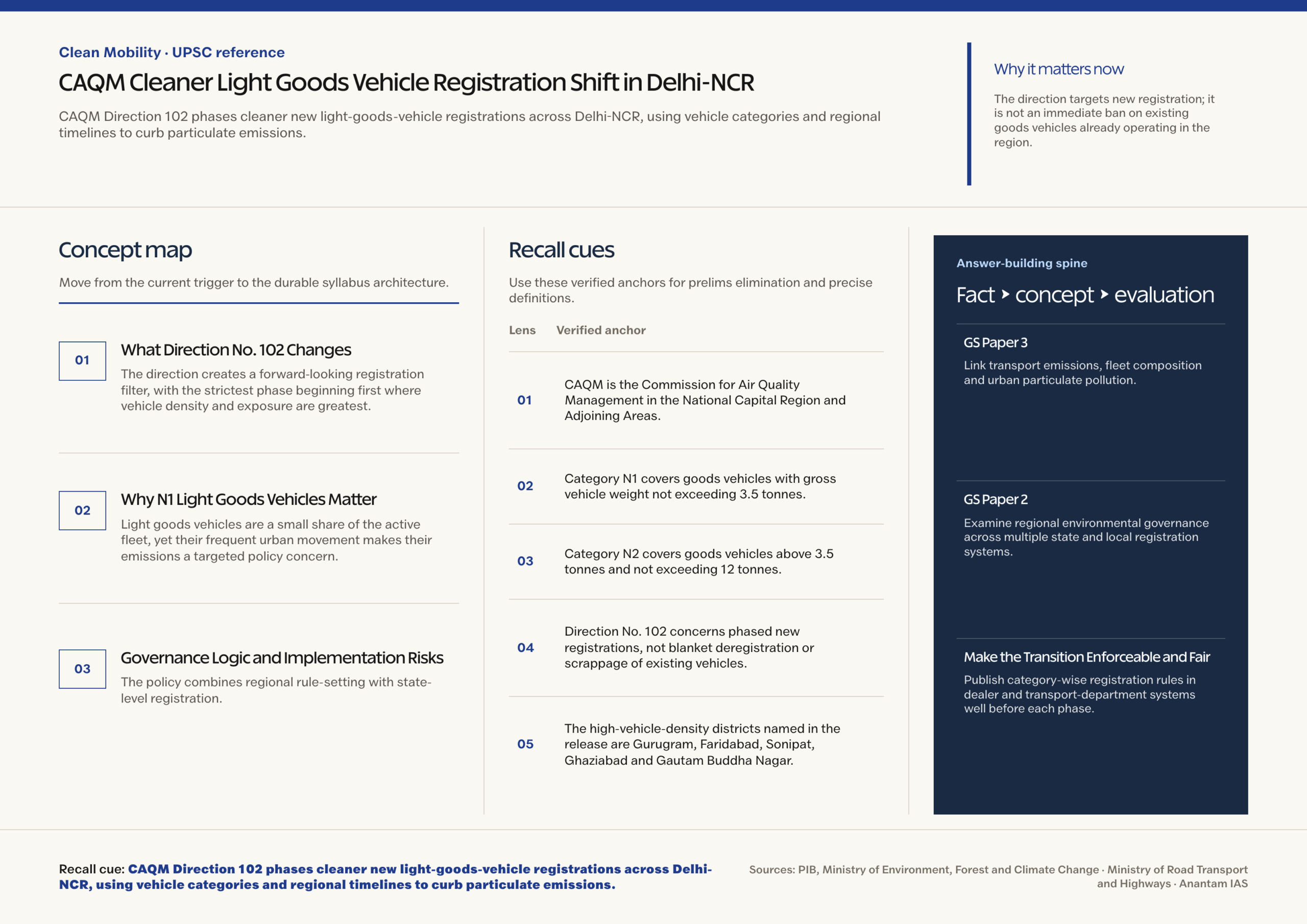
- CAQM is the Commission for Air Quality Management in the National Capital Region and Adjoining Areas.
- Category N1 covers goods vehicles with gross vehicle weight not exceeding 3.5 tonnes.
- Category N2 covers goods vehicles above 3.5 tonnes and not exceeding 12 tonnes.
- Direction No. 102 concerns phased new registrations, not blanket deregistration or scrappage of existing vehicles.
- The high-vehicle-density districts named in the release are Gurugram, Faridabad, Sonipat, Ghaziabad and Gautam Buddha Nagar.
Mains Relevance
GS Paper 3
- Link transport emissions, fleet composition and urban particulate pollution.
- Assess phased registration controls as a clean-mobility instrument alongside emission norms and public transport.
GS Paper 2
- Examine regional environmental governance across multiple state and local registration systems.
- Discuss how clear categories, lead time and monitoring affect regulatory compliance.
Essay
- Environmental transitions work best when regulation changes incentives predictably while protecting mobility and livelihoods during the shift.
Background and Context
What Direction No. 102 Changes
The direction creates a forward-looking registration filter, with the strictest phase beginning first where vehicle density and exposure are greatest.
- In Delhi, new diesel, petrol and CNG N1 registrations face restriction from 1 January 2027, giving buyers, dealers and freight operators advance notice.
- The same N1 fuel set is restricted from 1 July 2027 in Gurugram, Faridabad, Sonipat, Ghaziabad and Gautam Buddha Nagar, the listed high-density districts.
- Other NCR districts enter on 1 January 2028, but their first N1 phase covers diesel and petrol; the official release does not include CNG there.
- N2 registration restrictions start later: Delhi in January 2028, the five high-density districts in July 2028, and the remaining NCR in January 2029.
- The staggered sequence recognises differences in vehicle markets and charging or clean-fuel readiness while keeping one regional direction for the future fleet.
Why N1 Light Goods Vehicles Matter
Light goods vehicles are a small share of the active fleet, yet their frequent urban movement makes their emissions a targeted policy concern.
- PIB reports that LGVs form about 1.2% of active vehicles but contribute approximately 3.3% of particulate emissions from the active fleet.
- N1 is a technical classification, not a synonym for every small commercial vehicle: it covers goods vehicles with gross vehicle weight up to 3.5 tonnes.
- N2 covers goods vehicles above 3.5 tonnes and up to 12 tonnes, explaining why its transition begins after the lighter N1 segment.
- A registration restriction works at the entry point of the fleet: each affected new purchase must move toward an allowed cleaner mode rather than forcing one-day fleet replacement.
- Existing vehicles are not automatically cancelled by this direction, so near-term gains depend on fleet turnover, enforcement, replacement-vehicle performance and parallel controls on other urban emission sources.
Governance Logic and Implementation Risks
The policy combines regional rule-setting with state-level registration, creating both a coordination advantage and an enforcement challenge across NCR boundaries.
- CAQM supplies a common air-shed approach because pollution crosses administrative borders, while transport departments and registering authorities implement vehicle-entry rules within their jurisdictions.
- A phased calendar can reduce disruption for last-mile freight operators, but delayed availability of affordable compliant vehicles could raise delivery costs for small businesses.
- Different treatment of CNG outside the high-density districts requires precise software rules and dealer guidance; a simplified blanket-ban message would misstate the direction.
- Registration databases and permit records should distinguish N1 and N2 accurately, record propulsion type, and prevent circumvention through registration in a neighbouring district followed by regular NCR operation.
- The central exam trap is the distinction between new-fleet regulation and existing-fleet retirement: Direction 102 directly governs the former, not the latter.
Way Forward
Make the Transition Enforceable and Fair
- Publish category-wise registration rules in dealer and transport-department systems well before each phase, including the distinct CNG treatment in remaining NCR districts.
- Expand dependable charging and clean-fuel infrastructure along freight routes, markets and logistics hubs so compliance does not merely shift costs to small operators.
- Use interoperable registration and permit data across NCR to detect avoidance without creating duplicate paperwork for legitimate inter-state goods movement.
- Review fleet emissions and replacement affordability periodically, while changing timelines only through transparent, evidence-based orders rather than informal exemptions.
Conclusion
- Direction No. 102 is a phased clean-fleet rule: it changes which new N1 and N2 goods vehicles may enter the Delhi-NCR fleet at specified times.
- In an answer, connect air-shed governance with differentiated timelines, registration enforcement and transition support, while stating clearly that the direction does not immediately ban existing LGVs.
UPSC Practice Questions
Prelims MCQ 1
With reference to CAQM Direction No. 102, consider the following statements:
- It introduces phased restrictions on new registration of specified N1 and N2 light goods vehicles in Delhi-NCR.
- It immediately prohibits every existing diesel light goods vehicle from operating anywhere in NCR.
- Category N1 covers goods vehicles with gross vehicle weight not exceeding 3.5 tonnes.
How many of the above statements are correct?
(a) Only one (b) Only two (c) All three (d) None
Answer: (b) Only two
Explanation:
Statements 1 and 3 are correct. The direction regulates phased new registrations; the official release does not announce an immediate operating ban on every existing diesel LGV.
Prelims MCQ 2
Which one of the following correctly describes Category N2 under the motor-vehicle classification?
(a) Goods vehicles not exceeding 3.5 tonnes (b) Passenger vehicles with more than eight seats (c) Goods vehicles above 3.5 tonnes and not exceeding 12 tonnes (d) Goods vehicles exceeding 12 tonnes only
Answer: (c) Goods vehicles above 3.5 tonnes and not exceeding 12 tonnes
Explanation:
Category N2 covers goods vehicles with gross vehicle weight above 3.5 tonnes and not exceeding 12 tonnes; N1 is the category up to 3.5 tonnes.
UPSC Mains Questions
- Explain how phased restrictions on new light-goods-vehicle registrations can support air-quality management while limiting disruption to urban freight and small businesses.
- CAQM illustrates both the need and the difficulty of air-shed governance in a multi-state metropolitan region. Discuss with reference to clean-mobility regulation.
Sources: PIB, Ministry of Environment, Forest and Climate Change and Ministry of Road Transport and Highways.
Frequently Asked Questions
What did CAQM Direction No. 102 approve?
It approved phased restrictions on new registrations of specified N1 and N2 light goods vehicles across Delhi, high-density NCR districts and the remaining NCR.
Does Direction No. 102 ban existing light goods vehicles immediately?
No. The PIB release describes restrictions on new registration. It does not announce immediate cancellation of registrations or a blanket operating ban on the existing LGV fleet.
What is an N1 goods vehicle?
N1 is a motor vehicle used to carry goods with gross vehicle weight not exceeding 3.5 tonnes. The category is defined by vehicle use and weight.
Why has CAQM used different implementation dates?
The sequence starts with Delhi, then listed high-density districts, and later the remaining NCR, allowing a region-wide transition while accounting for differing market and infrastructure readiness.
How is this different from CAQM’s drone-based stubble monitoring?
Drone monitoring concerns detection of crop-residue-burning hotspots. Direction No. 102 instead changes the entry of specified new goods vehicles into the Delhi-NCR fleet.