CAQM Sub-Committee revokes Stage-III of revised GRAP across NCR
Why in News?
The highest emergency controls under the revised GRAP were withdrawn across the NCR after air-quality and meteorological forecasts indicated improvement. The move affects restrictions, enforcement posture, public health advisories and administrative coordination between the Centre and states.
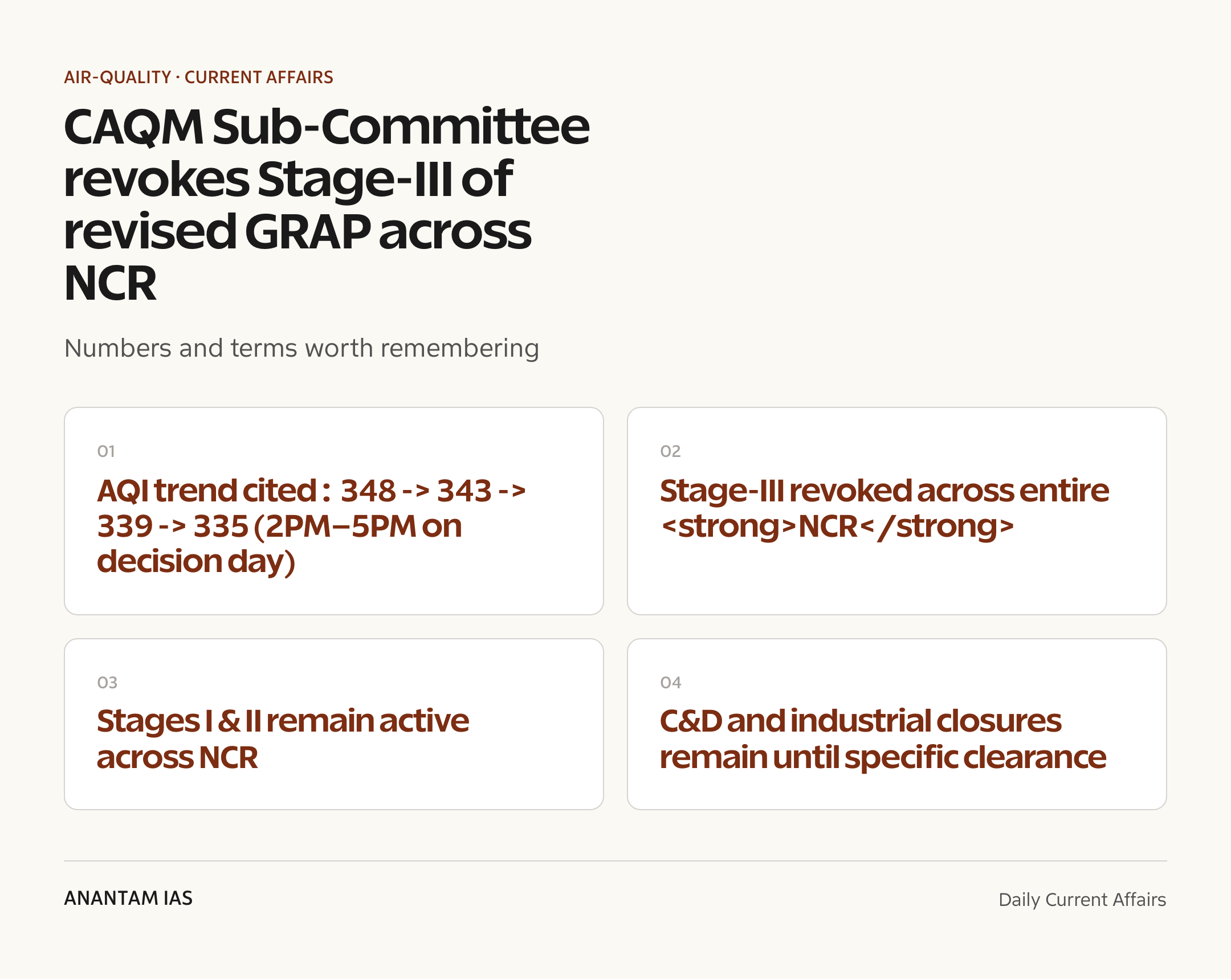
- CAQM Sub-Committee revoked all actions under Stage-III of the revised GRAP in the entire NCR with immediate effect.
- Decision based on recent AQI improvements in Delhi (sample readings: 348 at 2PM to 335 at 5PM on the day) and forecasts from IMD and IITM.
- All measures under Stage-II and Stage-I remain active and must be intensified to avoid re-imposition of Stage-III.
- Closure orders issued to specific C&D sites and industrial units for non-compliance remain in force until explicit clearance from the Commission.
- Public urged to follow the Citizen Charter under Stages I and II during the ongoing winter season when conditions may quickly worsen.
The development matters in the context of:
- GRAP structure: The revised Graded Response Action Plan is a set of pre-defined stages with targeted actions to manage air pollution in NCR. Stages escalate from advisory measures to stringent emergency controls.
- Stage-III triggers: Stage-III typically involves strict restrictions on vehicular movement, closure of major non-essential services, and suspension of construction to rapidly reduce emissions.
- Institutional role: The Commission for Air Quality Management (CAQM) sets region-wide directives; the Sub-Committee on GRAP operationalises stage decisions using inputs from CPCB, IMD, IITM and local agencies.
- Operational data: The CAQM Sub-Committee relied on near-real-time AQI bulletins and short-term forecasts indicating a downward trend and expected stabilization in the lower Very Poor / Poor bands.
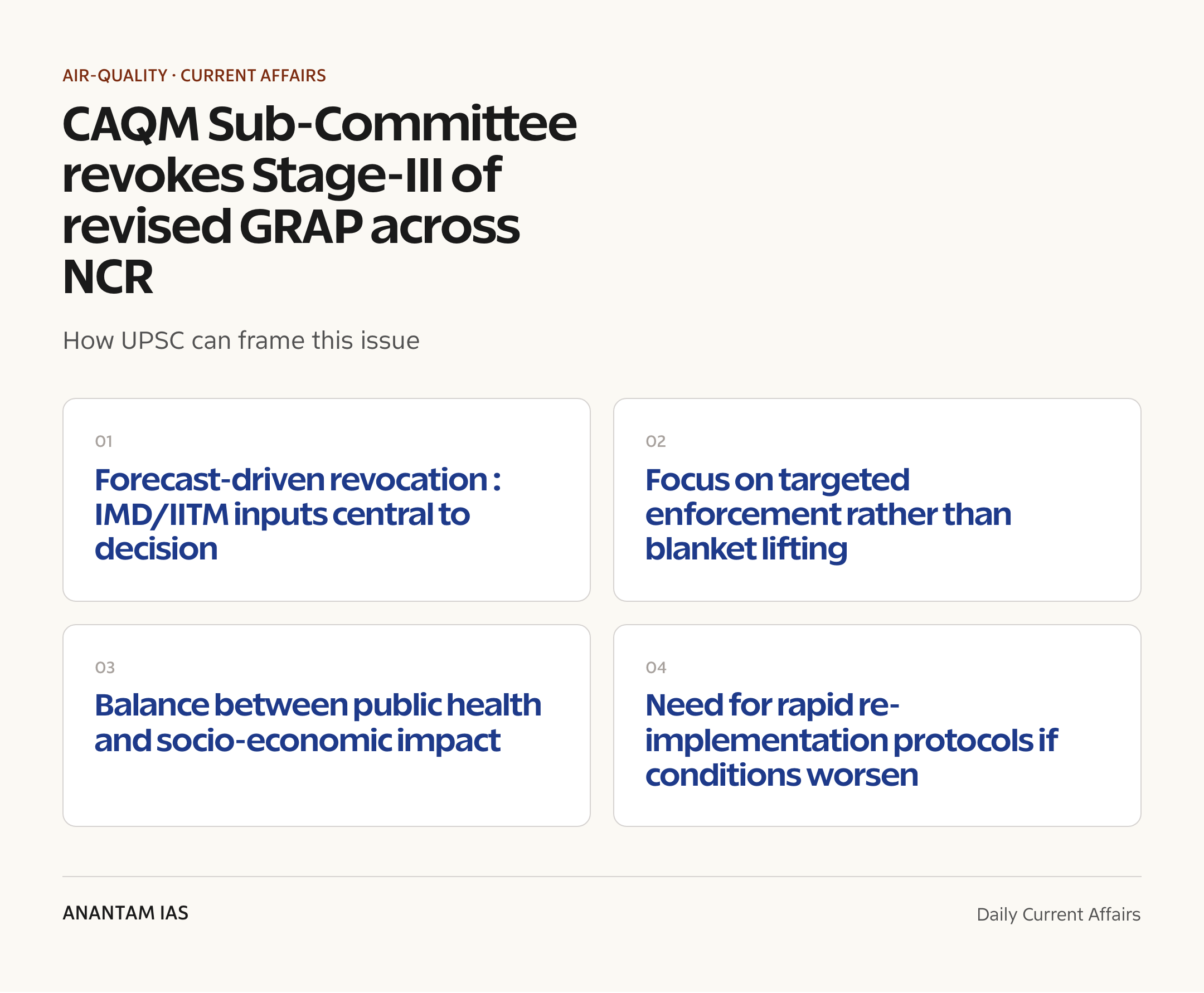
- Policy balance: Authorities weigh public-health benefits of restrictions against socio-economic disruption to stakeholders such as transport, construction, logistics and small businesses.
- Enforcement nuance: Revocation of Stage-III does not mean removal of all controls. Targeted orders for non-compliant units remain and local agencies must keep preparedness for rapid re-imposition.
- Seasonal risk: Winter meteorology in north India, including temperature inversions and low wind speeds, can cause rapid deterioration, creating the need for continuous monitoring and forecast-driven decisions.

UPSC Relevance
Prelims Relevance
- Definition and stages of the Graded Response Action Plan are factual items relevant for prelims.
- Roles of CAQM, CPCB, IMD and IITM in air-quality management are directly examinable.
- Key AQI categories and corresponding health advisories form objective-type content for prelims.
Mains Relevance
GS3 Environment
- Policy evaluation topic: trade-offs between public-health protection and economic disruption from emergency pollution controls.
- Governance topic: coordination challenges between central commissions and state/local agencies during environmental emergencies.
- Science-policy linkage: use of meteorological and air-quality forecast models (IMD/IITM) in real-time decision making.
Essay
- Environmental governance and public health: the event can be used to discuss preparedness, institutional design and response frameworks.
- Urban air pollution and sustainable development: trade-offs in enforcement, livelihoods and long-term emission reduction strategies.
Background and Context
What is GRAP and why it exists
GRAP is a staged action plan designed to manage acute air-quality episodes in NCR through graduated measures.
- GRAP stands for Graded Response Action Plan and includes a set of prescribed actions triggered by AQI thresholds.
- It aims to reduce population exposure quickly during high-pollution episodes by controlling key emission sectors.
- The plan links health-based AQI categories to operational responses such as advisories, traffic restrictions and construction bans.
- GRAP’s staged design allows authorities to scale interventions in line with observed and forecast air quality, reducing arbitrary measures.
- Revisions to GRAP over time have added new trigger metrics, clarified roles of agencies and incorporated forecast information.
Institutional architecture behind the decision
Multiple agencies provide data, legal authority and on-ground enforcement for air-quality actions in NCR.
- CAQM (Commission for Air Quality Management) has the mandate to oversee air quality in NCR and adjoining areas with powers to issue binding directions.
- CPCB supplies the continuous AQI monitoring and technical analysis that feeds stage decisions.
- IMD and IITM provide meteorological and air-quality forecast data critical for short-term planning.
- State pollution control boards and municipal agencies execute closures, enforce construction bans and manage traffic measures at local level.
- A Sub-Committee on GRAP within CAQM operationalises the plan by reviewing real-time AQI and model forecasts to trigger or revoke stages.
Stage-III actions in practice
Stage-III is the high-intensity emergency tier aimed at rapidly reducing emissions sources.
- Typical Stage-III measures include closure of non-essential offices, restrictions on non-essential vehicular movement and banning diesel generator use except for essentials.
- Large-scale construction and demolition activities are halted, and industrial operations may be curtailed if they exceed prescribed limits.
- Public transport is often expanded to reduce private vehicle use during severe episodes, but movement restrictions can still impact commuters.
- Stage-III orders have significant socio-economic costs, affecting workers at construction sites, small businesses and logistics chains.
- Because of disruption, authorities prefer short, targeted Stage-III periods supported by accurate forecasts to avoid prolonged hardship.
AQI metrics and forecast role
Decisions pivot on current AQI and short-term forecasts that predict how pollution will evolve under prevailing meteorology.
- AQI is an aggregate indicator derived from concentrations of PM2.5, PM10, NO2, SO2, CO, O3 and other pollutants measured at monitoring stations.
- PM2.5 is often the dominant pollutant driving health risks and stage triggers in NCR winter episodes.
- Forecasts from IMD and IITM model the interplay of emissions and weather (wind, temperature inversion, boundary layer) to predict AQI over 1-5 days.
- Forecast confidence influences whether authorities escalate to Stage-III or rely on Stage-II measures combined with advisories.
- Near-real-time monitoring allows authorities to track trends and revoke or reinstate stages quickly when conditions change.
Legal and compliance considerations
Revocation or imposition of GRAP stages interacts with existing environmental laws and administrative orders.
- CAQM directions under GRAP are binding and complement state pollution-control directives and municipal rules.
- Specific closure orders for violative industrial units and C&D sites are independent and remain in force until formally withdrawn.
- Non-compliance attracts penalties under the Environment Protection Act and related statutes, with enforcement by state and central agencies.
- Clear criteria for revocation reduce legal challenges by demonstrating reliance on monitored data and forecasts.
- Transparency in decision rationale and timelines for review can improve compliance and public trust.
Public-health implications of revoking Stage-III
Lifting emergency restrictions reduces disruption but carries risk if pollution rebounds rapidly.
- Stage-III reduces exposure significantly in the short term, lowering acute health events tied to high PM2.5 and other pollutants.
- Revocation transfers responsibility to Stages I and II measures and personal protective actions like masks and limiting outdoor exposure.
- Vulnerable groups such as children, elderly and people with respiratory conditions remain at higher risk even at Very Poor AQI.
- Timely communication about the change and continued advisories are essential to avoid behavioral complacency.
- Ready thresholds and trigger criteria help ensure quick re-implementation of Stage-III if forecasts or observations worsen.
Way Forward
Strengthen forecast-driven decision making
- Integrate ensemble forecasts from IMD, IITM and independent models to increase confidence in short-term AQI outlooks.
- Publish probabilistic forecasts and decision thresholds publicly to justify stage changes and improve transparency.
- Use trigger matrices that combine observed AQI trends, emissions indicators and meteorological forecasts to guide actions.
- Invest in data assimilation and real-time model verification to reduce false positives and negatives in stage imposition.
Improve targeted mitigation to reduce disruption
- Prioritise sector-specific controls (construction dust, heavy-duty diesel vehicles, brick kilns) during Stage-II to avoid blanket Stage-III.
- Promote rapid dust suppression measures, wheel-washing and site-enclosure for construction to lower emissions without full closures.
- Expand incentives and short-term compensation mechanisms for affected informal workers when high-stage restrictions are necessary.
- Establish pre-cleared essential-service exceptions with monitoring to keep critical supply chains moving while reducing emissions.
Enhance enforcement and compliance clarity
- Maintain public registers of units under closure orders with criteria for reopening to prevent premature resumptions.
- Standardise enforcement protocols across NCR municipalities to avoid regulatory arbitrage and uneven compliance.
- Use satellite and remote-sensing tools to detect non-compliant activities like unpermitted burning or large dust plumes.
- Set review timelines and publish compliance audit results to increase accountability and public confidence.
Public communication and health preparedness
- Issue clear, actionable health advisories tied to AQI categories and stages to guide the public and vulnerable groups.
- Strengthen school and workplace protocols for rapid transitions between stages, including virtual alternatives during Stage-III.
- Run awareness campaigns on sustained pollution reduction measures like vehicle pooling and reduced burning of waste.
- Coordinate with health services for surveillance of pollution-linked morbidity to assess effectiveness of staged actions.
Conclusion
The CAQM Sub-Committee’s revocation of Stage-III reflects careful use of observed AQI trends and meteorological forecasts to balance public-health protection and socio-economic disruption. Sustained gains will depend on stronger forecast integration, targeted mitigation during Stages I and II, uniform enforcement, and clear communication to keep the NCR ready for swift re-implementation if conditions deteriorate.
UPSC Practice Questions
Prelims MCQ 1
Which body is primarily responsible for issuing region-wide directions for air quality management in the National Capital Region and adjoining areas?
(a) Central Pollution Control Board (CPCB) (b) Commission for Air Quality Management (CAQM) (c) Ministry of Environment, Forest and Climate Change (MoEFCC) (d) Indian Meteorological Department (IMD)
Answer: (b) Commission for Air Quality Management (CAQM)
Explanation:
CAQM is the statutory commission established to oversee air quality in NCR and adjoining areas and to issue binding directions. CPCB provides monitoring data and technical inputs, while IMD supplies meteorological forecasts.
Prelims MCQ 2
Under the Graded Response Action Plan, which pollutant is most commonly used as the key driver for emergency stage triggers in northern India winter episodes?
(a) Ozone (O3) (b) Sulfur dioxide (SO2) (c) Particulate matter (PM2.5) (d) Carbon monoxide (CO)
Answer: (c) Particulate matter (PM2.5)
Explanation:
PM2.5 poses the greatest short-term health risk during winter episodes in north India and often determines AQI categories that trigger emergency measures under GRAP.
UPSC Mains Questions
- {‘question’: ‘Examine the trade-offs involved in imposing Stage-III emergency pollution controls under GRAP. In your answer, discuss public-health benefits, economic and social costs, and how governance frameworks can reduce these trade-offs.’, ‘model_answer’: ‘Imposing Stage-III reduces population exposure rapidly, lowering acute respiratory and cardiovascular events linked to high PM2.5. Life-years and hospitalisations avoided constitute major public-health benefits. Economic and social costs include loss of livelihoods for construction workers, disruption to logistics and small businesses, and increased administrative burden. The disproportionate impact on informal sector workers raises equity concerns. Governance frameworks can reduce trade-offs by using accurate forecasts to limit duration of Stage-III, employing targeted measures focused on high-emission activities, providing compensation or social protection for affected workers, and ensuring transparent criteria for decisions. Coordination among CAQM, state agencies and municipalities can standardise enforcement, while pre-planned essential-service exceptions and monitoring lower collateral harm. Long-term reductions in baseline emissions through cleaner fuels, public-transport investments and industrial upgradation reduce the frequency of emergency stages.’}
- {‘question’: ‘Assess the role of meteorological forecasting in operational air-quality management for urban regions. How can forecasts be integrated to make GRAP decisions more effective?’, ‘model_answer’: ‘Meteorological forecasting is central to predicting dispersion, boundary-layer dynamics and formation of pollution episodes, thereby enabling proactive actions. Forecasts allow authorities to anticipate episodes and implement pre-emptive controls to avoid escalation. To integrate forecasts effectively, agencies should harmonise model outputs from IMD, IITM and independent centres using ensemble approaches to quantify uncertainty. Decision protocols should use probabilistic thresholds rather than single deterministic values so that action is proportionate to forecast confidence. Real-time verification of forecast skill and post-event assessment can refine trigger criteria. Communication of forecast-based advisories to local enforcement units and the public shortens response times. Investing in high-resolution urban meteorological networks and data assimilation improves local forecast accuracy, making GRAP decisions more targeted and less disruptive.’}
Source: PIB, Ministry of Environment, Forest and Climate Change.
Frequently Asked Questions
q
a
q
a
q
a
q
a
q
a
q
a