Credit-deposit gap: why banks are turning to costly funds
Why in News?
The Reserve Bank of India’s latest Financial Safety Report flagged bank funding as an emerging challenge, warning that the liability profile is shifting from low-cost CASA (Current Account and Savings Account) deposits to costlier term deposits and certificates of deposit, pushing up the marginal cost of funds.
The gap between credit growth and deposit growth widened sharply through the first half of 2026, forcing banks to lean on price-sensitive wholesale money to keep funding a strong credit pipeline.
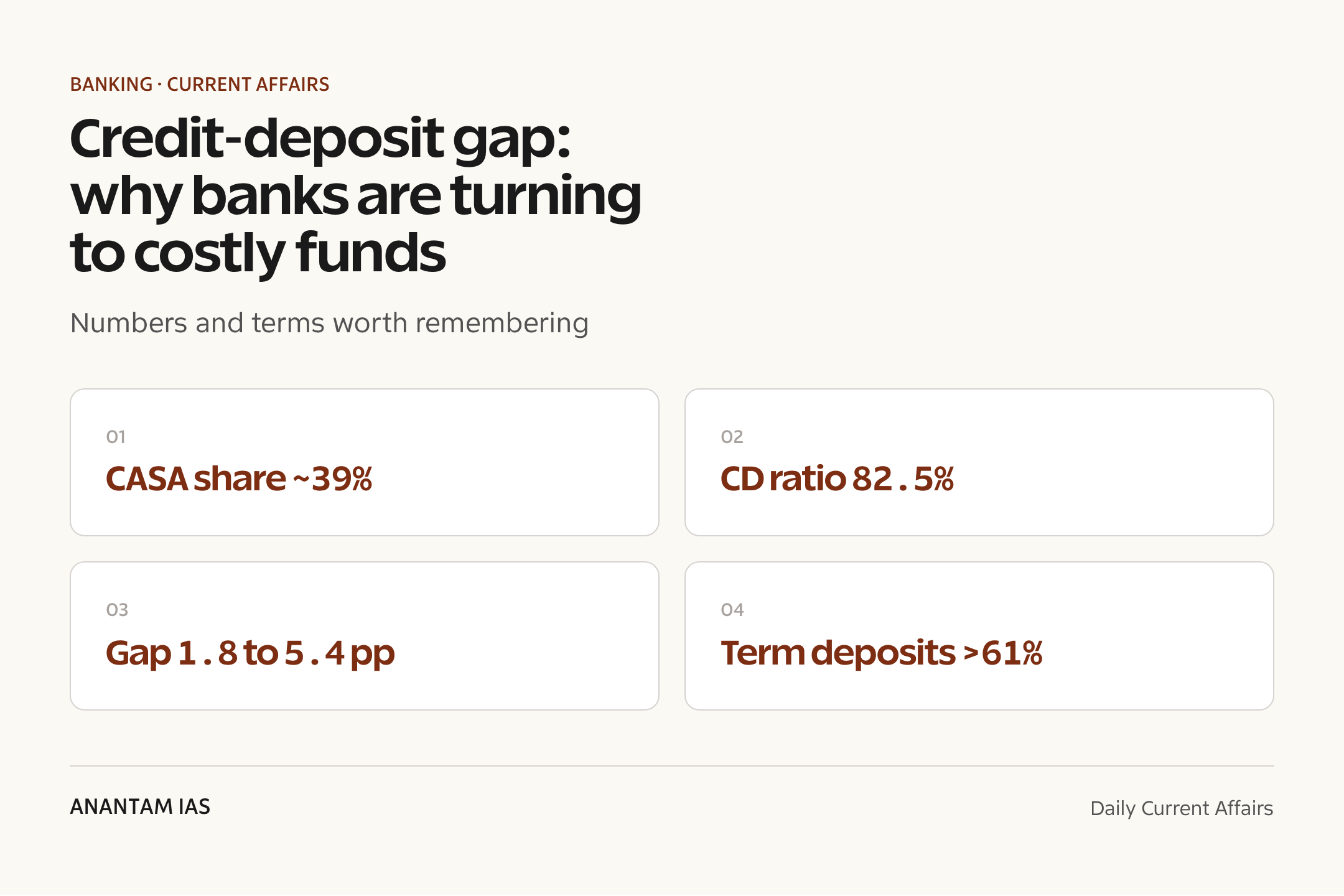
- The credit-deposit growth gap widened from 1.8 percentage points in December to 5.4 percentage points as of June 15, per RBI data.
- The system credit-to-deposit ratio rose to 82.5% (June 15) from about 75% in mid-2025.
- The share of CASA in total deposits fell to about 39% from a peak of near 44% in FY22.
- Term deposits’ share climbed to an all-time high above 61%, up from around 56% in FY23.
- CASA carries roughly 3-4% interest for banks; term deposits and CDs cost 7-8%.
- RBI’s Financial Safety Report flagged that term-deposit growth ‘continued to outpace’ CASA, signalling a sustained saver preference for interest-bearing money.
The development matters in the context of:
- Deposits are the cheapest, most stable funding base of a bank; a thinning low-cost base directly threatens net interest margins and lending capacity.
- The stress tests the durability of India’s credit boom and the reach of RBI’s monetary transmission.
- Liability quality is emerging as the key competitive moat when asset quality across banks looks broadly similar.
UPSC Relevance
Prelims Relevance
- CASA = Current Account + Savings Account deposits; low-cost, low-interest, ‘sticky’ funds
- Credit-Deposit (CD) ratio = share of deposits deployed as loans; ~82.5% (June 2026)
- Certificate of Deposit (CD) = negotiable money-market term instrument for corporates/institutions
- Term (time) deposit = money locked for a fixed tenure; includes FDs and recurring deposits
- Net Interest Margin (NIM) = (interest earned – interest paid) / average earning assets
- Repo rate cut by 125 basis points in 2025; anchors the rate structure
- FCNR(B) = Foreign Currency Non-Resident (Bank) deposits, classified as term deposits
- Marginal cost of funds underlies the MCLR lending-rate benchmark
- LCR (Liquidity Coverage Ratio), CRR and SLR shape a bank’s liquidity buffers
- EBLR (External Benchmark Lending Rate) links loans to the repo rate
Mains Relevance
GS Paper 3
- Examine how a widening credit-deposit gap and shrinking CASA base affect banks’ cost of funds, margins and lending rates.
- Discuss the role of deposit mobilisation and financial inclusion in a stable banking liability structure.
GS Paper 3
- Analyse RBI’s tools – repo rate, liquidity operations, CRR/SLR, LCR – for managing bank funding stress and monetary transmission.
Essay
- Savings behaviour and the financialisation of household wealth in a growing economy.
- Stability versus growth: the trade-offs in funding a credit-hungry economy.
Background and Context
What CASA deposits are and why they are prized
CASA is the cheapest and most stable slice of a bank’s funding.
- Current accounts – used by businesses and traders for high-frequency transactions – usually earn no interest, since the depositor values liquidity over yield.
- Savings accounts pay only a small administered rate, so the blended CASA cost to a bank is roughly 3-4% – well below any market-linked instrument.
- CASA is treated as ‘sticky’ money: churn is low because households and firms rarely move their primary current or savings balance to a rival bank over a marginal rate difference.
- Low cost plus stickiness lets a bank fund longer-tenure loans – its main revenue source – at a healthy spread, matching short-term liabilities against long-term assets with less rollover worry.
- A higher CASA ratio generally signals franchise strength: it widens the net interest margin, cushions rate shocks, and keeps credit cheaper for borrowers.
The credit-deposit ratio and why ~75% is the comfort zone
The CD ratio measures how much of every rupee of deposits a bank has lent out.
- The credit-to-deposit (CD) ratio is loans as a percentage of deposits; a reading of 82.5% means Rs 82.5 of every Rs 100 of deposits is deployed as credit.
- A ratio in the 70-75% band is generally seen as comfortable – it leaves a cushion once banks set aside statutory reserves and hold liquidity buffers.
- Banks must first park funds against the CRR (Cash Reserve Ratio) and SLR (Statutory Liquidity Ratio), so not every deposit rupee is even lendable.
- A high CD ratio squeezes profits once operational, marketing and funding costs are counted, and leaves thin headroom to grow loans without raising fresh, costlier money.
- The jump from about 75% to 82.5% within a year is the clearest signal that credit has outrun the deposit base funding it.
Why the credit-deposit gap widened
Loans are growing faster than the deposits meant to fund them.
- Credit growth picked up over recent months on the back of retail, MSME and personal lending, but deposit growth failed to keep pace, per RBI data cited by The Indian Express.
- The growth gap stretched from 1.8 percentage points in December to 5.4 percentage points by June 15 – a threefold widening in six months.
- The system credit-to-deposit ratio climbed to 82.5% from roughly 75% a year earlier, per RBI.
- The mismatch is not a one-bank story: it is a system-wide divergence that forces every lender to compete harder for the same shrinking pool of deposits.
- When banks bid up deposit rates to close the gap, they import the very cost pressure that erodes their margins.
The savings shift: financialisation of household wealth
Households now have richer, easier alternatives to a plain savings account.
- Retail savers are moving money into equities, mutual funds (via SIPs) and higher-yield fixed deposits that comfortably beat CASA returns.
- Digitisation and the simplification of regulatory norms have made these avenues far more accessible – a smartphone now opens a demat or MF account in minutes.
- This is a structural financialisation of savings: as incomes rise and trust in markets grows, households hold less idle cash in low-yield accounts.
- RBI’s report noted term-deposit growth ‘continued to outpace’ CASA, showing a sustained preference for interest-bearing deposits.
- The 5-year average share of CASA in incremental deposits is 40.2%, but it slid to 21% / 23% / 33% in FY24 / FY25 / FY26, per Equirus Securities – CASA has been under pressure for three straight years.
Term deposits and CDs: the costlier fix
Banks are plugging the gap with pricier, more volatile funds.
- A term (time) deposit locks money for a fixed tenure in return for interest – fixed and recurring deposits are the retail versions.
- A Certificate of Deposit (CD) is a negotiable money-market instrument corporates and institutions use to raise short-duration money; banks lean on CDs to manage near-term liquidity.
- CASA’s share of total deposits fell to about 39% from a 44% FY22 peak, while term deposits touched a record above 61% from about 56% in FY23.
- RBI’s push to attract foreign inflows led banks to aggressively hike rates on FCNR(B) offerings, which sit under term deposits and add to the higher-cost pile.
- Analysts note CDs are wholesale, price-sensitive money with 3-12 month tenors; in a tight-liquidity phase, rollover costs can spike quickly, unlike granular retail CASA.
Cost of funds and the net interest margin squeeze
Costlier liabilities are starting to bite into profitability.
- Term deposits and CDs cost banks about 7-8% against CASA’s 3-4%, so each rupee that shifts from CASA to term money lifts the marginal cost of funds.
- A rising cost of funds directly compresses the net interest margin (NIM) – the spread between what a bank earns on loans and pays on deposits, relative to earning assets.
- Large lenders including SBI, HDFC Bank and Canara Bank saw NIMs slip in the January-March quarter as the shift began to seep through.
- The blow is cushioned for now by the low-rate cycle after RBI cut the repo rate by 125 basis points in 2025, letting banks pay depositors less across the board.
- CDs and bulk term deposits reprice downward fastest, so wholesale reliance is ‘cheapest to carry precisely now’ – but the risk flips the moment the rate cycle turns upward.
- Analysts expect the full impact of higher bulk-deposit costs to flow into cost of funds during the second half of FY27.
RBI's liquidity toolkit and monetary transmission
How the deposit squeeze tests the passage of RBI’s rate signals to borrowers.
- The repo rate is RBI’s policy anchor; its 125 bps cut in 2025 influences interest rates across the entire banking system.
- RBI manages day-to-day liquidity through VRR (Variable Rate Repo) injections and VRRR (Variable Rate Reverse Repo) absorptions, alongside the CRR and SLR that set reserve requirements.
- The Liquidity Coverage Ratio (LCR) obliges banks to hold enough high-quality liquid assets to survive a 30-day stress run, shaping how aggressively they can chase loans.
- Most floating-rate loans are now linked to the EBLR (repo-linked), while older loans track the MCLR, which moves with the marginal cost of funds.
- A rising cost of funds slows the pass-through of repo cuts into MCLR-linked lending rates, testing how cleanly monetary transmission reaches borrowers.
Systemic risk: cyclical squeeze or structural shift?
Experts read the CASA squeeze mainly as a liquidity cycle, not a permanent break.
- Analysts view the slowdown as largely cyclical, tied to overall system liquidity after the post-Covid boom faded.
- The post-pandemic surge in CASA came from RBI’s easy-liquidity steps during Covid; that flush is now unwinding as policy normalises.
- With asset quality broadly similar across banks, a strong liability franchise – granular, low-cost, sticky deposits – is becoming the key competitive moat in Indian banking.
- The tail risk is real: a fresh RBI rate hike or an external shock could hit the sector hard if reliance on short-term wholesale funds is high and CASA growth has not revived.
- The financialisation of savings, though, has a structural element – as households keep migrating to markets, banks may never fully recover the CASA shares of the easy-money years.
Way Forward
Rebuild the low-cost deposit base
- Deepen financial inclusion and anchor salary, pension and transaction relationships to grow granular CASA rather than chasing bulk money.
- Compete on service, digital experience and branch-plus-app reach – the ‘liability franchise’ moat – not only on headline rates.
- Use targeted products for underbanked and rural savers to widen the deposit funnel that markets and mutual funds do not yet fully reach.
Manage funding and liquidity prudently
- Cap over-reliance on short-tenor CDs and bulk deposits that can reprice sharply when liquidity tightens.
- Use the current low-rate window to lock in stable, longer-duration funding and protect net interest margins before the cycle turns.
- Strengthen asset-liability management so that LCR buffers and deposit maturities are matched to the loan book’s tenure profile.
Policy and monetary transmission
- RBI can calibrate liquidity operations (VRR/VRRR), CRR and LCR settings to ease genuine funding stress without fuelling risky lending.
- Guard monetary transmission so that repo-rate signals reach borrowers even as banks’ cost of funds shifts upward.
- Continue monitoring the credit-deposit ratio as a system-stability metric, so that credit growth stays anchored to a durable deposit base.
Conclusion
The widening credit-deposit gap and the drift from CASA to term deposits mark a quiet but consequential shift in how Indian banks fund themselves. Cheap, sticky savings are giving way to costlier, price-sensitive money, and the buffer of a low-rate cycle is doing much of the work in keeping margins intact for now.
Part of this is cyclical – a hangover from the post-Covid liquidity surge that is unwinding. But part is structural: as households financialise their savings into equities, mutual funds and higher-yield deposits, the era of abundant, near-free CASA may not fully return. Liability franchise quality, not asset quality, is becoming the moat that separates strong banks from the rest.
The over-reliance on temporary wholesale fixes is a double-edged sword. It funds today’s credit boom, but a rate hike or an external shock could expose the sector if CASA growth is not revived. Rebuilding a stable, low-cost deposit base – through inclusion, trust and service – is the durable answer, and keeping the credit-deposit ratio in check is the discipline that protects both margins and monetary transmission.
UPSC Practice Questions
Prelims MCQ 1
With reference to CASA deposits in the Indian banking system, consider the following statements:
- CASA deposits are typically a higher-cost source of funds than certificates of deposit.
- Current account and savings account balances are considered relatively ‘sticky’ funds for banks.
- A rising share of CASA in total deposits tends to support a bank’s net interest margin.
How many of the above statements are correct?
(a) Only one (b) Only two (c) All three (d) None
Answer: (b) Only two
Explanation:
Statement 1 is wrong: CASA (~3-4%) is cheaper than CDs/term deposits (~7-8%). Statements 2 and 3 are correct – CASA is sticky and a higher CASA share widens NIM.
Prelims MCQ 2
The credit-to-deposit (CD) ratio of a bank indicates:
(a) The share of a bank’s deposits that has been deployed as loans (b) The ratio of a bank’s cash reserves to its total liabilities (c) The proportion of low-cost deposits in total deposits (d) The gap between the repo rate and the reverse repo rate
Answer: (a) The share of a bank's deposits that has been deployed as loans
Explanation:
The CD ratio is loans as a percentage of deposits; a ratio of 82.5% means Rs 82.5 of every Rs 100 of deposits is lent out.
UPSC Mains Questions
- The share of low-cost CASA deposits in Indian banks has fallen even as credit growth outpaces deposit growth. Examine the implications for banks’ cost of funds, net interest margins and lending rates, and suggest measures to rebuild a stable deposit base. (250 words)
- “Liability franchise quality is becoming the key competitive moat in Indian banking.” Discuss the causes of the current deposit-mobilisation challenge and the role of RBI’s liquidity and monetary-policy tools in addressing it. (250 words)
Sources: Reserve Bank of India and The Indian Express (Explained).
Frequently Asked Questions
What are CASA deposits?
CASA stands for Current Account and Savings Account deposits. Current accounts (used mainly by businesses) usually pay no interest, and savings accounts pay a small rate, so CASA is a low-cost source of funds for banks – roughly 3-4%. Because depositors rarely move these balances, CASA is also considered stable or ‘sticky’ money.
Why is the credit-deposit gap a concern?
When loans grow faster than deposits, banks have less low-cost funding to support lending. The growth gap widened from 1.8 percentage points in December to 5.4 percentage points by June 15, 2026, per RBI data. Banks then turn to costlier term deposits and certificates of deposit, which raises their cost of funds and squeezes profits.
What is the credit-to-deposit ratio?
It is the percentage of a bank’s deposits deployed as loans. A ratio of 82.5% means that for every Rs 100 of deposits, about Rs 82.5 is lent out. The system ratio rose to 82.5% by June 15, 2026, from around 75% a year earlier, leaving banks with thinner headroom to lend.
How do term deposits and CDs differ from CASA?
Term deposits lock money for a fixed tenure in return for interest, and include retail fixed and recurring deposits. A certificate of deposit is a money-market term instrument used by corporates and institutions. Both cost banks more – about 7-8% – and CDs are price-sensitive wholesale money whose rollover costs can spike when liquidity is tight.
How does this affect net interest margins?
Net interest margin is the gap between interest a bank earns on loans and interest it pays on deposits, relative to earning assets. Replacing cheap CASA with 7-8% term deposits and CDs raises funding costs and narrows margins. Large lenders including SBI, HDFC Bank and Canara Bank saw NIMs fall in the January-March 2026 quarter.
Is the CASA slowdown structural or cyclical?
Analysts see it as largely cyclical, linked to overall system liquidity after the post-Covid boom faded. Savers are also shifting to stocks, mutual funds and higher-yield deposits made easier by digitisation. The low-rate cycle, after RBI’s 125-basis-point repo cut in 2025, is cushioning the impact – but the risk rises if rates turn or an external shock hits.