Moth Bean Resilience: Developmental Plasticity Under Moisture Stress
Why in News?
On 13 September 2026, ICAR-CAZRI reported that its moth bean varieties maintained growth and pod development during an approximately 35-day dry spell in Kharif 2026.
- CAZRI Moth-4, Moth-5, Moth-6 and Moth-7 were released during the preceding three years; the fresh development is their reported field performance.
- The moisture deficit overlapped with flowering and pod formation, making continued reproductive development the significant observation.
- The report also records scattered light rainfall; a prolonged dry spell should not be described as complete absence of rain.
- Rainfed farming depends on rainfall timing and stored soil moisture, not merely the seasonal rainfall total.
- Variety selection and crop management must work together if promising breeding traits are to support dependable farm production.
UPSC Relevance
Prelims Relevance
- Moth bean: a pulse crop of the hot arid regions of western Rajasthan.
- ICAR-CAZRI: Central Arid Zone Research Institute, Jodhpur.
- Developmental plasticity: flexibility in growth and maturity in response to available soil moisture.
- Subsurface soil moisture: water below the surface layer that can continue contributing to crop requirements.
- Field resilience: continued growth under stress does not by itself establish a comparative harvested-yield advantage.
Mains Relevance
GS Paper 3
- Climate-resilient agriculture: combine locally suited varieties with moisture conservation.
- Research extension: distinguish promising crop observations from demonstrated farm-level productivity gains.
Essay
- Adaptation: resilience emerges from living systems and practical management working together.
Background and Context
Why moth bean matters in arid farming
Moth bean illustrates how a locally suited pulse can remain productive in principle when rainfall is uncertain, provided usable moisture remains available.
- Moth bean is an important pulse of western Rajasthan. Its agricultural relevance comes from cultivation under hot, arid conditions where uncertain rainfall and limited soil moisture constrain the crop throughout its growth.
- ICAR-CAZRI, Jodhpur developed the reported varieties through a breeding and genetic improvement programme focused on adaptation. The September announcement concerns their recent performance, rather than the immediate release of a new cultivar.
- The central observation was continued vegetative growth and pod development during moisture stress. This is more informative than green appearance alone because it also describes progress through reproductive stages of the crop.
- The reported dry spell lasted around 35 days, with small scattered rainfall events. Use that description carefully: low rainfall, moisture stress and a completely rainless period are not interchangeable claims about field conditions.
- The crop established with early-season rainfall before the prolonged deficit. Its later performance must be understood against that starting condition; the account does not describe seed germination and growth without any available water.
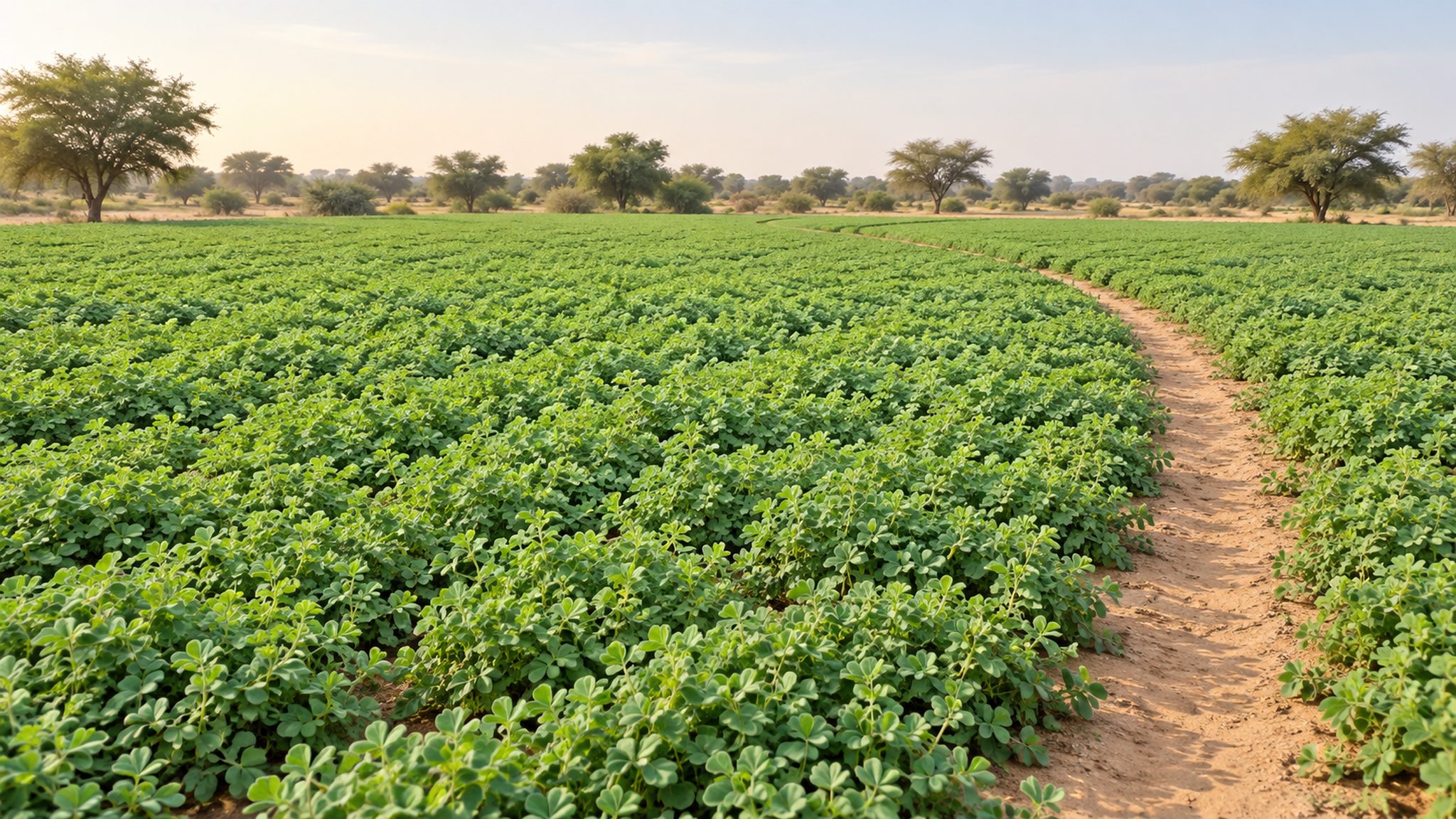
How developmental plasticity and stored moisture interact
Developmental plasticity describes flexible growth timing; stored soil moisture supplies the water that allows that flexibility to remain useful under stress.
- Developmental plasticity means the varieties can adjust growth and maturity according to soil moisture availability. The useful trait is flexibility in development as conditions change, rather than one fixed growth schedule regardless of stress.
- The report describes early reproductive development alongside continued vegetative growth. Moving towards flowering while moisture remains usable can offer an adaptation advantage, but it does not remove the crop’s continuing physiological requirement for water.
- Surface soil became drier during the prolonged deficit, while moisture below it continued contributing to crop requirements. A dry-looking surface alone cannot reveal the full amount of water still available within the soil profile.
- Early canopy development, soil binding and moisture retention around the roots supported establishment. The observed response belongs to a crop growing within a managed soil environment, rather than to an isolated genetic trait.
- Rainfall distribution matters because establishment and reproductive development occur at different times. An agricultural assessment should ask when water was available and which growth stages faced shortage, alongside considering the rainfall received overall.
What management adds, and what the evidence cannot prove
The field report supports a promising adaptation example, while leaving comparative yield performance and wider farm reliability open to further testing.
- Timely sowing with monsoon onset helped establishment while moisture was available. The practical lesson is to match the sowing opportunity to local rainfall and recommended practice, rather than prescribe one calendar date everywhere.
- Weed management, suitable plant arrangement and interculture operations formed part of the reported management package. These practices belong in the explanation of field performance, rather than treating seed choice as a complete farming solution.
- The report records poor soil fertility alongside prolonged moisture stress. That context strengthens the interest in the observation, but it does not establish that every farmer’s field will reproduce the same crop response.
- Maintained pods are not the same measurement as harvested grain yield. The release supplies no randomized comparative yield results establishing the size of an advantage over other varieties under otherwise matched growing conditions.
- Drought resilience remains conditional on stress intensity, timing, soil and management. Evidence from this field setting should inform further evaluation; it cannot justify claims of drought immunity or guaranteed harvests across different agroecological conditions.
Way Forward
Test the package under farmer conditions
- Compare harvested yield and yield stability across seasons and locations, using appropriate comparator varieties and recorded soil moisture conditions.
- Pair seed delivery with locally tested sowing, weed-control and moisture-conservation advice, so adoption includes the supporting practices.
- Track farmer performance and costs before recommending large-scale expansion; distinguish seed-production intentions from demonstrated adoption or income gains.
Conclusion
- Moth bean resilience offers a useful example of developmental flexibility supported by stored soil moisture and crop management. Its value lies in showing how these factors interact under an actual reported stress period.
- In an answer on climate-resilient agriculture, connect breeding with agronomy and evidence quality: continued growth is encouraging, while dependable yield gains still require comparative measurement across relevant farming conditions.
UPSC Practice Questions
Prelims MCQ 1
With reference to the reported CAZRI moth bean performance, consider the following statements:
- Developmental plasticity involves adjustment of growth and maturity to soil moisture availability.
- Stored subsurface moisture can contribute to crop water requirements during a dry spell.
- Continued pod development by itself proves a comparative harvested-yield advantage over other varieties.
How many of the above statements are correct?
(a) Only one (b) Only two (c) All three (d) None
Answer: (b) Only two
Explanation:
The first two statements describe the reported mechanisms. Pod development is a field observation, not a substitute for comparative harvested-yield evidence.
Prelims MCQ 2
Which interpretation best reflects the reported moth bean resilience?
(a) The crop can complete its life cycle without water. (b) Genetic traits make crop management unnecessary. (c) Developmental flexibility, stored soil moisture and management jointly supported the observed response. (d) A prolonged dry spell necessarily means no rainfall at all.
Answer: (c) Developmental flexibility, stored soil moisture and management jointly supported the observed response.
Explanation:
The report links developmental plasticity with available soil moisture and management practices, and records scattered light rainfall during the prolonged dry spell.
UPSC Mains Questions
- Explain how developmental plasticity, soil moisture and crop management interact in building resilience in rainfed agriculture. Use the reported moth bean performance as an example. (150 words)
- Why should field observations of crop resilience be distinguished from proof of comparative yield gains? Suggest an evaluation approach for climate-resilient varieties. (250 words)
Source: PIB, Ministry of Agriculture and Farmers Welfare.
Frequently Asked Questions
What is developmental plasticity in moth bean?
Developmental plasticity is the ability to adjust growth and maturity according to available soil moisture. It helps explain adaptation to uncertain rainfall, while the crop still requires usable water for growth.
Were these CAZRI varieties newly released in September 2026?
No. The official report says CAZRI Moth-4 to Moth-7 were released during the preceding three years. The September update describes their field performance under moisture stress during Kharif 2026.
Did the moth bean crop experience absolutely no rain?
The report describes an approximately 35-day dry spell but also records scattered light rainfall. The careful description is a prolonged period without substantial rainfall, rather than a completely rainless period.
Does continued pod development prove higher yield?
No. Continued pod development indicates reproductive activity under stress. Establishing higher harvested yield requires suitable comparisons and measurements; the release does not provide randomized comparative yield evidence for that conclusion.
Why does crop management matter for drought resilience?
Timely sowing, appropriate plant arrangement, weed management and moisture conservation supported the reported response. The variety’s potential depends partly on growing conditions, so seed selection cannot replace the supporting management package.