CE20 Cryogenic Engine Clears Flight-Acceptance Test for LVM3-M7
Why in News?
The Indian Space Research Organisation (ISRO) has successfully carried out the flight-acceptance hot test of the CE20 cryogenic engine that will power the upper stage (C25) of an upcoming LVM3-M7 mission. The test qualifies this specific engine for flight.
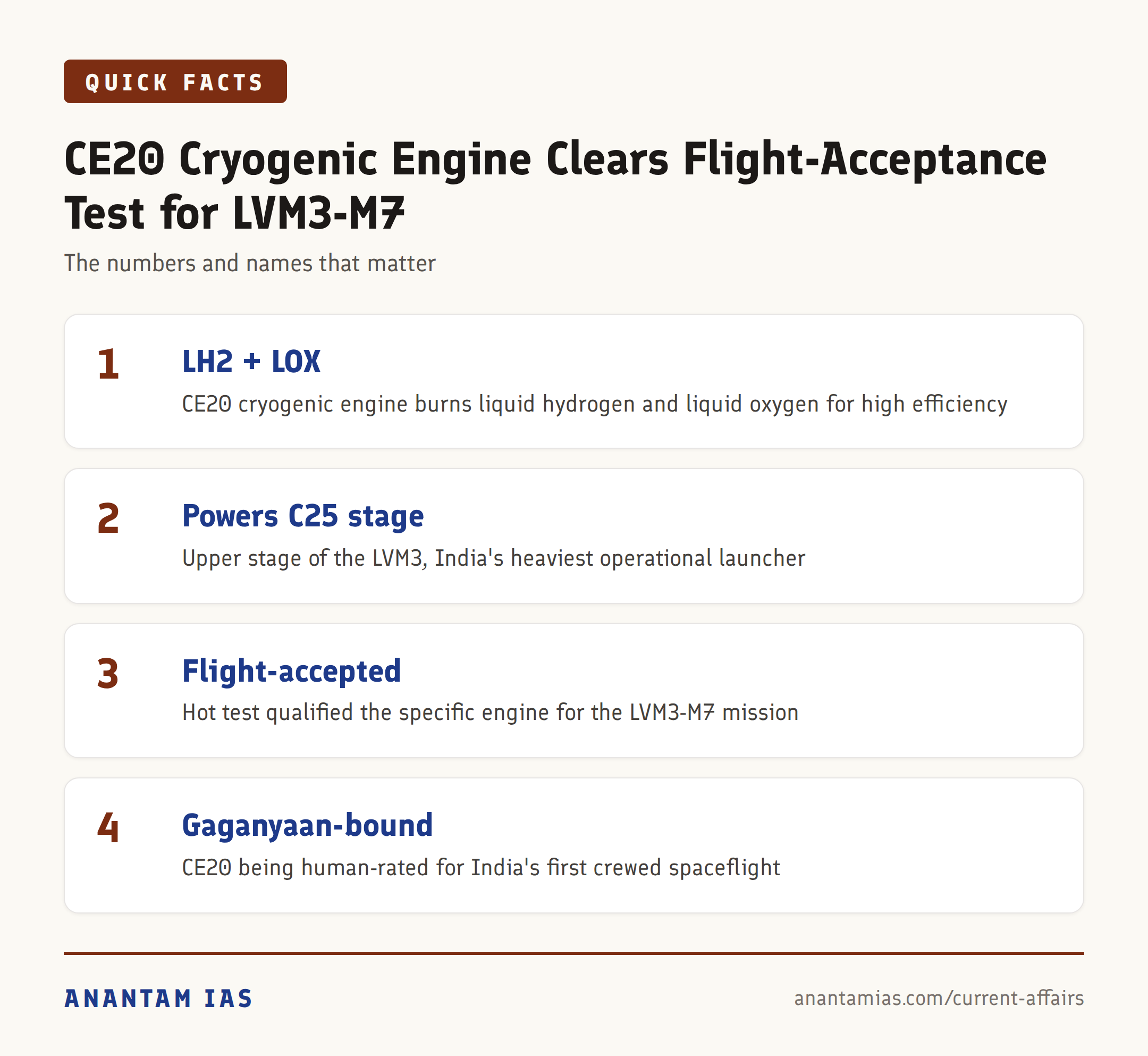
The CE20 is India’s indigenously developed cryogenic engine, burning liquid hydrogen (LH2) and liquid oxygen (LOX). Cryogenic propulsion is among the most technically demanding rocket technologies, and mastering it placed India in a small group of spacefaring nations.
- CE20 is a cryogenic engine developed by ISRO’s Liquid Propulsion Systems Centre (LPSC), powering the C25 upper stage of the LVM3 (Launch Vehicle Mark-3).
- It uses the LH2/LOX propellant combination, giving very high specific impulse (fuel efficiency) essential for injecting heavy payloads into orbit.
- The engine operates on a gas-generator cycle and has been progressively uprated to higher thrust levels across missions.
- A flight-acceptance test hot-fires the actual flight engine to confirm its performance before it is cleared for a specific mission, here LVM3-M7.
- CE20 variants are central to Gaganyaan, India’s human-spaceflight programme, where the engine is being human-rated for crew safety.
The development matters in the context of:
- LVM3 is India’s heaviest operational launcher, carrying Chandrayaan-3, commercial OneWeb constellations and the planned Gaganyaan crew missions.
- Cryogenic mastery is a marker of strategic and commercial space capability, reducing dependence on foreign upper stages.
- Each successful acceptance test de-risks the launch manifest and the human-spaceflight timeline.
UPSC Relevance
Prelims Relevance
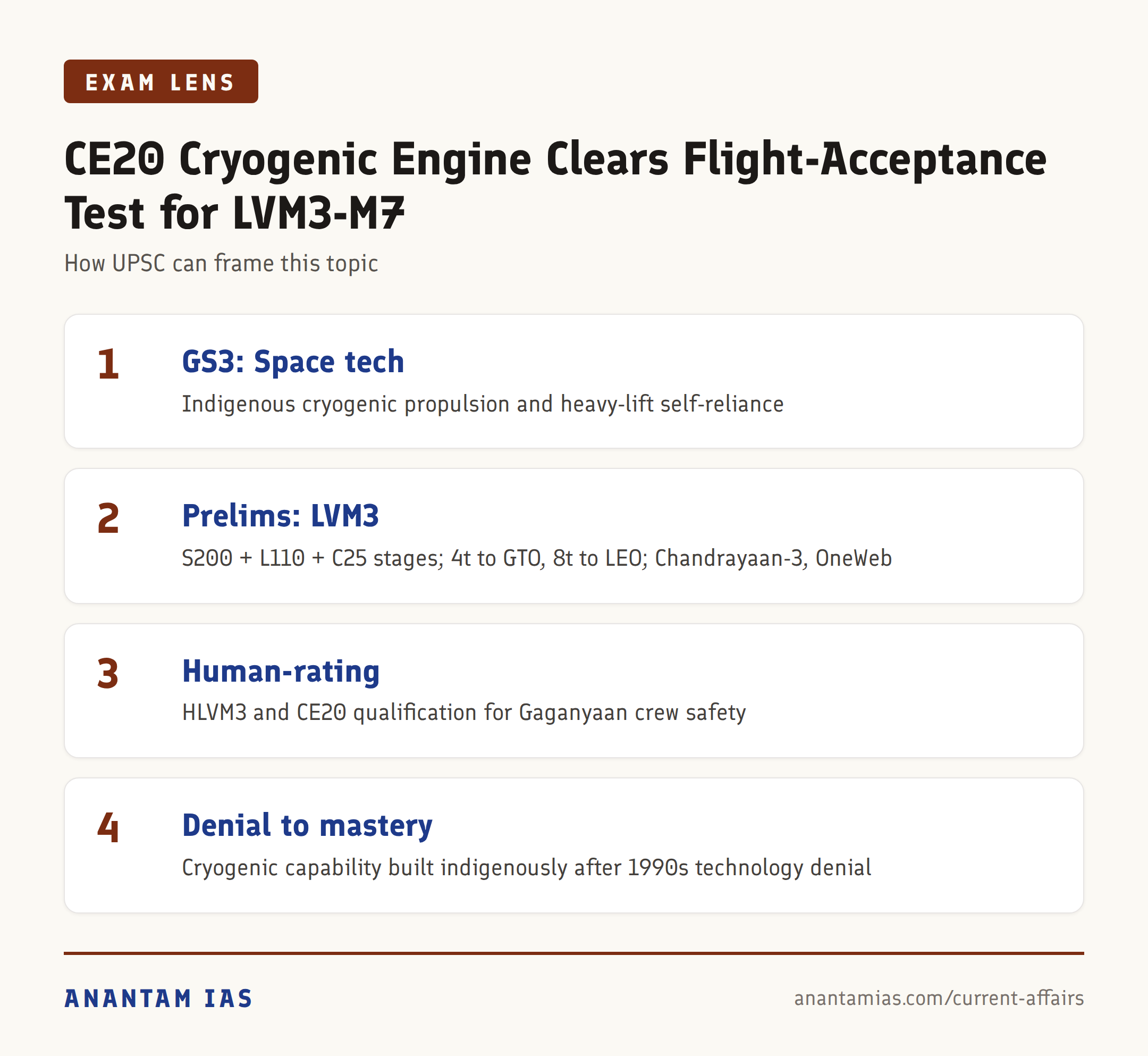
- CE20: indigenous cryogenic engine by ISRO’s LPSC; powers the C25 upper stage of the LVM3.
- Propellant: liquid hydrogen (LH2) + liquid oxygen (LOX); engine cycle is the gas-generator type.
- LVM3 (formerly GSLV Mk III): India’s heaviest operational launcher; three stages, two solid strap-ons (S200), a liquid core (L110) and the cryogenic C25 upper stage.
- LVM3 payload: about 4,000 kg to GTO and up to 8,000 kg to LEO; launched Chandrayaan-2 and Chandrayaan-3 and OneWeb satellites.
- A flight-acceptance test hot-fires the actual flight article to confirm performance before integration.
- Gaganyaan: India’s first human-spaceflight programme; a human-rated LVM3 (HLVM3) is the launcher, and CE20 is being human-rated.
- Cryogenic engines use propellants at extremely low temperatures (LH2 near -253 C, LOX near -183 C), giving high efficiency but demanding complex handling.
Mains Relevance
GS Paper 3
- Indigenous cryogenic technology: the strategic significance of self-reliant high-thrust upper stages for heavy-lift capability.
- Human-rating and reliability engineering: what qualifying CE20 for Gaganyaan demands in testing and safety margins.
- India’s space economy: LVM3’s role in commercial launch services and the push for larger indigenous launchers (NGLV).
GS Paper 2
- Space diplomacy and self-reliance: reducing dependence on foreign launch capability as a matter of strategic autonomy.
Essay
- The cold heart of a rocket: how mastering the hardest propulsion technology reshaped India’s space ambitions.
- Reliability as a value: the engineering culture behind putting humans safely into orbit.
Background and Context
What the CE20 Engine Is
The CE20 is the workhorse cryogenic upper-stage engine of India’s heavy launcher.
- Developed by ISRO’s LPSC, the CE20 powers the C25 cryogenic upper stage of the LVM3.
- It burns LH2 and LOX on a gas-generator cycle, and has been uprated across missions to lift heavier payloads.
- Cryogenic upper stages deliver the high efficiency needed to inject satellites into geostationary transfer orbit and beyond.
- India developed cryogenic technology indigenously after facing technology-denial in the 1990s, a long and hard-won capability.
Why Flight-Acceptance Testing Matters
Every flight engine is individually proven before it is trusted with a mission.
- A flight-acceptance hot test fires the specific engine that will fly, confirming thrust, combustion stability and system health.
- Passing it clears the engine for integration with the C25 stage and the LVM3-M7 vehicle.
- This individual qualification is central to ISRO’s reliability record on the LVM3.
- For crewed missions the bar rises further to human-rating, with added margins and redundancy.
LVM3 and the Missions It Carries
The engine’s importance flows from the launcher it powers.
- LVM3 is India’s heaviest operational rocket, lofting about 4 tonnes to GTO and up to 8 tonnes to LEO.
- It launched Chandrayaan-2 and Chandrayaan-3 and multiple OneWeb commercial constellations.
- A human-rated LVM3 (HLVM3) is the launcher for the Gaganyaan crewed missions.
- Reliable CE20 performance underpins both the commercial manifest and the human-spaceflight schedule.
The Human-Spaceflight Dimension
CE20’s testing feeds directly into Gaganyaan readiness.
- Gaganyaan is India’s first crewed programme, targeting a low-Earth-orbit mission with Indian astronauts.
- The CE20 is being human-rated, meaning higher safety factors, exhaustive testing and demonstrated reliability.
- Uncrewed test flights and the crew-escape system are being validated in parallel.
- Each acceptance test is a building block toward a safe crewed launch.
Way Forward
For the Programme
- Sustain the cadence of acceptance and qualification tests to keep the LVM3 manifest and Gaganyaan on track.
- Complete human-rating of CE20 and the HLVM3 with the required margins.
- Advance the Next-Generation Launch Vehicle (NGLV) to raise India’s heavy-lift ceiling.
For the Space Economy
- Leverage proven cryogenic capability to win more commercial launch contracts.
- Deepen the private-sector and IN-SPACe role in propulsion and stage manufacture.
- Build indigenous capacity for reusable and higher-thrust engines for the future.
Conclusion
The CE20’s flight-acceptance test is a routine-sounding milestone that carries real weight: it proves the exact engine that will fly, keeps the LVM3 launch manifest moving, and advances the human-rating that Gaganyaan depends on. Cryogenic reliability, hard-won after decades of indigenous effort, is now a dependable Indian capability.
For UPSC, the story links technology self-reliance, the space economy and human spaceflight in a single engine test, a compact example of why propulsion mastery matters strategically and commercially.
UPSC Practice Questions
Prelims MCQ 1
With reference to the CE20 engine, consider the following statements:
- It is a cryogenic engine that uses liquid hydrogen and liquid oxygen as propellants.
- It powers the cryogenic upper stage of the LVM3 launch vehicle.
- It is being human-rated for use in the Gaganyaan programme.
How many of the above statements are correct?
(a) Only one (b) Only two (c) All three (d) None
Answer: (c) All three
Explanation:
All three are correct. The CE20, developed by ISRO’s LPSC, is a cryogenic engine burning LH2 and LOX; it powers the C25 cryogenic upper stage of the LVM3; and it is being human-rated for the Gaganyaan human-spaceflight programme, where a human-rated LVM3 (HLVM3) is the launcher.
Prelims MCQ 2
The LVM3 launch vehicle, whose cryogenic upper stage is powered by the CE20, is best described as:
(a) India’s smallest sounding rocket (b) India’s heaviest operational launch vehicle, used for Chandrayaan-3 and OneWeb (c) A launcher used only for interplanetary probes (d) A reusable single-stage-to-orbit vehicle
Answer: (b) India’s heaviest operational launch vehicle, used for Chandrayaan-3 and OneWeb
Explanation:
The LVM3 (formerly GSLV Mk III) is India’s heaviest operational launcher, capable of about 4 tonnes to GTO and up to 8 tonnes to LEO. It launched Chandrayaan-2 and Chandrayaan-3 and multiple OneWeb commercial constellations, and its human-rated version is the launcher for Gaganyaan.
UPSC Mains Questions
- Mastery of cryogenic propulsion is a marker of an advanced spacefaring nation. Discuss the strategic and commercial significance of India’s indigenous cryogenic engine capability. (250 words)
- Human-rating a launch vehicle demands a different engineering standard from routine satellite launches. Examine the challenges involved with reference to the Gaganyaan programme. (150 words)
Frequently Asked Questions
What is the CE20 engine?
It is an indigenous cryogenic rocket engine developed by ISRO’s Liquid Propulsion Systems Centre. It powers the C25 cryogenic upper stage of the LVM3, India’s heaviest operational launch vehicle, and burns liquid hydrogen and liquid oxygen for high efficiency.
What is a flight-acceptance test?
It is a hot-fire test of the actual engine that will fly a specific mission, confirming its thrust, combustion stability and overall health before it is cleared for integration. The recent test qualified the CE20 engine intended for the LVM3-M7 mission.
Why are cryogenic engines difficult?
They use propellants at extremely low temperatures, liquid hydrogen near -253 C and liquid oxygen near -183 C, demanding complex materials, pumps and handling. In return they deliver very high efficiency, which is essential for placing heavy payloads into high orbits. India developed the technology indigenously after facing technology denial.
What is the LVM3?
The LVM3, formerly GSLV Mk III, is India’s heaviest operational launcher. It can place about 4 tonnes into geostationary transfer orbit and up to 8 tonnes into low-Earth orbit, and has launched Chandrayaan-2, Chandrayaan-3 and OneWeb satellites. Its human-rated version is the launcher for Gaganyaan.
How does this relate to Gaganyaan?
The CE20 is being human-rated for Gaganyaan, India’s first crewed spaceflight programme. Human-rating means higher safety margins, exhaustive testing and demonstrated reliability. Each successful acceptance and qualification test advances the readiness of the human-rated LVM3 that will carry Indian astronauts.
Why does each engine need individual testing?
Because a flight-acceptance test proves the specific flight article rather than the design in general. Firing the actual engine that will fly is central to ISRO’s reliability record and is especially important for missions carrying valuable payloads or, in the case of Gaganyaan, human crew.