Census 2027: Disability rights groups flag gaps in disability categories
Context:
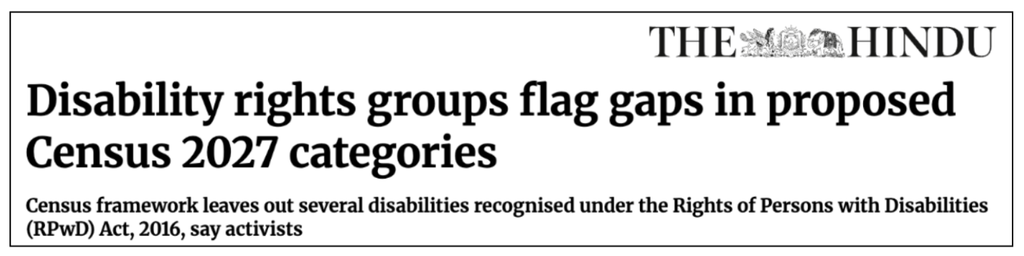
Disability-rights organisations have questioned the proposed nine-category framework for recording disability in Census 2027. They argue that it may not adequately capture the 21 specified disabilities recognised under the Rights of Persons with Disabilities (RPwD) Act, 2016.
However, the framework is not yet final: the government has clarified that questions for the Population Enumeration phase, during which disability data are collected, are yet to be officially notified.
| UPSC Relevance: GS-2 Social Justice: Vulnerable Sections Prelims: Rights of Persons with Disabilities (RPwD) Act, 2016 Mains: Challenges facing Persons with Disabilities. |
What is being proposed?
The nine categories reportedly proposed by the government are:
- Seeing
- Hearing
- Speech
- Mobility
- Intellectual disability
- Mental illness
- Acid-attack-related disability
- Chronic neurological disease; and
- Blood disorder.
Six largely continue the 2011 framework, with the outdated expression “mental retardation” replaced by intellectual disability. Acid-attack-related disability, chronic neurological disease and blood disorder are new additions.
What are the concerns?
- The Rights of Persons with Disabilities (RPwD) Act, 2016 recognises disabilities such as autism spectrum disorder, specific learning disabilities, cerebral palsy, dwarfism, muscular dystrophy, multiple sclerosis, Parkinson’s disease, leprosy-cured persons and multiple disabilities.
Disability Rights groups argue that:
- Conditions such as autism, learning disabilities and dwarfism are not separately visible in the proposed categories.
- Broad categories such as “mobility” or “chronic neurological disease” may conceal major differences in support requirements.
- The absence of clear “multiple disabilities” and “other disability” options may produce exclusion or forced classification.
- Proxy responses by household members, social stigma and insufficient enumerator training may particularly undercount psychosocial, intellectual and learning disabilities.
- Data would not be fully comparable with the legal framework used for disability certificates, reservations and welfare programmes.
Why does accurate enumeration matter?
The 2011 Census recorded 2.68 crore persons with disabilities, i.e., 2.21% of India’s population. However, narrow definitions and condition-based questions can underestimate functional limitations.
Reliable disaggregated data are essential for:
- Planning accessible schools, healthcare, transport and housing;
- Implementing the 4% reservation for persons with benchmark disabilities in government employment;
- Allocating assistive devices, social-security benefits and rehabilitation services;
- Identifying gender, caste, tribal and rural-urban inequalities within the disabled population;
- Disaster-management and district-level accessibility planning; and
- Monitoring the Sustainable Development Goals’ principle of leave no one behind.
Article 31 of the UN Convention on the Rights of Persons with Disabilities, ratified by India, requires States to collect appropriate and disaggregated disability data for policymaking.
Way Forward:
- Map every RPwD Act disability transparently to the Census categories and publish detailed sub-codes.
- Retain options for multiple and other disabilities.
- Combine condition-based categories with functional questions covering seeing, hearing, mobility, cognition, communication, self-care and independent living.
- Permit multiple responses instead of forcing a person into one category.
- Prepare accessible questionnaires in Indian Sign Language, Braille, audio and easy-to-read formats.
- Train enumerators in respectful, non-stigmatising identification and consult organisations led by persons with disabilities.
- Link Census data methodologically (not through automatic personal-data sharing) with the Unique Disability ID system and specialised surveys.
Disability enumeration is not merely a statistical exercise. If a disability remains invisible in official data, the people affected may also remain invisible in budgeting and public policy. Census 2027 should therefore reconcile administrative simplicity with the diversity recognised by the RPwD Act.
UPSC Mains PYQ 2022
Q. The Rights of Persons with Disabilities Act, 2016 remains only a legal document without intense sensitisation of government functionaries and citizens regarding disability. Comment.
UPSC Mains PYQ 2017
Q. Does the Rights of Persons with Disabilities Act, 2016 ensure effective mechanisms for empowerment and inclusion of the intended beneficiaries in society? Discuss.