Central Armed Police Forces (General Administration) Act, 2026
Why in News?
The Central Armed Police Forces (General Administration) Act, 2026 officially came into force on 8 October 2026 via an MHA notification. It establishes a unified statutory framework for officer recruitment, promotion, deputation, and service conditions across the CRPF, BSF, CISF, ITBP, and SSB.
| UPSC Relevance: GS-3 Internal Security: Security forces and agencies. Prelims & Mains: Central Armed Police Forces: Components, role & associated challenges. |
About Central Armed Police Forces:
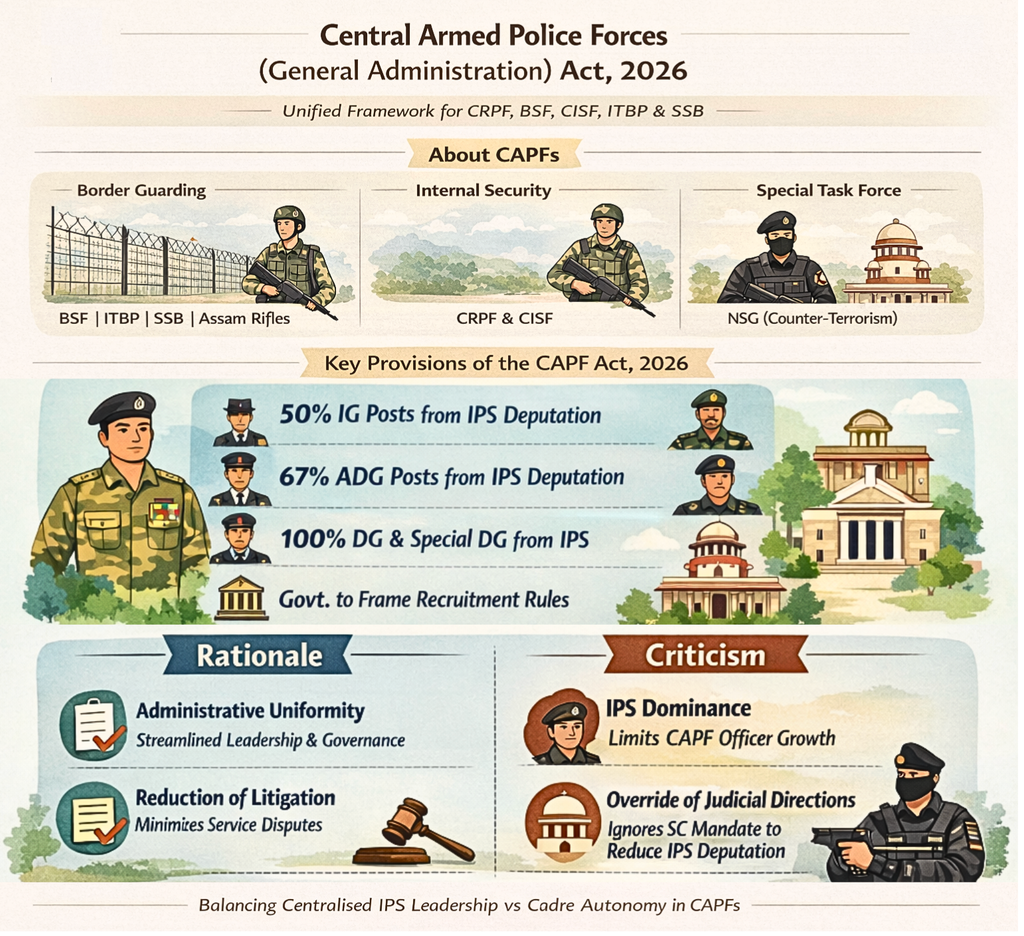
- Core Forces: CRPF, BSF, CISF, ITBP, and SSB operate under the Ministry of Home Affairs (MHA). Assam Rifles (under MHA administrative control and Indian Army operational control) and the NSG (specialised counter-terrorism) maintain distinct statutory or operational models.
- Functional Division:
- Border Guarding: Border Security Force (BSF), Indo-Tibetan Border Police (ITBP), Sashastra Seema Bal (SSB), and Assam Rifles.
- Internal Security & Counter-Insurgency: Central Reserve Police Force (CRPF)
- Critical Infrastructure Protection: Central Industrial Security Force (CISF)
- Specialised Counter-Terrorism / Anti-Hijacking: National Security Guard (NSG).
Major Statutory Provisions of the Act:
Aim: To establish a comprehensive and uniform system governing the recruitment and service conditions of Group A General Duty officers and other personnel across major CAPFs – CRPF, BSF, CISF, ITBP and SSB.
- Fixed Deputation Quotas for IPS Officers:
- Inspector General (IG): 50%
- Additional Director General (ADG): At least 67%
- Special DG & Director General (DG): 100%
- Central Rule-Making & Overriding Effect: Empowers the Central Government to frame rules on recruitment, service conditions, and deputation, carrying an overriding effect over legacy force-specific rules.
- Parliamentary Oversight: Rules framed under the Act are subject to being laid before Parliament for a 30-day scrutiny window.
In recent years, due to the absence of an umbrella law, regulatory provisions have evolved in a fragmented manner. This has resulted in several litigations on service-related matters, leading to some functional and administrative difficulties.
Judicial Background & Conflict:
- Sanjay Prakash v. Union of India 2025: The Supreme Court declared CAPF Group-A executive officers as members of Organised Group-A Services (OGAS) for all purposes and ordered:
- Completion of overdue cadre reviews and recruitment rule overhauls.
- A progressive reduction of IPS deputation posts up to the IG/SAG level within a two-year window to curb severe promotion stagnation.
- Current Constitutional Challenge: Critics and serving CAPF officers argue that the 2026 Act acts as a legislative override of binding judicial directions. Petitions challenging its constitutionality are currently pending before the Supreme Court, which has sought the Centre’s response.
Key Concerns:
- Career Stagnation & Morale: Cadre officers argue that statutory high-level IPS quotas block internal promotion pipelines, leaving direct-entry Assistant Commandants stagnant for decades compared to IPS counterparts.
- Loss of Specialised Field Experience: Over-reliance on lateral deputation sidesteps decades of institutional, terrain-specific, and paramilitary operational expertise built by career CAPF officers.
- Judicial Pushback: The tension between executive/legislative codification and the Supreme Court’s 2025 mandate creates an ongoing institutional impasse over the basic structure and separation of powers
The Act represents a major structural reform in internal security governance and is expected to improve administrative efficiency and coordination. However, it exposes a deep institutional conflict between centralised leadership (IPS model) and cadre-based autonomy (CAPF officers).
Its success will depend on balancing operational requirements with transparent promotions, timely cadre reviews and institutional morale.
UPSC PYQ 2023:
Q. With reference to Home Guards, consider the following statements:
1. Home Guards are raised under the Home Guards Act and Rules of the Central Government.
2. The role of the Home Guards is to serve as an auxiliary force to the police in the maintenance of internal security.
3. To prevent infiltration on the international border/coastal areas, the Border Wing Home Guards Battalions have been raised in some States.
How many of the above statements are correct?
(a) Only one
(b) Only two
(c) All three
(d) None
Answer: (b) (Statement 1 is incorrect)