CERD General Recommendation 40 and Reparatory Justice
Why in News?
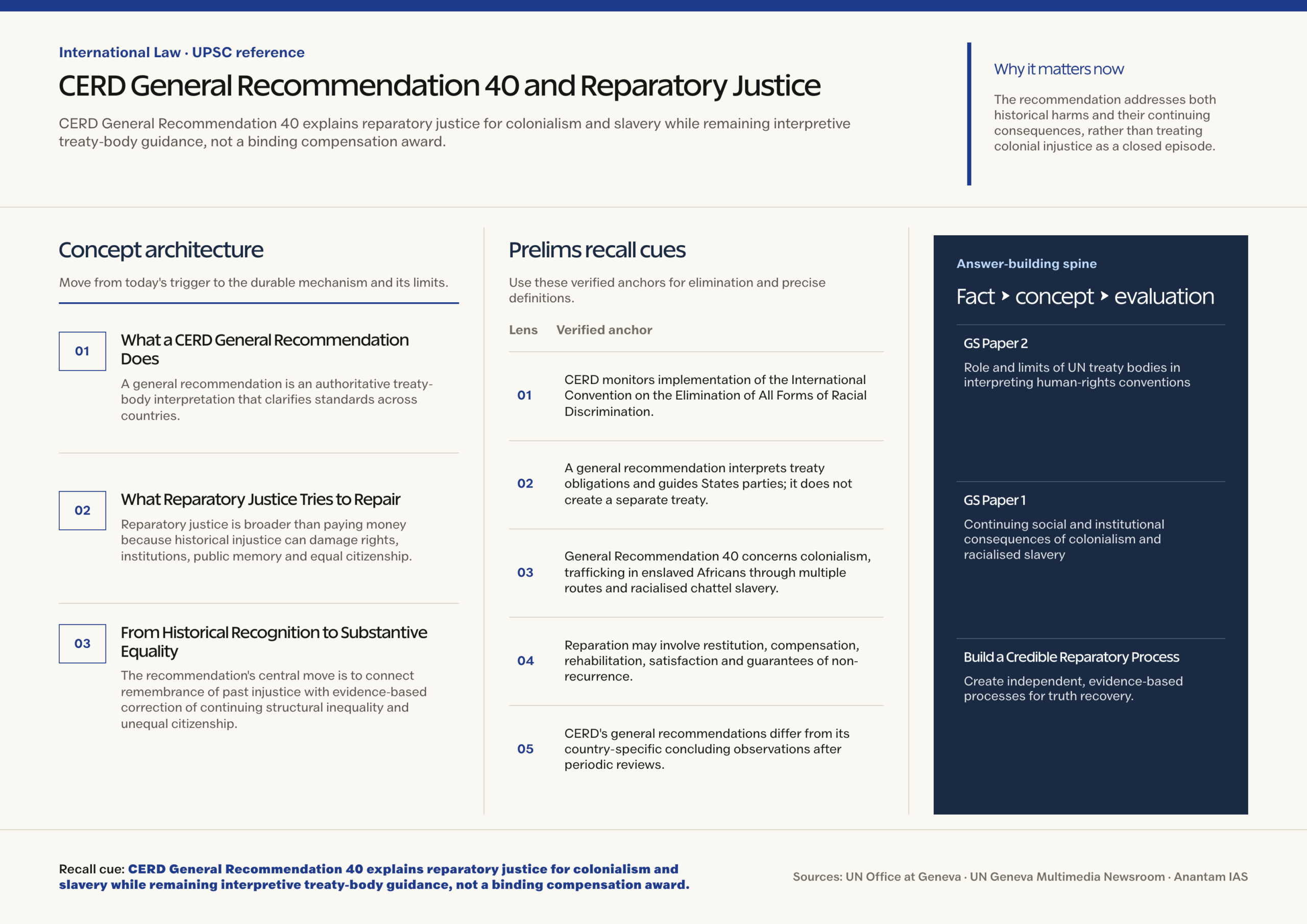
On 25 August 2026, CERD adopted General Recommendation 40 on reparatory justice for colonialism, trafficking in enslaved Africans and racialised chattel slavery.
- The recommendation addresses both historical harms and their continuing consequences, rather than treating colonial injustice as a closed episode.
- The official UN summary highlights dignity, structural inequality, truth-telling, historical memory, education and prevention of recurrence.
- It situates reparatory justice within States parties’ duty to eliminate racial discrimination and pursue substantive equality.
- It is interpretive guidance, not a new treaty, judicial verdict, compensation order or automatic amendment of domestic law.
- The development links colonial history to present institutions, unequal access, inherited disadvantage and the public narratives through which societies remember past injustice.
- For UPSC answers, the key issue is how international norms shape domestic policy without confusing expert guidance with directly enforceable adjudication.
UPSC Relevance
Prelims Relevance
- CERD monitors implementation of the International Convention on the Elimination of All Forms of Racial Discrimination.
- A general recommendation interprets treaty obligations and guides States parties; it does not create a separate treaty.
- General Recommendation 40 concerns colonialism, trafficking in enslaved Africans through multiple routes and racialised chattel slavery.
- Reparation may involve restitution, compensation, rehabilitation, satisfaction and guarantees of non-recurrence.
- CERD’s general recommendations differ from its country-specific concluding observations after periodic reviews.
Mains Relevance
GS Paper 2
- Role and limits of UN treaty bodies in interpreting human-rights conventions
- Relationship between international normative guidance and domestic implementation
GS Paper 1
- Continuing social and institutional consequences of colonialism and racialised slavery
- Historical memory, education and truth-telling as components of justice
Essay
- Justice for historical wrongs requires both acknowledgement of the past and reform of institutions that reproduce its consequences.
Background and Context
What a CERD General Recommendation Does
A general recommendation is an authoritative treaty-body interpretation that clarifies standards across countries, but its legal effect must be described carefully.
- CERD is the independent-expert body that monitors how States parties implement the racial discrimination convention through periodic reports, public dialogues, concluding observations and follow-up.
- Under the Convention’s reporting framework, CERD develops general recommendations from its accumulated review of State reports, recurring legal questions and patterns of discrimination.
- Such guidance explains how the Committee understands treaty duties and gives governments, courts and civil society a common normative framework for evaluating laws and policies.
- It can influence legislation, policy, diplomatic scrutiny and legal reasoning, yet implementation still depends on domestic institutions, constitutional arrangements and each legal system.
- It must not be confused with a court’s binding judgment, an individual compensation award or a new obligation created outside the ratified treaty and accepted procedures.
What Reparatory Justice Tries to Repair
Reparatory justice is broader than paying money because historical injustice can damage rights, institutions, public memory, social trust and equal participation across generations.
- Restitution seeks, where possible, to restore rights, status, property, liberty or other conditions disturbed by the wrongful act; literal restoration may be impossible after generations.
- Compensation addresses economically assessable harm and lost opportunities, but money alone cannot reverse erased histories, social exclusion, cultural damage or institutional discrimination.
- Rehabilitation concerns services needed to rebuild lives, including medical, psychological, legal and social support suited to affected persons, families and communities.
- Satisfaction can include truth recovery, acknowledgement, accountability, commemoration, accurate historical records and education that restores dignity rather than reproducing denial or silence.
- Guarantees of non-recurrence look forward through legal reform, institutional safeguards, equal participation and measures that prevent discriminatory structures, practices and narratives from reproducing harm.
From Historical Recognition to Substantive Equality
The recommendation’s central move is to connect remembrance of past injustice with evidence-based correction of continuing structural inequality and unequal citizenship.
- Colonialism and racialised slavery created durable hierarchies through dispossession, coerced labour, exclusion and narratives that treated unequal status, extraction and political marginalisation as natural or legitimate.
- A reparatory approach asks whether present laws, institutions, public narratives and resource patterns still carry those consequences, not merely whether historical abuse has formally ended.
- Truth-telling establishes a shared factual record; historical memory and education help prevent denial, distortion, selective commemoration and transmission of discriminatory ideas.
- Affected communities require meaningful participation in defining harm, priorities, remedies and review mechanisms; a purely top-down programme can repeat the exclusion it claims to correct.
- The exam trap is to present one universal payment formula: context, evidence, affected groups, institutional responsibility and domestic legal processes shape the appropriate mix of measures.
Way Forward
Build a Credible Reparatory Process
- Create independent, evidence-based processes for truth recovery, archival access and assessment of continuing structural effects.
- Ensure affected communities help design remedies, priorities, timelines and monitoring instead of being treated only as beneficiaries.
- Combine material measures with education, institutional reform, accountability and non-recurrence safeguards suited to the documented harm.
- Report progress transparently while respecting constitutional structures, judicial processes and the distinction between international guidance and enforceable domestic rules.
Conclusion
- General Recommendation 40 makes reparatory justice a framework for dignity, truth and substantive equality, not a synonym for a single payment.
- A strong Mains answer should pair historical recognition with present institutional reform, while stating clearly that CERD guidance is interpretive rather than binding adjudication.
UPSC Practice Questions
Prelims MCQ 1
With reference to CERD General Recommendation 40, consider the following statements:
- It concerns reparatory justice for colonialism, trafficking in enslaved Africans and racialised chattel slavery.
- It is a judicial compensation award directly enforceable in every State party.
- It addresses both historical harms and their continuing consequences.
How many of the above statements are correct?
(a) Only one (b) Only two (c) All three (d) None
Answer: (b) Only two
Explanation:
Statements 1 and 3 are correct. A CERD general recommendation is interpretive treaty-body guidance, not a judicial award automatically enforceable in every domestic legal system.
Prelims MCQ 2
Which one of the following best describes a guarantee of non-recurrence in reparatory justice?
(a) Restoring property to its former holder (b) Paying for economically assessable loss (c) Reforming institutions to prevent repetition of the harm (d) Providing medical and psychological support
Answer: (c) Reforming institutions to prevent repetition of the harm
Explanation:
Guarantees of non-recurrence are forward-looking safeguards. Restitution, compensation and rehabilitation perform different remedial functions.
UPSC Mains Questions
- Reparatory justice is wider than monetary compensation. Explain with reference to CERD General Recommendation 40.
- How do UN treaty-body general recommendations influence State conduct despite not being binding judicial decisions? Discuss.
Sources: UN Office at Geneva and UN Geneva Multimedia Newsroom.
Frequently Asked Questions
What is CERD General Recommendation 40?
It is CERD’s interpretive guidance on reparatory justice for harms and continuing consequences of colonialism, trafficking in enslaved Africans and racialised chattel slavery.
Is General Recommendation 40 a binding court judgment?
No. It is authoritative treaty-body guidance that interprets ICERD obligations, but it is not a new treaty, judicial verdict or automatic domestic compensation order.
What are the main forms of reparation?
A common framework includes restitution, compensation, rehabilitation, satisfaction and guarantees of non-recurrence. The appropriate combination depends on the documented harm and legal context.
Why are truth-telling and education part of reparatory justice?
They restore historical memory, challenge denial and discriminatory narratives, recognise affected communities’ dignity and help prevent harmful structures and ideas from recurring.
How should General Recommendation 40 be used in a UPSC answer?
Use it to connect colonial legacies with substantive equality, then distinguish historical recognition, material repair and institutional reform from automatically enforceable adjudication.