Chambal Flow Collapse Forces Ganges River Dolphins Downstream: WII Study 2026
Why in News?
The Wildlife Institute of India (WII), Dehradun, on 18 April 2026 released a technical study titled “Hydrological Stress on Platanista gangetica in the Lower Chambal Basin”. The report concludes that a sustained collapse of environmental flows between the Kota Barrage and the Chambal’s confluence with the Yamuna has pushed the Gangetic river dolphin, India’s National Aquatic Animal, out of several stretches it occupied as recently as 2022.
WII surveyors recorded a 41 per cent fall in sightings inside the National Chambal Sanctuary between 2022 and 2026, with near-complete absence of dolphins between Pali and Rameshwaram ghats during lean months. The animals have shifted downstream into the Yamuna-Chambal confluence and into the middle Ganga, where they face heavier pollution and vessel traffic.
The findings have landed at a politically awkward moment. The Union government is finalising the second phase of Project Dolphin (2020), the National Mission for Clean Ganga (NMCG) is reviewing its aquatic species action plan, and the Central Water Commission (CWC) is revising the environmental flow formula for peninsular rivers. A tributary that was supposed to be the species’ safest refuge is, by WII’s own measurement, becoming hydrologically unliveable.
UPSC Relevance at a Glance
| Axis | Mapping |
|---|---|
| GS Paper | GS3 — Environment, Biodiversity, Conservation |
| Prelims | Platanista gangetica, National Chambal Sanctuary, Kota Barrage, Project Dolphin, Schedule I WPA 1972, Vikramshila Dolphin Sanctuary, NMCG |
| Mains | River ecology and cumulative impact of dams; environmental flows as a governance problem; species-specific conservation vs catchment-level management |
| Syllabus Tags | Environment, Biodiversity, Wildlife Conservation, Water Resources |
Background and Context
The Gangetic river dolphin (Platanista gangetica gangetica) is one of only four obligate freshwater dolphin species in the world. It is effectively blind, with a degenerate eye that lacks a lens, and navigates and hunts entirely through echolocation. It lives exclusively in the Ganga, Brahmaputra, Meghna and Karnaphuli-Sangu river systems, and within these, in deep pools and confluences where water depth stays above one and a half to two metres even in the lean season.
The species carries unusually heavy protective layering. It was declared India’s National Aquatic Animal in 2009, is listed in Schedule I of the Wild Life (Protection) Act, 1972, is classified Endangered by the IUCN, and sits in Appendix I of CITES. The Vikramshila Gangetic Dolphin Sanctuary in Bhagalpur, Bihar, notified in 1991, was the first protected area designated for it. The date 5 January is observed as Gangetic Dolphin Day, marking the 2009 national-animal declaration. In 2020 the Union government launched Project Dolphin, modelled loosely on Project Tiger, to create a coordinated conservation architecture across the Ganga basin.
The first formal all-India Gangetic dolphin census, coordinated by WII and the NMCG, reported roughly 6,327 individuals in 2024. That headline figure masked a sharp geographic skew. The main Ganga channel, the Brahmaputra, and a handful of tributaries carried almost the entire population, with the Chambal standing out as the only major tributary where dolphins still lived in near-reference-condition water.
The Chambal itself has been a conservation success story precisely because its middle reach was never dammed to the extent of other rivers. The National Chambal Sanctuary, a tri-state protected area spanning Madhya Pradesh, Rajasthan and Uttar Pradesh, was notified in 1979 primarily for the critically endangered gharial but incidentally sheltered gangetic dolphins, smooth-coated otters and seven species of freshwater turtles. It is the upstream dams on the Chambal, not inside the sanctuary itself, that have now altered this picture.
Key Findings of the WII Study
Flow data from the Kota Barrage cascade
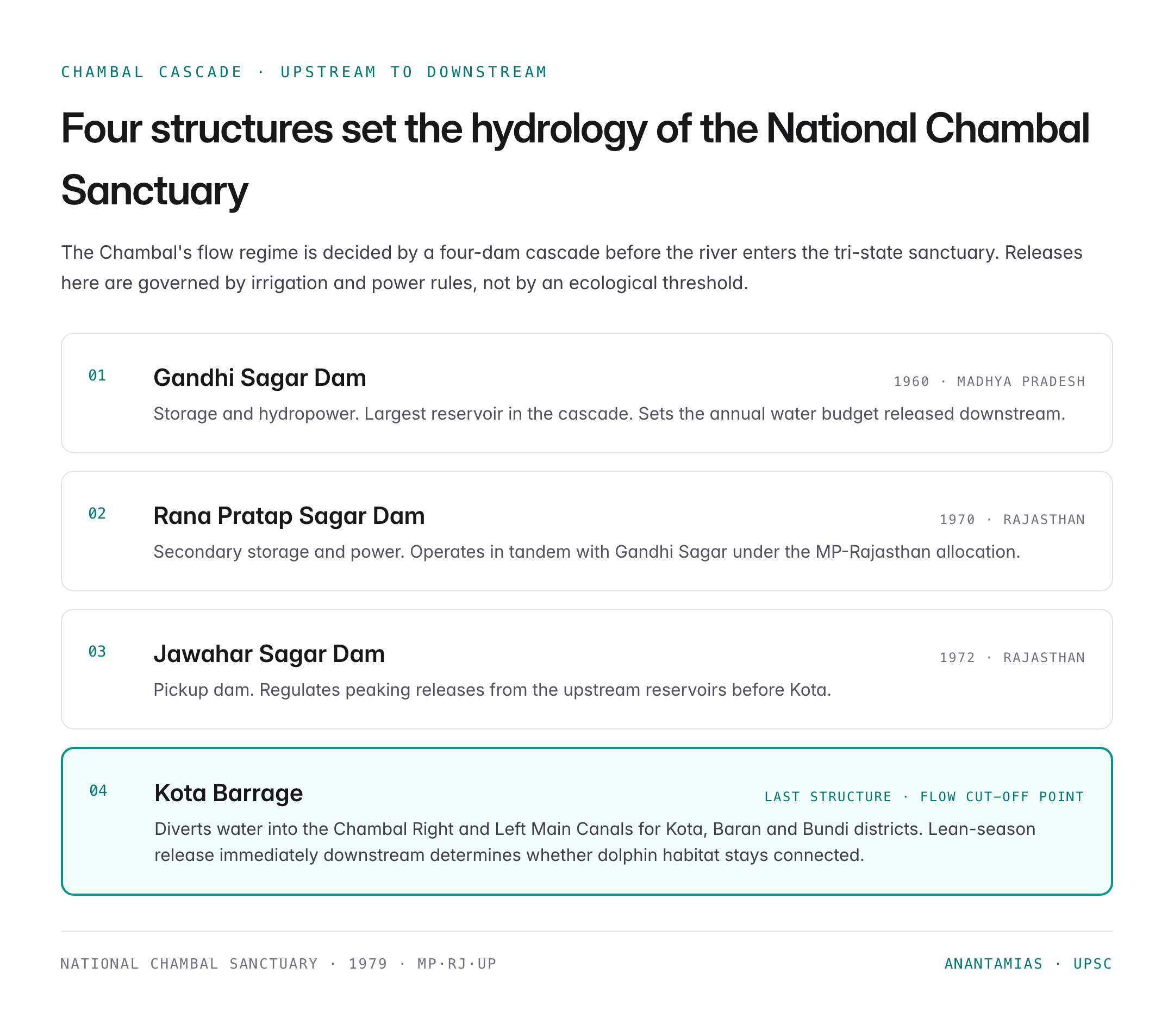
The Chambal below Kota is regulated by a four-dam cascade. Gandhi Sagar (Madhya Pradesh, commissioned 1960) and Rana Pratap Sagar (Rajasthan, 1970) store water for hydropower and irrigation. Jawahar Sagar (1972) functions as a pickup dam. Kota Barrage, the lowest structure, diverts water into the Chambal Right Main Canal and the Chambal Left Main Canal for command-area irrigation in the Kota, Baran and Bundi districts.
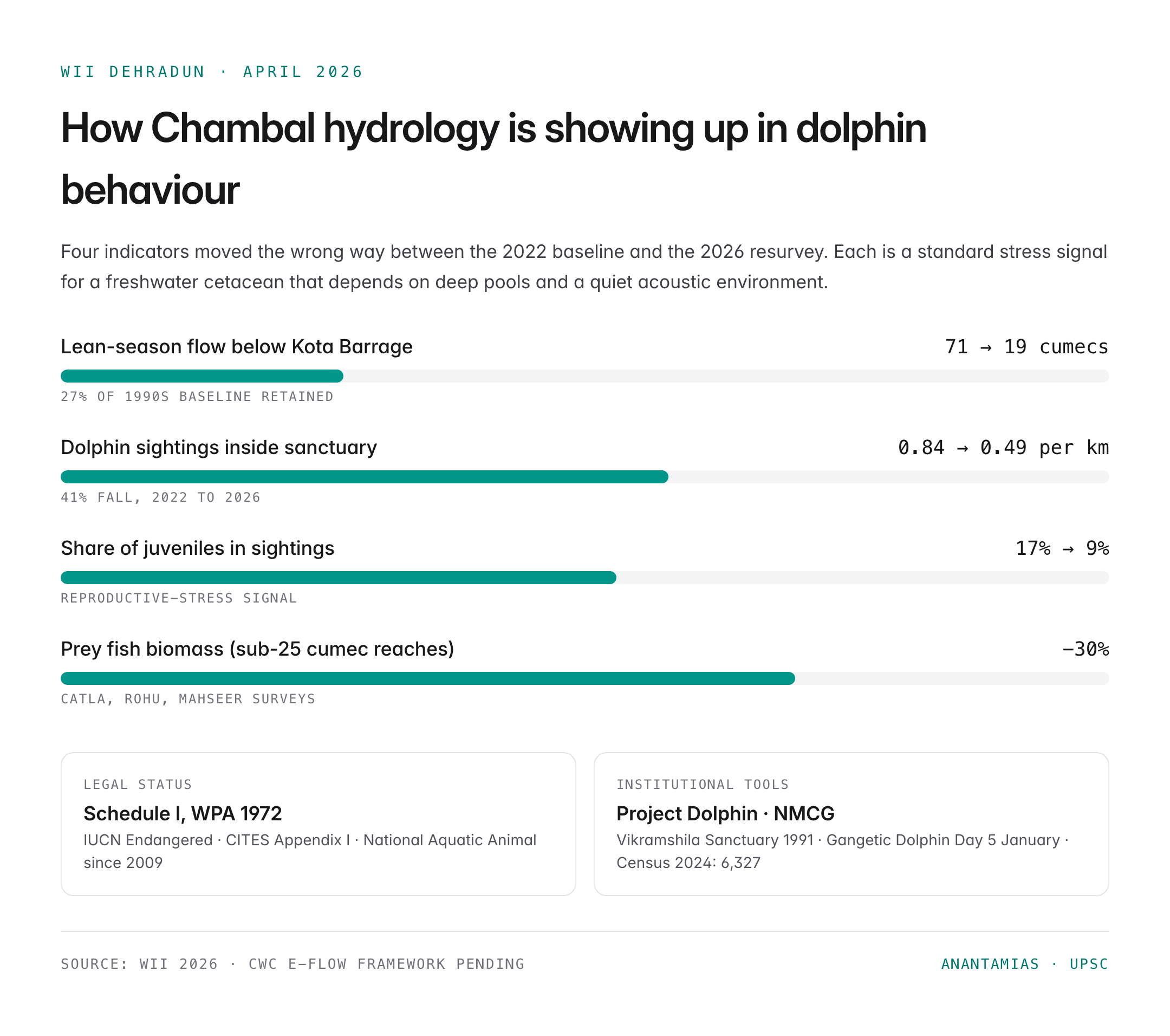
WII’s hydrology annex reports that mean lean-season discharge immediately downstream of Kota Barrage fell from 71 cumecs in the 1990s to 19 cumecs in 2024-25. For roughly 90 days between late February and early May, releases have been so low that several pool-and-riffle stretches between Kota and Dholpur now become disconnected, a condition freshwater ecologists call “hydrological fragmentation”.
Dolphin response signal
- Sighting rate: dropped from 0.84 dolphins per linear km in 2022 to 0.49 per km in 2026 inside the sanctuary.
- Range contraction: the upper Chambal stretch between Palighat and Rameshwaram, once a stable year-round habitat, recorded zero confirmed sightings across three survey seasons.
- Downstream crowding: densities at the Chambal-Yamuna confluence near Pachnada rose sharply, suggesting displacement rather than population collapse.
- Calf ratios: the share of juveniles in sightings fell from 17 per cent to 9 per cent, a classic indicator of reproductive stress.
- Acoustic environment: passive acoustic monitoring picked up a rise in background noise from pump-sets and sand-mining craft, shrinking the effective echolocation range that a blind species depends on.
Ecological mechanism
The study identifies three linked pressures. First, loss of deep pools: when lean-season flow drops, depth falls below the 1.5 metre threshold the species needs, and dolphins abandon the reach. Second, thermal stress: shallower, slower water warms faster, lowers dissolved oxygen and depresses fish prey. Third, prey collapse: catla, rohu and mahseer populations track flow volumes, and WII’s fish surveys found a 30 per cent decline in biomass in stretches where flow had dropped below 25 cumecs.
Governance finding
WII is explicit that the Kota cascade operates on a 1970s-era water accounting framework that does not carry a binding environmental-flow component. The CWC’s 2018 e-flow notification for the Ganga main stem has no equivalent for the Chambal. Releases are driven by the Rajasthan-Madhya Pradesh inter-state allocation and by canal demand, not by ecological thresholds.
Significance
- Stress-test for Project Dolphin: the Chambal was the reference site against which other stretches were being benchmarked. Its deterioration forces the mission to shift from species protection to catchment-level flow management.
- Link between river governance and biodiversity: the study turns what was treated as an irrigation and power management question into a wildlife question under the WPA, widening the universe of institutional actors.
- Data baseline: the first dolphin census of 2024 at 6,327 individuals provided a number; WII’s 2026 study provides a process, showing where and why that number can fall.
- Convention commitments: India’s Appendix I CITES listing and its 2024-commenced work under the Convention on Migratory Species for freshwater cetaceans are both strengthened by evidence-based tributary-level action.
- Federal signalling: because Gandhi Sagar, Rana Pratap Sagar and Kota Barrage sit in three different states, the finding sharpens the case for the River Basin Organisation model that the Draft River Basin Management Bill has proposed.
- Climate adaptation framing: lean-season flow reliability is itself a climate adaptation metric, linking dolphin survival to monsoon variability and to reservoir operation rules.
Concerns and Challenges
The first concern is attribution. Rajasthan and Madhya Pradesh irrigation departments have publicly questioned whether flow reduction alone explains the dolphin decline, pointing to sand mining, motorised boats and local fishing gear as parallel drivers. WII concedes that these stressors matter but points out that they have been stable or declining since the sanctuary’s 2020 enforcement upgrade, while dolphin numbers fell sharply in the same window.
A second concern is the absence of a legally enforceable e-flow regime for peninsular rivers. Even if the Ministry of Jal Shakti accepts WII’s flow prescription, there is no statutory route to compel the Kota Barrage operators to release it except by renegotiating the inter-state water sharing arrangement.
Third, Project Dolphin has been operating without a dedicated finance line. Unlike Project Tiger, which receives a protected budget head under the Centrally Sponsored Scheme for Integrated Development of Wildlife Habitats, Project Dolphin is funded through NMCG allocations that compete with sewage treatment and ghat development. Capacity to act at the sub-basin level is thin.
Fourth, there is a data gap on cumulative impact. India has no publicly available cumulative environmental impact assessment for the Chambal cascade, and the Supreme Court’s 2014 direction on such assessments for Uttarakhand’s hydropower projects has not been generalised.
Finally, the species itself is biologically cornered. With an effectively blind animal that depends on acoustic mapping, even modest increases in vessel noise or turbulence around engineered reaches produce disproportionate behavioural costs. That sets a ceiling on how much navigation, tourism and transport intensification these rivers can carry.
Comparative / Historical Perspective
The Chambal situation parallels two earlier freshwater cetacean crises internationally and one domestically. The Yangtze baiji (Lipotes vexillifer), declared functionally extinct in 2007, collapsed under a combination of Three Gorges-era flow alteration, shipping noise and incidental bycatch. The Indus river dolphin (Platanista gangetica minor) survived a comparable cascade of barrages by being concentrated into a single sanctuary reach between the Guddu and Sukkur barrages, with Pakistan’s WWF-assisted rescue protocol moving animals out of irrigation canals each monsoon. Domestically, the Ghaghra and Gandak have already seen similar range contractions in the past decade, but without the monitoring density WII has deployed on the Chambal.
| River / Species | Core Pressure | Protection Tool | Outcome |
|---|---|---|---|
| Yangtze, China — Baiji | Cascade dams, shipping, bycatch | Reserves on paper only | Functionally extinct, 2007 |
| Indus, Pakistan — Platanista minor | Barrage fragmentation | Sanctuary + canal rescue | Recovering, ~2,000 animals |
| Chambal, India — Platanista gangetica | E-flow collapse below Kota | Schedule I, NCS 1979 | Range contraction, WII 2026 |
| Ganga main stem, India | Pollution, dredging | NMCG + Project Dolphin | Stable core population |
The lesson across these cases is consistent. Species-focused sanctuaries matter, but they fail when the hydrological envelope of the river is set outside the conservation framework.
Way Forward
- CWC should notify a statutory environmental-flow schedule for the Chambal below Kota, using the Building Block Methodology rather than the 20 per cent-of-mean-monthly-flow thumb rule, and link it to reservoir operation rules for Gandhi Sagar and Rana Pratap Sagar.
- Ministry of Jal Shakti and NMCG should fold tributary e-flows into the second phase of Project Dolphin, with tripartite monitoring by Madhya Pradesh, Rajasthan and Uttar Pradesh forest departments.
- MoEFCC should commission a cumulative environmental impact assessment for the Chambal cascade, drawing on the 2014 Supreme Court direction on Uttarakhand hydropower as precedent.
- Rajasthan Irrigation Department should review the Chambal Right and Left Main Canal diversion schedule, moving canal-filling windows out of the dolphin breeding lean season.
- WII and NMCG should scale acoustic monitoring to all dolphin-bearing rivers and publish real-time noise and flow dashboards, following the model of the Ganga Water Quality Monitoring System.
- NITI Aayog should treat river-health indicators as a state-performance metric in the Composite Water Management Index, giving downstream ecological outcomes political weight.
- Parliament should revive consideration of the draft River Basin Management framework so that tri-state rivers like the Chambal have a single accountable basin authority.
Conclusion
The WII study is not really a dolphin story. It is a governance story about how India allocates water between irrigation, power, drinking supply and living rivers, and what happens when the living river is residual. The Gangetic dolphin, being blind, charismatic and slow-breeding, simply makes that trade-off visible in a way sewage and sand mining do not.
For UPSC purposes, the case illustrates the gap between species-level protection tools such as Schedule I listing and sanctuary notification, and landscape-level drivers such as dam operation rules and inter-state allocations. Closing that gap is the actual work of environmental governance in 2026. A National Aquatic Animal whose last tributary refuge is drying up seasonally is an uncomfortable prompt, and one the next phase of Project Dolphin will have to answer with hydrology rather than publicity.
Prelims Pointers
- Platanista gangetica gangetica is one of four obligate freshwater dolphin species worldwide.
- The species is effectively blind and navigates by echolocation.
- Declared India’s National Aquatic Animal in 2009.
- Listed in Schedule I of the Wild Life (Protection) Act, 1972, and Appendix I of CITES.
- IUCN Red List status: Endangered.
- 5 January is observed as Gangetic Dolphin Day.
- Project Dolphin launched in 2020 under the Ministry of Jal Shakti, implemented through NMCG.
- Vikramshila Gangetic Dolphin Sanctuary, Bihar, was notified in 1991 — the first for the species.
- First all-India dolphin census (2024) estimated about 6,327 individuals.
- National Chambal Sanctuary, notified in 1979, is a tri-state protected area across MP, Rajasthan and UP.
- The Chambal cascade comprises Gandhi Sagar, Rana Pratap Sagar, Jawahar Sagar and Kota Barrage.
- CWC is the statutory body tasked with environmental-flow assessment; its e-flow notification currently covers only the Ganga main stem.
Mains Practice Question
Q. “Species-specific legal protection cannot substitute for catchment-level hydrological management.” Critically examine this statement with reference to the Gangetic river dolphin and the 2026 Wildlife Institute of India study on the Chambal. (15 marks, 250 words)
- Set up the tension: Schedule I WPA protection and the National Chambal Sanctuary gave the Gangetic dolphin strong species-level protection, yet WII 2026 records a 41 per cent fall in sightings driven by flow collapse below Kota Barrage.
- Argue the case: reservoir operation rules, canal diversion schedules and the absence of a statutory e-flow regime for the Chambal sit outside the wildlife-protection framework, so species law cannot reach the actual driver of decline.
- Close with the reform agenda: binding CWC e-flow schedules, a cumulative environmental impact assessment for the Chambal cascade, Project Dolphin’s second phase with a dedicated finance line, and a river-basin authority for tri-state rivers.
Frequently Asked Questions
What is the Gangetic river dolphin and why does it matter?
Platanista gangetica gangetica is an obligate freshwater dolphin found in the Ganga, Brahmaputra and Meghna systems. It is effectively blind and hunts by echolocation. India declared it the National Aquatic Animal in 2009, and it is listed in Schedule I of the Wild Life (Protection) Act, 1972 and Appendix I of CITES. IUCN lists it Endangered.
Why is the Chambal flow collapse in the news in April 2026?
The Wildlife Institute of India released a study on 18 April 2026 showing that mean lean-season discharge below Kota Barrage has fallen from 71 cumecs in the 1990s to 19 cumecs in 2024-25. Dolphin sightings inside the National Chambal Sanctuary fell 41 per cent between 2022 and 2026, with the population shifting downstream to the Yamuna confluence.
Which dams and barrages regulate the Chambal?
The Chambal below Kota is regulated by a four-structure cascade. Gandhi Sagar in Madhya Pradesh commissioned in 1960, Rana Pratap Sagar in Rajasthan in 1970, Jawahar Sagar in 1972, and Kota Barrage which diverts water into the Chambal Right and Left Main Canals for irrigation in Kota, Baran and Bundi districts.
What is Project Dolphin?
Project Dolphin was launched by the Union government in 2020, modelled loosely on Project Tiger, to coordinate Gangetic and Indus dolphin conservation across the Ganga basin. It is implemented through the National Mission for Clean Ganga under the Ministry of Jal Shakti. The first all-India dolphin census in 2024 estimated about 6,327 individuals.
What is an environmental flow and who sets it in India?
Environmental flow is the quantity, timing and quality of water required to sustain freshwater ecosystems. The Central Water Commission is the statutory body for e-flow assessment. A binding e-flow notification currently exists only for the Ganga main stem. Peninsular rivers such as the Chambal have no statutory e-flow regime, which is the governance gap WII flags.
Why is the Gangetic dolphin called blind?
The species has a degenerate eye that lacks a proper lens and does not form images. It navigates, hunts and communicates entirely through echolocation, emitting ultrasonic clicks and interpreting the echoes. This makes it unusually vulnerable to underwater noise from pump-sets, sand-mining craft and motorised boats, which shrink its effective acoustic range.
How does this topic help UPSC preparation?
It sits at the Prelims-Mains interface. Prelims factual hooks include Schedule I status, Project Dolphin 2020, Vikramshila Sanctuary 1991, National Chambal Sanctuary 1979, and the 2024 census figure. Mains use includes GS3 environment, biodiversity and water resources, especially the argument that species law cannot substitute for catchment-level hydrological governance.
What is the Vikramshila Dolphin Sanctuary?
Vikramshila Gangetic Dolphin Sanctuary is a 50 km stretch of the Ganga in Bhagalpur district, Bihar, notified in 1991 as India’s first protected area dedicated specifically to the Gangetic river dolphin. It remains a core conservation site and is a key reference population for the 2024 all-India census coordinated by the Wildlife Institute of India and NMCG.