Chandrayaan-2 detects possible Subsurface Ice near South Pole of Moon
Why in News?
Scientists at the ISRO’s Physical Research Laboratory have found signs of possible subsurface water-ice beneath four permanently shadowed craters near the Moon’s south pole using data from Chandrayaan-2’s DFSAR instrument.
The latest findings indicate that the Moon’s polar regions may contain substantial reserves of water ice beneath the surface.
| UPSC Relevance: GS-3 Science and Technology: Space Technology Prelims & Mains: Chandrayaan series of missions and their findings. |
About Chandrayaan-2:
- The second moon mission was launched in 2019 using the launch vehicle LVM-3.
- The spacecraft consisted of an orbiter, a lander, and a rover.
- The orbiter circled the Moon in a polar orbit at a height of 100 km, and has a planned mission lifetime of seven and a half years.
- Vikram Lander planned to demonstrate a soft landing on the moon; however, it crashed due to a software error. Despite it, 90-95% of the mission objectives have been accomplished.
The mission has enriched our understanding of the Moon’s evolution and mapped minerals and water molecules in the Polar Regions.
Possible Subsurface Ice near the South Pole of the Moon:
India’s Chandrayaan-2 orbiter continues to yield significant scientific returns.
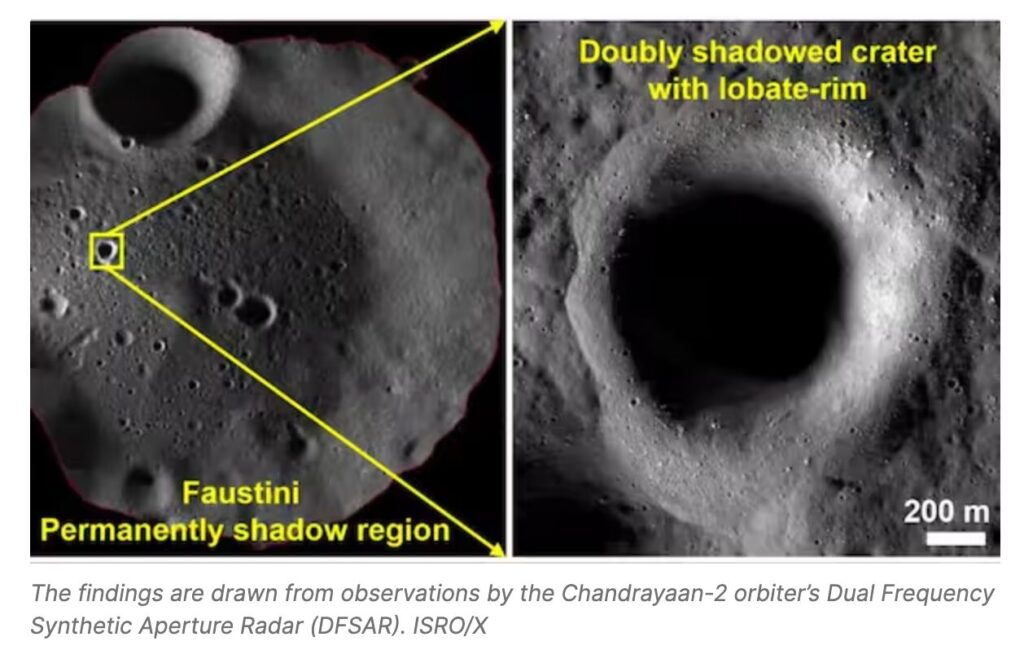
- Researchers examined nine doubly shadowed craters (craters within permanently shadowed regions) near the lunar south pole using the orbiter’s radar payload.
- Doubly shadowed craters are shielded from both direct sunlight and reflected thermal radiation from surrounding terrain.
- Their temperatures drop to approximately 25 Kelvin (−248°C), among the coldest known environments in the entire solar system.
- These conditions make them natural “cold traps” capable of preserving ancient water-ice over geological timescales spanning billions of years.
- Using advanced radar polarimetric analysis (DFSAR), the team found evidence of subsurface ice beneath the floors of four out of the nine craters studied, located within the Faustini, Haworth, and Shoemaker crater regions. The strongest evidence was found in a small crater, approximately 1.1 km wide, nested inside the larger Faustini crater.
Key Instrument: Dual Frequency Synthetic Aperture Radar (DFSAR)
- ISRO describes DFSAR as the first fully polarimetric SAR instrument designed to study the Moon, operating in both L-band and S-band frequencies, giving it the ability to probe beneath the surface at different depths.
- The DFSAR is a microwave imaging instrument aboard the Chandrayaan-2 orbiter.
- Rather than capturing photographs, it fires microwave signals at the lunar surface and analyses how they scatter back.
- Water-ice produces a distinctive backscatter pattern (called circular polarisation enhancement) that rock and regolith dust do not replicate.
Significance:
- The findings could prove crucial for future lunar exploration missions, particularly those aimed at supporting a sustained human presence on the Moon.
- Water ice is considered one of the most valuable potential resources on the lunar surface, as it could be transformed into drinking water, breathable oxygen, and even rocket fuel for future deep-space missions.
- Enhances the utility of the region (near the South Pole of the Moon) for future lunar bases due to the possibility of accessible ice reserves within permanently shadowed craters. At the same time, nearby peaks receive almost continuous sunlight, making them well-suited for power generation.
Chandrayaan-2’s discovery of water on the Moon could prove to be a major achievement, as it may help power humanity’s next phase of space exploration.
Following the success of Chandrayaan-3, India has unveiled plans for Chandrayaan-4, a sample-return mission that could further explore resources near the lunar poles. The government has also outlined an ambitious plan to send an Indian astronaut to the Moon by 2040.