Chandrayaan-3 Hop Experiment reveals Regolith Heterogeneity at Moon’s South Pole
Why in News?
Scientists from the Physical Research Laboratory, using data from the Indian Space Research Organisation’s Chandrayaan-3 mission, have reported that the Moon’s surface near the south polar region is not uniform.
Data from the Vikram lander’s “Hop Experiment” revealed that the lunar regolith has a distinct two-layer structure, with a loose upper layer and a denser compact layer beneath it.
| UPSC Relevance: GS-3 Science and Technology: Space Technology Prelims: Chandrayaan-3, Lunar Regolith, ChaSTE, ISRO, Moon’s South Pole, Lunar Mission. |
Brief Overview of the Chandrayaan-3 Mission:
- The third lunar mission was launched in 2023. The spacecraft consisted of the Vikram lander and the Pragyan rover.
- Launch vehicle: Launch Vehicle Mark-3
- Vikram lander touched down on the Moon on August 23, 2023. It made one of the closest approaches to the moon’s South Pole. The landing site is located about 600 kilometres from the Moon’s South Pole, on the near side of the Moon.
- Pragyaan rover operated for one lunar day (approximately 14 Earth days). It aimed to collect lunar samples, conduct in-situ experiments and send data to the Vikram lander to transmit it back to Earth.
- The Virtual Launch Control Centre at the Vikram Sarabhai Space Centre played a vital role in continuous real-time monitoring of the launch activities from SHAR.
- India became the fourth country to land a spacecraft on the Moon after the US, Russia, and China.
What is the Chandrayaan-3 Hop Experiment?
- After the successful soft landing of the Vikram lander on the Moon on 23 August 2023, some propellant remained unused in the lander. ISRO decided to utilise this remaining fuel to conduct an experimental manoeuvre known as the “hop experiment”.
- During the experiment:
- The Vikram lander reignited its engines.
- It lifted nearly 40 cm above the lunar surface.
- It moved laterally and landed approximately 50 cm away from the original landing site (named Statio Shiv Shakti).
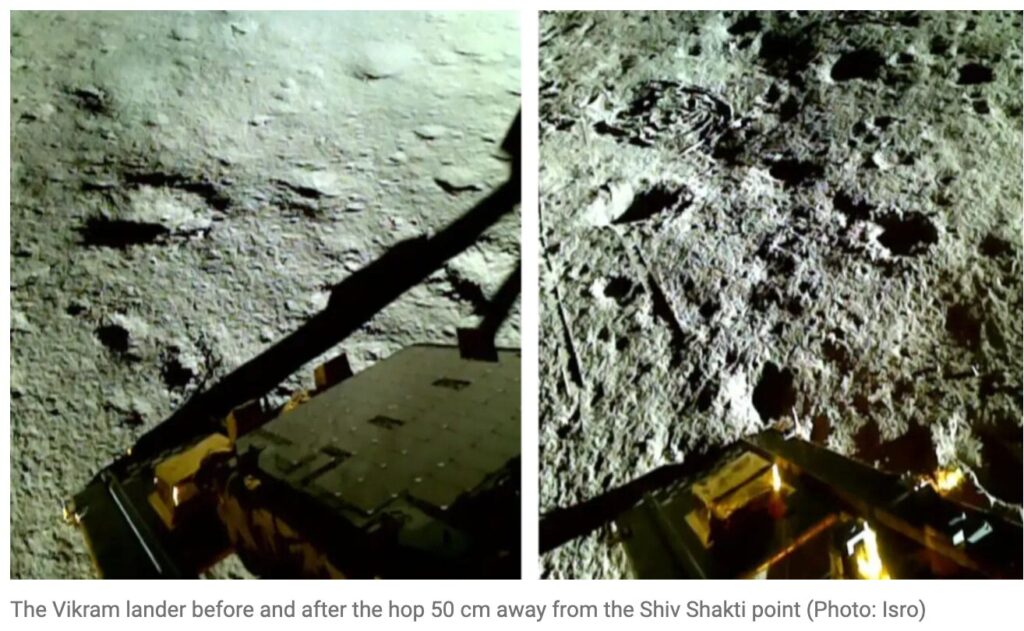
Initially, the experiment was viewed primarily as a demonstration of India’s capability to restart engines and generate lift from the lunar surface.
However, scientists later realised that the rocket plume generated during the hop disturbed the lunar soil and exposed deeper layers of regolith. This allowed the ChaSTE instrument to analyse newly exposed material underneath the surface.
What is Lunar Regolith?
- Lunar regolith refers to the loose, fragmented material covering the Moon’s surface. It consists of: Dust particles, Broken rocks, Fine soil-like material created by meteorite impacts over billions of years.
- Unlike Earth’s soil, lunar regolith contains no organic matter or moisture and experiences extreme temperature variations.
Key Findings from the Study:
- Moon’s Surface has a Two-Layer Structure: The study revealed that the lunar surface near the Chandrayaan-3 landing site resembles a “layered cake”.
- Upper Layer: Extremely loose and porous. Thickness of around 2-6 cm.
- Lower Layer: Denser and more compact. Possesses different thermal and physical properties.
The findings indicate significant heterogeneity in the Moon’s upper surface even within a few centimetres of depth.
- Thermal Properties change rapidly with Depth: The ChaSTE instrument recorded a sharp drop in temperature beneath the lunar surface. At depths of nearly 8-10 cm, the temperatures were found to be around 60°C lower than the surface temperature. This suggests:
- Lunar regolith is a poor conductor of heat.
- Subsurface regions may provide more stable thermal conditions.
Such findings are important for designing Lunar habitats, Storage systems, Astronaut shelters, and Long-duration moon bases.
- Presence of Water-Ice: Earlier studies based on ChaSTE data had suggested that water ice may exist beyond permanently shadowed polar craters. The newly identified thermal characteristics strengthen the possibility that:
- Certain subsurface regions may preserve volatile compounds
- Water ice may survive in cooler subsurface pockets.
This has implications for Future human settlement, In-situ resource utilisation (ISRU), Production of oxygen and rocket fuel on the Moon.
What is ChaSTE?
Chandra’s Surface Thermophysical Experiment (ChaSTE) was one of the scientific payloads onboard the Vikram lander.
Objective: To study thermal conductivity, temperature variation, and thermophysical behaviour of lunar soil.
Working Mechanism: ChaSTE used a rod-shaped probe fitted with temperature sensors. The probe penetrated the lunar surface and measured temperature at different depths.
Significance: It produced the first in-situ thermal profile near the Moon’s south polar region.