Charged Water Droplets: How Electrical Breakdown Damages Coatings
Why in News?
An 11 September 2026 Max Planck Society release highlighted research showing that charged water droplets can electrically damage protective coatings and enable corrosion of underlying metal.
- The study by Ni and colleagues appeared online in Nature on 26 August; the September research release explains the findings to a wider audience.
- In the reported comparison, 3,000 charged-droplet impacts produced visible microscopic changes, while the same number of uncharged impacts left the test coating apparently unchanged.
- The work identifies an electrical failure mechanism; it does not announce a commercially available coating that prevents it.
- Protective coatings shield metals from their surroundings, so microscopic defects can matter even before damage becomes obvious to the eye.
- Understanding how a barrier fails helps researchers design relevant durability tests instead of checking only resistance to abrasion or chemical attack.
UPSC Relevance
Prelims Relevance
- Contact electrification: charge separation associated with contact between materials.
- Sliding electrification: water droplets can acquire charge while moving over insulating surfaces.
- Dielectric breakdown: an insulating material locally fails under a sufficiently strong electric field.
- Corrosion: material degradation; metal corrosion can follow loss of a protective barrier.
- Experimental control: the uncharged-droplet comparison helps distinguish charge-related damage from impact alone.
Mains Relevance
GS Paper 3
- Materials research: improve the durability of protective coatings through mechanism-based testing.
- Technology assessment: distinguish controlled laboratory findings from established effects on infrastructure in service.
Essay
- Invisible causes, visible consequences: careful experiments can reveal overlooked sources of material failure.
Background and Context
What the researchers compared
The decisive comparison separated ordinary droplet impact from impact after the droplet had acquired electrical charge by sliding across another surface.
- Protective coatings act as barriers between metal and the external environment. Familiar explanations for their deterioration include mechanical wear from moving droplets and chemical degradation caused by substances carried within the water.
- The researchers examined Teflon-coated copper as a test system. Choosing a chemically robust coating helped investigate whether a different route to damage could operate, rather than assuming chemical resistance guarantees protection against every stress.
- Uncharged droplets fell directly onto the coated sample. After 3,000 impacts, microscopy showed no notable change in surface morphology, providing a reference against which to examine the effect of charged drops.
- Other droplets first slid over surfaces including a plant leaf and plastics, acquired charge and then struck the coating. The researchers observed microscopic damage in the coating and underlying metal after the repeated impacts.
- The primary evidence concerns controlled laboratory samples and observed damage. It supports an additional mechanism of coating failure, rather than establishing that a particular bridge, vehicle or household object has already failed this way.
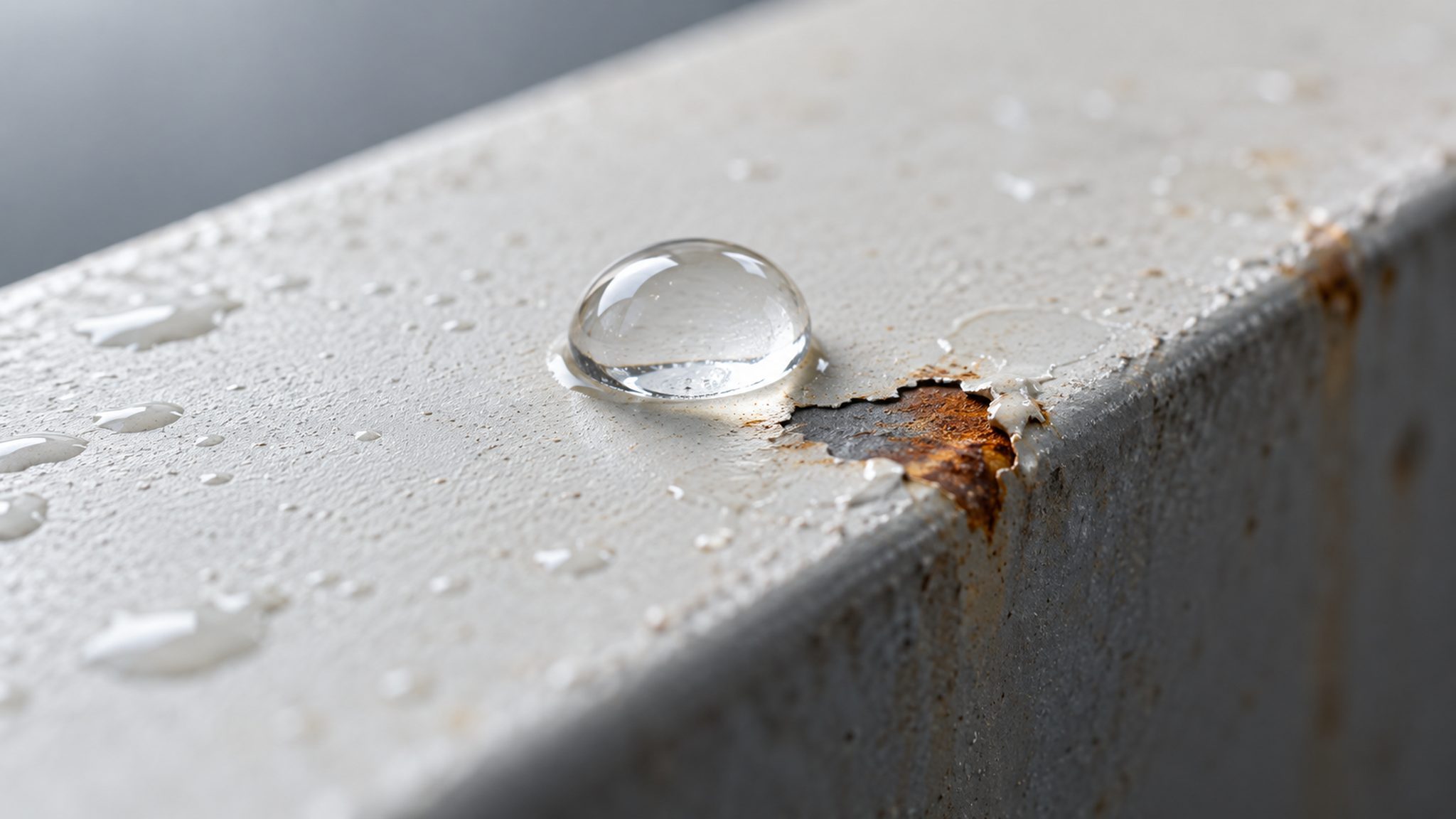
From sliding electrification to barrier failure
An electrically insulating coating can resist some chemical attack yet still fail locally when the electric field generated by a charged droplet becomes sufficiently strong.
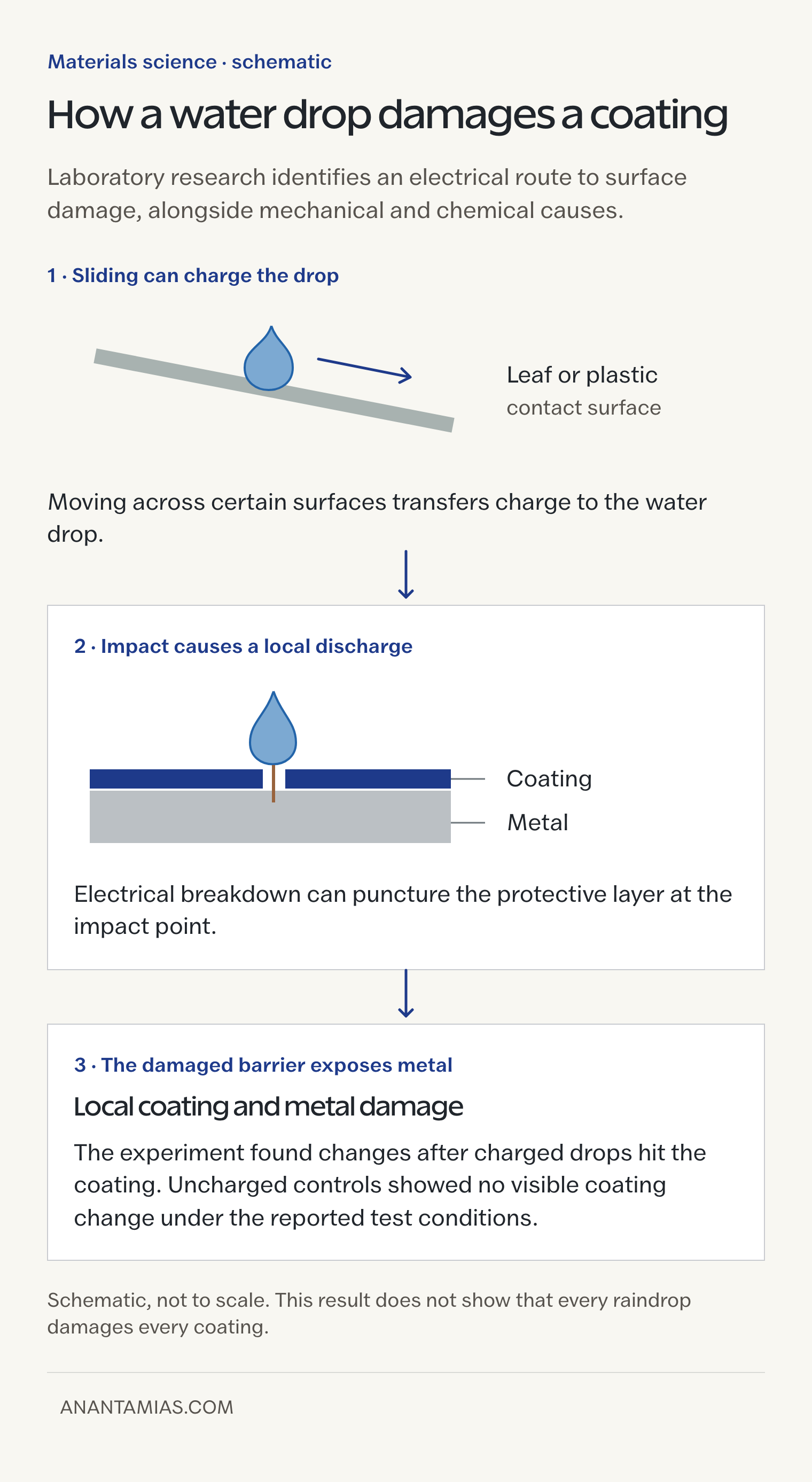
- Sliding electrification occurs as water moves over a surface and charge separates between them. The droplet can leave carrying electrical charge; the amount acquired depends on the material and the conditions of contact.
- When that charged droplet approaches coated metal, its charge creates a local electric field. The study connects sufficiently strong fields with failure of the insulating layer, rather than treating water impact as purely mechanical.
- Dielectric breakdown means the insulating barrier locally loses its ability to withstand the field. Electrical discharge can puncture the coating at small sites, creating defects that compromise its original protective function.
- Once the barrier is breached, the underlying metal can become exposed to the water and its dissolved substances. The experiment links damage to the coating with subsequent corrosion of the metal beneath it.
- The causal sequence is charge acquisition, local breakdown and barrier damage. Its significance is that an electrical event can initiate failure; it does not imply that ordinary chemical or mechanical corrosion pathways cease to matter.
What the finding changes, and what remains uncertain
The result widens the questions asked during coating design, while practical significance still depends on the material system and its exposure conditions.
- The uncharged control matters because both comparisons involve water contacting a coated surface. The difference in observed damage makes electrical charging relevant to the explanation, instead of attributing every defect simply to repeated wetting.
- Coating properties and droplet charge influence electrical stress and breakdown. A result on specified laboratory materials cannot be treated as a universal rule that every raindrop penetrates every outdoor coating upon contact.
- The researchers identify possible relevance to buildings, vehicles and other exposed metal components. These are potential application areas for further investigation, not measured estimates of damage or replacement costs in those sectors.
- Stronger anticorrosion strategies may need to consider resistance to charge-induced damage alongside established stresses. The paper provides a research direction; it does not demonstrate a finished protective product ready for general deployment.
- The use of Teflon in an experiment specifies the tested coating, not a finding about consumer health. These results do not establish food contamination, human exposure or health outcomes associated with household cookware.
Way Forward
Translate the mechanism into relevant durability tests
- Test commercially relevant coatings under controlled charged and uncharged exposure while recording material properties, coating thickness and water composition.
- Combine laboratory work with field measurements to determine where naturally charged droplets materially contribute to damage during actual service.
- Assess proposed solutions against electrical, chemical and mechanical stresses before claiming improved lifetime or reduced maintenance requirements.
Conclusion
- Charged water droplets add an electrical route to the explanation of coating failure: sliding can charge the drop, local breakdown can puncture the barrier, and exposed metal can subsequently corrode under the tested conditions.
- For a science answer, connect the mechanism with the control experiment, then state its limit. Laboratory evidence establishes a credible pathway, while the scale of its contribution to real-world deterioration requires further investigation.
UPSC Practice Questions
Prelims MCQ 1
With reference to charged water droplets and protective coatings, consider the following statements:
- A water droplet can acquire charge while sliding across an insulating surface.
- Dielectric breakdown can create defects in an electrically insulating coating.
- The study establishes that every raindrop destroys every protective coating.
How many of the above statements are correct?
(a) Only one (b) Only two (c) All three (d) None
Answer: (b) Only two
Explanation:
The first two describe the reported mechanism. Breakdown depends on the experimental material system and electrical conditions; the universal claim in the third statement is unsupported.
Prelims MCQ 2
What is the main purpose of comparing charged droplets with uncharged droplets in this study?
(a) To prove that all forms of corrosion are electrical. (b) To distinguish charge-related coating damage from the effect of water impact alone. (c) To establish the health effects of cookware. (d) To show that insulating materials never conduct under any circumstances.
Answer: (b) To distinguish charge-related coating damage from the effect of water impact alone.
Explanation:
The uncharged-droplet comparison provides a reference for interpreting damage after charged-droplet impacts. It supports examining electrical charge as a relevant cause under the test conditions.
UPSC Mains Questions
- Explain how sliding electrification of water droplets can contribute to coating failure and metal corrosion. Why is the control experiment important? (150 words)
- Discuss how an improved understanding of material failure mechanisms can inform infrastructure durability. Distinguish laboratory evidence from field-level validation. (250 words)
Sources: Max Planck Society and Nature, Ni et al..
Frequently Asked Questions
How do water droplets become electrically charged?
Water droplets can acquire charge while sliding across surfaces such as leaves and plastics. This contact or sliding electrification separates charge, and the amount acquired depends on the particular surface and conditions.
What is dielectric breakdown of a coating?
Dielectric breakdown occurs when an insulating coating can no longer withstand a sufficiently strong electric field at a location. Local damage can create a defect through which the barrier loses its protective function.
What did the uncharged-droplet comparison show?
Under the reported test conditions, the coating showed no notable microscopic surface change after 3,000 uncharged impacts. Charged impacts produced damage, supporting investigation of electrical charging as a cause rather than impact alone.
Does this prove that rain rapidly destroys bridges?
No. The study demonstrates a mechanism in controlled experiments and identifies possible relevance to exposed metal structures. Its contribution to the deterioration of actual bridges requires field evidence under relevant conditions.
Has the research produced a new commercial anticorrosion coating?
The reported work identifies a previously overlooked mechanism and suggests directions for improved protection. It does not announce a commercially available coating proven to prevent this form of damage in general use.