China Dealt with Air Pollution, lesson for India
Context:
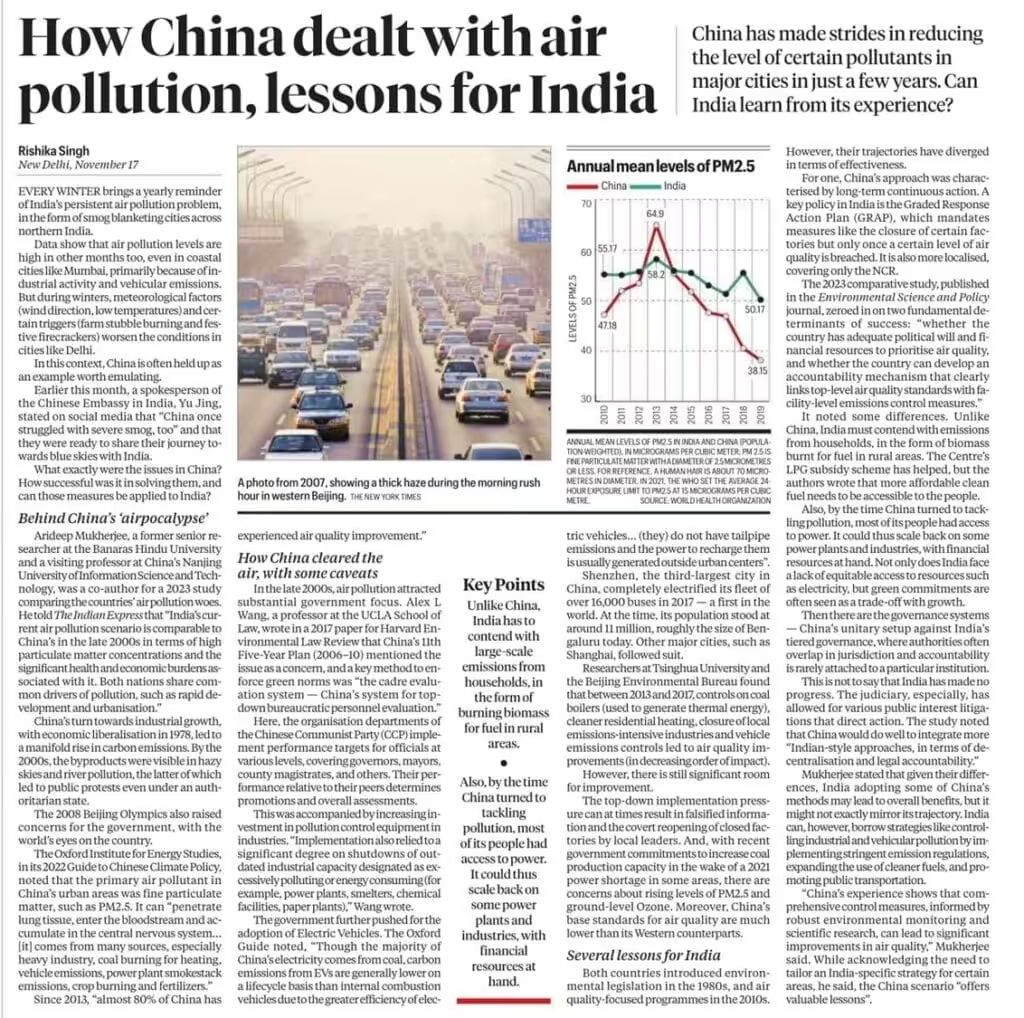
Every winter, northern India—especially Delhi-NCR—faces severe air pollution. China faced a similar crisis in the early 2010s (“Airpocalypse”), but achieved 35–50% reduction in PM2.5 within a few years. The article examines what China did, and what India can learn.
UPSC Relevance:
Environment
UPSC PYQ:
Q: Mumbai, Delhi and Kolkata are the three mega cities of the country but the air pollution is much more serious problem in Delhi as compared to the other two. Why is this so? India is well endowed with fresh water resources. Critically examine why it still suffers from water scarcity.
China’s Air Pollution Crisis & Its Strategy:
China’s pollution drivers
- Lack of early environmental regulation
- Rapid industrialisation
- Coal-based power and heating
- Massive urbanisation
- Increasing vehicle emissions
2013 Air Pollution Prevention and Control Action Plan:
China adopted a highly centralised, aggressive, and well-funded plan:
Massive coal reduction
- Shut down small/inefficient coal plants, boilers and factories.
- Switched residential heating from coal to electricity/gas.
Industrial emission crackdown
- Strict norms + real-time monitoring.
- Heavy fines for non-compliance.
Transportation reforms
- Investment in public transport.
- Strong push for electric vehicles.
- Phase-out of polluting vehicles.
Clean energy transition
- Rapid expansion of natural gas pipelines.
- Large-scale shift to renewables.
Huge financial investment
- Billions of dollars for clean air, monitoring networks, and industrial restructuring.
Outcomes:
Air quality improved rapidly, though still not fully at WHO standards. PM2.5 levels reduced by ~40% nationwide, ~50% in Beijing.
India–China Air Pollution: Key Differences
| Dimension | China | India |
|---|---|---|
| 1. Governance Structure | Highly centralised authority; uniform implementation across provinces | Fragmented governance — Centre, States, Urban bodies; weak coordination |
| 2. Major Sources of Pollution | Dominated by coal burning, industry, and coal-based heating | Multiple sources: biomass burning, vehicles, road dust, industries, crop-residue burning |
| 3. Access to Clean Fuel | Provided cheap pipeline natural gas for heating and cooking | LPG expanded through schemes, but refill affordability remains low |
| 4. Accountability Mechanisms | Strong monitoring, heavy penalties, strict emission audits, full data transparency | Overlapping agencies (CPCB, SPCBs, DPCC, MCD), weak enforcement, slow judicial action |
| 5. Financial Capacity | Invested massive capital to shift industries and energy systems | Higher resource constraints limit large-scale industrial restructuring |
| Overall Approach | Aggressive, well-funded, centralised clean air mission | Decentralised efforts, inconsistent implementation, budget limitations |
Key Lessons for India:
| Category | Lessons for India | Explanation / Focus Areas |
|---|---|---|
| A. Short-Term Lessons | 1. Industrial pollution control | Tackle India’s weakest enforcement area; strict norms and inspections for factories, boilers, construction sites. |
| 2. Uniform clean air action plans | Standardise policies across States/UTs instead of fragmented approaches. | |
| 3. Affordable clean fuel access | Ensure cheaper LPG/electric alternatives to reduce biomass burning in rural/urban poor households. | |
| 4. Strengthen real-time monitoring | Expand continuous air quality monitoring stations (CAAQMS) in Tier-1, Tier-2 and industrial clusters. | |
| 5. Enforce emission standards strictly | Enforce thermal power plant norms, vehicular standards (BS-VI), and industrial stack monitoring. | |
| B. Long-Term Lessons | 1. Empowered central authority for clean air | A China-like central coordinating body for joint Centre–State action. |
| 2. Urban planning reforms | Reduce dust, congestion; promote green buffers, transit-oriented development. | |
| 3. EV + public transport expansion | Scale metro, bus rapid transit, EV charging networks. | |
| 4. Judicial/environmental accountability | Time-bound enforcement, penalties, and environmental courts’ efficiency. | |
| 5. Integrated cross-sector approach | Pollution policy must combine agriculture, energy, industry, transport, and urban development. |