Chitra Core Coronary Stent: Indigenous Design and MedTech Regulation
Why in News?
Sree Chitra Tirunal Institute for Medical Sciences and Technology, or SCTIMST , unveiled Chitra Core , a commercially launched indigenous drug-eluting coronary stent, in Thiruvananthapuram in August 2026.
- Chitra Core is a drug-eluting coronary stent, not merely a bare-metal scaffold. It combines mechanical support for a narrowed coronary artery with local drug release intended to limit tissue growth that can re-narrow the treated.
- Its reported design feature is a lower metal-to-artery ratio, meaning less metal surface is placed against the vessel wall. The design is intended to reduce vessel injury, but the public announcement does not establish superiority.
- The product reached the market after technology transfer from SCTIMST to an industry partner and licensing under India’s medical-device regulatory system. A transfer agreement alone would not have been a market authorisation.
- The launch should not be confused with SCTIMST’s separate Chitra titanium-nitride-coated coronary stent. The latter is an L605 alloy, TiN-coated bare-metal platform whose official technology-transfer material places additional pre-clinical, clinical and regulatory work with the.
- No verified retail price, procurement price or head-to-head clinical result was supplied in the source record used for this note. Claims of affordability or performance must be tested through transparent pricing, clinical evidence and post-market.
- Coronary artery disease narrows vessels supplying the heart. During percutaneous coronary intervention, a balloon-mounted stent is guided to the lesion, expanded, and left as a scaffold to preserve blood flow.
- A drug-eluting stent releases an anti-proliferative medicine from its coating to reduce neointimal growth and restenosis. The device still demands careful implantation, appropriate antiplatelet therapy, manufacturing consistency and follow-up.
- Indigenous design can improve supply security and create domestic capability in alloys, laser cutting, surface engineering, coating, catheter delivery systems, testing and regulatory documentation. Local origin by itself does not prove lower cost or better.
UPSC Relevance
Prelims Relevance
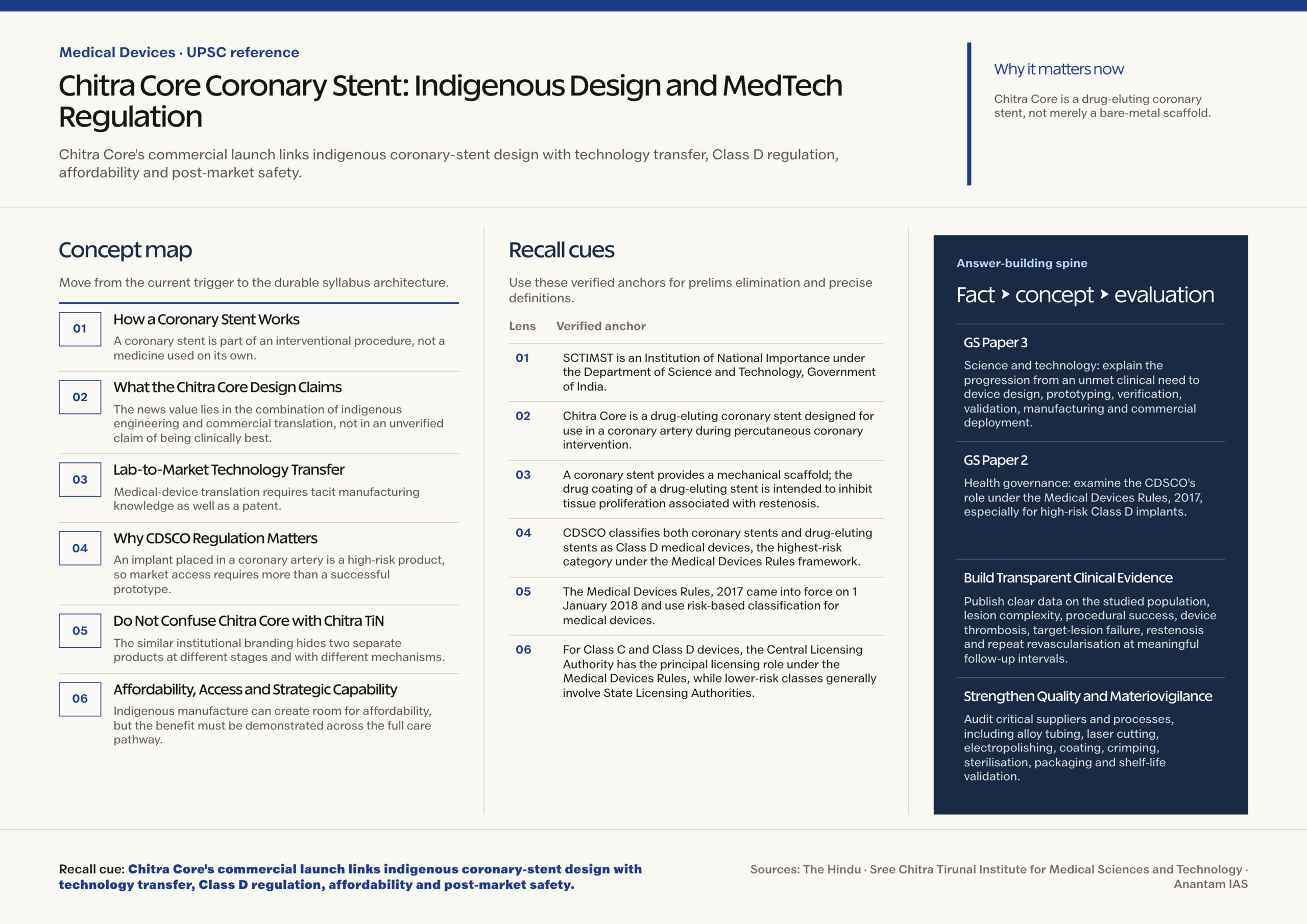
- SCTIMST is an Institution of National Importance under the Department of Science and Technology, Government of India.
- Chitra Core is a drug-eluting coronary stent designed for use in a coronary artery during percutaneous coronary intervention.
- A coronary stent provides a mechanical scaffold; the drug coating of a drug-eluting stent is intended to inhibit tissue proliferation associated with restenosis.
- CDSCO classifies both coronary stents and drug-eluting stents as Class D medical devices, the highest-risk category under the Medical Devices Rules framework.
- The Medical Devices Rules, 2017 came into force on 1 January 2018 and use risk-based classification for medical devices.
- For Class C and Class D devices, the Central Licensing Authority has the principal licensing role under the Medical Devices Rules, while lower-risk classes generally involve State Licensing Authorities.
Mains Relevance
GS Paper 3
- Science and technology: explain the progression from an unmet clinical need to device design, prototyping, verification, validation, manufacturing and commercial deployment.
- Indigenisation: assess how domestic intellectual property, process know-how, components and quality systems can reduce strategic dependence in high-risk medical devices.
GS Paper 2
- Health governance: examine the CDSCO’s role under the Medical Devices Rules, 2017, especially for high-risk Class D implants.
- Public policy: balance affordability and access with informed consent, procurement quality, adverse-event reporting and independent clinical evaluation.
Essay
- Self-reliance is capability, not a label: a medical device becomes socially valuable only when indigenous science is converted into safe, scalable and accessible care.
Background and Context
How a Coronary Stent Works
A coronary stent is part of an interventional procedure, not a medicine used on its own.
- Atherosclerotic plaque can narrow a coronary artery and restrict oxygen-rich blood reaching heart muscle. In selected patients, cardiologists perform percutaneous coronary intervention to open the narrowed segment.
- A compressed stent is carried on a balloon catheter to the lesion. Balloon inflation expands both the narrowed segment and the metal scaffold; after the balloon is withdrawn, the stent remains to help keep the lumen.
- A bare-metal stent supplies structural support, but healing tissue can grow within it. A drug-eluting stent adds controlled local release of a medicine intended to limit excessive neointimal proliferation and reduce restenosis.
- Clinical success depends on more than the implant. Lesion selection, deployment technique, complete expansion, antiplatelet management, patient adherence and follow-up can all affect outcomes.
What the Chitra Core Design Claims
The news value lies in the combination of indigenous engineering and commercial translation, not in an unverified claim of being clinically best.
- Chitra Core is described as SCTIMST’s first commercially launched coronary stent and as a drug-eluting product derived from a patented indigenous design.
- The reported lower metal-to-artery ratio seeks to reduce the amount of metal in contact with the vessel wall. In engineering terms, less metal may affect flexibility, deliverability and vessel interaction.
- Stent engineering involves trade-offs among strut geometry, radial support, longitudinal strength, recoil, foreshortening, fatigue resistance, flexibility, coating integrity and catheter deliverability. One attractive design feature cannot substitute for full-device testing.
- The appropriate formulation is that the design is intended to reduce vessel injury. Comparative clinical superiority would require adequately designed studies with defined endpoints and follow-up, not inference from geometry alone.
Lab-to-Market Technology Transfer
Medical-device translation requires tacit manufacturing knowledge as well as a patent.
- SCTIMST combines a hospital environment with a Biomedical Technology Wing. That arrangement can help engineers define clinical needs with doctors and evaluate whether a prototype fits real procedural constraints.
- A technology-transfer package may include design specifications, material requirements, manufacturing processes, jigs and fixtures, quality-control procedures, test reports and a design dossier. The receiving firm must convert these into a reproducible, validated production process.
- The industry partner carries responsibilities such as process scale-up, supplier qualification, quality management, sterilisation and packaging validation, regulatory submissions, distribution, complaint handling and corrective action.
- The Chitra Core case illustrates an innovation chain: publicly supported research can generate intellectual property, while industry supplies manufacturing scale and market access under regulatory oversight.
Why CDSCO Regulation Matters
An implant placed in a coronary artery is a high-risk product, so market access requires more than a successful prototype.
- Under India’s risk-based framework, a drug-eluting stent is a Class D device. The classification reflects the potential consequences of device failure and drives stronger evidence, licensing and quality requirements.
- The Medical Devices Rules, 2017 cover licensing, quality systems, clinical investigation, import or manufacture, labelling and post-market obligations. The precise submission depends on the device, novelty, intended use and evidence already available.
- A CDSCO manufacturing licence shows that the product has crossed the applicable regulatory gate; it should not be translated into a claim that every patient will have a better outcome or that long-term surveillance is unnecessary.
- Materiovigilance connects adverse-event reports, complaint investigation, signal detection, field safety corrective action and recalls. For permanent implants, this feedback loop is central to public trust.
Way Forward
Build Transparent Clinical Evidence
- Publish clear data on the studied population, lesion complexity, procedural success, device thrombosis, target-lesion failure, restenosis and repeat revascularisation at meaningful follow-up intervals.
- Use independent registries and appropriately designed comparative studies before making broad claims about superiority, safety or reduced vessel injury.
- State the device’s licensed sizes, indications and contraindications clearly so promotional language does not outrun the approved evidence.
Conclusion
- Chitra Core is significant because it shows an indigenous coronary-stent design moving from a public research institution into regulated commercial use.
- The strongest measure of success will be neither the launch ceremony nor the indigenous label.
UPSC Practice Questions
Prelims MCQ 1
With reference to coronary stents in India, consider the following statements:
- A drug-eluting coronary stent combines a mechanical scaffold with a coating intended to inhibit restenosis.
- Drug-eluting stents are classified as Class D medical devices under India’s regulatory framework.
- A technology-transfer agreement by itself is equivalent to a CDSCO licence for commercial manufacture.
How many of the above statements are correct?
(a) Only one (b) Only two (c) All three (d) None
Answer: (b) Only two
Explanation:
Statements 1 and 2 are correct. A drug-eluting stent supplies mechanical support and local drug release, and CDSCO places it in Class D. Technology transfer passes know-how or rights to a manufacturer but does not replace the applicable manufacturing and marketing licence.
Prelims MCQ 2
Which one of the following correctly distinguishes Chitra Core from the separate Chitra TiN coronary-stent project?
(a) Chitra Core is a neurovascular flow diverter, while Chitra TiN is a coronary device (b) Chitra Core is a commercially launched drug-eluting coronary stent, while Chitra TiN is a TiN-coated bare-metal platform still on an earlier evaluation pathway (c) Chitra Core is a Class A device, while Chitra TiN is a Class B device (d) Chitra Core is imported, while Chitra TiN has completed global commercial deployment
Answer: (b) Chitra Core is a commercially launched drug-eluting coronary stent, while Chitra TiN is a TiN-coated bare-metal platform still on an earlier evaluation pathway
Explanation:
Chitra Core is the commercially launched drug-eluting product in the news. Official SCTIMST material describes Chitra TiN as an L605 alloy, titanium-nitride-coated bare-metal system whose industry partner must complete further evaluation and regulatory work.
UPSC Mains Questions
- Indigenous medical-device innovation succeeds only when design capability is matched by regulatory science, quality manufacturing and post-market evidence. Discuss with reference to high-risk cardiovascular implants. (250 words)
- Explain the role of technology transfer in India’s medical-device ecosystem. Why must technology transfer, regulatory approval and clinical superiority be treated as three distinct questions? (250 words)
Sources: The Hindu and Sree Chitra Tirunal Institute for Medical Sciences and Technology.
Frequently Asked Questions
What is Chitra Core?
Chitra Core is an indigenous drug-eluting coronary stent developed from SCTIMST technology and commercially launched after technology transfer and the applicable CDSCO licensing pathway. It mechanically supports a narrowed coronary artery and carries a drug coating intended to reduce tissue.
What does a lower metal-to-artery ratio mean?
It means that a smaller proportion of the vessel wall is covered by the stent’s metal structure. The feature may influence flexibility, delivery and vessel interaction, but it cannot alone prove better clinical outcomes. Radial strength, expansion, fatigue, coating integrity.
Is Chitra Core the same as the Chitra TiN-coated stent?
No. Chitra Core is the commercially launched drug-eluting coronary stent in the present news. Chitra TiN is a separate L605 alloy, titanium-nitride-coated bare-metal platform. Official SCTIMST material places the TiN project on an earlier development and evaluation pathway.
Why are drug-eluting stents classified as Class D devices in India?
They are implanted in coronary arteries, remain in the body and can cause grave harm if design, manufacture or deployment fails. India’s risk-based system consequently places coronary and drug-eluting stents in Class D, bringing them under the strongest tier of.
Does CDSCO licensing prove that Chitra Core is superior to imported stents?
No. Licensing permits manufacture and marketing after the applicable regulatory review; it does not establish superiority over every alternative. A superiority claim needs suitable head-to-head clinical evidence, defined endpoints, adequate follow-up and transparent reporting.