Chrome Shavings to Syntans: Recovering Protein for Leather Retanning
Why in News?
On 16 September 2026, CSIR presented a CLRI technology that converts chrome shavings into protein-based syntans for leather retanning at a technology-transfer event.
- The process recovers chromium-free protein hydrolysate and converts it into acrylic-, phenolic- and melamine-based syntans.
- The release reports commercial-scale validation at 1,500 kg and says the patented technology is ready for commercial licensing.
- According to CLRI, adoption can reduce total dissolved solids by up to 50% in the post-tanning stream; this is a bounded performance claim.
- Chrome shavings contain valuable collagen protein, but their waste status and chromium content complicate straightforward reuse.
- Recovering that material for retanning connects waste management with input production within the leather-processing chain.
UPSC Relevance
Prelims Relevance
- CSIR-CLRI: Central Leather Research Institute, Chennai.
- Collagen: the protein resource identified in chrome shavings.
- Protein hydrolysate: the recovered protein-derived intermediate used in the announced process.
- Syntans: synthetic tanning agents; the reported products are used in retanning.
- TDS: total dissolved solids, a water-quality measure distinct from an overall toxicity assessment.
Mains Relevance
GS Paper 3
- Circular economy: recovering useful material from industrial waste.
- Science and industry: technology transfer, process validation and commercial adoption.
- Pollution control: measuring specific benefits without losing sight of remaining waste streams.
Essay
- Resource efficiency requires both useful recovery and credible environmental safeguards.
Background and Context
Why leather waste still contains a useful resource
The useful starting point is the material inside the waste, rather than the assumption that every discarded material is ready for reuse.
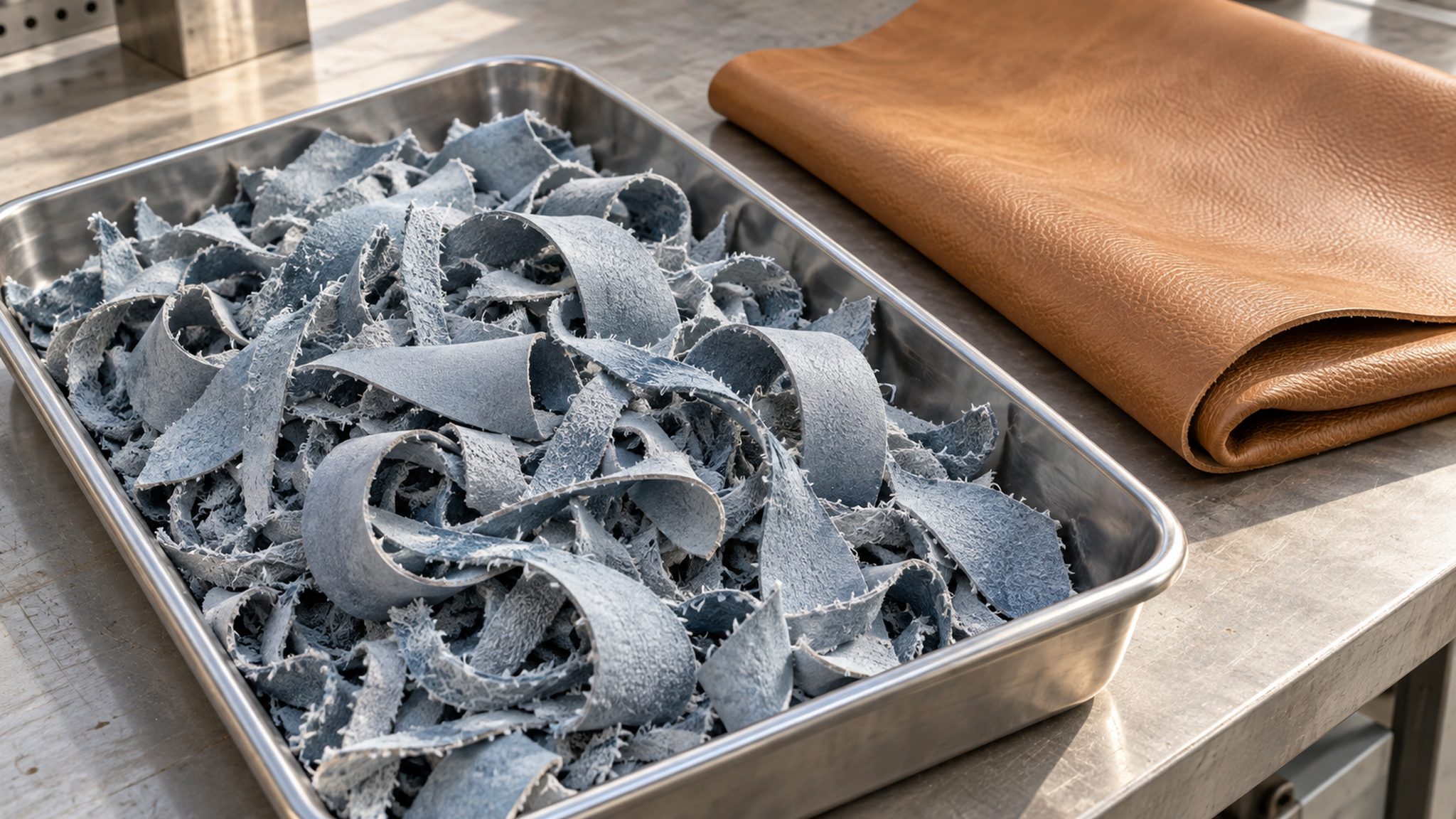
- Chrome shavings are a solid leather-industry waste containing collagen protein. The announced technology targets this recoverable component, showing how an industrial residue can retain useful material even when it presents a waste-management problem.
- Chromium-free hydrolysate describes the recovered protein intermediate in CLRI’s process. It does not mean the original waste was chromium-free, or that all substances separated during processing can be released without further environmental assessment.
- Material recovery differs from directly adding untreated shavings back into production. The announced route first produces a usable intermediate and then converts it into retanning agents, making processing quality central to the claimed circular pathway.
- Product specifications matter because a recovered material must perform a useful function in its next application. Waste diversion alone cannot establish that the resulting chemical is suitable for consistent use in industrial leather processing.
- Circularity connects recovery with a credible end use. The wider question, also raised by e-waste recovery decisions, is whether economic value and environmental protection improve together rather than simply shifting a waste burden elsewhere.
From protein intermediate to retanning agents
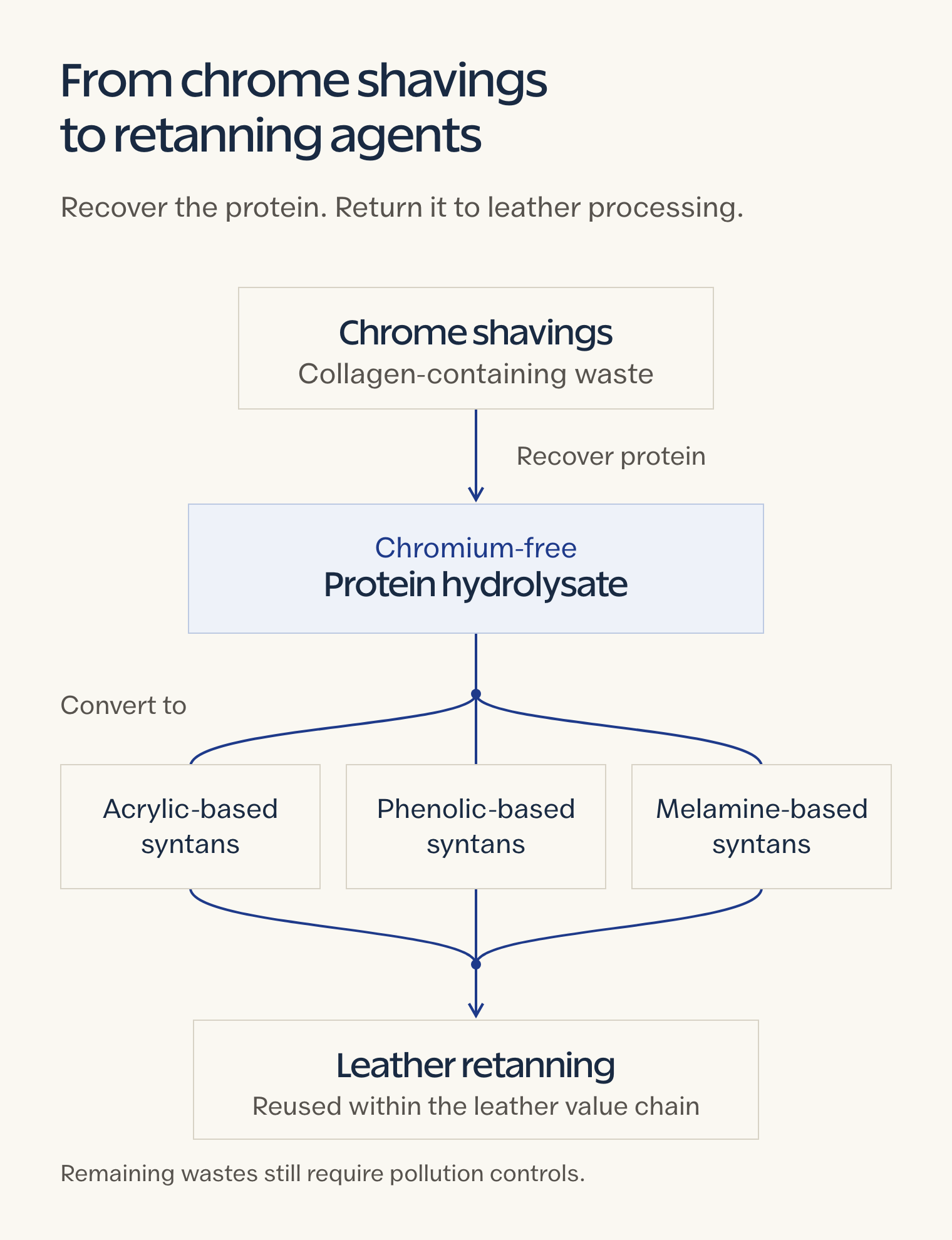
The pathway has distinct stages: recover the intermediate, manufacture useful agents, and return them to leather processing.
- The first reported output is protein hydrolysate recovered without chromium. This intermediate is the bridge between a difficult waste stream and further chemical manufacture; it should not be confused with the finished retanning formulation.
- The hydrolysate is converted into acrylic-, phenolic- and melamine-based syntans. These are the product categories identified by the release, not a sequence in which acrylic becomes phenolic and then transforms into melamine.
- Retanning is the destination of these products within leather processing. CLRI’s technical description explains that protein-based agents can contribute to fullness and grain properties, illustrating why recovery must be connected to useful product performance.
- The reuse connection is within the leather value chain: material recovered from a leather-industry residue becomes an input for further leather processing. This does not establish complete recovery of every constituent of the original shavings.
- Industrial validation helps assess whether the method can operate beyond laboratory conditions. Like testing an industrial by-product for road use, the step is demonstrating application-specific performance rather than assuming all recovered material is automatically usable.
What the pollution claim establishes and what it does not
An environmental result must retain its metric, process boundary and attribution before it can support a wider sustainability argument.
- Total dissolved solids measures dissolved material in water. A reduction in this measure can be useful, but it does not by itself identify every contaminant or demonstrate that an entire effluent stream is harmless.
- The reported benefit concerns the post-tanning stream. Extending it to every stage of a tannery would change the claim’s scope; the release does not establish an equivalent reduction across the plant’s combined wastewater discharge.
- Up to indicates a maximum reported potential rather than a guaranteed result for every operator. CLRI attributes the benefit to adoption of the technology; routine plant performance would still need measurement under operating conditions.
- Separated residues remain part of environmental assessment even when the recovered intermediate is useful. A responsible appraisal should ask what happens to chromium-bearing material and other outputs, without inventing a disposal route absent from the announcement.
- Commercial readiness is different from widespread adoption. The release’s validation and licensing statements support industrial potential, but they do not show nationwide deployment, universal cost savings or a measured reduction in the sector’s total pollution burden.
Way Forward
Validate the whole material balance
- Require clear input, product and residue records so recovery can be assessed without overlooking material that leaves the useful-product pathway.
- Verify retanning performance and stream-specific TDS under actual operating conditions, using comparable measurements before and after adoption.
- Pair technology-transfer support with handling guidance, quality checks and responsible management of remaining wastes.
Conclusion
- The chrome-shavings pathway illustrates useful circular manufacturing: recover a protein intermediate, convert it into retanning agents and connect waste recovery with a defined industrial application.
- For an exam answer, preserve the distinction between resource recovery and complete pollution control. A bounded TDS benefit strengthens the case for assessment; it does not remove the need to manage other outputs.
UPSC Practice Questions
Prelims MCQ 1
With reference to the announced CSIR-CLRI technology, consider the following statements:
- Chromium-free protein hydrolysate is recovered from chrome shavings.
- The recovered intermediate is converted into syntans for leather retanning.
- The reported TDS benefit proves that all tannery effluent is harmless.
How many of the above statements are correct?
(a) Only one (b) Only two (c) All three (d) None
Answer: (b) Only two
Explanation:
Statements 1 and 2 describe the announced pathway. Statement 3 overstates a claim limited to TDS in the post-tanning stream.
Prelims MCQ 2
Which sequence correctly represents the announced material pathway?
(a) Chrome shavings → chromium-free protein hydrolysate → syntans → leather retanning (b) Chrome shavings → steel aggregate → road construction (c) Finished syntans → raw collagen → chromium extraction from ore (d) Untreated shavings → direct discharge into post-tanning water
Answer: (a) Chrome shavings → chromium-free protein hydrolysate → syntans → leather retanning
Explanation:
CLRI recovers a protein intermediate, converts it into acrylic-, phenolic- and melamine-based syntans, and uses these in retanning.
UPSC Mains Questions
- Explain how recovering protein-based retanning agents from chrome shavings illustrates circular-economy principles. What safeguards should accompany industrial adoption?
- Why must environmental claims specify their metric and process boundary? Discuss with reference to the reported TDS benefit of CLRI’s leather-processing technology.
Sources: PIB, Ministry of Science & Technology and CSIR-CLRI, Leather Chemicals.
Frequently Asked Questions
What are chrome shavings in this technology?
They are a solid waste from the leather industry containing useful collagen protein. The CLRI process recovers a chromium-free protein intermediate from this material for further conversion into retanning agents.
What products are made from the recovered protein?
The announced process converts protein hydrolysate into acrylic-, phenolic- and melamine-based syntans. These are useful categories of retanning agents, not three successive stages in a single chemical conversion sequence.
Does lower TDS mean all effluent is safe?
No. TDS measures dissolved material, while overall environmental safety involves other characteristics too. The reported reduction concerns the post-tanning stream and cannot establish harmlessness of all wastewater or remaining residues.
Is the technology already used throughout the leather industry?
The release reports commercial-scale validation and readiness for licensing. Those statements support industrial potential, but they do not establish nationwide adoption or measured environmental gains across the entire leather industry.
Why is this a circular-economy example?
It links a leather-industry waste to a useful input for retanning. That recovery reduces reliance on disposal as the only pathway, while remaining residues and product performance still require assessment.