Coal India Smart Mining: From Remote Sensing to Safer Operations
Why in News?
The Coal Ministry’s 15 September 2026 update described Coal India’s smart-mining systems, pilots and development projects, linking digital monitoring with safer operations and equipment maintenance.
- Deployed systems include command centres, vehicle tracking, RFID, automated weighbridges and GPS fleet monitoring.
- DigiCoal tested 17 solutions in seven mines; broader replication is a stated next step, not evidence of nationwide completion.
- Remote-operated line-of-sight dozers are being piloted; underground networks, digital twins and monitoring rovers are under development.
- Mining safety depends on connecting reliable information to timely action, rather than simply installing more screens and sensors.
- Operational status matters: a deployed tracking system, a field pilot and a developing autonomous tool represent different levels of demonstrated capability.
UPSC Relevance
Prelims Relevance
- Operational technology monitors or controls physical equipment and processes.
- RFID identifies tagged objects using radio-frequency communication.
- Predictive maintenance uses condition information to anticipate maintenance needs.
- Remote operation is distinct from autonomous operation.
- A digital twin is a digital representation of a physical asset or system used for analysis.
Mains Relevance
GS Paper 3
- How sensing, communication and supervised action can reduce occupational exposure.
- Limits of digitalisation: reliability, skills, cybersecurity and local operating conditions.
- Why safer and more efficient mining does not eliminate coal-related environmental impacts.
Essay
- Technology improves safety when information becomes accountable action.
Background and Context
From mine data to an operational decision
Smart mining connects observations about equipment, movement and working conditions with decisions about dispatch, maintenance and safety; each stage needs a usable response.
- Sensing and tracking establish what equipment is doing and where it is located. Coal India reports deployed vehicle tracking, RFID and GPS fleet monitoring; these tools provide operational visibility rather than automatically making machines autonomous.
- Command centres bring information together so responsible personnel can coordinate operations. A display becomes useful when teams can interpret an alert, identify the relevant equipment and decide what action is appropriate for the situation.
- Vehicle-health monitoring supplies information about equipment condition, while payload and dispatch systems support management of work. Their functions differ: locating a truck, measuring its load and assessing its condition answer separate operational questions.
- Predictive maintenance uses condition patterns to anticipate problems and plan intervention. It can support earlier action, but a prediction still needs inspection, scheduling and repair; recording a warning is not the same as removing a hazard.
- Operational technology differs from office IT. Tracking equipment and controlling physical processes concern mine operations; procurement, finance and personnel systems support enterprise administration. Digitalisation in one area does not establish equivalent capability in the other.
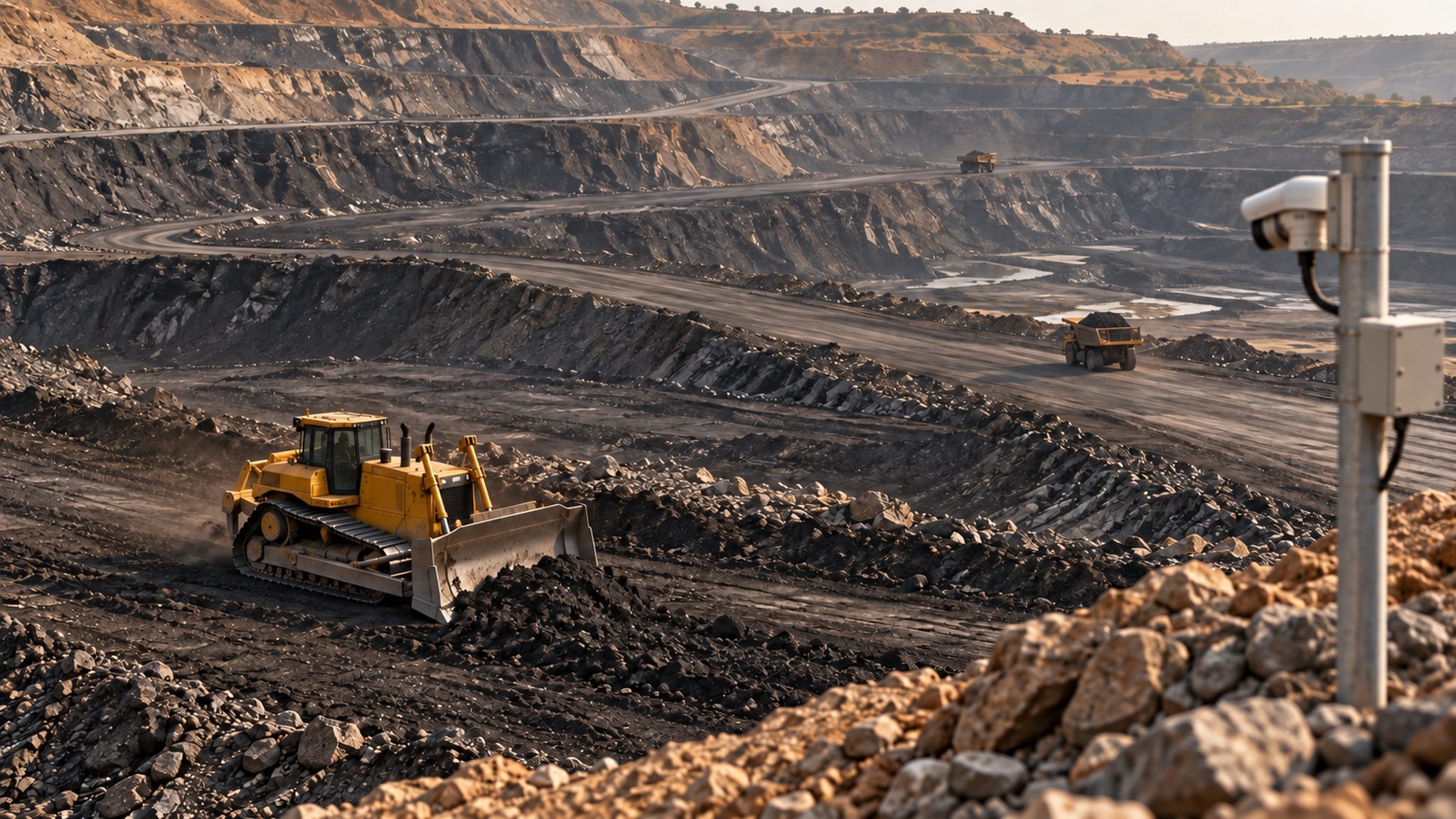
Remote action needs feedback and human responsibility
The safety objective is to reduce hazardous exposure while retaining reliable supervision, communication and the ability to verify what happened after a command.
- Remote-operated line-of-sight dozers are being piloted in SECL and NCL, according to the update. Remote control can separate an operator from the machine, but it must not be described as unrestricted autonomous operation.
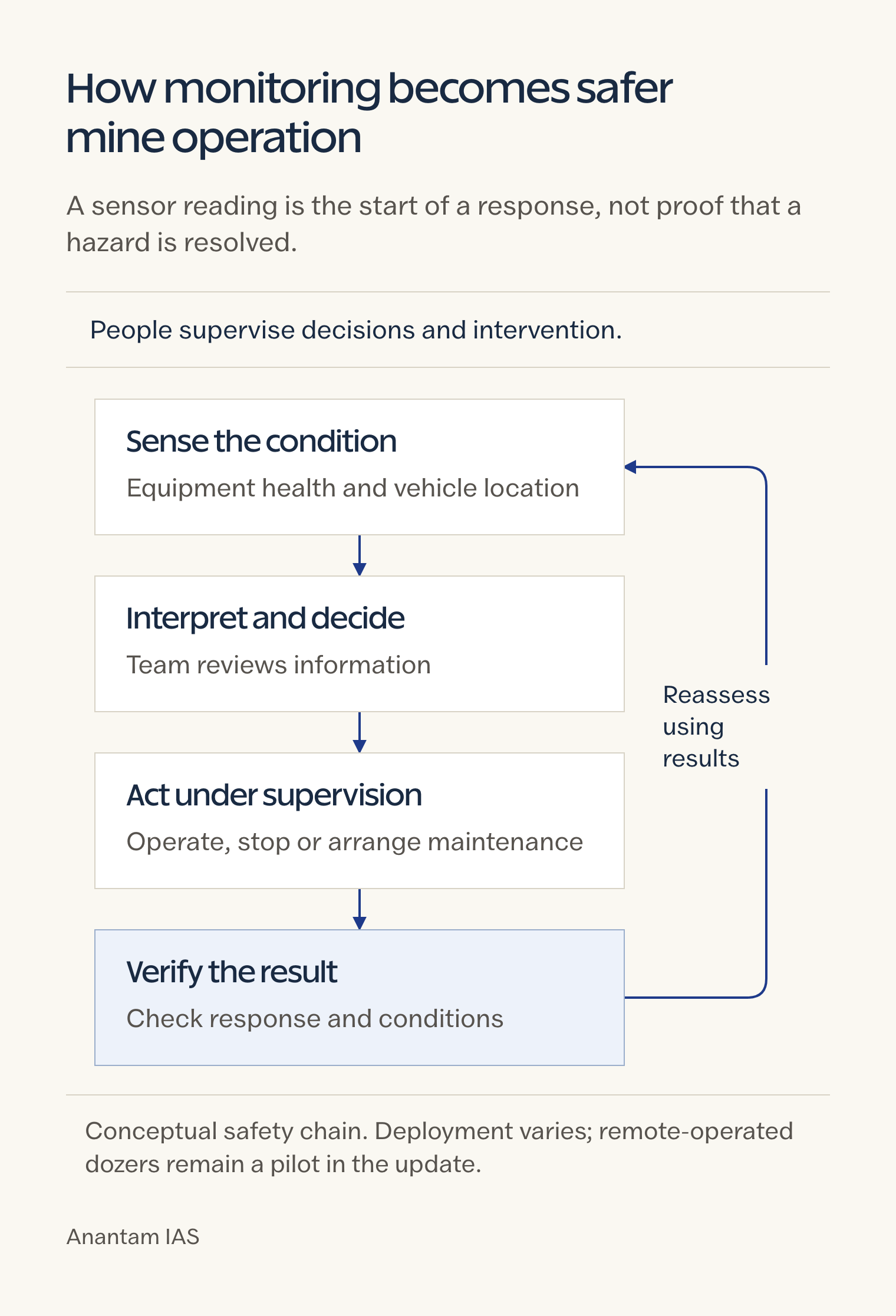
- The control chain runs from observation to a decision, a command and confirmation of the result. This is a conceptual explanation of safe remote operation, not a claim that every Coal India mine uses identical architecture.
- Feedback matters because sending a command does not prove that the intended action occurred. Equipment response and surrounding conditions must remain observable; responsibility for stopping unsafe work cannot be replaced by confidence in a dashboard.
- Safety features being incorporated include fatigue monitoring, proximity warnings, cameras and automatic fire detection or suppression. Their different purposes show why a single sensor cannot substitute for the full range of operational safety measures.
- Skills remain part of the system. The release identifies training and capacity constraints alongside technology adoption. Operators and maintenance teams need to understand alerts, limitations and intervention procedures as equipment becomes connected and digitally managed.
Pilots, environmental monitoring and the limits of automation
The update includes deployed tools alongside future plans. Keeping these categories separate prevents a technology roadmap from being mistaken for an already completed transformation.
- DigiCoal’s tested solutions are not universal deployment. Replication across mega mines is a future direction in the release; evidence from pilot sites should guide adaptation to local geology, equipment and operating conditions before broader implementation.
- Underground networks, digital twins and autonomous monitoring rovers are under development. These projects may support communication and simulation, but their mention does not establish that all underground mines already operate with autonomous inspection or control.
- Satellite and drone information can support mine monitoring and environmental auditing. The forest-roadmap discussion on better inventories offers a related measurement lesson: observations must be translated into dependable information before they support management decisions.
- Operational improvements do not replace environmental decisions. The Tara coal-block boundary discussion concerns a different governance stage; digital monitoring of machinery cannot by itself resolve questions about project location, ecological impact or appropriate mining boundaries.
- Safer mining is not impact-free mining. Better monitoring, dispatch and maintenance can address particular operational problems, but the update does not prove elimination of coal-related emissions, land disturbance or every occupational risk associated with extraction.
Way Forward
Scale verified safety functions
- Evaluate pilots against operational outcomes, including hazard exposure, maintenance response and reliability, before replicating tools across mines with different conditions.
- Specify human responsibility and fallback procedures for communication failure, uncertain readings and unsafe equipment responses.
- Protect connected operational systems through information security, controlled access and staff training, while retaining independent safety and environmental oversight.
Conclusion
- The useful unit of smart mining is a complete safety chain: dependable sensing, informed decisions, supervised action and verified results. Hardware and dashboards alone cannot guarantee safer work or effective maintenance.
- Distinguish deployed systems, pilots and development projects. Coal India’s update supports an answer on industrial modernisation, but claims about nationwide autonomy or elimination of environmental impacts go beyond the evidence it provides.
UPSC Practice Questions
Prelims MCQ 1
With reference to the Coal Ministry’s September 2026 technology update, consider the following statements:
- Coal India reports deployed GPS fleet monitoring and RFID systems.
- Remote-operated line-of-sight dozers are described as pilots.
- The update establishes nationwide autonomous operation of all underground mines.
How many of the above statements are correct?
(a) Only one (b) Only two (c) All three (d) None
Answer: (b) Only two
Explanation:
Statements 1 and 2 are correct. Underground networks, digital twins and monitoring rovers are under development; the release does not establish nationwide autonomy.
Prelims MCQ 2
Which example best describes predictive maintenance?
(a) Inferring equipment problems from condition trends to plan inspection and repair (b) Assuming every machine is safe because its position is known (c) Replacing maintenance staff with a digital map (d) Treating all sensors as autonomous controllers
Answer: (a) Inferring equipment problems from condition trends to plan inspection and repair
Explanation:
Predictive maintenance uses condition information to support timely intervention. Location tracking alone does not diagnose equipment health, and a prediction still needs an appropriate maintenance response.
UPSC Mains Questions
- Explain how sensing, communication and supervised remote operations can improve mine safety. What institutional and technical conditions determine their effectiveness? (150 words)
- A digitalisation roadmap should not be confused with demonstrated operational transformation. Discuss with reference to Coal India’s deployed systems, pilots and developing technologies. (250 words)
Source: PIB, Ministry of Coal.
Frequently Asked Questions
What is the main idea behind smart mining?
Smart mining uses connected information and control tools to support operational decisions, maintenance and safety. Its value depends on linking observations to timely action rather than merely collecting data or adding dashboards.
Are Coal India’s remote dozers fully autonomous?
The update describes remote-operated line-of-sight dozers as pilots in SECL and NCL. That wording does not establish fully autonomous operation or deployment across all mines; remote control and autonomy are different capabilities.
Which technologies are still under development?
The release places underground networks, digital twins and autonomous monitoring rovers under development. Their proposed roles include communication, automation and simulation, but this should not be presented as completed nationwide implementation.
Does smart mining eliminate coal’s environmental impacts?
No. Monitoring and operational improvements address specific problems, such as equipment management or hazardous exposure. They do not by themselves establish elimination of emissions, land disturbance or the need for environmental assessment and oversight.