Citizenship Amendment Act

Why in News:
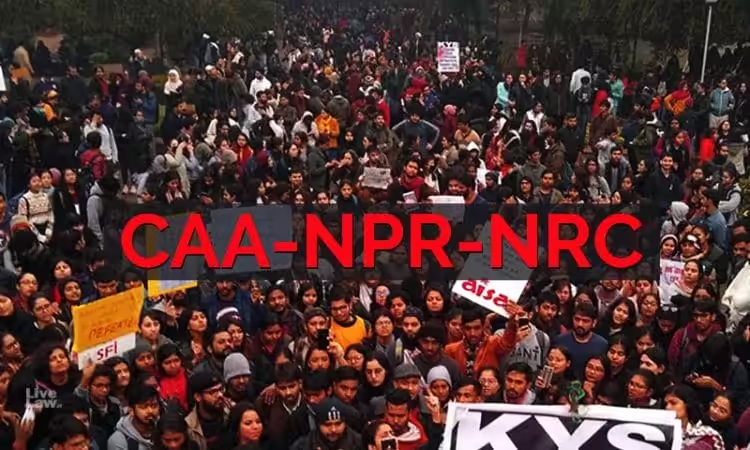
185 Pakistani refugees were officially granted Indian citizenship under the Citizenship (Amendment) Act, 2019 (CAA) in Gujarat’s Rajkot. This marks a major implementation milestone for the CAA, which had seen a long delay in granting citizenship after its passage.
UPSC relevance: GS II
UPSC CSE in prelims as well as in mains examination has focused on Citizenship and Amendments in citizenship act made by GOI for Citizenship. A case in point is a following PYQ.
UPSC Prelims 2021
With reference to India, consider the following statements:
- There is only one citizenship and one domicile.
- A citizen by birth only can become the Head of State.
- A foreigner once granted citizenship cannot be deprived of it under any circumstance
Which of the statements given above is/are correct?
a) 1 only
b) 2 only
c) 1 and 3
d) 2 and 3
Difference Between NPR and NRC:
| Feature | NPR (National Population Register) | NRC (National Register of Citizens) |
| Legal Basis | Citizenship Act, 1955 and Rules (2003) | Citizenship Act, 1955 and Rules (2003) |
| Purpose | To create a database of usual residents of India | To identify Indian citizens and exclude illegal migrants |
| Who is Included? | All usual residents (citizens + non-citizens) living in India | Only Indian citizens |
| Documents Required | No documents needed at initial stage; based on self-declaration | Proof of Indian citizenship needed (birth certificates, etc.) |
| Implemented By | Registrar General of India (under Ministry of Home Affairs) | Registrar General of India (for national NRC); Assam by state govt under SC supervision |
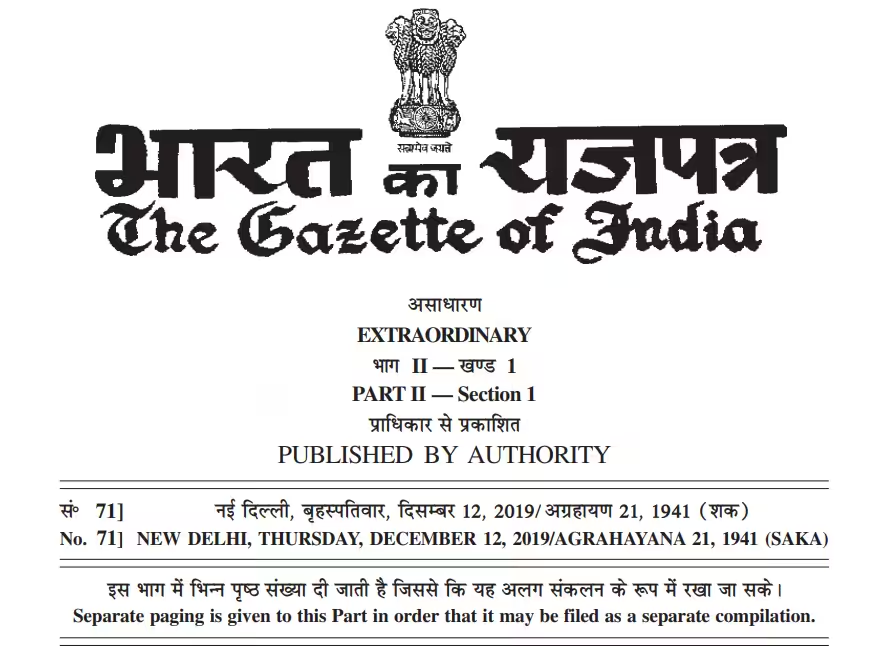
Citizenship Act, 2019:
Source
Provisions:
- Provided that any person belonging to Hindu, Sikh, Buddhist, Jain, Parsi or
Christian community from Afghanistan, Bangladesh or Pakistan, who entered into
India on or before the 31st day of December, 2014. - Definition of illegal migrants: The Act prohibits illegal migrants from acquiring Indian citizenship. It defines an illegal migrant as a foreigner: (i) who enters India without a valid passport or travel documents, or (ii) stays beyond the permitted time.
- In order to get this benefit, they must have also been exempted from the Foreigners Act, 1946 and the Passport (Entry into India) Act, 1920 by the central government. The 1920 Act mandates foreigners to carry passport, while the1946 Act regulates the entry and departure of foreigners in India.
- To obtain citizenship by naturalization, one of the qualifications is that the person must have resided in India or have been in service of the central government for at least 11 years before applying for citizenship.
- Cancellation of registration of OCIs: The Act provides that the central government may cancel registration of OCIs on certain grounds. These include: (i) if the OCI has registered through fraud, or (ii) if within five years of registration, the OCI has been sentenced to imprisonment for two years or more, or (iii) if it becomes necessary in the interest of sovereignty and security of India.
NOTE: Nothing in this section shall apply to tribal area of Assam, Meghalaya, Mizoram or Tripura as included in the Sixth Schedule to the Constitution and the area covered under “The Inner Line” notified under the Bengal Eastern Frontier Regulation, 1873.
Issues:
- Violation of Article 14: Article 14 of the Constitution which guarantees all ‘persons’ (not only citizens) equality before the law and equal protection of law. They also argue that making religion a qualifier for citizenship violates secularism, which is a basic feature of the Constitution.
- The special treatment given to the specific “persecuted religious minorities” from the three Muslim-majority neighbouring countries does not constitute a “reasonable classification” under Article 14. More so because groups like the Tamil Hindus in Sri Lanka, the Rohingyas in Myanmar and minority Muslim sects like the Hazaras in Afghanistan also face persecution but have been denied similar protection under this law.
- Tt is also unclear why there is a differential treatment of migrants based on their date of entry into India, i.e., whether they entered India before or after December 31, 2014.
- Bill also excludes illegal migrants residing in areas covered by the Sixth Schedule, that is, notified tribal areas in Assam, Meghalaya, Mizoram and Tripura. The purpose behind the enactment of the Sixth Schedule of the Constitution was to aid in the development of tribal areas through autonomous councils, while protecting the indigenous population in these areas from exploitation and preserving their distinct social customs.