Modern Civil Defence Network for Critical Infrastructure
Why in News?
In his Independence Day address on 15 August 2026 , the Prime Minister announced a nationwide voluntary Civil Defence network designed for modern security risks rather than only the older image of wartime preparedness near India’s borders.
- The proposed network is voluntary and national in ambition, placing trained citizens and institution-level readiness within the wider security architecture.
- Its stated focus reflects a change in the threat environment: disruption can reach the hinterland through sabotage, drones, cyber incidents, fire, hazardous-material emergencies or cascading failures in essential services.
- The announcement named both physical and digital assets, showing that resilience now depends on the continuity of energy, finance, communications, data and industrial production.
- No official operational design has yet assigned a lead ministry, recruitment channel, volunteer strength, training syllabus or site list for the new network. These details should be treated as pending.
- For UPSC answers, the initiative should be assessed as a proposal to modernise community preparedness, not as a new armed force or proof that a nationwide system is already operational.
- Modern infrastructure works as an interdependent system. A power outage can disable telecom towers and data centres; payment failure can slow fuel and relief supply; a refinery accident can affect transport and local health services.
- Professional agencies cannot be present at every facility in the first minutes of an emergency. Trained local volunteers can support warning, evacuation, first aid, fire safety, crowd management and verified communication until specialist responders take charge.
- Civilian participation can increase resilience only when command, vetting, liability, training standards and limits on volunteer access to sensitive sites are clearly defined.
UPSC Relevance
Prelims Relevance
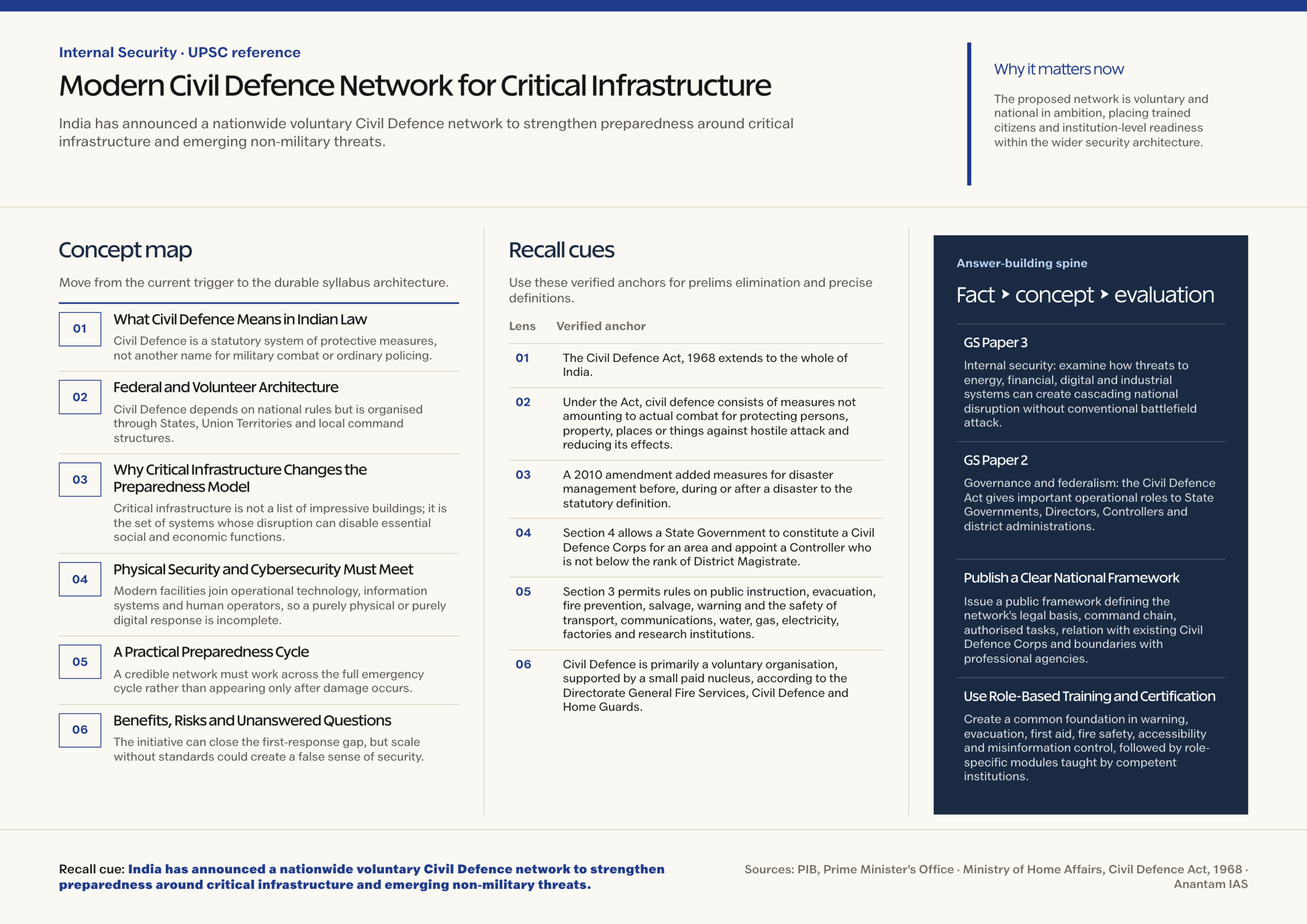
- The Civil Defence Act, 1968 extends to the whole of India.
- Under the Act, civil defence consists of measures not amounting to actual combat for protecting persons, property, places or things against hostile attack and reducing its effects.
- A 2010 amendment added measures for disaster management before, during or after a disaster to the statutory definition.
- Section 4 allows a State Government to constitute a Civil Defence Corps for an area and appoint a Controller who is not below the rank of District Magistrate.
- Section 3 permits rules on public instruction, evacuation, fire prevention, salvage, warning and the safety of transport, communications, water, gas, electricity, factories and research institutions.
- Civil Defence is primarily a voluntary organisation, supported by a small paid nucleus, according to the Directorate General Fire Services, Civil Defence and Home Guards.
Mains Relevance
GS Paper 3
- Internal security: examine how threats to energy, financial, digital and industrial systems can create cascading national disruption without conventional battlefield attack.
- Disaster management: connect community volunteers with prevention, preparedness, response, recovery and the principle of whole-of-society resilience.
GS Paper 2
- Governance and federalism: the Civil Defence Act gives important operational roles to State Governments, Directors, Controllers and district administrations.
- Institutional design: assess accountability, privacy, volunteer vetting and safeguards against overlapping commands or misuse of access to sensitive facilities.
Essay
- National security is not only the defence of territory; it is also society’s capacity to keep essential systems functioning under stress.
Background and Context
What Civil Defence Means in Indian Law
Civil Defence is a statutory system of protective measures, not another name for military combat or ordinary policing.
- The Civil Defence Act, 1968 defines it as measures that do not amount to actual combat and protect people, property, places or things from hostile attack, or reduce the effects of such an attack.
- The definition covers measures taken before, during or after a hostile attack. The law defines hostile attack broadly enough to include dangers arising during war, external aggression, internal disturbance or otherwise.
- The Civil Defence (Amendment) Act, 2009, brought into effect in 2010, added disaster-management measures before, during and after natural or human-made disasters while retaining the organisation’s primary civil-defence role.
- Section 3 authorises rules covering public instruction, storage of essential items, control of lights and sounds, fire prevention, evacuation, shelter, salvage and protection of essential facilities.
- This statutory breadth matters because the new announcement is not a complete break from the law. It can be read as an effort to update the risk model, geographic reach and operational readiness of an existing.
Federal and Volunteer Architecture
Civil Defence depends on national rules but is organised through States, Union Territories and local command structures.
- Under Section 4, a State Government may constitute a Civil Defence Corps for an area and appoint a Controller, not below the rank of District Magistrate, to command it.
- A State may appoint a Director of Civil Defence to coordinate Controllers. This makes district administration central to mobilisation, training and site-level coordination.
- Members are persons whom the State Government considers fit and willing to serve. A Controller may call members out for training or assigned civil-defence functions.
- The official Civil Defence portal describes the organisation as primarily voluntary, with a small nucleus of paid staff. It also describes training at local or district, State and national levels.
- A nationwide network will need interoperability across States without weakening local accountability. Common operating procedures can support mutual aid, while the incident authority must remain unambiguous.
Why Critical Infrastructure Changes the Preparedness Model
Critical infrastructure is not a list of impressive buildings; it is the set of systems whose disruption can disable essential social and economic functions.
- The Civil Defence Act already lists the safety of transport, communication, water, gas, electricity, warehouses, oilfields, factories, commercial undertakings and research institutions among matters for which rules may be made.
- The 2026 announcement brings this older legal scope into a setting shaped by digitised operations, remotely controlled equipment, tightly coupled supply chains and around-the-clock financial services.
- A refinery emergency can combine fire, toxic exposure, evacuation and fuel-supply disruption. A data-centre failure can affect cloud services and dependent institutions. A bank-system outage can obstruct payments needed for emergency logistics.
- These are cascading risks: the first failure may be local, but interdependence spreads its effects across sectors and districts.
- Resilience needs both hardening and continuity. Physical security, cybersecurity, backup power, alternative communication, manual fallback procedures, stockpiles and rehearsed public instructions serve different parts of the same problem.
Physical Security and Cybersecurity Must Meet
Modern facilities join operational technology, information systems and human operators, so a purely physical or purely digital response is incomplete.
- Under Section 70 of the Information Technology Act, Critical Information Infrastructure refers to computer resources whose incapacitation or destruction would have a debilitating impact on national security, the economy, public health or safety.
- The appropriate government may notify a relevant computer resource as a protected system. Section 70A provides for a national nodal agency for Critical Information Infrastructure protection.
- Civil Defence volunteers should not receive unrestricted access to protected systems or sensitive control rooms. Their useful roles can include perimeter safety, public warning, evacuation support, first aid and disciplined reporting under authorised command.
- Cyber specialists and facility operators must handle containment, restoration and evidence preservation. Volunteers need simple protocols for recognising suspicious events and escalating them without spreading rumours or sensitive details.
- Joint exercises should test mixed incidents, such as a cyber-triggered service outage accompanied by fire, crowd panic or communications failure. This reveals gaps that isolated drills miss.
Way Forward
Publish a Clear National Framework
- Issue a public framework defining the network’s legal basis, command chain, authorised tasks, relation with existing Civil Defence Corps and boundaries with professional agencies.
- Publish measurable readiness outcomes, financing arrangements and a phased coverage rationale without disclosing site vulnerabilities.
- Create a common foundation in warning, evacuation, first aid, fire safety, accessibility and misinformation control, followed by role-specific modules taught by competent institutions.
- Require practical assessment, refresher training and expiry of certification so a database entry does not become a permanent claim of competence.
Conclusion
- The proposed Modern Civil Defence network recognises a central fact of contemporary security: the home front now includes refineries, factories, payment systems, data centres and the communities living around them.
- The announcement is only a starting point.
UPSC Practice Questions
Prelims MCQ 1
With reference to the Civil Defence Act, 1968, consider the following statements:
- Civil defence measures under the Act do not amount to actual combat.
- The statutory definition includes disaster-management measures before, during or after a disaster.
- Only the Central Government may constitute a Civil Defence Corps for an area.
How many of the above statements are correct?
(a) Only one (b) Only two (c) All three (d) None
Answer: (b) Only two
Explanation:
Statements 1 and 2 are correct. The Act defines civil defence as non-combat protective measures and, after the amendment effective in 2010, includes disaster management. Statement 3 is incorrect because Section 4 permits a State Government to constitute a Civil Defence Corps for an area.
Prelims MCQ 2
Which one of the following best describes Critical Information Infrastructure under the Information Technology Act, 2000?
(a) Every computer owned by a government department (b) Any privately owned data centre with overseas customers (c) A computer resource whose incapacitation or destruction would have a debilitating impact on national security, the economy, public health or safety (d) Any social-media platform with more than one million users
Answer: (c) A computer resource whose incapacitation or destruction would have a debilitating impact on national security, the economy, public health or safety
Explanation:
Section 70 of the Information Technology Act uses the debilitating-impact test. Government ownership, foreign customers or user count alone does not satisfy this statutory definition. The appropriate government may notify qualifying computer resources as protected systems.
UPSC Mains Questions
- Modern national security requires protection of networks and services as much as protection of territory. Discuss in the context of India’s proposed nationwide Civil Defence network for critical infrastructure. (GS Paper 3)
- Community volunteers can reduce the first-response gap, but they cannot replace professional emergency services. Suggest an accountable institutional design for integrating volunteers into critical-infrastructure preparedness. (GS Paper 3)
Sources: PIB, Prime Minister's Office and Ministry of Home Affairs, Civil Defence Act, 1968.
Frequently Asked Questions
What has India announced about a modern Civil Defence network?
The Prime Minister announced a nationwide voluntary Civil Defence network on 15 August 2026, linking preparedness to modern threats facing refineries, banks, data centres, factories and other critical infrastructure. It remains an announced initiative; a detailed budget, curriculum, implementing arrangement.
Is Civil Defence the same as the armed forces or police?
No. The Civil Defence Act defines civil defence as protective measures that do not amount to actual combat. Volunteers may support warning, evacuation, first aid, fire safety and civil administration under authorised command. Armed forces, police, firefighters, cyber specialists and.
Who can constitute a Civil Defence Corps in India?
Section 4 of the Civil Defence Act allows a State Government to constitute a Corps for an area. The State may appoint a Controller, not below the rank of District Magistrate, and a Director of Civil Defence to coordinate Controllers.
Why are data centres and banks part of a Civil Defence discussion?
Digital and financial systems support payments, communications, government services and emergency logistics. Their disruption can spread across sectors even when the initial incident is local. Civil Defence can support public safety and continuity around these facilities, while authorised cyber and.
How is Critical Information Infrastructure different from critical infrastructure generally?
Critical infrastructure is a wider resilience idea covering essential physical and service systems. Critical Information Infrastructure has a specific definition under Section 70 of the Information Technology Act: a computer resource whose incapacitation or destruction would seriously affect national security.