Climate Overshoot: The Peak-and-Decline Pathway
Why in News?
On 2 September 2026, UNEP released Limiting Overshoot, assessing a multi-year exceedance of 1.5°C as likely and mapping an urgent peak-and-decline pathway.
- UNEP identifies overshoot, peak and decline as the best remaining pathway for limiting the magnitude and duration of exceedance and attempting a return below 1.5°C.
- Its most optimistic assessed scenario peaks at 1.8°C above pre-industrial levels; most other scenarios produce higher peaks, including some above 2°C.
- The report links every additional fraction of warming and year of exceedance to intensifying impacts, harder adaptation and a greater chance of crossing irreversible thresholds.
- It calls for immediate emissions cuts, stronger adaptation and carefully governed carbon dioxide removal, while rejecting removal as a replacement for mitigation.
- Overshoot does not amend the Paris Agreement: its Article 2 temperature aim remains well below 2°C while pursuing efforts to limit warming to 1.5°C.
- Policy can still shape the curve’s peak, duration and decline, which determine cumulative exposure, adaptation needs and the risk of lasting losses.
UPSC Relevance
Prelims Relevance
- Climate overshoot: a period when long-term global warming exceeds a target before potentially declining below it.
- The pathway has four stages: exceedance, peak, decline and stabilization.
- A single warm calendar year is not identical to a long-term warming threshold, which climate science assesses over longer periods.
- Net-zero balances emissions with removals; net-negative emissions remove more greenhouse gases than are emitted.
- CDR removes carbon dioxide from the atmosphere and stores it in biological, geological or other reservoirs.
- Mitigation reduces the cause of warming; adaptation reduces vulnerability and exposure to its effects.
Mains Relevance
GS Paper 3
- Climate mitigation, adaptation limits and disaster-risk reduction under an overshoot pathway
- Carbon dioxide removal, land competition, permanence and environmental integrity
GS Paper 2
- Climate justice, international cooperation and differentiated responsibility for limiting overshoot
Essay
- Climate policy must manage both avoidable risks and irreversible losses without allowing an emergency pathway to weaken the original goal.
Background and Context
Reading the Overshoot Curve
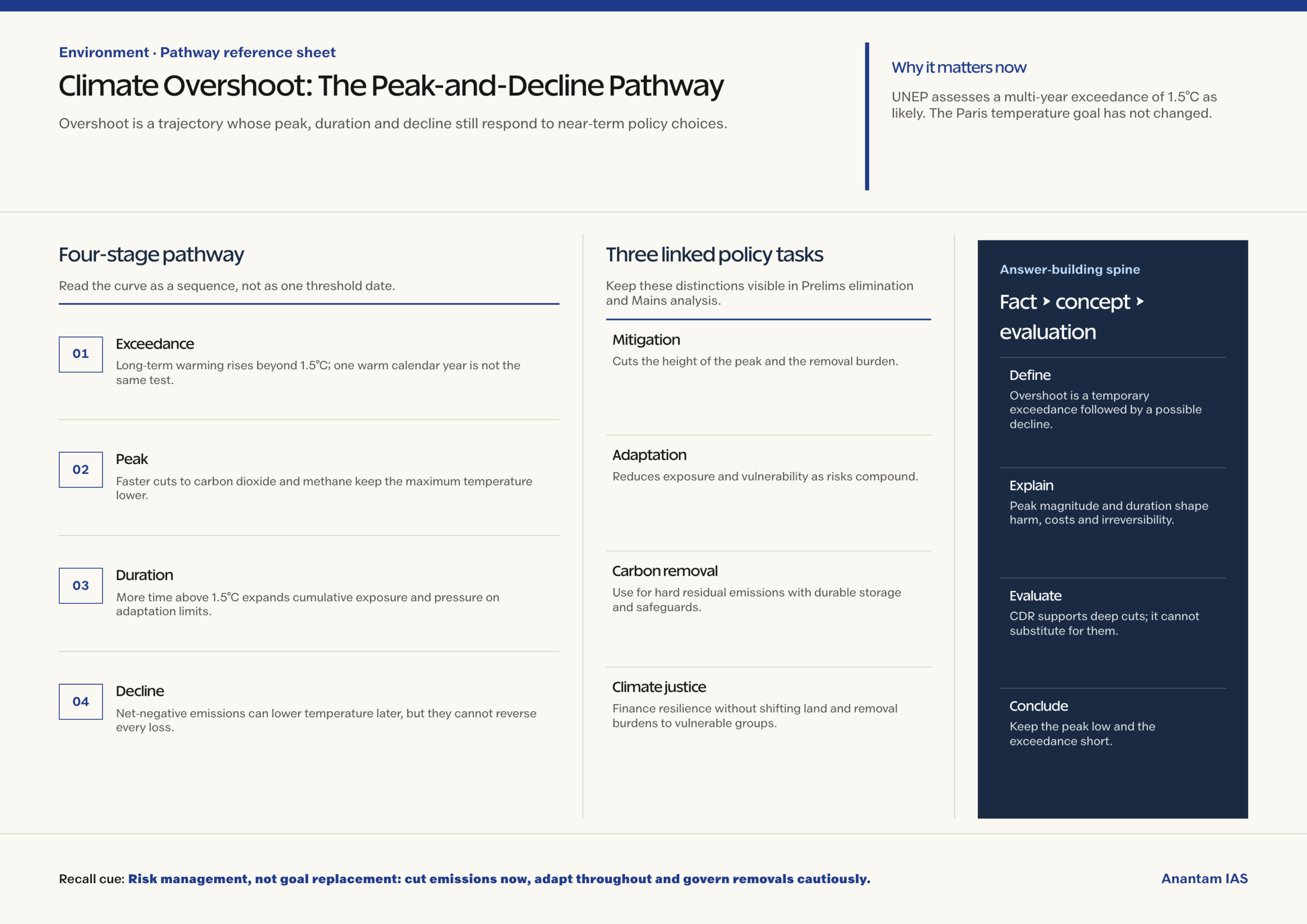
Overshoot is a changing trajectory, not one date on which the climate system suddenly crosses a legal boundary; emissions and natural variability shape it over decades.
- The exceedance stage begins when long-term warming rises beyond 1.5°C; year-to-year natural variability can still produce individual calendar years above or below that level.
- The peak is the pathway’s highest warming level, shaped chiefly by how quickly and deeply carbon dioxide, methane and other greenhouse-gas emissions fall.
- The duration is time spent above 1.5°C; a longer stay expands cumulative exposure and raises the likelihood that ecosystems or communities reach hard adaptation limits.
- The decline requires sustained net-negative emissions after net-zero, while stabilization describes the later temperature level rather than restoration of every damaged natural and human system.
- Curve shape matters because a lower peak and shorter exceedance reduce severe impacts, adaptation costs, irreversible-loss risks and pressure on uncertain future removal capacity.
Three Linked Policy Tasks
Mitigation determines how high temperatures rise, adaptation manages unavoidable harm, and removals help create a later decline after net-zero is achieved.
- Rapid, sustained emissions reduction is the first lever: fossil-fuel transition, energy efficiency and methane cuts reduce both peak warming and the scale of future removal required.
- Adaptation must evolve with changing and compounding risks through heat action, resilient infrastructure, water security, early warning and social protection for exposed populations.
- Mitigation and adaptation reinforce each other: resilient energy, food, water and natural systems preserve society’s capacity to cut emissions as repeated climate shocks intensify.
- Reaching net-zero can halt further warming, but pushing temperatures downward requires net-negative emissions, meaning verified removals exceed the remaining emissions produced over time.
- Early adaptation cannot eliminate every loss; ice sheets, sea level, ecosystems, cultural heritage and livelihoods may respond slowly or irreversibly even after global temperature declines.
Carbon Removal Without Moral Hazard
CDR is a constrained residual tool whose credibility depends on deep emissions cuts, durable storage, fair burden-sharing and accountable long-term governance globally.
- Conventional CDR includes afforestation and soil management, but large land demand can compete with food, biodiversity and livelihoods, while drought or wildfire can reverse stored carbon.
- Novel methods such as direct air capture may offer more measurable storage, yet remain expensive, energy-intensive and unproven at the required global deployment scale.
- CDR should address residual emissions that are exceptionally difficult to eliminate, not preserve avoidable fossil-fuel use, inflate weak offsets or delay near-term mitigation.
- Governance must establish additionality, credible baselines, measurement, reporting, verification, storage permanence, liability and safeguards against ecological damage or unequal land burdens.
- Even a successful temperature decline cannot recreate the previous climate; delayed sea-level rise, displacement and ecosystem losses make loss and damage a continuing international justice issue.
Way Forward
Keep the Peak Low and the Exceedance Short
The pathway remains viable only if near-term action cuts warming and vulnerability before dependence on removals grows.
- Strengthen near-term national targets with credible sectoral delivery for power, transport, industry, buildings and methane, backed by transparent progress reviews.
- Integrate adaptation planning with observed and projected risk, including finance for vulnerable countries, locally led action and protection against non-linear hazards.
- Create robust CDR standards covering lifecycle emissions, land and water effects, storage duration, community consent, independent verification and responsibility for reversal.
- Preserve climate justice by requiring historically high emitters to move faster, finance resilience and avoid shifting removal or adaptation burdens onto vulnerable communities.
Conclusion
- Overshoot is risk management, not goal replacement: the Paris temperature aim remains, while immediate choices determine the peak, duration and feasibility of decline.
- A strong answer should connect deep emissions cuts, adaptive capacity, cautiously governed residual CDR and climate justice across the entire peak-and-decline pathway.
UPSC Practice Questions
Prelims MCQ 1
With reference to climate overshoot, consider the following statements:
- It describes a pathway in which long-term warming exceeds a target before potentially declining below it.
- One calendar year above 1.5°C by itself establishes that the Paris long-term threshold has permanently been breached.
- Returning temperature downward after a peak requires net-negative emissions.
How many of the above statements are correct?
(a) Only one (b) Only two (c) All three (d) None
Answer: (b) Only two
Explanation:
Statements 1 and 3 are correct. Long-term warming is assessed over longer periods, so an individual annual anomaly is not the same as permanently crossing the long-term threshold.
Prelims MCQ 2
Which one of the following best describes the appropriate role of carbon dioxide removal in an overshoot pathway?
(a) Replacing immediate emissions reductions (b) Offsetting all present fossil-fuel emissions indefinitely (c) Complementing deep cuts by addressing residual emissions and enabling net-negative emissions (d) Guaranteeing reversal of all climate impacts
Answer: (c) Complementing deep cuts by addressing residual emissions and enabling net-negative emissions
Explanation:
UNEP treats CDR as necessary alongside sustained emissions cuts. Its role is constrained by scale, cost, permanence, land, energy and governance concerns.
UPSC Mains Questions
- Climate overshoot is a pathway to be minimized and reversed, not a revision of the Paris Agreement’s temperature goal. Discuss.
- Examine why carbon dioxide removal can support a temperature decline but cannot substitute for rapid and sustained emissions reduction.
Sources: UN Environment Programme, Limiting Overshoot report and The Hindu.
Frequently Asked Questions
What is climate overshoot?
Climate overshoot is a period when long-term global warming exceeds a chosen threshold, reaches a peak and may later decline through sustained mitigation and net-negative emissions.
Has the Paris Agreement’s 1.5°C goal changed?
No. Overshoot describes a likely physical pathway under current trajectories; it does not amend Article 2 or convert warming above 1.5°C into an accepted destination.
Why is one year above 1.5°C not the same as long-term breach?
Annual temperatures fluctuate with natural variability. The Paris temperature threshold concerns long-term human-caused warming, which scientists assess over longer periods rather than one calendar year.
Why is carbon dioxide removal not a substitute for emissions cuts?
Removal faces limits involving scale, cost, energy, land, storage permanence and governance. Deep cuts reduce both peak warming and the amount of uncertain removal later required.
Can declining temperatures reverse every climate impact?
No. Sea-level rise, ecosystem loss, displacement and other changes can persist or become irreversible, so adaptation, loss-and-damage support and climate justice remain essential.