Coast Guard inducts indigenous Air Cushion Vehicle
Why in News?
The Indian Coast Guard (ICG) has strengthened its operational reach by inducting an indigenously built Air Cushion Vehicle (ACV), commonly known as a hovercraft. The Press Information Bureau, releasing details through the Ministry of Defence, framed the induction as a step that deepens India’s coastal security architecture while advancing self-reliance in defence production.
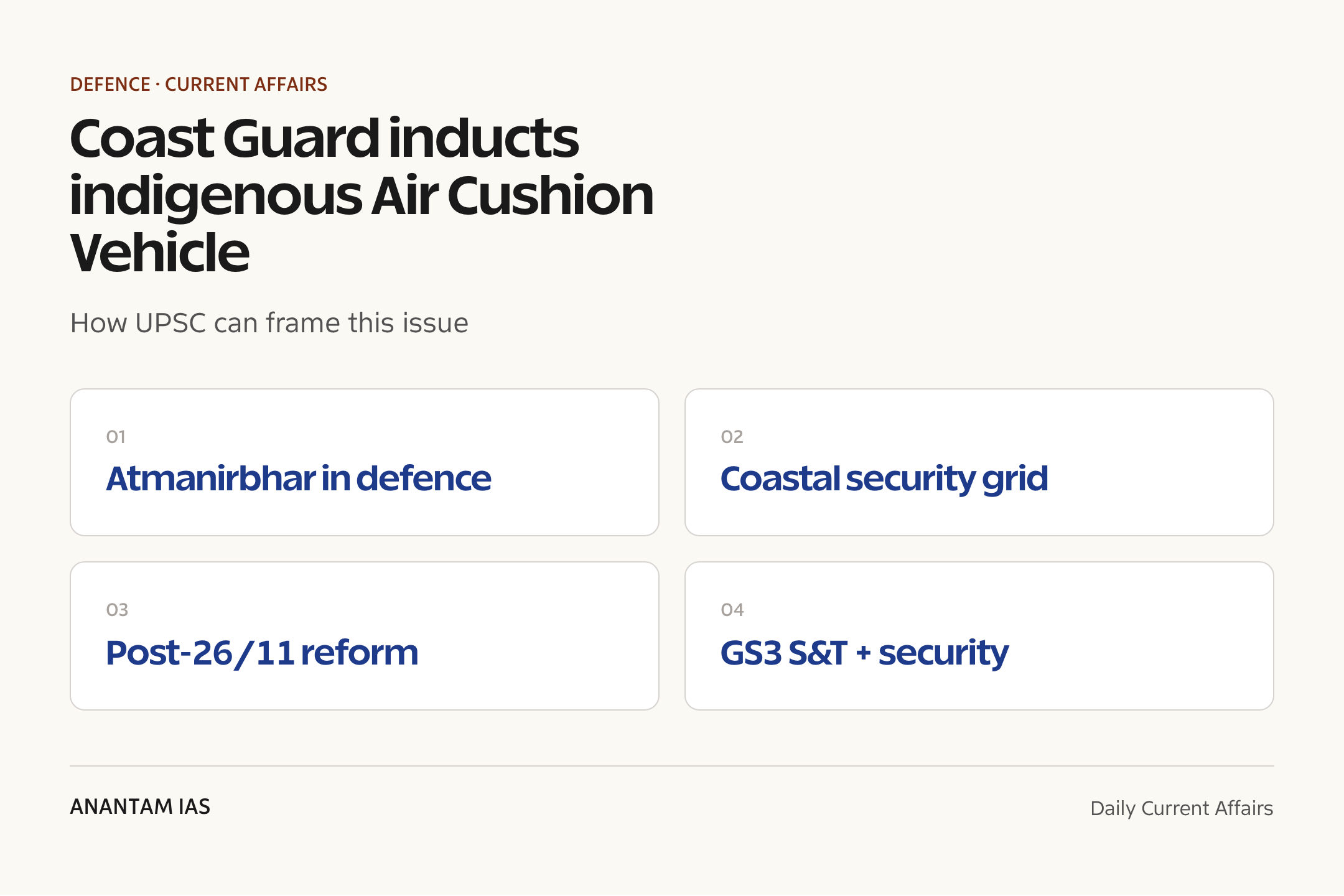
An ACV rides on a cushion of air rather than displacing water, which lets it operate in shallow waters, creeks, mudflats and sandbanks where conventional patrol boats cannot venture. For UPSC, the story links a single platform to durable themes — Atmanirbhar Bharat in defence, the post-26/11 layered coastal-security grid, and the role of the ICG as the maritime force guarding India’s near-shore zone.
- The Indian Coast Guard inducted an indigenously built Air Cushion Vehicle (hovercraft), per PIB / Ministry of Defence.
- The ACV is an amphibious craft that operates over shallow water, mudflats, creeks and sandbanks unreachable by conventional vessels.
- Its roles include shallow-water surveillance, anti-smuggling patrol, search-and-rescue and policing inaccessible stretches of coastline.
- The induction reflects the Make in India and positive indigenisation push, with defence production at record levels.
- It reinforces the multi-layered coastal security framework built up after the 26/11 Mumbai attacks.
The development matters in the context of:
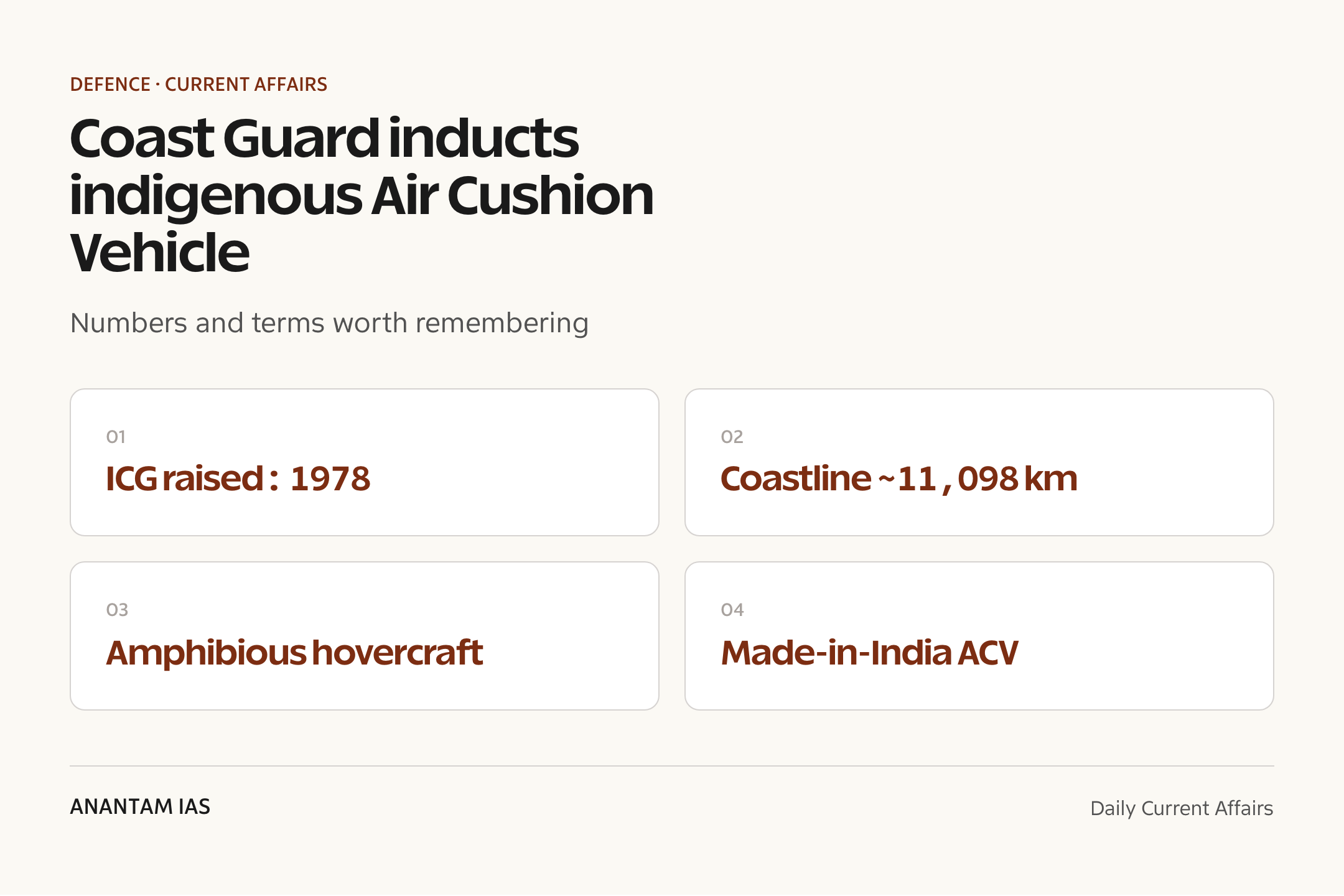
- India has a coastline of about 11,098 km (including island territories), much of it shallow and difficult to patrol.
- The ICG functions under the Ministry of Defence and is often called India’s fourth armed force.
UPSC Relevance
Prelims Relevance
- Air Cushion Vehicle (ACV) / hovercraft — amphibious craft riding on a cushion of air; works in shallow water and over land/mudflats.
- Indian Coast Guard — raised 1978; armed force under the Ministry of Defence.
- ICG mandate flows from the Coast Guard Act, 1978.
- 26/11 (2008) attacks triggered the overhaul of coastal security.
- Sagar Prahari Bal — Navy force for harbour and near-shore protection.
- IMAC (Information Management and Analysis Centre) — nerve centre of the NC3I coastal surveillance network.
- Coastal radar chain — static sensor network for near-shore domain awareness.
- Marine Police — first layer of the three-tier coastal security grid (Marine Police, Coast Guard, Navy).
- Positive Indigenisation Lists — items barred from import to push domestic manufacture.
- ICG motto: Vayam Rakshamah (We Protect).
Mains Relevance
GS Paper 3
- Indigenisation of defence manufacturing under Atmanirbhar Bharat — achievements, dependencies and gaps.
- Role of science and technology in strengthening internal and coastal security platforms.
- Coastal security challenges along India’s long shoreline — smuggling, infiltration, IUU fishing and disaster response.
- Inter-agency coordination among Navy, Coast Guard and Marine Police in the layered security grid.
Essay
- Self-reliance and national security: building capability at home.
- Technology as the frontier of a nation’s defence.
Background and Context
What an Air Cushion Vehicle is
An ACV is a hybrid craft that floats on a layer of pressurised air, making it amphibious in a way ordinary boats are not.
- It uses powerful fans to trap a cushion of air beneath the hull, held in by a flexible skirt, lifting the craft clear of the surface.
- Because it does not rely on buoyancy in deep water, it can move over shallow water, mud, sand and marsh with minimal friction.
- Propellers or ducted fans drive it forward, giving high speed across mixed terrain that mixes water and land.
- This amphibious quality is the core advantage: it reaches creeks, mudflats and sandbanks that beach conventional patrol boats.
- Limitations include sensitivity to high winds and rough seas, and higher noise and fuel demands than displacement hulls.
Operational role for the Coast Guard
The hovercraft fills a specific gap in near-shore patrolling that larger ships and small boats both miss.
- Shallow-water surveillance of creeks and tidal zones used by smugglers and traffickers.
- Anti-smuggling and anti-infiltration patrols in low-tide areas where conventional craft run aground.
- Search-and-rescue in flood-hit and marshy coastal belts where speed across mixed terrain saves lives.
- Reaching remote and inaccessible coastline, including island fringes and estuaries.
- Support during natural disasters — cyclones and floods — where amphibious mobility is decisive.
The Indian Coast Guard
The ICG is the maritime force charged with protecting India’s interests in its near-shore and exclusive economic zone.
- Raised in 1978 under the Coast Guard Act, 1978; functions under the Ministry of Defence.
- Often described as India’s fourth armed force, alongside the Army, Navy and Air Force.
- Mandate covers maritime law enforcement, search-and-rescue, marine environment protection and anti-smuggling.
- After the 26/11 Mumbai attacks (2008), the ICG was designated the agency responsible for overall coastal security in territorial waters.
- Its expansion of platforms — patrol vessels, aircraft and now ACVs — tracks the widening of its near-shore role.
Atmanirbhar Bharat in defence
An indigenously built ACV is a small but telling marker of India’s drive to make rather than import military hardware.
- Make in India and Atmanirbhar Bharat aim to cut import dependence and build a domestic defence industrial base.
- Positive Indigenisation Lists bar phased import of specified items, reserving them for Indian manufacturers.
- India’s annual defence production and defence exports have climbed to record highs in recent years.
- Domestic shipbuilding for the Navy and Coast Guard is a flagship of the indigenisation effort.
- Each home-built platform deepens design, integration and maintenance capability and shrinks lifecycle import costs.
The layered coastal security grid
India’s coastal defences are organised as concentric layers of agencies and sensors after the 2008 attacks exposed gaps.
- Three-tier patrolling: Marine Police close to shore, Coast Guard in territorial waters, Navy further out.
- Sagar Prahari Bal — a dedicated Navy force for harbour and base protection.
- NC3I network with the Information Management and Analysis Centre (IMAC) at Gurugram fusing maritime data.
- A nationwide coastal radar chain provides static surveillance of the near-shore zone.
- Vessel tracking, fishermen registration and biometric ID cards plug the human and small-craft gaps.
Why a long coastline raises the stakes
India’s geography makes coastal security a permanent, high-effort task rather than a one-time fix.
- A coastline of roughly 11,098 km spans nine states and several union territories, with island chains far offshore.
- Vast stretches of creeks and tidal flats create natural blind spots for conventional patrolling.
- Threats range from terror infiltration and arms or drug smuggling to illegal fishing and people trafficking.
- Climate-driven cyclones and floods add a recurring disaster-response burden along the coast.
- Amphibious platforms like the ACV directly address the shallow-water blind spots in this picture.
Way Forward
Build depth in indigenous platforms
- Scale domestic production of ACVs and patrol craft with a stable order pipeline for Indian yards.
- Invest in R&D for quieter, fuel-efficient and rough-sea-capable hovercraft designs.
Tighten the security grid
- Integrate ACV patrol data into the NC3I / IMAC common operating picture.
- Deepen joint drills among Coast Guard, Navy and Marine Police to close coordination gaps.
Leverage technology
- Pair near-shore craft with drones, radar and satellite surveillance for fuller coastal domain awareness.
- Strengthen maintenance and crew-training ecosystems so indigenous fleets stay mission-ready.
Conclusion
The induction of an indigenously built Air Cushion Vehicle is a modest headline that carries a larger story. A single amphibious craft closes a real operational gap — the shallow creeks and mudflats where conventional boats cannot follow — while signalling that India is increasingly building its security hardware rather than buying it.
For the Coast Guard, it extends a post-26/11 architecture that now stretches from marine police boats to radar chains and data-fusion centres. For the wider story of Atmanirbhar Bharat, it is one more proof point that self-reliance in defence is being assembled platform by platform, coastline included.
UPSC Practice Questions
Prelims MCQ 1
With reference to the Indian Coast Guard, consider the following statements:
- It was raised in 1978 and functions under the Ministry of Defence.
- It was designated the agency responsible for overall coastal security in territorial waters after the 26/11 Mumbai attacks.
- It is a paramilitary force placed under the Ministry of Home Affairs.
How many of the above statements are correct?
(a) Only one (b) Only two (c) All three (d) None
Answer: (b) Only two
Explanation:
Statements 1 and 2 are correct: the ICG was raised in 1978 under the Coast Guard Act, 1978, functions under the Ministry of Defence, and was made the nodal agency for coastal security in territorial waters after 26/11. Statement 3 is wrong — the ICG is an armed force under the Ministry of Defence, not a paramilitary force under the Home Ministry.
Prelims MCQ 2
An Air Cushion Vehicle (hovercraft) is best described as a platform that:
(a) Operates only in deep open-sea waters (b) Is amphibious and rides on a cushion of air, enabling movement over shallow water and mudflats (c) Is a submersible designed for underwater surveillance (d) Relies solely on hull buoyancy like a conventional patrol boat
Answer: (b) Is amphibious and rides on a cushion of air, enabling movement over shallow water and mudflats
Explanation:
A hovercraft traps a cushion of pressurised air beneath a flexible skirt to lift clear of the surface, making it amphibious. This lets it cross shallow water, creeks, sand and mud where displacement-hull boats run aground. It is neither a deep-sea-only vessel nor a submersible.
UPSC Mains Questions
- Indigenously built platforms such as the Coast Guard’s Air Cushion Vehicle are often cited as markers of Atmanirbhar Bharat in defence. Examine the achievements and persisting gaps in India’s defence indigenisation drive. (250 words)
- Discuss the structure of India’s multi-layered coastal security architecture put in place after the 26/11 attacks, and assess how new platforms strengthen near-shore surveillance. (250 words)
Sources: Press Information Bureau (PIB), Ministry of Defence and Indian Coast Guard.
Frequently Asked Questions
What is an Air Cushion Vehicle?
An Air Cushion Vehicle, or hovercraft, is an amphibious craft that rides on a cushion of pressurised air trapped beneath a flexible skirt. Because it lifts clear of the surface, it can travel over shallow water, mud, sand and marsh that conventional boats cannot cross.
Why is the hovercraft useful for the Coast Guard?
It reaches creeks, mudflats and sandbanks that beach ordinary patrol boats, making it valuable for shallow-water surveillance, anti-smuggling patrols, search-and-rescue and policing remote coastline. Its amphibious mobility is especially useful during floods and cyclones.
When was the Indian Coast Guard established?
The Indian Coast Guard was raised in 1978 under the Coast Guard Act, 1978. It operates under the Ministry of Defence and is frequently described as India’s fourth armed force, alongside the Army, Navy and Air Force.
How does this link to Atmanirbhar Bharat?
The craft was built in India rather than imported, reflecting the Make in India and Atmanirbhar Bharat push for self-reliance in defence. Tools like positive indigenisation lists bar phased imports, and India’s defence production and exports have risen to record levels.
What is India’s coastal security grid?
It is a layered system set up after the 26/11 attacks: Marine Police patrol close to shore, the Coast Guard covers territorial waters and the Navy operates further out. It is backed by the NC3I network, the IMAC data-fusion centre and a coastal radar chain.