Coffee

Why in news:
India’s coffee-producing regions — especially Chikkamagaluru, Coorg, and Hassan districts of Karnataka — have been severely impacted by incessant rainfall, extreme cold, and prolonged lack of sunlight over the past three months.
UPSC Relevance:
UPSC CSE in prelims examination has focused on different boards like Tea Board, Coffee Board and Turmeric Board etc. A case in point is a following PYQ.
UPSC Prelims PYQ 2022
Consider the following States:
- Andhra Pradesh
- Kerala
- Himachal Pradesh
- Tripura
How many of the above are generally known as tea-producing States?
(a) Only one State
(b) Only two States
(c) Only three States
(d) All four States
Coffee:

- India’s journey with coffee began centuries ago, when the legendary holy saint Baba Budan brought seven Mocha seeds to the hills of Karnataka in the 1600s. His simple act of planting these seeds in the courtyard of his hermitage in Baba Budan Giri unknowingly set in motion the rise of India as one of the world’s prominent coffee producers.
- India is now the seventh-largest coffee producer globally with exports reaching $1.29 billion in FY 2023-24, almost double the $719.42 million in 2020-21.
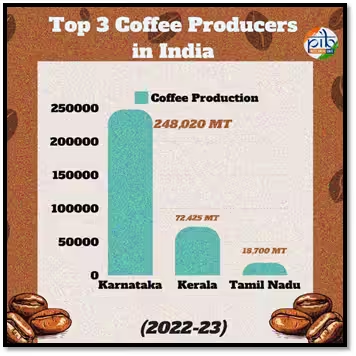
- India’s coffee is primarily grown in the ecologically rich Western and Eastern Ghats, areas famous for their biodiversity. Karnataka leads in production, contributing 248,020 MT in 2022-23, followed by Kerala and Tamil Nadu.
Types of Coffee Grown in India:
- Arabica: Known for its mild flavor and aromatic profile, Arabica coffee is predominantly grown in high-altitude regions.
- Robusta: Stronger and less acidic, Robusta thrives in lower altitudes and is valued for its higher yield. Specialty coffees like monsooned Malabar coffee, which undergoes a unique aging process during the monsoon, and organic and shade-grown coffees are gaining popularity in domestic and international markets.
Growing Conditions:
- In the coffee the predominant climate is tropical and equatorial, where Moisture prevails all year round
- The optimum range for the cultivation of arabica coffee is between 18 and 22ºC, while for robusta coffees it is between 22 and 26ºC.
- The appropriate amount of rainfall for the crop is between 1,500 and 2,000 millimeters per year, about 125 millimeters per month. Excessive rainfall can easily damage the flowering of coffee plants.
- The recommended number of hours of sunshine is 1,800 hours per year.
- Coffee thrives in deep, well-drained, loamy soils, rich in organic matter, and with good aeration, often found in volcanic regions or on hill slopes.
About the Coffee Board:
- The Government of India established the ‘Coffee Board’ through a constitutional act “Coffee Act VII of 1942” under the administrative control of Ministry of Commerce and Industry.
- The Board comprises 33 members including the Chairman and the Secretary & Chief Executive Officer. The remaining 31 members represent the various interests such as coffee growing industry, coffee trade interests, curing establishments, interests of labour and consumers, representatives of governments of the principal coffee growing states, and Members of Parliament.
- Statutory Committees: The Board functions through six statutory committees which are appointed for one year term each and the functions of each committee as per the Coffee Act are:
- Executive Committee: Deals with functions specifically assigned to it under the Coffee Rules. In addition to that deals with matters not specifically assigned to the Propaganda, Marketing, Research, or any other committees constituted by the Board.
- Propaganda Committee: Deals with matters relating to promotion of sale and increasing the consumption in India and elsewhere of the coffee produced in India.
- Marketing Committee: Deals with coffee marketing scheme as set forth in the Act and Rules.
- Research Committee: Deals with promotion of agricultural and technological research in the interest of the coffee industry in India.
- Development Committee: Deals with the measures that may be undertaken for the development of coffee estates.
- Quality Committee: Deals with all issues relating to the improvement in the quality of coffee produced in India.
Ministry:
MOC&I(Ministry of Commerce and Industry)
Headquarter:
Bengaluru
Practice Question:
Consider the following statements
- India is the largest producer of coffee
- The Indian Coffee Board is located in Uttar Pradesh
- India is the largest producer of Arabica coffee
How many of the above statements are/are false?
a) Only one
b) Only two
c) All three
d) None of the above