Defence Industrial Corridors: Coimbatore Park Exposes an Implementation Gap
Why in News?
The Hindu reported that the proposed defence industrial park at Varapatti in Coimbatore district has yet to translate its long planning history into a functioning manufacturing cluster.
- Coimbatore is one of the five officially identified nodes of the Tamil Nadu Defence Industrial Corridor, alongside Chennai, Hosur, Salem and Tiruchirappalli.
- The Varapatti project is a specific industrial park within the Coimbatore node. It is not synonymous with the entire Tamil Nadu corridor, which contains several nodes, firms and projects.
- A 2022 TIDCO request for proposals described a land parcel of about 400 acres at Varapatti and sought a consultant for a feasibility study and detailed project report.
- A 2025 TIDCO tender document identified a 10.87-acre developed plot within the park for plug-and-play facilities and recorded basic infrastructure such as roads, water supply, storm-water drains, electricity and streetlights.
- The official project record shows movement through planning, land, environmental and tender stages. The policy question is whether these inputs are converting into occupied units, certified production and supply-chain orders.
- Defence manufacturing combines industrial policy with national security. Delayed facilities can weaken domestic supply chains and prolong dependence on imported systems or components.
- Cluster policy works only when land and incentives are joined by testing, certification, skilled labour, finance, anchor orders and vendor development.
- Public reporting often highlights MoUs and proposed investment. UPSC answers should separate commitments, grounded investment, operational capacity and actual output.
UPSC Relevance
Prelims Relevance
- India has two Defence Industrial Corridors: one in Uttar Pradesh and one in Tamil Nadu.
- The Tamil Nadu corridor has five nodes: Chennai, Coimbatore, Hosur, Salem and Tiruchirappalli.
- The Uttar Pradesh corridor has six nodes: Agra, Aligarh, Chitrakoot, Jhansi, Kanpur and Lucknow.
- The Tamil Nadu Industrial Development Corporation is the nodal agency for TNDIC; the Uttar Pradesh Expressways Industrial Development Authority performs that role for UPDIC.
- The corridors seek to build a defence-manufacturing ecosystem through supply chains, testing, certification and economies of scale.
- The respective state governments provide key enabling inputs such as land, connectivity and basic infrastructure.
Mains Relevance
GS Paper 3
- Assess defence corridors as instruments of industrial clustering, import substitution and strategic manufacturing.
- Explain why MSMEs need common testing, certification, tooling, finance and predictable orders to enter defence supply chains.
GS Paper 2
- Analyse cooperative implementation between the Union Ministry of Defence, state agencies, public-sector units and private firms.
- Use the case to discuss outcome-based monitoring, public disclosure and inter-agency accountability in large industrial projects.
Essay
- Self-reliance is not secured by announcements alone; it is built through institutions that convert capability into dependable production.
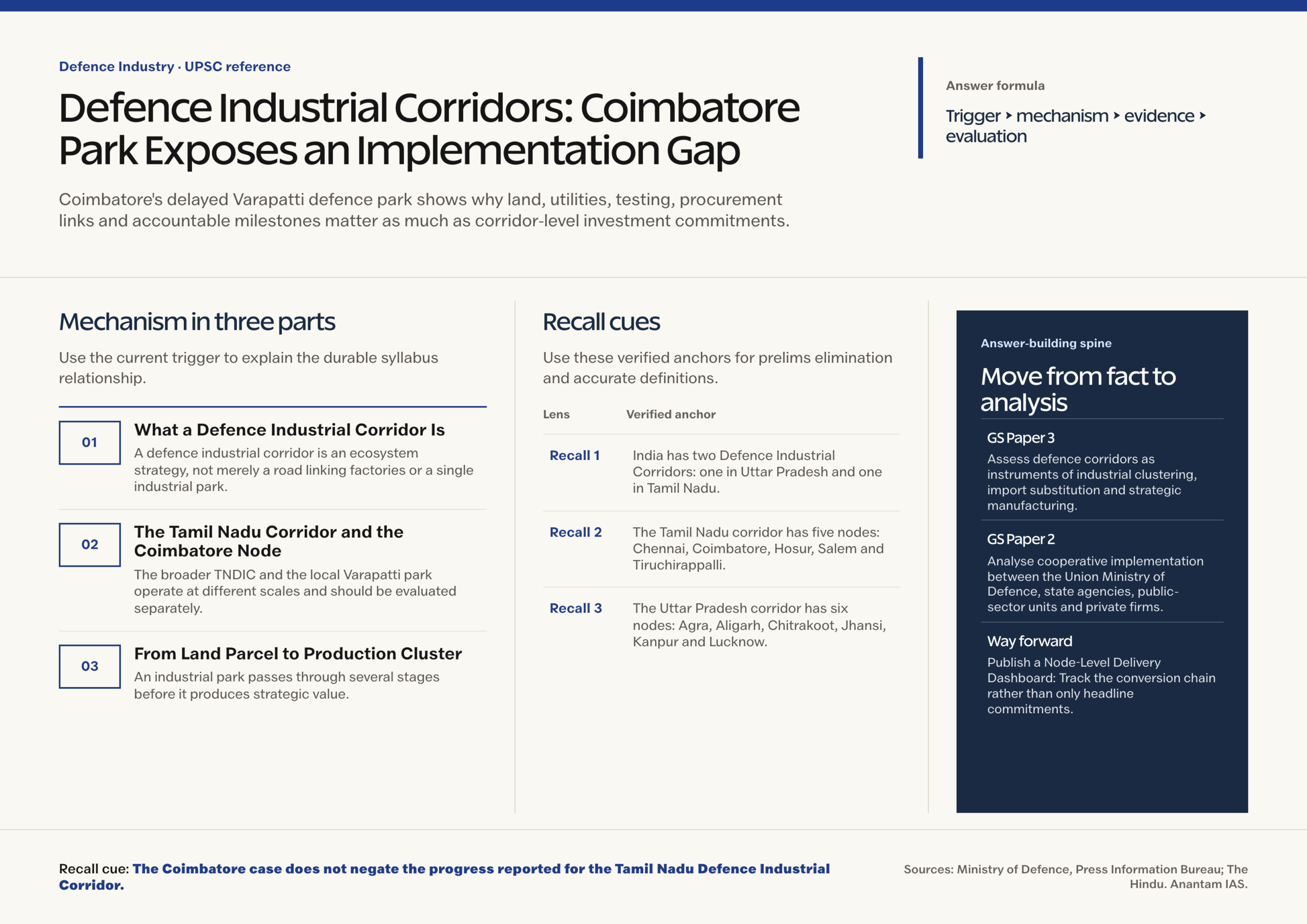
Background and Context
What a Defence Industrial Corridor Is
A defence industrial corridor is an ecosystem strategy, not merely a road linking factories or a single industrial park.
- The Union Budget 2018-19 announced two corridors, later located in Uttar Pradesh and Tamil Nadu, to deepen the domestic defence-manufacturing base.
- The node model seeks to connect original equipment manufacturers, public-sector units, private firms, MSMEs, start-ups, laboratories, training institutions and logistics providers.
- Clustering can reduce transaction costs by placing suppliers, tooling, testing and skilled workers close to production facilities.
- For strategic systems, proximity alone is insufficient. Firms also need security-compliant facilities, quality assurance, traceability and certification acceptable to defence buyers.
The Tamil Nadu Corridor and the Coimbatore Node
The broader TNDIC and the local Varapatti park operate at different scales and should be evaluated separately.
- The Ministry of Defence identifies Chennai, Coimbatore, Hosur, Salem and Tiruchirappalli as the corridor’s five nodes, with TIDCO as the state nodal agency.
- Coimbatore brings a dense base of precision engineering, pumps, motors, machine tools, foundries and MSMEs that can potentially diversify into aerospace and defence supply chains.
- TIDCO’s 2022 planning document proposed a dedicated park near Coimbatore because suitable land and a short supplier chain were considered important for attracting large firms and their tiered vendors.
- The Varapatti park is one mechanism for developing the Coimbatore node. Firms elsewhere in the node can still participate in defence production even if this particular estate is delayed.
From Land Parcel to Production Cluster
An industrial park passes through several stages before it produces strategic value.
- The input stage includes land possession, environmental clearance, internal roads, drainage, water, power and digital connectivity.
- The transaction stage includes transparent plot allotment, bankable lease conditions, time-bound approvals and selection of credible developers or concessionaires.
- The capability stage requires plug-and-play buildings, common machinery, laboratories, testing, certification, skilling and links with research institutions.
- The market stage depends on anchor manufacturers, vendor-development programmes and predictable procurement opportunities. Without demand, serviced land may remain underused.
- The outcome stage begins only when units are commissioned, workers are employed, orders are fulfilled and products or components enter domestic or export supply chains.
What the Official Numbers Do and Do Not Show
Corridor-level totals reveal momentum, but they cannot by themselves prove that every node or park is functioning well.
- The Ministry of Defence reported that by April 2026 the TNDIC had attracted investment commitments of ₹32,699 crore, while actual investment had reached ₹6,446 crore.
- These are aggregate corridor figures. They cover the five-node ecosystem and should not be assigned to Coimbatore or Varapatti without a node-wise official breakdown.
- The gap between commitment and actual investment is not automatically evidence of failure because large industrial projects are phased. It is still a reason to track conversion timelines and abandoned commitments.
- A better dashboard would publish node-wise land allotment, units under construction, units commissioned, jobs created, procurement orders, test facilities used and investment actually deployed.
Way Forward
Publish a Node-Level Delivery Dashboard
- Report land acquired, land allotted, construction starts, commissioned units, actual investment, employment and production for each node.
- Show the status, responsible agency and revised completion date for utilities, plug-and-play buildings and testing facilities.
- Map local MSME capabilities against indigenisation lists and the component needs of defence public-sector units and private manufacturers.
- Pair common facilities with vendor-development programmes, trial orders and transparent qualification pathways.
Conclusion
- The Coimbatore case does not negate the progress reported for the Tamil Nadu Defence Industrial Corridor .
- For defence self-reliance, the decisive metric is conversion: land into facilities, facilities into qualified firms, firms into orders, and orders into reliable indigenous capability.
UPSC Practice Questions
Prelims MCQ 1
With reference to Defence Industrial Corridors in India, consider the following statements:
- India has established one Defence Industrial Corridor each in Uttar Pradesh and Tamil Nadu.
- Coimbatore is one of the identified nodes of the Tamil Nadu Defence Industrial Corridor.
- Tamil Nadu Industrial Development Corporation is the nodal agency for the Tamil Nadu Defence Industrial Corridor.
How many of the above statements are correct?
(a) Only one (b) Only two (c) All three (d) None
Answer: (c) All three
Explanation:
The two corridors are located in Uttar Pradesh and Tamil Nadu. Coimbatore is one of TNDIC’s five nodes, and TIDCO is its nodal agency.
Prelims MCQ 2
Which one of the following would best indicate that a defence industrial park has moved from infrastructure creation to ecosystem operation?
(a) A memorandum of understanding announcing potential investment (b) Identification of land for the project (c) Qualified suppliers fulfilling defence orders using shared testing and certification facilities (d) Appointment of a consultant to prepare a detailed project report
Answer: (c) Qualified suppliers fulfilling defence orders using shared testing and certification facilities
Explanation:
Land, MoUs and project reports are inputs or intermediate milestones. Actual order fulfilment by qualified firms shows that infrastructure, capability and demand have combined into an operating ecosystem.
UPSC Mains Questions
- Defence industrial corridors should be evaluated through production capability rather than investment announcements alone. Discuss with reference to the Coimbatore node of the Tamil Nadu Defence Industrial Corridor.
- What prevents established engineering MSMEs from entering defence supply chains? Suggest an implementation framework for node-level defence manufacturing clusters.
Sources: Ministry of Defence, Press Information Bureau and The Hindu.
Frequently Asked Questions
What is a Defence Industrial Corridor?
A Defence Industrial Corridor is a cluster-based policy instrument that brings manufacturers, suppliers, laboratories, testing facilities, skills and logistics into a connected ecosystem. India has established two such corridors, in Uttar Pradesh and Tamil Nadu, to strengthen indigenous defence production.
Is the Varapatti defence park the same as the Tamil Nadu Defence Industrial Corridor?
No. The Tamil Nadu Defence Industrial Corridor is a five-node ecosystem covering Chennai, Coimbatore, Hosur, Salem and Tiruchirappalli. The proposed Varapatti park is a specific industrial-estate project within the Coimbatore node. Delay at that park should not be treated as.
Why is Coimbatore suitable for defence manufacturing?
Coimbatore has a strong base in precision engineering, machine tools, motors, foundries and component manufacturing. This gives local firms capabilities that can be adapted for aerospace and defence work, provided they receive access to specialised testing, certification, finance, skills and.
Why are MoU figures not enough to measure corridor success?
An MoU generally records intended investment or cooperation. It does not by itself prove that capital has been deployed, a factory commissioned or an order delivered. A stronger evaluation separates proposed investment, actual investment, operational units, domestic value addition, employment.
What is the main implementation lesson from the Coimbatore park?
Industrial land must be linked with utilities, approvals, common facilities, anchor buyers, vendor development and accountable timelines. A park can have planning documents and basic infrastructure yet remain economically weak if firms cannot qualify for defence supply chains or see.