Competition Commission of India
Context: The Supreme Court admitted an appeal filed by Alphabet Inc., the parent company of Google, against a judgment of the National Company Law Appellate Tribunal (NCLAT). The tribunal had earlier upheld, at least in part, the Competition Commission of India’s (CCI) findings that Google had abused its dominant position in the Google Play Store Billing (GPSB) ecosystem to indulge in anti-competitive practices

UPSC Relevance:
GS 2, Statutory, regulatory and various quasi-judicial bodies
PYQ: 2023 Mains
Discuss the role of the Competition Commission of India in containing the abuse of dominant position by the Multi-National Corporations in India. Refer to the recent decisions.
CCI
- It is a statutory quasi-judicial body.
- It functions under the Ministry of Corporate Affairs.
- It replaced the Monopolies Restrictive Trade Practices Act 1969 to align Indian competition law with global standards after the economic liberalization reforms from 1991.
| Establishment | Established by the Central Government on 14 October 2003It became fully functional in May 2009. |
| Governing Law | Created under the Competition Act, 2002Amended in 2007 and 2023 |
| Composition | Chairperson Members- not less than 2 and not more than 6They are appointed by the Central Government, with professional experience requirements. |
| Director General (DG) | DG is responsible for conducting investigations into alleged violation of the Competition Act, 2002.The Central Government appoints the DG through a Search-cum-Selection Committee.DG has powers of a Civil CourtCan conduct search and seizure operations to gather evidence with prior approval from a Chief Magistrate. |
| Powers | Investigate anti-competitive agreements and abuse of dominant position.Approve or block mergers and acquisitions that affect competition.Impose penalties (up to 10% of Global Turnover or thrice the profit earned from violation).Formulate regulations consistent with the Competition Act.Undertake competition advocacy, public awareness, and training.Offer opinions on competition issues on references from statutory authorities. |
| Jurisdiction | CCI has exclusive jurisdiction over competition issues that affect trade, business, or commerce in India. No other regulator hears such cases.CCI shares some authority with sectoral regulators, but the Competition Act takes precedence when it comes to judging anti-competitive behavior. |
| Appeals | Decisions of the CCI can be appealed to the National Company Law Appellate Tribunal (NCLAT) within 60 days of receiving the CCI’s order. |
| Procedural Timelines | The CCI must now form a prima facie opinion within 30 days of receiving a combination notice. Failure to do so results in deemed approval.The maximum review period for combinations is 150 days.A 3 year limitation period has been introduced for filing information or a reference by the company about violation of the Act. Earlier there was no such timeline. |
Successes in Curbing Anti-Competitive Practices
- Dismantling Cartels
The CCI has been effective in tackling cartels. Cartels are agreements between competitors to fix prices, limit production, or allocate markets. CCI actively monitors key sectors.
- Cement Cartel Case (2012) – This landmark case involved the CCI imposing a significant penalty on 11 cement companies for colluding to control prices and supply. Although this decision was later challenged on procedural grounds, it sent a strong message to industries that such practices would not be tolerated.
- Airlines Cartel (2015) – The CCI fined three airlines for colluding to fix fuel surcharges on air cargo. This decision clearly showed that it would not hesitate to penalize companies that engaged in anti-competitive behavior.
- Regulating Abuse of Dominant Position
The CCI has confronted some of the largest global tech companies to prevent them from abusing their market power.
- Google Case – The CCI has imposed penalties on Google in multiple cases for abusing its dominant position.
- Promoting Consumer Welfare
By acting against anti-competitive practices, the CCI has directly benefited consumers through better pricing, more choices, and higher-quality products and services.
- Automobile Spare Parts Case (2014) – The CCI fined 14 car manufacturers for not making branded spare parts and diagnostic tools available to independent repairers to make car maintenance more affordable.
- Ensuring Fairness in Mergers and Acquisitions
The CCI reviews mergers and acquisitions to prevent them from negatively impacting competition. This keeps markets competitive and avoids monopolies.
- Walmart-Flipkart Deal (2018) – The CCI approved the acquisition of Flipkart by Walmart but with some conditions. It aimed to protect the interests of smaller players while also supporting foreign investment.
- Advocacy and Market Studies
Beyond enforcement, the CCI has engaged in advocacy and conducted market studies to understand and address competition concerns in sectors such as e-commerce and e-delivery platforms like Zomato and Swiggy after complaints against them and called for more transparency.
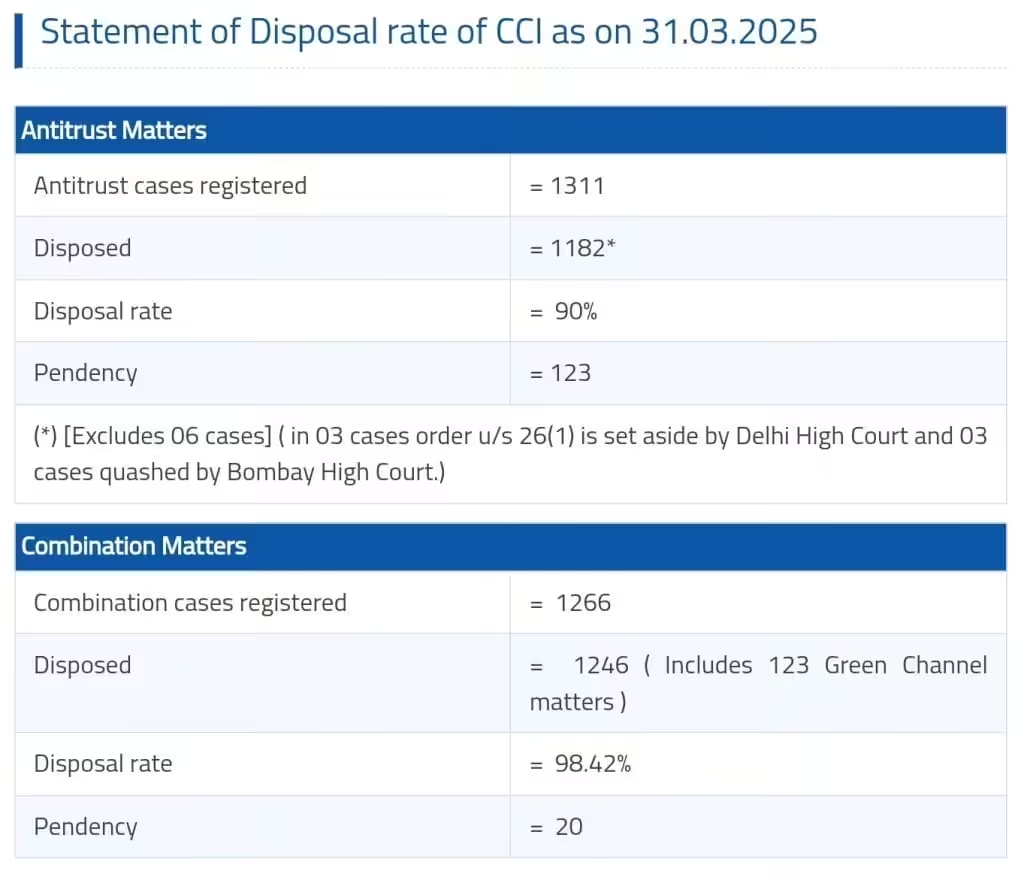
- High Disposal rates of case – The disposal rate of cases is more than 90% as per CCI.
Challenges faced by CCI
- Adjudication and Procedural Delays -Investigation of any case, especially high-profile cases against companies like Google and Apple go on for years without final orders due to inefficient procedures, such as mandatory prior notices and lengthy legal processes.
- Inadequate Enforcement of Penalties – While the CCI has imposed large penalties (over ₹18,000 crore since 2011) but it has only collected 2.3% out of it. The lack of a mandatory deposit for penalties before appealing lets corporations challenge fines without immediate payment of penalty. For Example – Google has not paid any penalty yet , rather it has taken up a long legal battle against CCI.
- New Market Structures and Business Models – Rapid technological changes and digital platforms create new challenges. Current competition laws rely on traditional concepts like assets and turnover and do not effectively address issues specific to digital markets, such as data access, network effects, and platform dominance. Proposed measures like the Digital Competition Bill highlight the need for clear policies and guidelines that fit today’s market realities.
- Lack of a National Competition Policy (NCP) – India does not have an implemented NCP, which is essential for guiding competition law enforcement and policy across sectors. This gap leaves the CCI overwhelmed and without a clear strategic direction, especially when tackling new economic models.
- Judicial and Jurisdictional Challenges – Courts have sometimes restricted the CCI’s authority, particularly in areas like patent law. Judicial decisions that limit the CCI’s investigative power or delay enforcement hurt its ability to regulate effectively. The Supreme Court’s ruling on the applicability of the Competition Act to state-owned enterprises like Coal India Ltd. has helped clarify some of these issues, but challenges remain.
- Staffing and Leadership Vacancies – The CCI has faced gaps in leadership and not enough staff. Since 2014-15, it has never run at full capacity. Some leadership roles, like the Chairperson position, have stayed vacant for long periods, including nearly 7 months in 2022. This has led to delays in decision-making and resolving cases.
The Google Case
CCI’s accusations
- CCI accused Google of abusing dominance in the Android ecosystem and Google Play Billing System (GPBS). In 2022, CCI fined Google ₹936.44 crore and ordered behavioral remedies like decoupling GPBS from Play Store access and increasing transparency.
- Key accusations:
- Mandatory use of GPBS for in-app purchases on Play Store, charging 15-30% commission but exempted Youtube from it giving cost advantages.
- Android licensing required phone makers to pre-install Google apps (Search, Chrome, YouTube) as a condition to access Play Store.
- This bundling restricted consumer choice and stifled innovation by alternative app providers.
Google’s Defence
- Google rejected the allegations. It claims that these practices are aimed to enhance user experience, security, and ecosystem sustainability.
- Pre-installation of Google apps is for efficiency, user convenience, and does not block competing apps.
- Highlighted success of many Indian apps on Android as a sign of a competitive market.
Stakeholders
- The case raises issues on how much control dominant platforms like Google should have and how much regulators can intervene.
- For consumers – A CCI win could mean more app choice, better prices, greater privacy, and fairer rankings but may lead to inconsistent Android experiences.
- For smartphone makers – Could lower licensing costs and increase flexibility for alternative apps and OS versions.
- For Indian startups and developers – Potential for better bargaining power and more equitable market access.
- For Google – An adverse ruling in India, a major market, could prompt global regulatory challenges and force changes in the Android business model.
Way Forward for CCI to effectively curb anti competitive practices
- Adapting to Digital Markets – The CCI needs to create a specialized Digital Markets Division with experts to address the unique challenges of new technologies and business models. It should also conduct market studies proactively instead of waiting for complaints.
- Enhanced Enforcement – The CCI must improve its penalty collection, possibly by mandating pre-deposit for appeals.
- Stronger Institutional Capacity – Filling vacant positions and providing specialized training to staff are important for managing complex cases effectively.
- Promoting Competition Advocacy – Increased cooperation with other government regulators and actively working for a National Competition Policy can help create a unified, pro-competition environment in the economy.
- Leveraging the “Leniency Plus” Regime – The Competition (Amendment) Act, 2023, introduced a “leniency plus” mechanism. A firm in a leniency program may receive an additional reduction in penalties if the firm exposes another cartel.
- International Cooperations with like minded countries like the EU and learning from their best practices.