Comprehensive Nuclear-Test-Ban Treaty (CTBT)

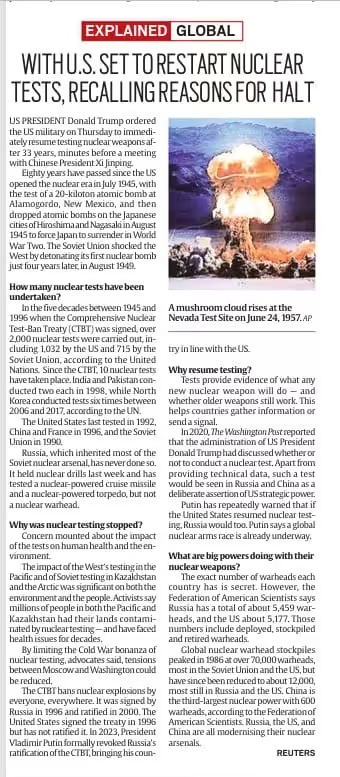
Context:
United States under President Donald Trump had ordered preparations to restart nuclear weapons testing after a gap of 33 years, a move that could end the long-standing moratorium on nuclear tests observed since the Comprehensive Nuclear-Test-Ban Treaty (CTBT) of 1996.
UPSC Relevance:
International treaties
UPSC PYQ:
Q. What is/are the consequence/consequences of a country becoming the member of the ‘Nuclear Suppliers Group’? (2018)
- It will have access to the latest and most efficient nuclear technologies.
- It automatically becomes a member of “The Treaty on the Non-Proliferation of Nuclear Weapons (NPT)”.
Which of the statements given above is/are correct?
(a) 1 only
(b) 2 only
(c) Both 1 and 2
(d) Neither 1 nor 2
About CTBT:
- The Comprehensive Nuclear-Test-Ban Treaty (CTBT) bans all nuclear test explosions, whether for military or civilian purposes.
- The CTBT was negotiated at the Conference on Disarmament in Geneva in 1994.
- The Treaty was opened for signature in 1996 to stop the development of new nuclear weapons and prevent upgrades to existing ones, supporting global efforts in non-proliferation and disarmament.
Status of the Treaty:
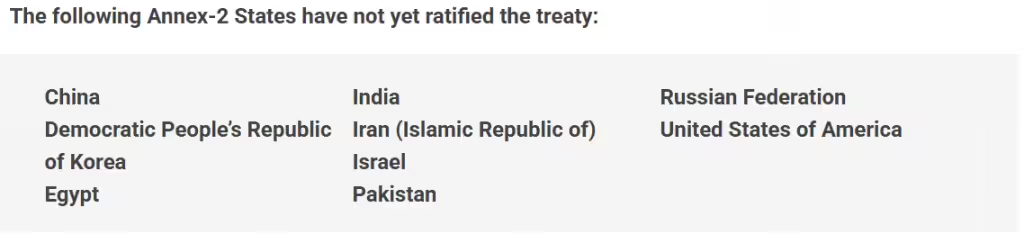
In accordance with Article XIV of the Treaty, it will enter into force after all 44 States listed in Annex 2 to the Treaty have ratified it.
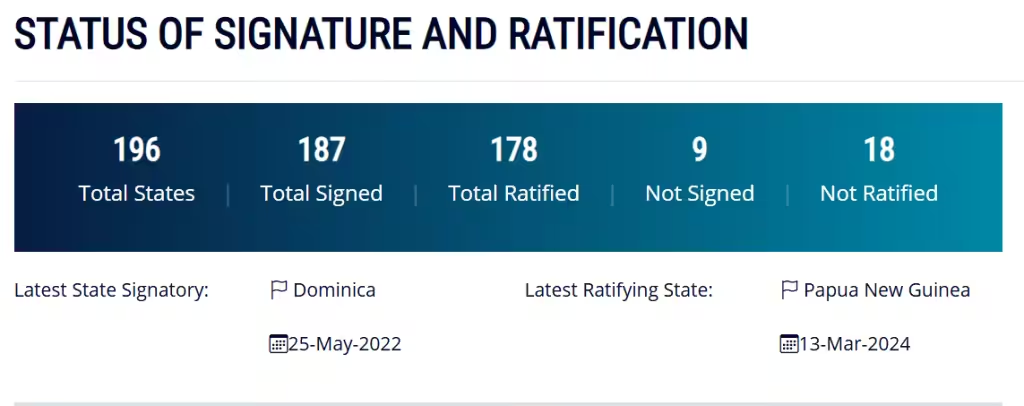
Although the Treaty has not yet entered into force, it has made a significant contribution to international peace and security. It has helped to establish a strong global norm against nuclear testing and built confidence that any nuclear test explosion would be reliably detected.-https://www.ctbto.org/our-mission/the-treaty
why?
The treaty cannot formally enter into force until it is ratified by 44 specific nations. Eight of these nations have yet to ratify the treaty: China, India, Pakistan, North Korea, Israel, Iran, Egypt, United States.
Why USA again resuming Nuclear Test:
- Scientific Reason:
- To verify the reliability of existing nuclear arsenals and understand the effects of aging warheads.
- Strategic Signalling:
- To pressure rivals like Russia and China, both accused by U.S. intelligence of conducting low-yield nuclear tests.
- Political Context:
- Occurred amid strained U.S.–China relations and growing geopolitical competition.
PRELIMS POINTERS:
- India’s nuclear tests: 1974 (Smiling Buddha), 1998 (Operation Shakti).
- CTBT: Not yet in force; India, Pakistan, and North Korea are non-signatories.
- NPT (1968): India is not a signatory due to its discriminatory nature.
- First nuclear test (U.S.): July 1945, Trinity Test at Alamogordo.
Practice Question:
Q: Consider the following
- China
- India
- Pakistan
- North Korea
- Israel
How many of the above countries not ratified Comprehensive Nuclear-Test-Ban Treaty
a) only one
b) Only Three
c) Only Four
d) All Five