Conflict-Induced Hunger and Critical Food Supply Routes
Why in News?
At the UN Security Council’s 25 August 2026 Food under Fire debate, India urged protection of humanitarian access and essential food, fertiliser and fuel flows during conflict.
- The meeting was an open debate on conflict-driven food crises; it did not adopt a new Security Council resolution.
- The UN Secretary-General said at least 266 million people faced acute food insecurity in 2025.
- He said conflict and violence were the primary drivers in 12 of 13 hunger hotspots of greatest concern.
- India prioritised safe humanitarian access, de-confliction, sanctions safeguards and uninterrupted legitimate trade in essential commodities.
- Conflict can simultaneously destroy local food systems and interrupt the cross-border supplies needed to keep production, transport and relief operations functioning.
- The Council’s task is not food management; it is addressing conflict-related threats, protecting civilians and using its tools without worsening humanitarian conditions.
- Import-dependent developing countries bear cascading costs when insecurity delays shipping, raises insurance and freight costs, or constrains fertiliser and fuel availability.
UPSC Relevance
Prelims Relevance
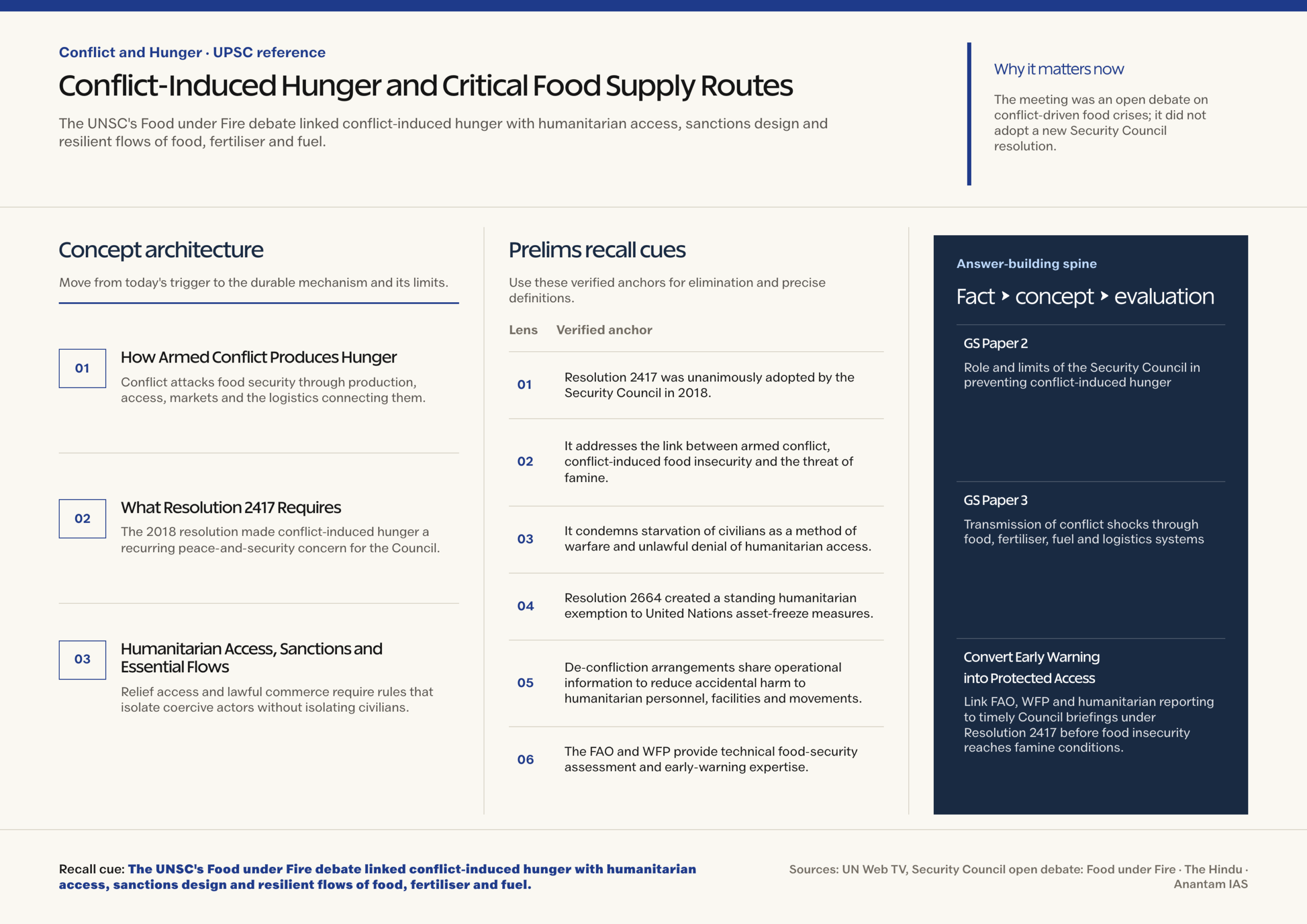
- Resolution 2417 was unanimously adopted by the Security Council in 2018.
- It addresses the link between armed conflict, conflict-induced food insecurity and the threat of famine.
- It condemns starvation of civilians as a method of warfare and unlawful denial of humanitarian access.
- Resolution 2664 created a standing humanitarian exemption to United Nations asset-freeze measures.
- De-confliction arrangements share operational information to reduce accidental harm to humanitarian personnel, facilities and movements.
- The FAO and WFP provide technical food-security assessment and early-warning expertise.
Mains Relevance
GS Paper 2
- Role and limits of the Security Council in preventing conflict-induced hunger
- International humanitarian law, humanitarian access and sanctions design
GS Paper 3
- Transmission of conflict shocks through food, fertiliser, fuel and logistics systems
- Supply-chain resilience and food security in import-dependent economies
Essay
- Hunger in war is not only a humanitarian outcome; it can become an instrument of coercion and a multiplier of displacement and instability.
Background and Context
How Armed Conflict Produces Hunger
Conflict attacks food security through production, access, markets and the logistics connecting them.
- Fighting can damage farms, irrigation, storage, markets and power systems, while displacement separates cultivators, pastoralists and fishers from the land, water, labour and productive assets needed for local production.
- Insecurity, checkpoints and access denials can block planting, harvesting and relief delivery, turning an availability problem into an acute access and nutrition crisis during critical seasonal windows.
- A fuel disruption raises costs for irrigation, milling, refrigeration and road transport; a fertiliser disruption can depress yields and household purchasing power in the next agricultural season.
- Commercial shipping and ports carry essential inputs across borders, so conflict-related delays can transmit a regional shock to distant food-importing economies through price and availability pressures.
- The burden is unequal: poorer importing countries face higher freight and insurance costs, limited fiscal buffers and weaker storage, leaving less capacity to absorb sudden external shocks.
What Resolution 2417 Requires
The 2018 resolution made conflict-induced hunger a recurring peace-and-security concern for the Council.
- Unanimously adopted on 24 May 2018, Resolution 2417 recognised the link among armed conflict, food insecurity and the threat of famine.
- It strongly condemned starvation of civilians as a method of warfare and the unlawful denial of access to food and other objects indispensable to civilian survival during hostilities.
- Parties must comply with international humanitarian law, protect civilians and civilian objects, and allow safe and unimpeded passage of impartial humanitarian relief where required.
- The resolution asked the Secretary-General to report swiftly when conflict creates a risk of famine or widespread food insecurity, making early warning relevant to preventive Council action.
- Council responses can include diplomacy, access demands, monitoring, accountability and targeted sanctions against aid obstruction; the resolution does not create automatic enforcement in every crisis.
Humanitarian Access, Sanctions and Essential Flows
Relief access and lawful commerce require rules that isolate coercive actors without isolating civilians.
- Poorly designed restrictions can trigger over-compliance: banks, insurers and carriers may avoid even lawful transactions, delaying food, agricultural inputs, fuel and humanitarian payments across multiple jurisdictions.
- Resolution 2664 permits specified humanitarian funds, goods and services despite UN asset freezes, while retaining risk management, due diligence and monitoring against diversion.
- That exemption concerns UN asset-freeze measures; it does not automatically remove other sectoral restrictions, domestic licensing duties or the need for case-specific permissions where applicable.
- De-confliction can share locations, routes and timings to reduce accidental harm to relief movements, but it neither guarantees safety nor replaces parties’ legal obligations.
- India called for objective FAO-WFP assessments, protected legitimate trade and stronger domestic production, storage and logistics; these remain resilience proposals from the debate, not outcomes adopted by the Council.
Way Forward
Convert Early Warning into Protected Access
- Link FAO, WFP and humanitarian reporting to timely Council briefings under Resolution 2417 before food insecurity reaches famine conditions.
- Demand rapid, safe and unimpeded relief access, protect food-system infrastructure and investigate deliberate starvation or unlawful obstruction.
- Design sanctions with clear humanitarian exemptions, workable payment channels and monitoring that controls diversion without encouraging blanket private-sector withdrawal.
- Diversify import sources, storage and logistics while keeping legitimate food, fertiliser and fuel trade moving under international law.
Conclusion
- Conflict-induced hunger is produced by damaged livelihoods, denied access and disrupted supply systems; treating it only as a shortage misses the coercion and governance failures involved.
- A strong answer should connect Resolution 2417 to early warning, international humanitarian law, humanitarian access, accountability and targeted Council action.
- It should also explain that resilient commodity flows and carefully designed sanctions protect civilians without turning a food-security note into a generic maritime-security discussion.
UPSC Practice Questions
Prelims MCQ 1
With reference to United Nations Security Council Resolution 2417, consider the following statements:
- It recognises the link between armed conflict, conflict-induced food insecurity and the threat of famine.
- It condemns starvation of civilians as a method of warfare and unlawful denial of humanitarian access.
- It created a standing humanitarian exemption to asset freezes under all United Nations sanctions regimes.
How many of the above statements are correct?
(a) Only one (b) Only two (c) All three (d) None
Answer: (b) Only two
Explanation:
Statements 1 and 2 describe Resolution 2417. The standing humanitarian exemption to UN asset-freeze measures was created by Resolution 2664, not Resolution 2417.
Prelims MCQ 2
In conflict settings, the primary purpose of humanitarian de-confliction arrangements is to:
(a) authorise military control over all relief agencies (b) replace the obligations of parties under international humanitarian law (c) share operational information to reduce accidental harm to humanitarian movements and facilities (d) exempt all commercial shipments from sanctions and customs rules
Answer: (c) share operational information to reduce accidental harm to humanitarian movements and facilities
Explanation:
De-confliction communicates relevant locations, routes or timings to reduce operational risk. It does not remove legal obligations, guarantee safety or provide a blanket trade exemption.
UPSC Mains Questions
- Conflict-induced hunger is both a protection-of-civilians challenge and a threat to international peace. Discuss the relevance and limits of UNSC Resolution 2417.
- Explain how humanitarian access, sanctions exemptions and resilient food, fertiliser and fuel flows can reduce the civilian costs of armed conflict.
Sources: UN Web TV, Security Council open debate: Food under Fire and The Hindu.
Frequently Asked Questions
What is conflict-induced hunger?
It is acute food insecurity caused or intensified by fighting, displacement, destruction of food systems, access denial, market disruption and obstruction of humanitarian relief to civilians.
What does UNSC Resolution 2417 do?
Adopted in 2018, it links armed conflict with food insecurity and famine, condemns starvation tactics and unlawful aid denial, and supports early warning and Council action.
Why do sanctions need humanitarian exemptions?
Exemptions keep specified aid funds, goods and services moving despite asset freezes, while due diligence and monitoring seek to prevent benefits from reaching sanctioned actors.
What is humanitarian de-confliction?
It is the exchange of operational information, such as protected locations or movement routes, intended to reduce accidental harm; it does not replace international humanitarian law.
Why do food, fertiliser and fuel flows matter together?
Food supplies meet immediate needs, fertiliser affects future harvests, and fuel powers irrigation, processing, refrigeration and transport, so disruption can compound across seasons and markets.