Constitutional Limits on Arrest: Grounds, Liberty and Due Process
Why in News?
A recent analysis in The Hindu revisited the constitutional limits on arrest, focusing on the duty to communicate grounds of arrest and the protection of personal liberty.
- Article 22(1) requires an arrested person to be informed, as soon as may be, of the grounds for arrest and protects the right to consult and be defended by a legal practitioner of choice.
- The Supreme Court linked this guarantee directly to Article 21: custody is lawful only when the procedure used to curtail liberty is fair, effective and constitutionally compliant.
- In Mihir Rajesh Shah, decided on 6 November 2025, the Court said the grounds must ordinarily be supplied in writing at arrest and must be intelligible to the arrestee.
- In exceptional situations where immediate writing is impractical, the officer may first communicate the grounds orally, but a written copy must reach the arrestee at least two hours before production before the magistrate for remand.
- Failure to follow the safeguard renders the arrest and subsequent remand illegal, although it does not by itself erase the investigation, charge sheet or trial.
- Arrest is not merely an investigative step. It transfers control over a person’s movement, privacy and access to assistance from the individual to the State.
- Communication of grounds enables the arrested person and counsel to challenge the factual basis of custody, oppose remand and seek bail on an informed basis.
- The doctrine places duties on three institutions: the arresting agency must communicate and record; the magistrate must verify compliance; and the court must provide an effective remedy for breach.
UPSC Relevance
Prelims Relevance
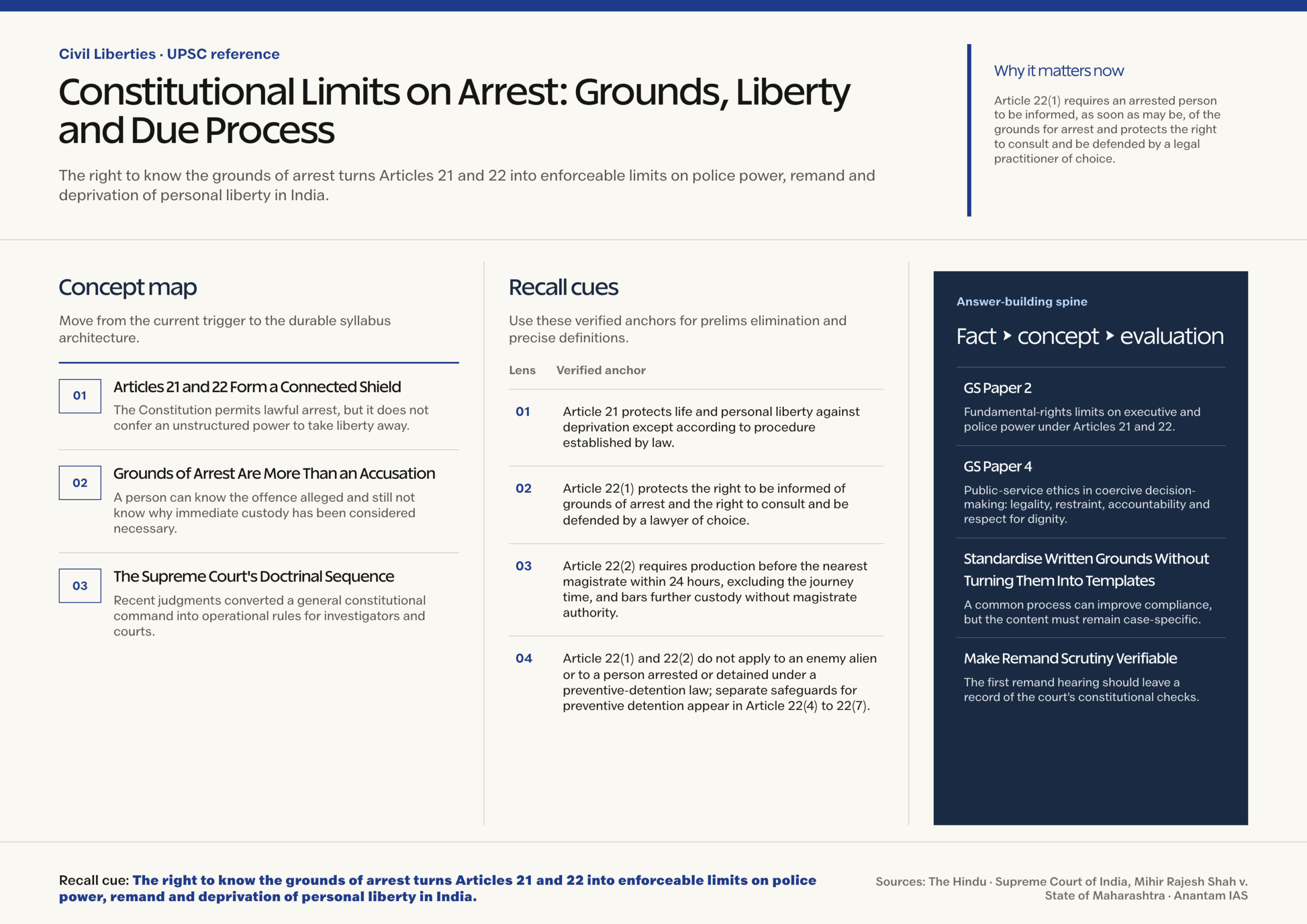
- Article 21 protects life and personal liberty against deprivation except according to procedure established by law.
- Article 22(1) protects the right to be informed of grounds of arrest and the right to consult and be defended by a lawyer of choice.
- Article 22(2) requires production before the nearest magistrate within 24 hours, excluding the journey time, and bars further custody without magistrate authority.
- Article 22(1) and 22(2) do not apply to an enemy alien or to a person arrested or detained under a preventive-detention law; separate safeguards for preventive detention appear in Article 22(4) to 22(7).
- Section 35 of the BNSS governs when police may arrest without warrant and, for specified offences punishable up to seven years, requires written reasons for making or not making an arrest.
- Section 47 of the BNSS requires communication of full particulars of the offence or other grounds of arrest and information about the right to bail where the offence is bailable.
Mains Relevance
GS Paper 2
- Fundamental-rights limits on executive and police power under Articles 21 and 22.
- Role of judicial magistrates as the first constitutional checkpoint against unlawful custody.
GS Paper 4
- Public-service ethics in coercive decision-making: legality, restraint, accountability and respect for dignity.
- Why procedural safeguards protect institutional legitimacy even when allegations are serious.
Essay
- The strength of constitutional government is tested most clearly when the State acts against a person who is unpopular, accused or powerless.
Background and Context
Articles 21 and 22 Form a Connected Shield
The Constitution permits lawful arrest, but it does not confer an unstructured power to take liberty away.
- Article 21 says no person may be deprived of life or personal liberty except according to procedure established by law. After Maneka Gandhi v. Union of India, such procedure must satisfy standards of fairness, reasonableness.
- Article 22 adds concrete safeguards at the moment of arrest: knowledge of the grounds, access to legal counsel, production before a magistrate within 24 hours and no further detention without judicial authority.
- These safeguards serve different but connected functions. Article 21 supplies the broad protection of liberty, while Article 22 specifies minimum duties that make a coercive process answerable to law.
- The guarantees use the word person, not citizen. Their protection is not confined to Indian citizens, subject to the express exceptions written into Article 22(3).
Grounds of Arrest Are More Than an Accusation
A person can know the offence alleged and still not know why immediate custody has been considered necessary.
- An FIR, arrest memo or recital of penal sections may identify the allegation, but grounds of arrest must convey the basic facts that connect the person to the alleged offence and justify the arrest.
- The distinction matters because the legal power to investigate an offence and the necessity of arresting a particular individual are not identical questions.
- For offences within the relevant part of BNSS Section 35, the officer must assess necessity through concerns such as preventing a further offence, ensuring proper investigation, protecting evidence or witnesses, and securing appearance before court.
- Communication must be effective, not ritualistic. A document in an unfamiliar language, a hurried oral recital or a reference to unseen remand papers cannot equip the arrested person to instruct counsel.
- The police must maintain a contemporaneous record of what was communicated. When non-communication is pleaded before a court, the investigating agency bears the burden of proving compliance.
The Supreme Court's Doctrinal Sequence
Recent judgments converted a general constitutional command into operational rules for investigators and courts.
- In Pankaj Bansal v. Union of India, the Supreme Court treated written grounds under the Prevention of Money Laundering Act as essential to meaningful compliance and distinguished them from reasons recorded internally by an officer.
- In Prabir Purkayastha v. State (NCT of Delhi), the Court applied the constitutional safeguard in a case under the Unlawful Activities (Prevention) Act and held that failure to furnish written grounds before remand invalidated arrest.
- In Vihaan Kumar v. State of Haryana, the Court said Article 22(1) is not a formality. The grounds must convey sufficient knowledge of the basic facts in a language understood by the arrestee, and a.
- In Kasireddy Upender Reddy v. State of Andhra Pradesh, the Court reiterated that a breach vitiates arrest and remand but does not automatically vitiate the investigation, charge sheet or trial.
- The line of cases shifted the inquiry away from whether an accused somehow knew about the case. The constitutional question is whether the State itself discharged its affirmative duty in a usable and provable form.
The Mihir Rajesh Shah Rule and Its Narrow Exception
The 2025 ruling supplied a uniform written-communication rule while recognising the practical demands of an arrest made during an unfolding offence.
- The Supreme Court held that the Article 22(1) duty applies to all offences under all statutes, including ordinary offences under the Bharatiya Nyaya Sanhita. It is not confined to special laws such as PMLA or.
- Where the police already possess documents providing a cogent basis for arrest, or where a person has joined investigation after notice, written grounds must ordinarily be supplied when the arrest is made.
- If an offence against body or property is committed in the officer’s presence and immediate written communication is genuinely impractical, the grounds may first be given orally at arrest.
- Even in that narrow situation, a written copy must be supplied within a reasonable time and no later than two hours before production for remand. The delay and its cause must be recorded for the magistrate.
- The two-hour interval protects a functional opportunity for counsel to examine the basis of arrest and oppose remand. It is not a general grace period available whenever paperwork is inconvenient.
Way Forward
Standardise Written Grounds Without Turning Them Into Templates
- Police manuals should require a dated and timed document stating the basic facts, the person’s alleged connection, the legal basis of arrest and the reasons custody is considered necessary.
- The document should be translated or accurately explained in the language understood by the arrestee, with acknowledgement recorded without treating refusal to sign as proof of non-service.
- Digital records may create an audit trail, but technology should supplement physical service and human explanation rather than displace them.
Conclusion
- The constitutional limit on arrest is not a demand that police disclose their entire investigation.
- A system that records grounds, enables counsel and requires a magistrate to verify compliance protects innocent persons without disabling lawful investigation.
UPSC Practice Questions
Prelims MCQ 1
With reference to constitutional safeguards relating to arrest, consider the following statements:
- Article 22(1) protects the right of an arrested person to consult and be defended by a legal practitioner of choice.
- Article 22(2) requires production before the nearest magistrate within 24 hours, excluding journey time.
- The safeguards in Article 22(1) and Article 22(2) apply without exception to persons held under preventive-detention laws.
How many of the above statements are correct?
(a) Only one (b) Only two (c) All three (d) None
Answer: (b) Only two
Explanation:
Statements 1 and 2 are correct. Article 22(3) excludes enemy aliens and persons arrested or detained under preventive-detention laws from the safeguards in clauses (1) and (2); preventive detention is governed by the separate safeguards in clauses (4) to (7).
Prelims MCQ 2
Which one of the following best reflects the Supreme Court’s rule on communicating grounds of arrest in Mihir Rajesh Shah v. State of Maharashtra?
(a) Oral communication is sufficient in every ordinary criminal case. (b) Written grounds are required only for arrests under special statutes. (c) Written grounds are required across offences; in a genuine exceptional situation, oral grounds at arrest must be followed by written grounds at least two hours before remand production. (d) Filing a charge sheet automatically cures any earlier failure to communicate grounds.
Answer: (c) Written grounds are required across offences; in a genuine exceptional situation, oral grounds at arrest must be followed by written grounds at least two hours before remand production.
Explanation:
The Court applied the mandate to all offences under all statutes. The exception concerns only the timing and initial mode in circumstances where immediate written service is impractical; the written copy remains mandatory before remand production.
UPSC Mains Questions
- The requirement to communicate grounds of arrest converts personal liberty from an abstract promise into an enforceable constitutional safeguard. Discuss with reference to Articles 21 and 22. (150 words)
- A judicial magistrate is the first constitutional checkpoint against unlawful custody, not a mere processor of remand requests. Examine. (150 words)
Sources: The Hindu and Supreme Court of India, Mihir Rajesh Shah v. State of Maharashtra.
Frequently Asked Questions
What does Article 22(1) require after an arrest?
Article 22(1) requires the arrested person to be informed, as soon as may be, of the grounds for arrest. It also protects the right to consult and be defended by a legal practitioner of choice. The communication must provide usable.
Must grounds of arrest be provided in writing?
The Supreme Court has held that grounds must be supplied in writing, in a language the arrested person understands, across offences and statutes. If an unfolding emergency makes immediate written service impractical, oral grounds may be given first, followed by.
Are an FIR and the grounds of arrest the same thing?
No. An FIR records information about an alleged cognizable offence. Grounds of arrest must communicate the basic facts connecting the person to the allegation and explain the basis for taking that person into custody. Mere knowledge of the case or.
What happens if the police do not communicate the grounds?
Non-compliance violates Articles 21 and 22(1), making the arrest and consequent remand illegal and entitling the person to release. The breach does not automatically erase the investigation, charge sheet or trial, and authorities may pursue lawful procedural steps afterward.
What must a magistrate check at the first remand hearing?
The magistrate should verify the time and legality of arrest, service and intelligibility of written grounds, compliance with the 24-hour rule, communication to a nominated person and access to counsel. Remand requires independent judicial satisfaction; it cannot cure an arrest.