COP30 Belem Package: Adaptation Finance and the Global Mutirao
Why in News?
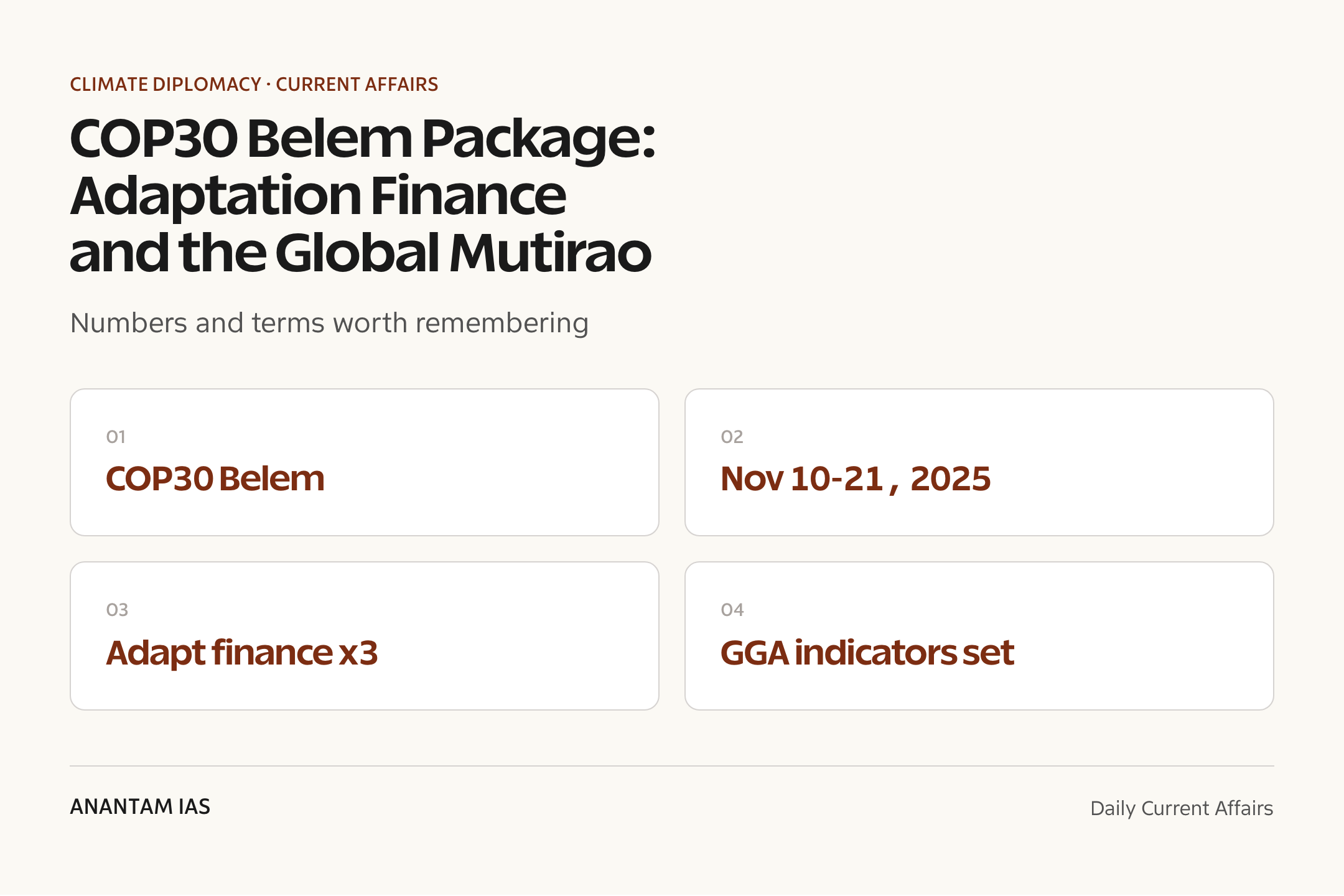
The 30th Conference of the Parties (COP30) to the UN Framework Convention on Climate Change (UNFCCC) met in Belem, Brazil from 10-21 November 2025 and ran into overtime before adopting its outcome. As the first climate COP held in the Amazon, it placed forests, adaptation and the credibility of climate finance at the centre of the debate that carried into December.
Parties adopted the ‘Belem Package’ and a cover decision the Presidency branded the ‘Global Mutirao’ (a Brazilian term for collective community effort). It calls for a tripling of adaptation finance by 2035, finalises a set of Global Goal on Adaptation indicators, and notes the new Tropical Forests Forever Facility — but the final text carried no roadmap to transition away from fossil fuels, the summit’s sharpest fault line.
- COP30 was the first COP hosted in the Amazon, presided over by Brazil’s Andre Correa do Lago.
- The cover decision urges parties to triple adaptation finance from 2025 levels by 2035.
- A package of about 59-60 indicators for the Global Goal on Adaptation (GGA) was finalised after a multi-year work programme.
- Brazil launched the Tropical Forests Forever Facility (TFFF), a fund to reward countries for keeping tropical forests standing.
- Over 80 countries pushed for a fossil-fuel phase-out roadmap, but it was kept out of the final text.
- The Presidency carried forward the ‘Baku to Belem Roadmap to USD 1.3 trillion’ on scaling climate finance for developing countries.
The development matters in the context of:
- COP30 followed COP29 (Baku), which had set a New Collective Quantified Goal of at least USD 300 billion a year by 2035 for developing countries — widely seen as inadequate.
- It also marked a decade since the 2015 Paris Agreement, sharpening scrutiny of whether the 1.5°C goal remains within reach.
UPSC Relevance
Prelims Relevance
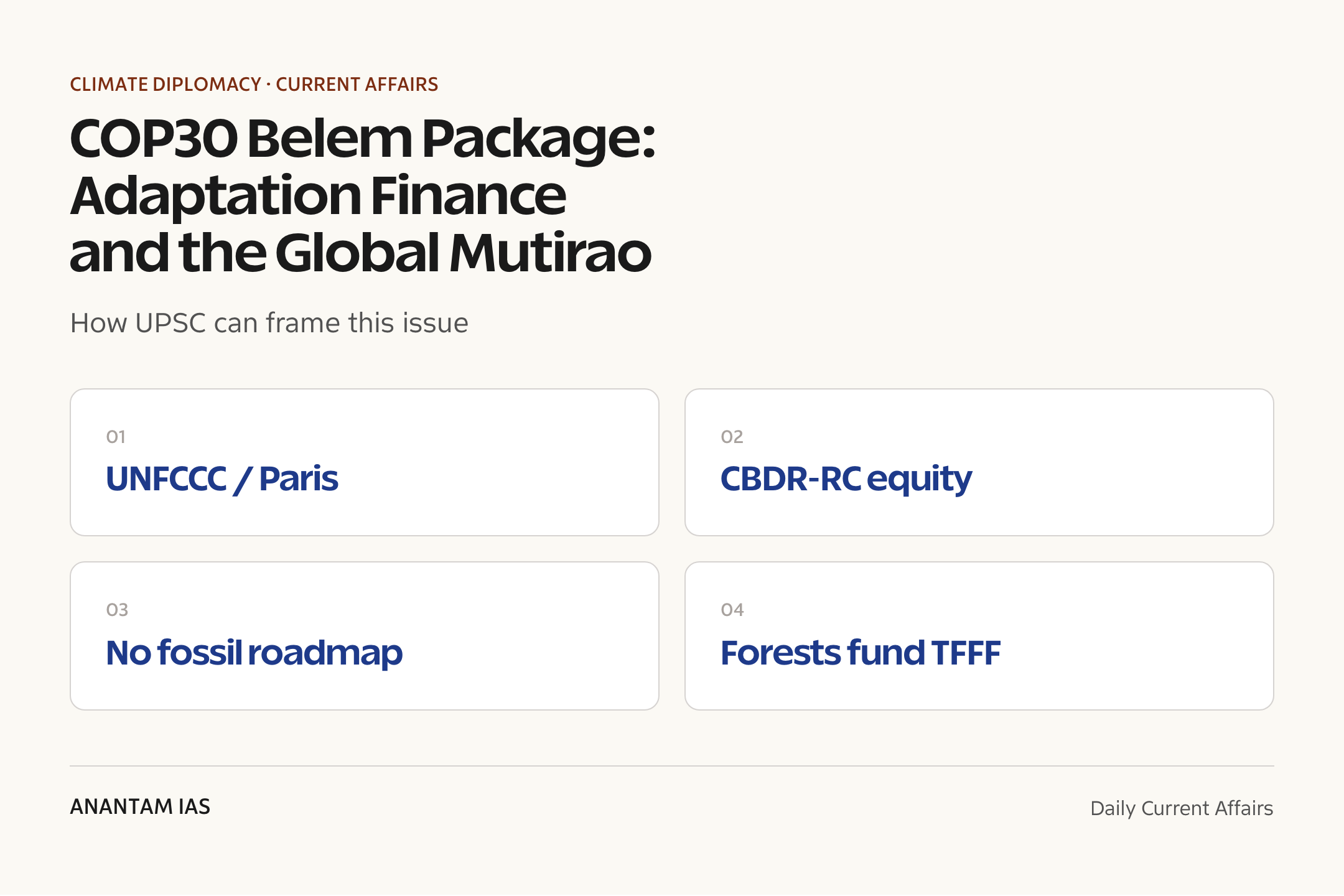
- UNFCCC (1992, Rio Earth Summit) is the parent convention; the COP is its supreme decision-making body.
- Kyoto Protocol (1997) bound only developed countries; the Paris Agreement (2015) covers all parties through Nationally Determined Contributions (NDCs).
- Global Goal on Adaptation (GGA) was established under Article 7 of the Paris Agreement; the UAE-Belem work programme developed its indicators.
- Common But Differentiated Responsibilities and Respective Capabilities (CBDR-RC) is the core equity principle India invokes.
- Loss and Damage Fund was operationalised at COP28 (Dubai); the Global Stocktake also concluded there.
- New Collective Quantified Goal (NCQG) on finance — at least USD 300 billion/year by 2035 — was agreed at COP29.
- Tropical Forests Forever Facility (TFFF) is a Brazil-led results-based forest-finance mechanism.
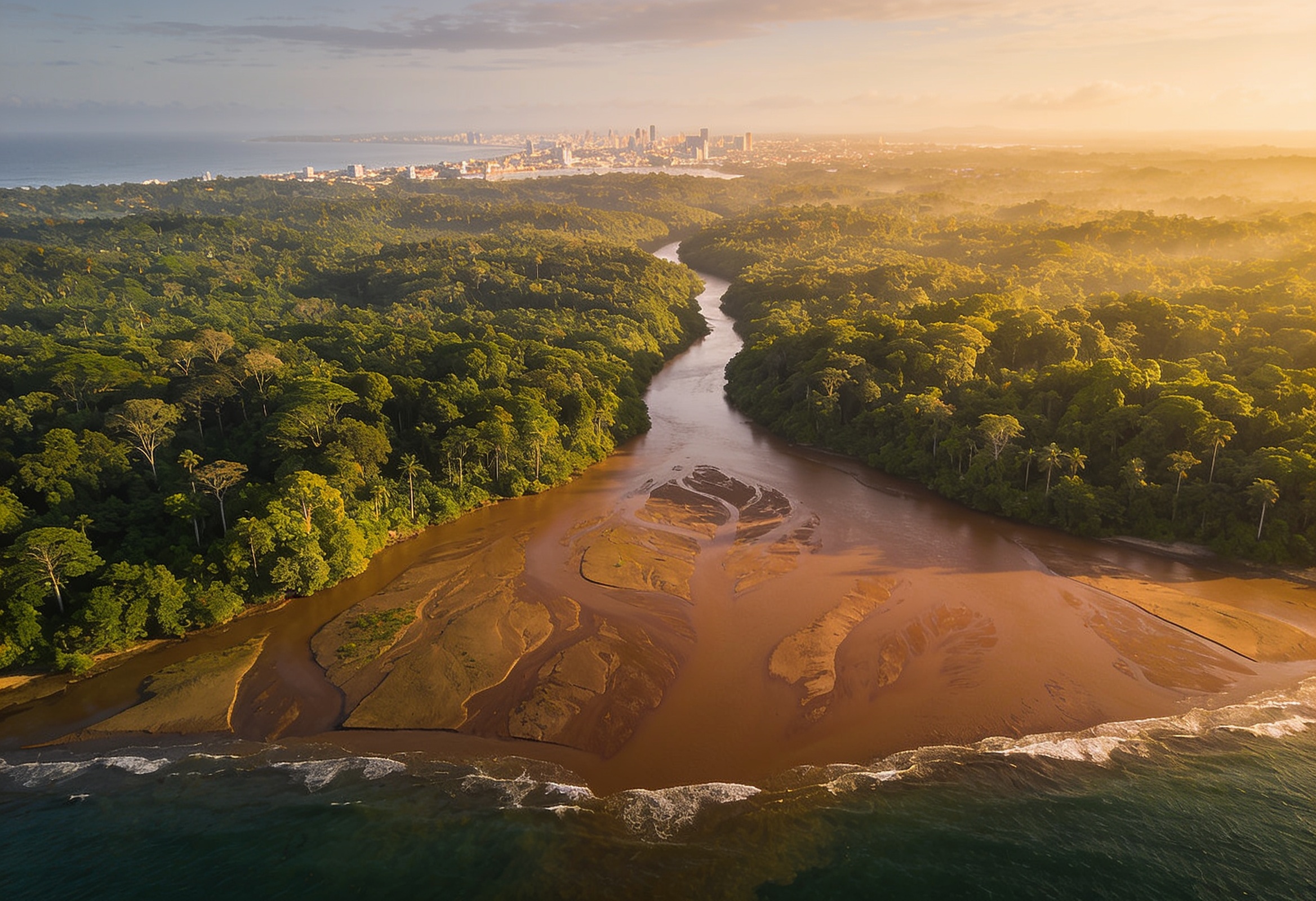
- Belem lies on the Amazon delta in Para state, Brazil.
Mains Relevance
GS Paper 3
- Adequacy of global climate finance and the gap between pledges and the needs of developing countries.
- Adaptation versus mitigation: why the GGA and adaptation finance matter for a climate-vulnerable India.
GS Paper 2
- CBDR-RC and equity in multilateral climate negotiations, and India’s positioning in the Global South coalition.
Essay
- Promises at the podium and finance on the ground: the widening trust deficit in global climate action.
Background and Context
The UNFCCC and the COP architecture
COP30 sits within a treaty system three decades in the making.
- The UNFCCC was adopted at the 1992 Rio Earth Summit with the objective of stabilising greenhouse-gas concentrations at a safe level.
- The Conference of the Parties (COP) meets annually as the convention’s supreme body; COP30 is its thirtieth session.
- The Kyoto Protocol (1997) imposed binding cuts only on developed (Annex-I) countries; the Paris Agreement (2015) shifted to universal, nationally determined action.
- Under Paris, every party submits NDCs and updates them in five-year cycles, informed by the Global Stocktake.
What the Belem Package delivered
The headline wins were on adaptation, forests and a finance roadmap.
- A call to triple adaptation finance from 2025 levels by 2035, responding to the long-standing imbalance favouring mitigation.
- Adoption of a finalised set of GGA indicators to make adaptation progress measurable and comparable.
- Launch of the Tropical Forests Forever Facility, designed to pay forest nations for standing forests rather than only for avoided deforestation.
- A just-transition mechanism and continued work on the Baku to Belem Roadmap toward USD 1.3 trillion in climate finance.
Where COP30 fell short
The biggest gap was the missing signal on fossil fuels.
- Despite a push by 80-plus countries, the final decision did not include a roadmap to transition away from fossil fuels, walking back the language of COP28.
- Many developing countries judged the finance commitments as still short of need and lacking clear, new public money.
- Critics flagged the reliance on voluntary initiatives outside the formal negotiated text, which are harder to hold parties to.
India's stance at Belem
India anchored its position in equity and finance.
- India reaffirmed CBDR-RC and pressed developed countries to deliver finance and technology, not shift the burden to developing economies.
- It resisted unilateral trade measures such as carbon border levies that penalise developing-country exports.
- India highlighted its own record — a large renewable-energy build-out and initiatives like the International Solar Alliance and Mission LiFE.
- It backed a strong outcome on adaptation and predictable finance, priorities for a climate-vulnerable economy.
Why adaptation finance is the crux
For vulnerable nations, adaptation money is survival money.
- Adaptation covers sea-walls, drought-resilient crops, early-warning systems and heat action plans — costs that fall hardest on developing countries.
- Adaptation has historically drawn a fraction of climate finance compared with mitigation, despite rising disaster losses.
- The UNEP Adaptation Gap assessments repeatedly show needs running far ahead of flows.
- A measurable GGA with indicators is meant to convert vague adaptation goals into trackable targets.
Way Forward
Convert pledges into delivered finance
- Developed countries should provide new and additional public finance, not relabelled loans, and front-load adaptation support.
- Operationalise the Baku to Belem Roadmap with transparent milestones.
Keep the 1.5°C goal alive
- Sharpen the next round of NDCs and address the fossil-fuel question that Belem deferred.
- Scale credible carbon markets under Article 6 with strong integrity safeguards.
Protect tropical forests
- Capitalise the TFFF at scale and ensure benefits reach indigenous and local communities.
Conclusion
COP30 in the Amazon produced real gains on adaptation finance, adaptation indicators and forest protection, yet it dodged the central question of phasing out fossil fuels and left developing countries unconvinced that finance will match ambition.
For the UPSC aspirant the durable lessons are structural: how the UNFCCC-Paris system works, why CBDR-RC and adaptation finance dominate India’s negotiating brief, and how the gap between summit rhetoric and delivered money keeps the credibility of climate multilateralism in question.
UPSC Practice Questions
Prelims MCQ 1
With reference to the global climate-governance framework, consider the following statements:
- The UNFCCC was adopted at the 1992 Rio Earth Summit.
- Under the Paris Agreement, only developed countries are required to submit Nationally Determined Contributions.
- The Global Goal on Adaptation was established under the Paris Agreement.
How many of the above statements are correct?
(a) Only one (b) Only two (c) All three (d) None
Answer: (b) Only two
Explanation:
Statements 1 and 3 are correct. Statement 2 is wrong — under the Paris Agreement all parties, developed and developing, submit NDCs; this universality is what distinguishes it from the Kyoto Protocol.
Prelims MCQ 2
The ‘Tropical Forests Forever Facility (TFFF)’, launched at COP30, is best described as:
(a) A trade bloc of Amazon-basin countries (b) A results-based fund to reward countries for keeping tropical forests standing (c) A UN body that replaces the UNFCCC (d) A carbon-trading platform under the Kyoto Protocol
Answer: (b) A results-based fund to reward countries for keeping tropical forests standing
Explanation:
The Brazil-led TFFF is a forest-finance mechanism that pays nations for conserving standing tropical forests, shifting incentives toward keeping forests intact.
UPSC Mains Questions
- COP30 advanced adaptation finance and forest protection but failed to signal a transition away from fossil fuels. Critically examine the outcomes of the Belem summit and their implications for developing countries.
- ‘Climate finance remains the weakest link in global climate governance.’ Discuss with reference to the CBDR-RC principle and India’s negotiating position.
Sources: UNFCCC / COP30 Presidency, Brazil and UN News.
Frequently Asked Questions
Where and when was COP30 held?
COP30, the 30th Conference of the Parties to the UNFCCC, was held in Belem, Brazil, from 10 to 21 November 2025. It was the first UN climate COP hosted in the Amazon region, which put forests and adaptation at the centre of the agenda.
What is the ‘Global Mutirao’ decision?
‘Mutirao’ is a Brazilian term for collective community effort. The COP30 Presidency used it to brand the summit’s cover decision, the ‘Belem Package’, which calls for tripling adaptation finance by 2035, finalises Global Goal on Adaptation indicators, and frames continued work on scaling climate finance.
Did COP30 agree to phase out fossil fuels?
No. Although more than 80 countries pushed for a roadmap to transition away from fossil fuels, the demand was kept out of the final negotiated text, making it the most contentious gap of the summit.
What is the Global Goal on Adaptation?
The Global Goal on Adaptation (GGA) was established under Article 7 of the Paris Agreement to drive collective progress on adaptation. COP30 finalised a set of indicators so that adaptation efforts can be measured and compared across countries.
What was India’s position at COP30?
India reaffirmed the principle of Common But Differentiated Responsibilities, pressed developed countries to deliver finance and technology, opposed unilateral trade measures such as carbon border taxes, and backed a strong outcome on adaptation finance as a climate-vulnerable economy.
What is the Tropical Forests Forever Facility?
It is a Brazil-led results-based fund launched at COP30 that rewards countries for keeping tropical forests standing, rather than financing only avoided deforestation. It aims to channel large, predictable payments to forest nations and their communities.