Core Sector growth slows to 5.4% in July
Why in the News?
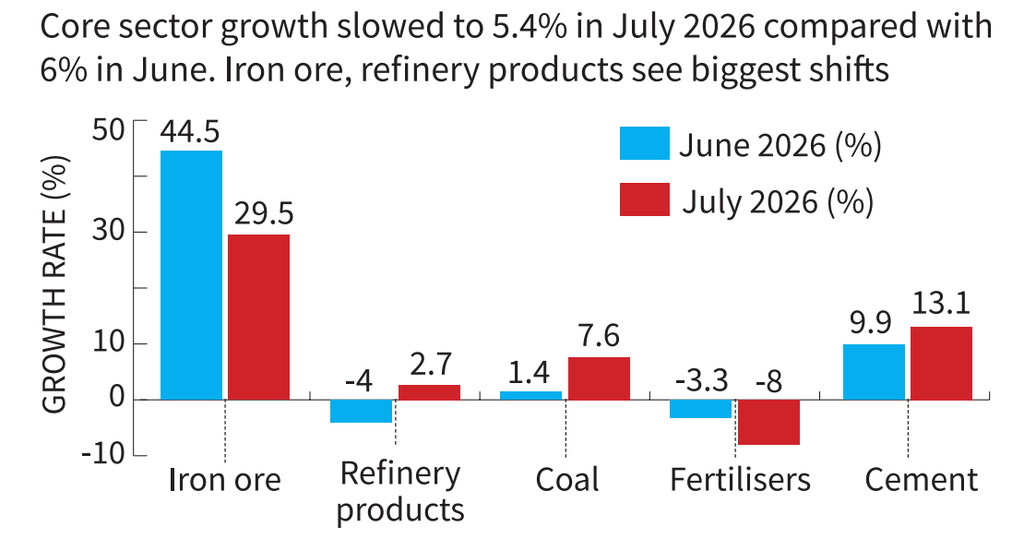
India’s Index of Core Industries (ICI) grew by 5.4% in July 2026, moderating from the revised growth of 6% in June. However, it remained the second-highest growth recorded in the preceding seven months.
| UPSC Relevance: GS-3 Economy: Manufacturing sector Prelims: Index of Core Industries (Key facts) |
Sectoral Performance:
- Strong growth: Iron ore (29.5%), cement (13.1%), electricity (9%), coal (7.6%), steel (2.9%) and refinery products (2.7%).
- Contraction: Fertilisers (-8%), crude oil (-5.3%) and natural gas (-3.7%).
- Cumulative core-sector growth during April-July 2026 increased to 4.3%, compared with 1.5% during the corresponding period of 2025.
Although iron-ore and coal production registered high growth, this partly reflected a low-base effect, as their output had contracted during the corresponding period of 2025. Slower steel growth and continued contraction in crude oil and natural gas indicate uneven industrial recovery.
Revised Index of Core Industries:
The Index of Core Industries (ICI) in India tracks the production performance of foundational infrastructure sectors. In July 2026, the government introduced a revised Index of Core Industries (ICI) series:
- Base year: Changed from 2011-12 to 2022-23.
- Number of sectors: Increased from eight to nine, with iron ore added.
- Nine core industries: Coal, crude oil, natural gas, refinery products, fertilisers, steel, cement, electricity and iron ore.
- It is compiled monthly by the Office of the Economic Adviser, Department for Promotion of Industry and Internal Trade, Ministry of Commerce and Industry.
- The nine industries constitute 32.88% of the weight of the revised Index of Industrial Production, down from 40.27% under the previous series.
- Under the revised ICI, electricity has the highest weight (30.932%), while fertilisers have the lowest (2.731%).
Economic Significance:
- The ICI acts as a lead indicator of industrial and infrastructure activity. Strong cement and electricity production suggest continuing construction and infrastructure demand.
- However, persistent weakness in domestic crude oil and natural gas production raises concerns regarding energy import dependence, while fertiliser contraction may affect agricultural input availability.