Courtroom Clips: Open Justice Meets Context Collapse
Why in News?
A 4 September report examined how short social-media clips from livestreamed and virtual court hearings expand access while stripping judicial exchanges of legal and procedural context.
- In July, the Supreme Court issued an interim restriction on circulating judicial audio or video clips without prior permission from court registrars.
- The Court later clarified that recognised news outlets may report proceedings but may not use the audio or video clips.
- The 2018 Swapnil Tripathi judgment recognised livestreaming of constitutionally important cases as part of access to justice under Article 21.
- The Supreme Court e-Committee’s 2021 Model Rules already restrict unauthorised dissemination and commercial or promotional use.
- Open justice lets citizens observe institutions, but a viral fragment can confuse a judge’s exploratory question with the binding reasoning of a final order.
- A workable protocol must protect sensitive parties and fair process without turning public access into opaque discretionary permission.
UPSC Relevance
Prelims Relevance
- Open justice supports public scrutiny of judicial proceedings and confidence in administration of justice.
- Article 21 has been connected with access to justice in the livestreaming context.
- Constitution Benches have five or more judges deciding substantial constitutional-interpretation questions.
- Oral observations test arguments but do not carry the binding force of the signed order or judgment.
- Sensitive matters may be excluded or delayed to protect privacy, children, victims or trial fairness.
Mains Relevance
GS Paper 2
- Open justice, institutional accountability and access to courts
- Privacy, fair trial and proportional regulation of courtroom footage
GS Paper 4
- Context, professional responsibility and ethical use of public records
Essay
- Transparency without context can illuminate institutions and distort them at the same time.
Background and Context
Why Livestreaming Serves Open Justice
Physical courtrooms have limited space, while distance and cost can exclude litigants, students, journalists and ordinary citizens from observing proceedings.
- Official livestreams widen access to constitutional hearings and allow the public to see arguments, questions and institutional procedure rather than rely only on summaries.
- Archives can strengthen legal education, enable accurate reporting and give litigants a record of how important public questions were heard.
- Visibility can improve professional accountability because judges and lawyers know that conduct may be observed beyond the courtroom.
- Access is not absolute: courts can restrict or delay transmission where privacy, child protection, sexual offences, national security or trial fairness require it.
- A public feed also creates accessibility duties, including reliable audio, captions, schedules and records that people with disabilities or limited bandwidth can use.
How Context Collapses
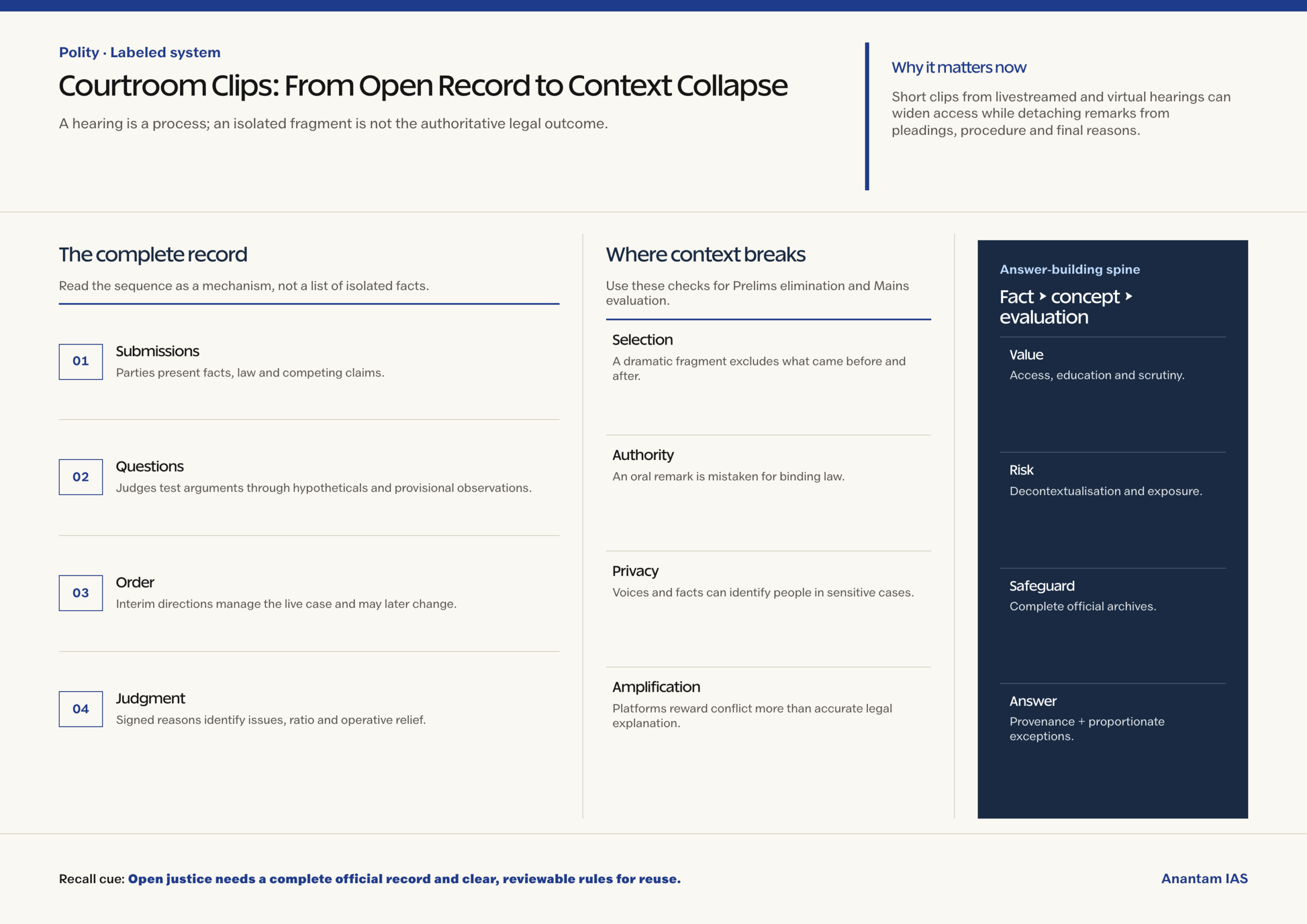
A hearing is an unfolding process, but social platforms reward brief, emotional and shareable fragments detached from pleadings and final reasons.
- Judges often ask hard hypothetical questions to test both sides; a question or preliminary view may change as evidence and argument develop.
- A short clip can omit the lawyer’s preceding submission, later clarification and final operative direction, creating a false account of the proceeding.
- Sensitive family, custody or sexual-offence hearings can expose parties even when names are removed because facts, voices or surrounding details remain identifying.
- Virality may encourage performative advocacy or cautious judging, weakening candid courtroom exchange and shifting attention from legal reasons to personalities.
- Platform ranking adds another layer: engagement systems can repeatedly amplify conflict while quieter explanations of jurisdiction, evidence and precedent receive little visibility.
From Blanket Control to Proportionate Rules
The policy challenge is to target harmful extraction and misuse without making the registrar an unexplained gatekeeper for ordinary public communication.
- An official complete archive provides a reference against which misleading fragments can be checked and corrected quickly.
- Rules should distinguish live access, downloading, editing, commercial reuse, reporting, research and accessibility because these uses create different risks.
- Permission systems need published criteria, response times and review mechanisms to prevent arbitrary treatment of independent journalists, researchers or citizens.
- Platform cooperation can prioritise provenance, links to the full record and rapid removal of privacy violations without suppressing accurate textual reporting.
- Media literacy remains essential because viewers must distinguish submissions, oral observations, interim directions, operative orders and precedential judgments when interpreting any hearing fragment.
Institutional Speech Needs Legal Context
Courts communicate through hearings, daily orders and final judgments, but these forms do not carry identical authority or completeness.
- An interim direction manages a live case and may change after further hearings, evidence or submissions from added parties.
- A final judgment explains facts, issues, reasons and relief, allowing readers to identify the ratio rather than infer law from a remark.
- Accurate reporting should link the spoken exchange to the case number, order date and procedural stage without implying that every observation creates precedent.
Way Forward
Protect the Record and the People
A layered protocol can preserve openness while reducing decontextualisation, privacy harm and unauthorised commercial exploitation.
- Maintain searchable official archives with stable links to full hearings, orders and corrections.
- Define excluded case categories and redaction standards through clear, public and reviewable rules.
- Require clips to preserve provenance and link viewers to the full official record where reuse is permitted.
- Build expedited remedies for manipulated footage, privacy breaches and false attribution while protecting fair reporting and criticism.
Conclusion
- Open justice works when the public can reach the complete and authoritative record, not only the most dramatic seconds selected by an algorithm.
- A strong answer should balance access, privacy and fair trial through differentiated uses, clear exceptions, official archives and reviewable safeguards.
UPSC Practice Questions
Prelims MCQ 1
With reference to livestreaming of court proceedings, consider the following statements:
- Oral observations always have the same binding force as a signed judgment.
- Constitution Benches comprise five or more judges.
- Sensitive proceedings may be excluded from livestreaming.
How many of the above statements are correct?
(a) Only one (b) Only two (c) All three (d) None
Answer: (b) Only two
Explanation:
Statements 2 and 3 are correct. Oral observations test arguments and are not equivalent to the binding reasons and directions in a final signed order.
Prelims MCQ 2
Which measure best counters misleading courtroom clips while preserving open justice?
(a) Deleting every official archive (b) Publishing a complete official record with provenance-linked permitted clips (c) Prohibiting all textual reporting (d) Allowing unrestricted recording in sensitive cases
Answer: (b) Publishing a complete official record with provenance-linked permitted clips
Explanation:
A complete authoritative record helps verify context while proportionate rules can address privacy and misuse.
UPSC Mains Questions
- Court livestreaming advances open justice, but platform-driven context collapse can damage privacy and legal understanding. Discuss.
- Design a proportionate governance framework for reuse of courtroom footage that protects transparency, fair trial and sensitive parties.
Source: The Hindu.
Frequently Asked Questions
What is open justice?
Open justice is the principle that judicial proceedings should ordinarily be observable and reportable, supporting public scrutiny, institutional accountability and confidence in adjudication.
Are a judge’s oral remarks binding law?
No. Oral questions and observations are part of testing arguments; binding reasons and directions appear in the court’s signed order or judgment.
Why can a short courtroom clip be misleading?
It may omit the underlying pleadings, preceding exchange, later clarification and final ruling, converting a provisional question into a false institutional conclusion.
Can sensitive cases be kept off livestreams?
Yes. Privacy, children, sexual offences, national security and fair-trial concerns can justify exclusion, delay, redaction or restricted access under clear rules.
What is the best response to decontextualised clips?
Maintain complete official archives, define permitted reuse, require provenance, protect sensitive identities and provide rapid remedies for manipulation or privacy breaches.