Retail Inflation at 2.1%: Lowest Since 2019
Why in News?
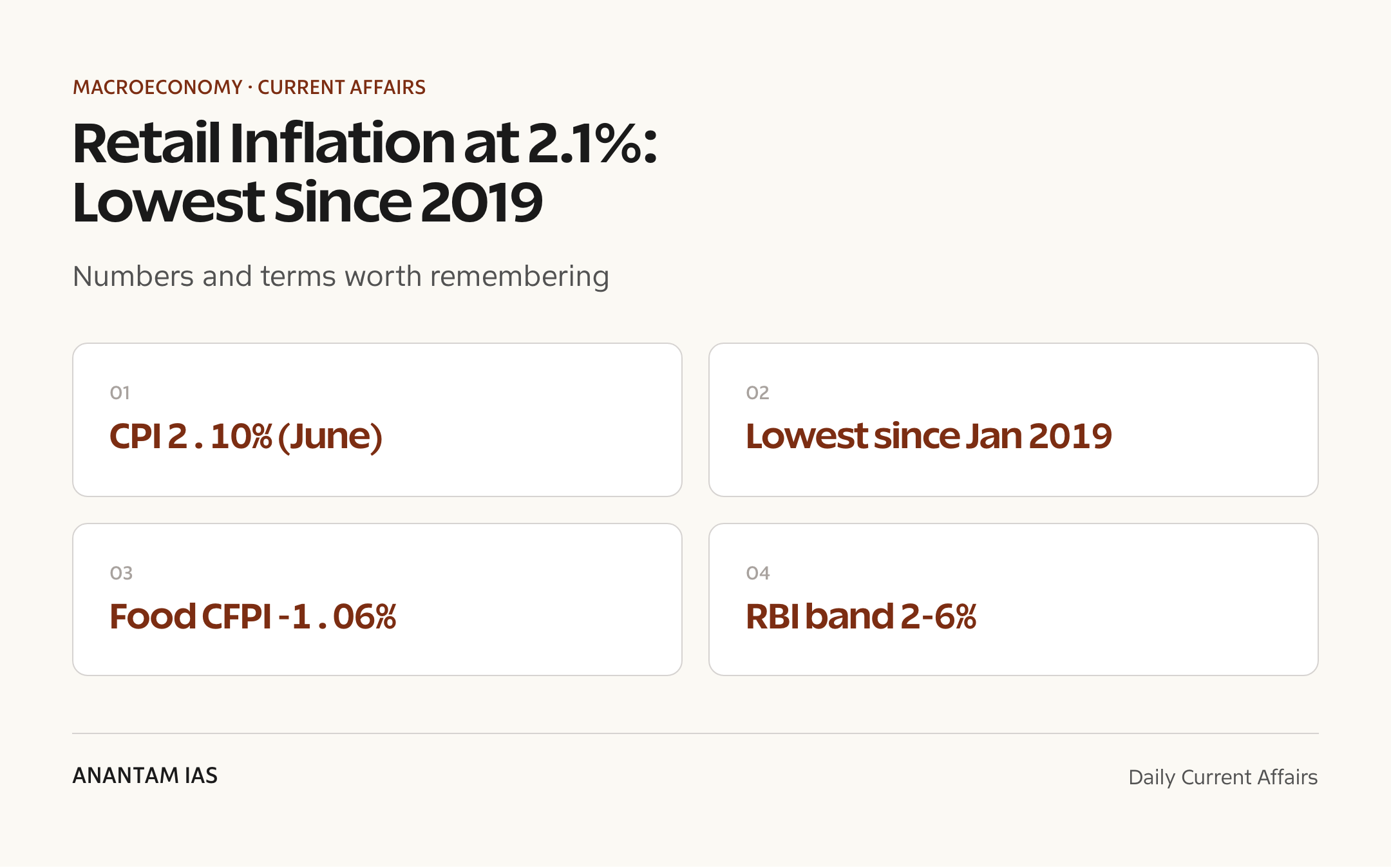
Data released on 14 July 2025 by the National Statistical Office (NSO) under the Ministry of Statistics and Programme Implementation showed India’s headline retail inflation, measured by the Consumer Price Index (CPI), easing to 2.10% in June 2025 from 2.82% in May. That is the lowest CPI print since January 2019, a fall of about 72 basis points in a single month.
The cooling was led by food: the Consumer Food Price Index (CFPI) slipped to -1.06%, turning negative for a second straight month. With the headline number sitting at the floor of the RBI’s 2-6% tolerance band, the print widened the space for further monetary easing and put the spotlight on how food and core inflation move within India’s flexible inflation-targeting framework.
- Headline CPI fell to 2.10% in June 2025 from 2.82% in May — the lowest since January 2019.
- Food inflation (CFPI) came in at -1.06%, the second consecutive month of food deflation.
- Rural inflation was 1.72% and urban inflation 2.56%; rural food inflation was -0.92% and urban -1.22%.
- The decline was driven by easing prices of vegetables, pulses, cereals, milk, meat and fish, sugar and spices.
- The print sits at the lower bound of the RBI’s 4% (+/- 2%) target, widening room for rate cuts.
- Data were compiled from 1,100+ urban markets and 1,181 villages; the NSO collects CPI prices nationwide each month.
The development matters in the context of:
- Why this matters for monetary policy: a sub-target CPI gives the RBI’s Monetary Policy Committee more headroom to support growth.
- Why this matters for the economy: low and stable inflation protects real incomes and anchors household and business expectations.
- Why this matters for agriculture: food deflation lifts consumer purchasing power but can squeeze farm-gate realisations for producers.
UPSC Relevance
Prelims Relevance
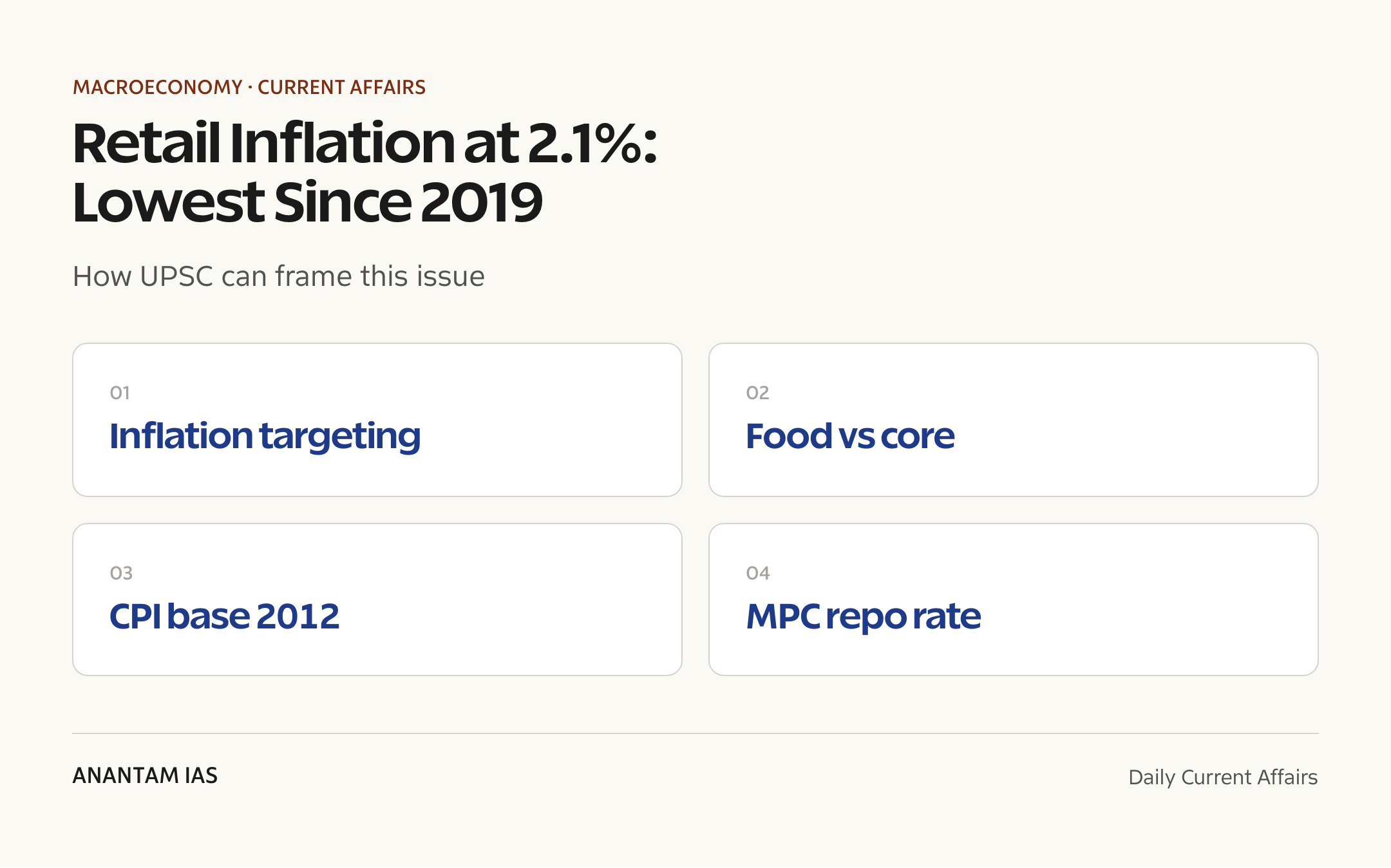
- CPI is compiled and released monthly by the National Statistical Office (NSO) under MoSPI, with base year 2012.
- CPI, not the Wholesale Price Index (WPI), is the RBI’s anchor for inflation targeting since 2016.
- The Consumer Food Price Index (CFPI) tracks the food and beverages component of CPI.
- Food and beverages carry the largest weight (~45.86%) in the CPI basket.
- India’s flexible inflation-targeting framework sets a CPI target of 4% with a 2-6% tolerance band.
- The target is set by the Central Government in consultation with the RBI under the amended RBI Act, 1934.
- The Monetary Policy Committee (MPC) has six members — three from the RBI and three appointed by the Centre.
- Headline inflation covers the full basket; core inflation excludes volatile food and fuel.
- A negative CFPI means food prices are lower than a year earlier — deflation, not just slower inflation.
- WPI is released by the Office of the Economic Adviser, Department for Promotion of Industry and Internal Trade (DPIIT).
Mains Relevance
GS Paper 3
- India’s flexible inflation-targeting framework: design, the role of the MPC, and how the tolerance band shapes monetary policy.
- Food versus core inflation in India: why supply-side food shocks complicate a CPI-anchored regime.
GS Paper 3
- Implications of food deflation for farmers’ incomes, MSP policy and rural demand.
Essay
- Price stability and growth: the balancing act at the heart of central banking.
- When cheaper food hurts the farmer: the paradox of food deflation in an agrarian economy.
Background and Context
What CPI Measures and Who Releases It
The Consumer Price Index tracks the change in retail prices that ordinary households actually pay.
- CPI is a basket-based index measuring year-on-year change in retail prices of goods and services consumed by households, with the current base year 2012.
- It is compiled and released monthly by the National Statistical Office (NSO) under the Ministry of Statistics and Programme Implementation.
- Food and beverages form the heaviest segment of the basket (about 45.86%), so food-price swings dominate the headline number.
- The Consumer Food Price Index (CFPI) isolates the food component, while core inflation strips out volatile food and fuel to show underlying price pressure.
The June 2025 Print in Detail
June’s reading was a broad-based cooling led almost entirely by food.
- Headline CPI eased to 2.10% from 2.82% in May — the lowest since January 2019.
- The CFPI printed at -1.06%, the second straight month of food deflation.
- There was a clear rural-urban gap: rural inflation at 1.72% versus urban at 2.56%.
- Falling prices of vegetables, pulses, cereals, milk, meat and fish, sugar and spices pulled the food index down year-on-year.
India's Inflation-Targeting Framework
Since 2016, the RBI has run a formal, flexible inflation-targeting regime built around the CPI.
- The amended RBI Act, 1934 tasks the central bank with maintaining price stability while keeping growth in mind.
- The Central Government, in consultation with the RBI, sets a CPI target of 4% with a tolerance band of +/- 2% (the 2-6% band).
- A six-member Monetary Policy Committee (MPC) decides the policy repo rate, with the RBI Governor holding a casting vote in a tie.
- Missing the band for three consecutive quarters obliges the RBI to send the government a written explanation — a built-in accountability check.
Why Food and Core Inflation Diverge
The June data show why a CPI anchored to a food-heavy basket can be hard for a central bank to steer.
- Food inflation is largely supply-driven — monsoon, sowing patterns, storage and global commodity cycles — and lies outside the RBI’s direct control.
- Core inflation reflects demand and underlying cost pressures and responds more predictably to interest rates.
- In June, headline relief came from food deflation even as service categories stayed firmer — education at 4.37% and health at 4.43% year-on-year.
- A favourable base effect and a good rabi harvest helped the food index, but such gains can reverse quickly if weather turns adverse.
Implications for Monetary Policy
A print at the floor of the band changes the calculus for the RBI’s rate-setting.
- With headline CPI at 2.10%, well below the 4% target, real interest rates rise, giving the MPC room to ease.
- Lower inflation supports a pivot toward growth, but the RBI typically waits for durable, not transient, disinflation.
- Food deflation can be temporary, so the bank weighs core inflation and the outlook for the monsoon before cutting rates.
- Stable, low inflation also anchors inflation expectations, which feed into wage and price-setting across the economy.
The Two-Edged Effect of Food Deflation
Cheaper food is welcome for consumers but carries a cost for the rural economy.
- For consumers, food deflation lifts real incomes and frees household budgets for other spending.
- For farmers, lower prices mean weaker farm-gate realisations, especially for vegetables and pulses that lack assured procurement.
- Persistent deflation can blunt the incentive to sow in the next season, risking a future supply squeeze and a price rebound.
- It sharpens the policy case for assured procurement, better storage and value chains so price relief for buyers does not erode producers’ margins.
Way Forward
Keep disinflation durable
- Treat food deflation as data, not a trend — the MPC should confirm that core inflation and expectations are firmly anchored before easing.
- Sustain investment in supply-side fixes — cold storage, logistics and price-data systems — so food shocks fade faster.
Protect the producer while helping the consumer
- Strengthen procurement and market access for perishables and pulses so farm-gate prices do not collapse during gluts.
- Use buffer stocks and timely imports/exports calibration to smooth volatility rather than amplify it.
Strengthen the data and framework
- Update the CPI base year and consumption weights to reflect current household spending and keep the index representative.
- Maintain transparent communication so households and markets read RBI intent clearly, reinforcing the credibility of inflation targeting.
Conclusion
June 2025’s 2.10% CPI is a genuine relief print: the lowest in over six years, sitting at the floor of the RBI’s tolerance band and driven by a second month of food deflation. It hands the Monetary Policy Committee more room to weigh growth against price stability, and it protects the real incomes of households squeezed by years of food-price spikes.
But the same number carries a caution. Food deflation can reverse with one bad monsoon, and lower prices squeeze the farmers who grow the food. The durable test for India’s inflation-targeting framework is not a single soft reading but whether core inflation, supply chains and farm incomes stay balanced as the cycle turns.
UPSC Practice Questions
Prelims MCQ 1
With reference to inflation measurement and targeting in India, consider the following statements:
- The Consumer Price Index is compiled and released by the National Statistical Office under MoSPI.
- The Reserve Bank of India targets the Wholesale Price Index under its inflation-targeting framework.
- The flexible inflation-targeting framework sets a Consumer Price Index target of 4% with a tolerance band of 2-6%.
How many of the above statements are correct?
(a) Only one (b) Only two (c) All three (d) None
Answer: (b) Only two
Explanation:
Statements 1 and 3 are correct. Statement 2 is wrong — the RBI anchors its inflation target to the CPI, not the WPI, since the 2016 framework.
Prelims MCQ 2
Which of the following best describes ‘core inflation’?
(a) Headline retail inflation including all items (b) Inflation in food and beverages only (c) Inflation excluding volatile food and fuel components (d) Wholesale inflation of manufactured goods
Answer: (c) Inflation excluding volatile food and fuel components
Explanation:
Core inflation strips out the volatile food and fuel categories to reveal the underlying, demand-driven price trend that monetary policy can influence more directly.
UPSC Mains Questions
- India’s June 2025 retail inflation fell to its lowest level since 2019, led by negative food inflation. Examine how the divergence between food and core inflation complicates the conduct of monetary policy under a CPI-anchored inflation-targeting framework.
- Cheaper food helps consumers but can hurt farmers. Critically analyse the implications of sustained food deflation for rural incomes, sowing decisions and India’s broader food-security and price-stability objectives.
Sources: DD News, Prasar Bharati and NewsOnAir, Prasar Bharati.
Frequently Asked Questions
What was India’s retail inflation in June 2025?
India’s headline retail inflation, measured by the Consumer Price Index, fell to 2.10% in June 2025 from 2.82% in May. Released by the National Statistical Office on 14 July 2025, it was the lowest CPI reading since January 2019, driven largely by a fall in food prices.
Why is 2.10% inflation significant?
At 2.10%, headline CPI sat at the floor of the RBI’s 2-6% tolerance band and well below the 4% target. Such a low print signals easing price pressure, raises real interest rates and gives the Monetary Policy Committee more room to consider supporting growth through rate cuts.
What is the Consumer Food Price Index?
The Consumer Food Price Index, or CFPI, measures retail price change for the food component of the CPI basket. In June 2025 it came in at -1.06%, meaning food prices were lower than a year earlier for a second straight month, led by cheaper vegetables, pulses, cereals and milk.
Who releases India’s CPI data?
The Consumer Price Index is compiled and released every month by the National Statistical Office under the Ministry of Statistics and Programme Implementation. Prices are collected from over 1,100 urban markets and 1,181 villages, with the current series using 2012 as the base year.
What is India’s inflation-targeting framework?
Since 2016, under the amended RBI Act, the Central Government in consultation with the RBI sets a CPI inflation target of 4% with a tolerance band of 2-6%. A six-member Monetary Policy Committee sets the repo rate to keep inflation near this target while supporting growth.
Is low food inflation always good?
Not entirely. Cheaper food lifts consumers’ real incomes, but food deflation lowers the prices farmers receive, especially for vegetables and pulses without assured procurement. Persistently low prices can discourage sowing, risking a future supply squeeze and a sharp price rebound.