Criminalisation of politics


Why in news:
A latest nationwide analysis of elected representatives across India has revealed a disturbing rise in the number of MPs and MLAs facing serious criminal charges, raising pressing concerns over criminalisation of politics and the failure of decriminalisation reforms.
UPSC Relevance:
Parliament and State legislatures—structure, functioning, conduct of business, powers & privileges and issues arising out of these.
UPSC PYQ (2013):
Q: It is often said that ‘politics’ and ‘ethics’ do not go together. What is your opinion in this regard? Justify your answer with illustrations.
Criminalsation of politics:
What?
“Criminalisation of politics” refers to the rise in the number of people with criminal histories participating in politics. This complex issue not only undermines democratic principles but also harms the difficult process of developing and enacting public policy.
Data:
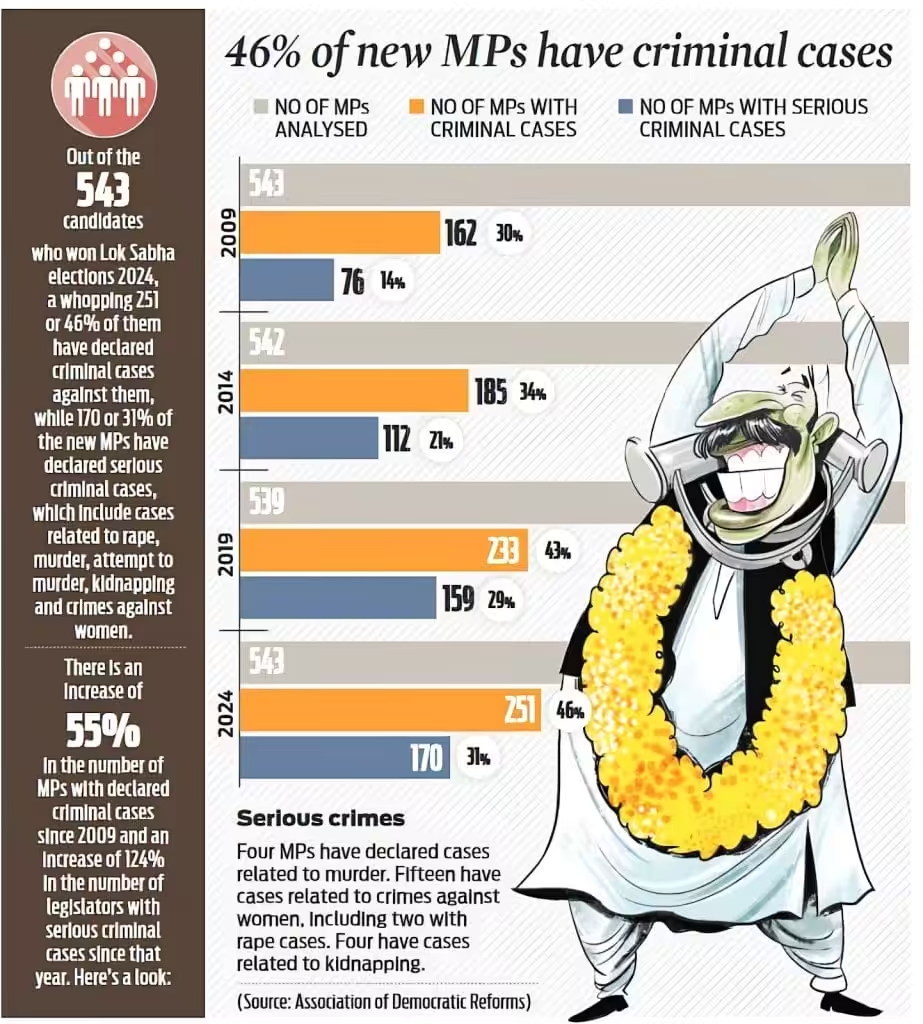
- In the Lok Sabha, the share of MPs facing serious criminal cases has more than doubled, from 14% in 2009 to 31% in 2024. In the Assemblies, the share was 29% in 2024, which accounts for more than 1,200 MLAs.
State wise:

- Telangana had the highest share of MPs with serious criminal cases (71%), followed by Bihar (48%). Uttar Pradesh recorded the highest absolute number at 34.
- The Bharatiya Janata Party (BJP) had the highest absolute number of MPs facing serious cases (63 members or 26% of its total). The Congress followed with 32 MPs (32%). Among smaller parties, the proportions were higher: all four MPs of the Rashtriya Janata Dal (RJD) had serious cases against them.
- Andhra Pradesh had the highest share of MLAs with serious criminal cases at 56%, followed by Telangana (50%). U.P. recorded the highest absolute number (154 MLAs or 38% of its total).

Association for Democratic Reforms report:
According to the ADR report, 306 out of the 763 sitting MPs that were examined (about 40%) had filed criminal complaints against themselves. The ADR analysis encompassed that out of 4033 MLA’s serving in India, 1136 MLA’s are having criminal record. Several factors have contributed to the growth of the relationship between politics and crime, including the relationship between politicians and organized crime, the use of coercion during elections, and the abuse of legal loopholes.
Causes and Impact:
| Causes | Impact | Way Forward |
| 1) Focus on Electoral Dynamics & Vote Bank Politics rather than criminal background. Ability to win elections matters more. | 1) Decline in parliamentary productivity and legislature – quality of deliberation and debate has declined, use of unparliamentary language and frequent disruption and misbehaviour by some MP’s and MLA’s. | 1) ARC and Law Commission– Debar such people from contesting and membership post chargesheet |
| 2) Political Patronage – Criminals are often backed by some influential politician and vice versa. | 2) Undermines Democracy as it prevents good candidates from contesting & prevents discussions and discourse on public’s issues. | 2) ECI – Life time ban for certain heinous offences. |
| 3) Contribution in terms of money power for election expenses by criminals. | 3) Social disharmony – Elected criminals act arbitrarily and cause threat to society. | 3) Criminalising false disclosure under Sec 8 of RPA, 1950. |
| 4) Legal loophole– under (sec 8) false disclosure of criminal background is not criminalised | 4) Compromises on the Morale of Civil Services – well qualified civil servants are supposed to work under alleged criminals. | 4) Follow ups and verification of affidavits submitted by candidates must be done. |
| 5) Political Culture in Country – Apathy and Tolerance to Criminals Electorate focuses more on parochial identities than background of candidate. | 5) Threat to Constitutionalism and constitutional value of Rule of Law. | |
| 6) Vohra Committee – Nexus of Criminal, Politicians, Bureaucrats Acc to CBI, RAW, IB this network runs a parallel govt. virtually. |
SC Judgements:
- Union of India v Association for Democratic Reforms(2002):
- The Court in dealing with the question of criminalization of politics held that under the Indian Constitution, electors had a fundamental right to know the antecedents of candidates contesting elections to hold public office. The court read in ‘right to be informed’ as a right flowing from freedom of speech and expression.
- Election Commission was directed to secure affidavits by candidates recording all particulars relating to past or pending criminal charges or cases against them. This included information as to whether the candidate was convicted/acquitted/discharged of any criminal offence in the past. Additionally, if convicted, the quantum of punishment that was awarded; and whether prior to six months of filing of nomination, the candidate was accused of an offence punishable with minimum two years of imprisonment.
2. PUCL v Union of India(2004):
- The Peoples Union for Civil Liberties approached the Supreme Court challenging Section 33B of the Representation of People (Third Amendment) Act which nullified the decision in Association for Democratic Reforms (2002) by providing that candidates contesting elections need not file affidavit of criminal antecedents and particulars as directed by the Court.
- This provision was held unconstitutional and void as it infringed the “right of electors’ to know”, a constituent of the fundamental right to free speech and expression and hindered free and fair elections, which is part of the basic structure of the Constitution.
3. Lily Thomas v Union of India(2013):
A 2 Judge bench of the Supreme Court in 2013 ruled that Members of Parliament, Legislative Councils and Legislative Assemblies convicted of crimes where they had been awarded a minimum sentence of 2 years imprisonment would cease to be members of the house to which they were elected from the date of sentencing. It further struck down the provision, which allowed convicted members a 3 month time period for appeal against the conviction and sentencing and held that those convicted would suffer immediate disqualification.
4. Rambabu Singh Thakur v Sunil Arora(2020):
On February 13th 2020, a 2 judge Bench comprising RF Nariman and SR Bhat JJ delivered a judgment in the contempt petition arising out of the Electoral Disqualification case (Public Interest Foundation). Various litigants, including BJP spokesperson Ashwini Kumar Upadhyay, had filed contempt petitions against the Election Commission of India for not monitoring whether political parties were complying with the directions issued in the 2018 judgment in Public Interest Foundation. The Bench re-iterated the Court’s 2018 directions and directed the Election Commission to report to the Supreme Court any non-compliance by political parties.
Conclusion:
The infamous definition of democracy given by former U.S. President, Abraham Lincoln, says,
“Democracy is a government of the people, by the people and for the people”. It provides for an
ambiance in which the rights of not only the majority of the citizens but also that of minority are preserved. In a democracy, the people are sovereign and hence are the ultimate source of
authority. But the criminalization of politics has led to the dominance of money and muscle power which has posed a threat to the very foundation of democratic arrangement in the nation.
Bills for removal of PM, CM and Ministers on Arrest – Anantam IAS