India’s Inventory-Based Framework for Cross-Border E-Commerce Exports
Why in News?
On August 5, 2026, the Union government operationalised an inventory-based cross-border e-commerce export framework under the Foreign Trade Policy 2023 through Notification No.
- The measure follows Press Note No. 3 (2026 Series), which amended the FDI policy to permit inventory-based e-commerce operations exclusively for exports.
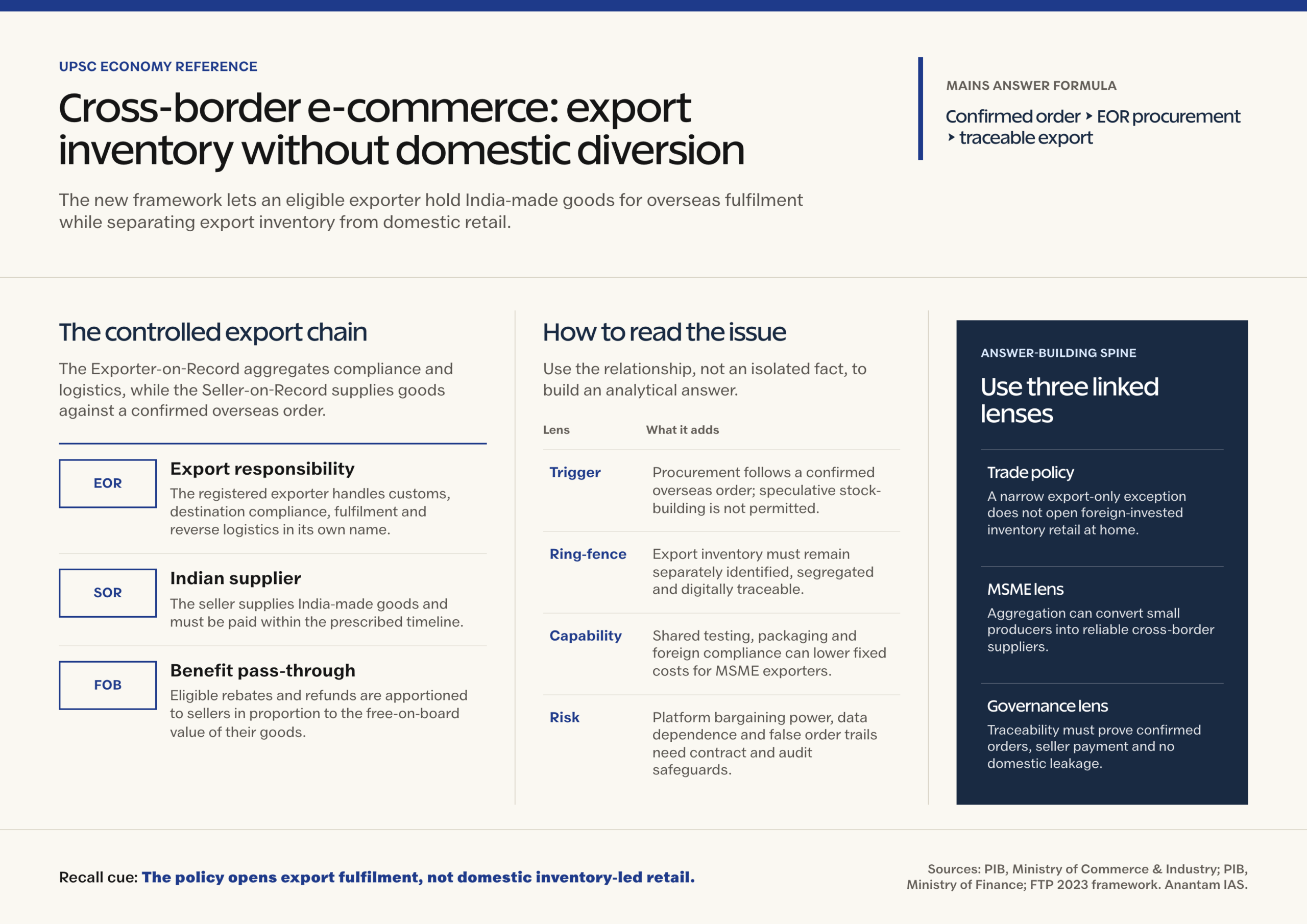
- A registered Exporter-on-Record (EOR) may procure India-made goods from a Seller-on-Record only after an overseas order is confirmed and then export those goods in its own name.
- The EOR assumes responsibility for export documentation, customs formalities, destination-country compliance, testing, certification, packaging, labelling, fulfilment, logistics and reverse logistics.
- Export inventory must be separately identified, segregated and digitally traceable; it cannot be diverted for sale in India’s domestic market.
- The seller must receive payment within the prescribed timeline even if the overseas buyer has not yet paid the EOR, while eligible rebates and refunds must be passed through in proportion to the goods’ FOB value.
- The reform addresses a structural constraint faced by MSMEs and artisans: they may produce exportable goods but lack overseas fulfilment capacity, destination-country compliance expertise and economical reverse logistics.
- It changes the allocation of export functions. The Indian producer can concentrate on production, while a registered EOR becomes the accountable exporter and service integrator.
- The policy must be read with the 2026 courier reforms, including removal of the earlier ₹10 lakh per-consignment value cap and simplified treatment of returned or rejected e-commerce parcels.
UPSC Relevance
Prelims Relevance
- The framework operates under the Foreign Trade Policy 2023, administered by the Directorate General of Foreign Trade under the Department of Commerce.
- An inventory-based e-commerce model involves ownership or control of inventory by the e-commerce entity; it differs from a marketplace model that primarily facilitates transactions between buyers and sellers.
- The 2026 policy opening is limited to export-only operations involving goods manufactured or produced in India; it is not a general permission for foreign-invested inventory-led retail in the domestic market.
- The EOR exports in its own name and carries responsibility for export operations and destination-country requirements.
- The SOR is the registered Indian seller from whom goods are procured against a confirmed overseas order.
- Speculative procurement or build-up of export inventory is not permitted; procurement must be linked to confirmed export orders.
Mains Relevance
GS Paper 3
- Assess how organised fulfilment, pooled compliance capacity and reverse logistics can lower fixed export costs for MSMEs, artisans and manufacturing clusters.
- Examine whether an export-only inventory model can improve India’s participation in digital trade without weakening domestic retail safeguards.
GS Paper 2
- Evaluate the governance design of separating the commercial seller, accountable exporter, platform and regulator while maintaining a clear audit trail.
- Analyse safeguards needed to prevent domestic diversion, delayed seller payments, opaque transfer pricing and excessive platform power.
Essay
- Digital platforms can widen market access only when convenience is matched by accountability, traceability and fair sharing of value.
Background and Context
What the new framework changes
The framework creates a regulated route through which an eligible e-commerce entity can hold inventory for exports without opening the same model to domestic retail.
- Under the earlier FDI architecture, foreign investment was permitted in the marketplace model of e-commerce, subject to conditions, while the inventory-based B2C model remained restricted.
- Press Note No. 3 of 2026 created a narrow exception for inventory-based operations conducted exclusively for exports. The August FTP notification supplies the operational policy and procedures for that exception.
- The permitted goods must be manufactured or produced in India. This links the opening to export promotion and domestic production rather than to import-led online retail.
- The design gives platforms or export entities more control over fulfilment, but attaches that control to a registered exporter, confirmed orders and a traceable inventory trail.
How the EOR-SOR chain works
The EOR-SOR arrangement assigns commercial and regulatory duties to named actors instead of leaving a small seller to manage every cross-border step.
- An overseas buyer first places a confirmed order. Only then may the registered EOR procure the relevant goods from the Indian SOR.
- The EOR exports the goods in its own name and becomes responsible for documentation, customs clearance and compliance in the destination market.
- The EOR may integrate testing, certification, packaging, labelling, warehousing, fulfilment, international logistics and reverse logistics. This can spread fixed compliance costs across many small consignments and sellers.
- The SOR retains an economic claim over timely payment, visibility into the final overseas sale price, order status and shipment tracking, and a proportionate share of export rebates and refunds.
- This separation is important for accountability: the producer remains identifiable, while customs and foreign regulators have a clearly designated exporter responsible for the consignment.
Seller-protection and anti-diversion safeguards
The framework tries to ensure that export facilitation does not become a route for speculative stocking, domestic-market leakage or transfer of excessive risk to small sellers.
- Inventory can be procured only against confirmed overseas orders. The EOR cannot build speculative export stock merely in anticipation of future demand.
- Goods acquired for the framework must be distinctly identified and physically or operationally segregated from other inventory.
- A digital repository must preserve traceability from the Indian seller through procurement, export, overseas sale and any return or disposal event.
- Goods designated as export inventory cannot be diverted into India’s domestic market. This is the principal ring-fence separating the export exception from domestic inventory-led e-commerce.
- Payment to the Indian seller is due within the prescribed timeline irrespective of whether the EOR has received payment from the foreign buyer. This places the overseas receivables risk on the EOR rather than passing it.
Why the reform matters for MSMEs and export clusters
Small producers often face a gap between making a globally saleable product and operating a reliable international retail chain.
- Cross-border e-commerce can aggregate dispersed demand for handicrafts, apparel, home products, books, jewellery and other differentiated goods made by smaller firms.
- A shared EOR can reduce the need for every seller to master foreign labelling rules, product certification, customs documentation and destination-country consumer requirements independently.
- Organised fulfilment and consolidated logistics may improve delivery predictability and make reverse logistics less costly, two major constraints in direct-to-consumer exports.
- Visibility into final sale prices can help sellers understand overseas demand and reduces the information asymmetry that arises when a platform controls the customer relationship.
- The requirement to pass through rebates and refunds prevents the export intermediary from automatically retaining benefits attributable to the producer’s goods.
Way Forward
Build interoperable digital traceability
- Link EOR and SOR records with customs declarations, shipping events, payment reconciliation and export-benefit claims through secure identifiers and auditable logs.
- Give sellers a usable dashboard for order confirmation, procurement value, FOB attribution, overseas sale price, shipment status, returns and benefit pass-through.
- Adopt risk-based inspections that focus on anomalous orders, repeated returns, domestic diversion indicators and mismatches between physical goods and digital records.
Conclusion
- India’s inventory-based cross-border e-commerce framework is a targeted institutional reform: it opens an export-only business model while retaining a firm boundary against domestic inventory-led retail.
- The framework can widen global market access for MSMEs only if enforcement keeps inventory ring-fenced, platforms disclose value fairly and producers retain bargaining power.
UPSC Practice Questions
Prelims MCQ 1
With reference to India’s Inventory-based Cross-border E-Commerce Export Framework, consider the following statements:
- The Exporter-on-Record exports goods in its own name and assumes responsibility for destination-country compliance.
- Export inventory may be procured speculatively before an overseas order is received.
- Goods procured under the framework may be diverted to India’s domestic market if the foreign buyer cancels the order.
How many of the above statements are correct?
(a) Only one (b) Only two (c) All three (d) None
Answer: (a) Only one
Explanation:
Statement 1 is correct. Procurement must follow a confirmed overseas order, speculative inventory build-up is barred, and export-designated inventory cannot be diverted to the domestic market. Returned or rejected goods must follow the prescribed re-export, return or disposal route.
Prelims MCQ 2
Which one of the following best describes the Seller-on-Record protection built into the framework?
(a) Payment depends entirely on prior receipt from the overseas buyer (b) The EOR may retain all export rebates because it files the export documents (c) The seller receives prescribed-timeline payment and a proportionate pass-through of export benefits (d) The seller becomes solely responsible for destination-country certification
Answer: (c) The seller receives prescribed-timeline payment and a proportionate pass-through of export benefits
Explanation:
The framework protects timely payment irrespective of receipt from the overseas buyer and requires rebates and refunds to be apportioned to SORs according to the FOB value attributable to their goods. The EOR handles export and destination-country compliance.
UPSC Mains Questions
- India’s inventory-based cross-border e-commerce export framework seeks to combine market access with regulatory ring-fencing. Explain its institutional design and assess its likely impact on MSME export competitiveness. (250 words)
- Digital traceability can reduce trade friction while strengthening regulatory oversight. Discuss with reference to the Exporter-on-Record and Seller-on-Record framework for e-commerce exports. (150 words)
Sources: PIB, Ministry of Commerce & Industry and PIB, Ministry of Finance.
Frequently Asked Questions
What is India’s inventory-based cross-border e-commerce export framework?
It is an export-only mechanism under Foreign Trade Policy 2023 that lets eligible e-commerce entities conduct inventory operations through a registered Exporter-on-Record. It applies to goods made or produced in India and combines organised fulfilment with confirmed-order procurement, digital traceability.
How is an Exporter-on-Record different from a Seller-on-Record?
The EOR procures goods against a confirmed overseas order, exports in its own name and bears responsibility for export processes and destination-country compliance. The SOR is the registered Indian seller supplying those goods. The SOR receives payment, price and shipment.
Does the policy allow inventory-based e-commerce for domestic sales?
No. The relaxation is expressly limited to export-only operations. Inventory procured under the framework must be distinctly identified, segregated and digitally traceable, and it cannot be diverted for sale in the Indian domestic market. This ring-fence separates export facilitation from.
Can an EOR build inventory before receiving foreign orders?
No. The official framework says export inventory may be procured only against confirmed export orders and prohibits speculative inventory build-up for export purposes. This condition limits warehousing risk, supports item-level traceability and reduces the possibility that export-designated goods will leak.
How does the framework protect Indian MSME sellers?
It assigns complex export functions to the EOR, requires seller payment within the prescribed timeline regardless of overseas-buyer payment, provides visibility into final sale price and shipment status, and mandates proportionate pass-through of export rebates and refunds. Digital records and.