CSIR announces indigenously developed paracetamol formulation
Why in News?
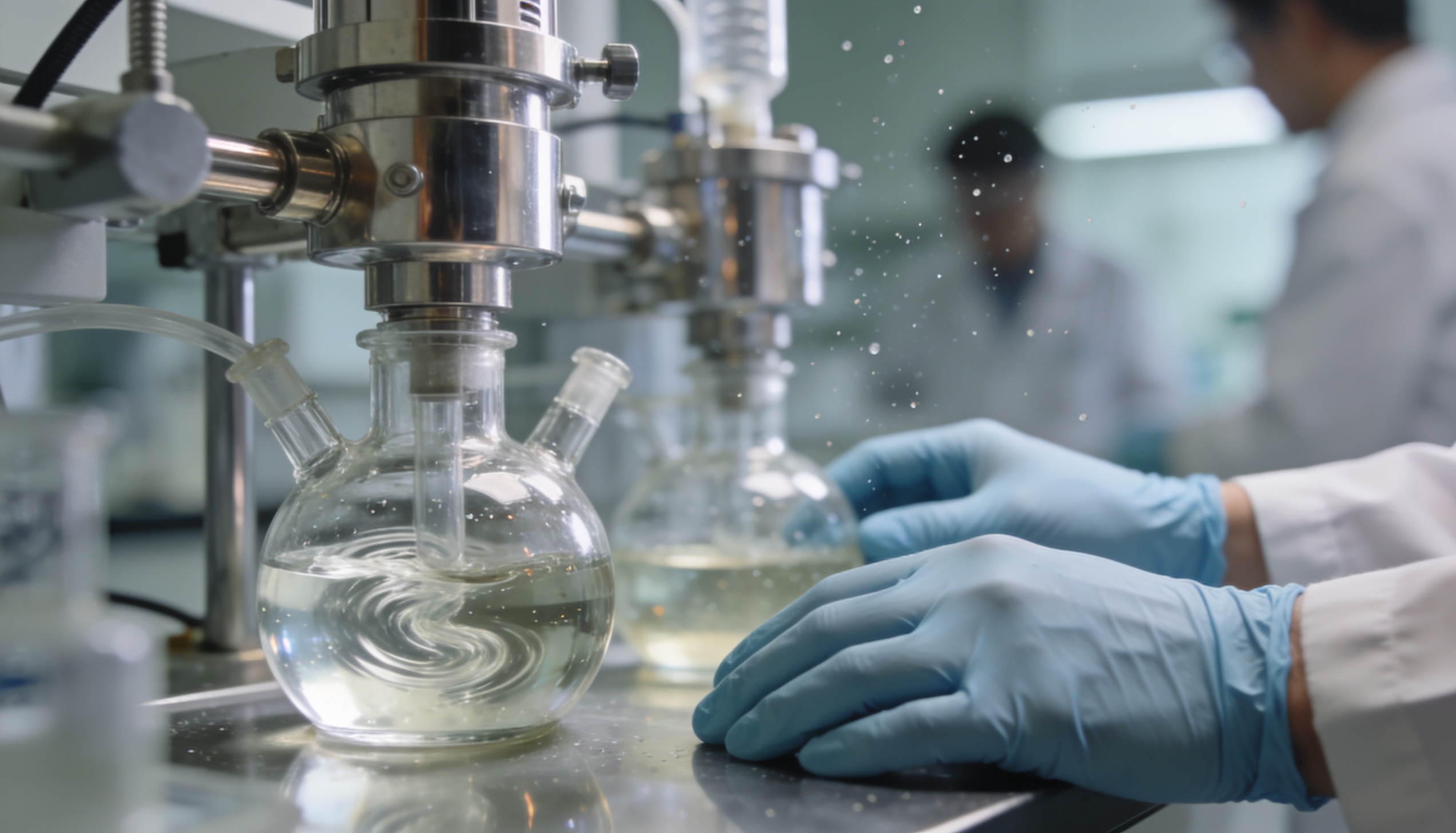
CSIR publicly announced a domestically developed paracetamol production technology at the DSIR 40th Foundation Day. The step is presented as a measure to reduce import dependence for key raw materials, support price stability and supply security for a widely used generic drug, and demonstrate science-industry translation under an Atmanirbhar Bharat agenda.
- CSIR declared successful development of an indigenous paracetamol production technology aimed at substituting imported raw materials.
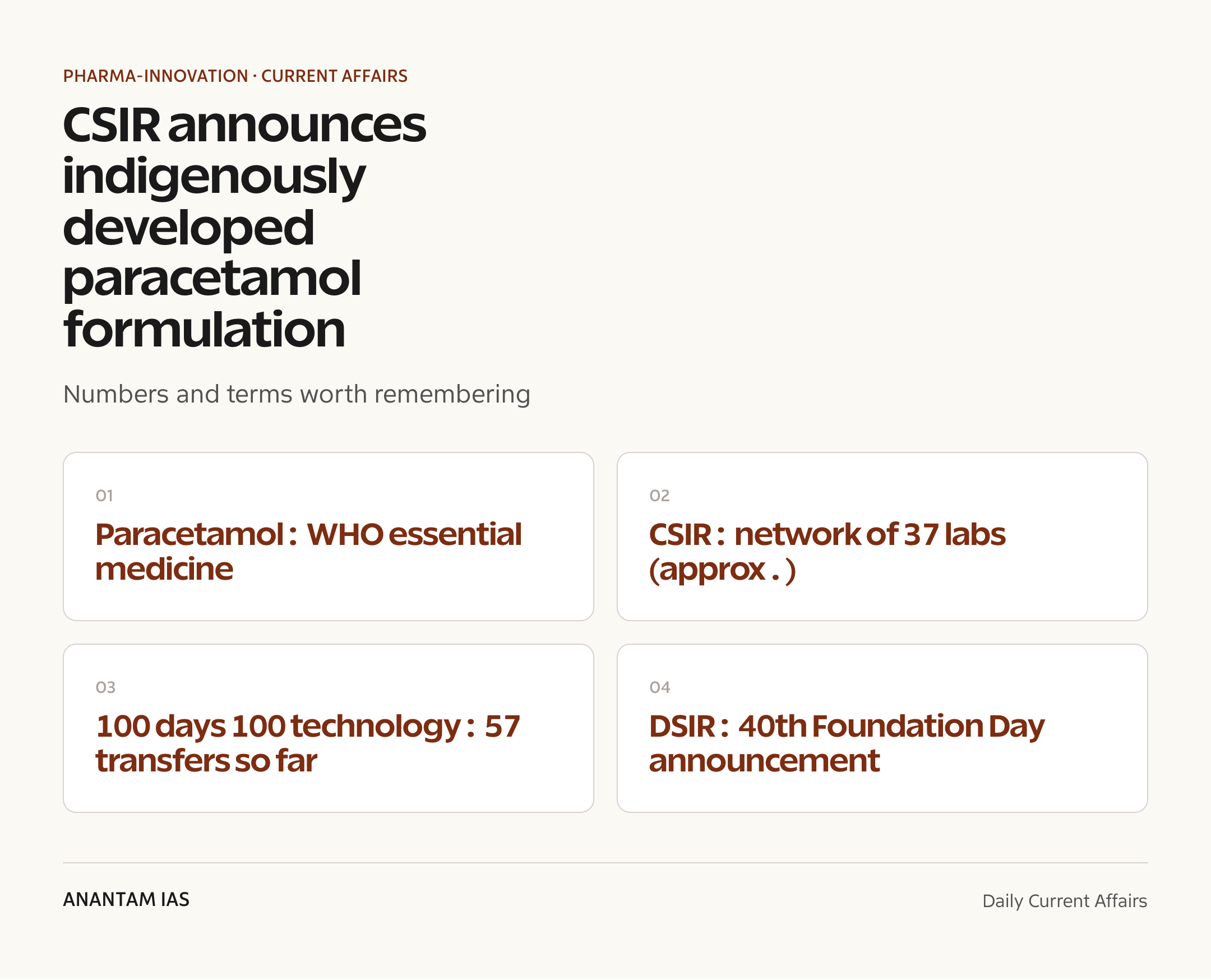
- Technology transfer has been initiated to Satya Deeptha Pharmaceuticals Ltd in Karnataka to enable domestic manufacturing at commercial scale.
- The announcement links the development to broader policy goals: self-reliance, industrial translation of research, and support for MSMEs through technology transfers.
- The disclosure occurred during the DSIR 40th Foundation Day, when multiple CSIR technologies were transferred to industry and MSME partners.
The development matters in the context of:
- Paracetamol is one of the most widely used over-the-counter analgesic and antipyretic drugs in primary healthcare and hospital settings.
- India currently imports key precursors and intermediates used for paracetamol manufacture from global chemical producers; supply constraints can affect price and availability.
- CSIR is a national network of laboratories with a mandate to convert research into industrial applications via technology development and transfer.
- Public sector R&D-to-industry transfer aims to support MSMEs and domestic manufacturers under national programs like Atmanirbhar Bharat and Make in India.
- Technology transfer to private firms and MSMEs is a standard mechanism used by CSIR to scale lab-level processes to commercial production.
- Reliable domestic production of basic generics supports public distribution of essential medicines and reduces vulnerability to global supply-chain disruptions.
UPSC Relevance
Prelims Relevance
- Questions can test facts about CSIR mandate, DSIR, paracetamol drug class and uses, and recent tech-transfer events; also identify stakeholders like Satya Deeptha Pharmaceuticals and LAGHU UDYOG BHARATI.
Mains Relevance
GS3 Science & Technology
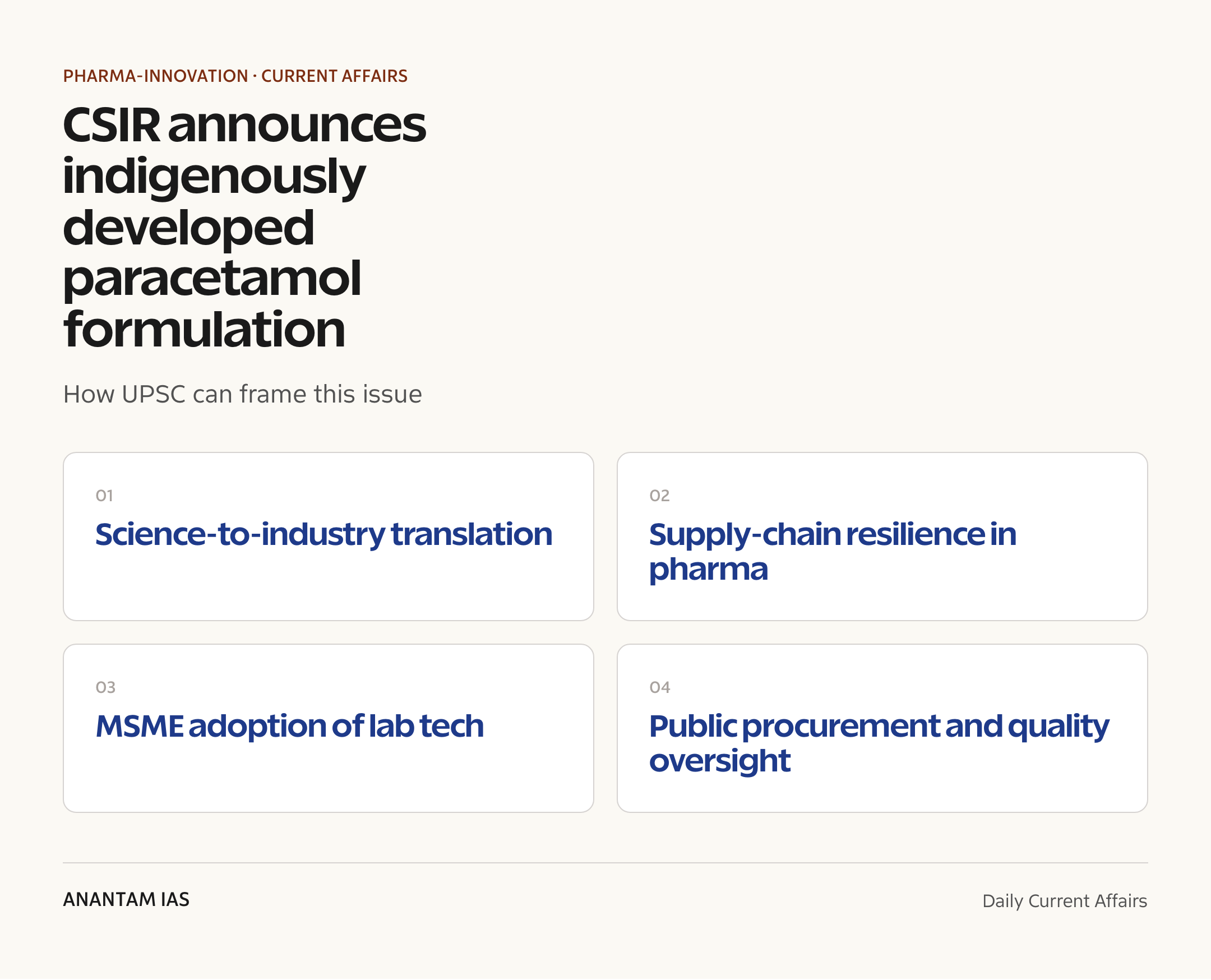
- Material useful for answers on science-policy linkages: translation of public research to industry, pharmaceutical supply chain resilience, Atmanirbhar Bharat in pharma, role of technology transfer for MSME capacity building, and public-health implications of domestic generic production.
Essay
- Supports essay themes on science and technology for nation building, self-reliance, healthcare infrastructure, and role of research institutions in socio-economic development.
Background and Context
Paracetamol: Therapeutic and industrial profile
Paracetamol is a basic analgesic and antipyretic with simple chemistry and large public-health utility.
- Commonly used for pain relief and fever management across age groups; on WHO Essential Medicines List as a core generic.
- Chemically known as acetaminophen or N-acetyl-p-aminophenol; synthesis involves intermediates that may be imported.
- Large volumes are consumed by hospitals, primary-care facilities, and households, making stable supply critical.
- Being an off-patent generic, paracetamol production is a volume business where input-costs determine retail price.
India's pharmaceutical raw-material dependence
India exports finished drugs but imports many active pharmaceutical ingredients or chemical precursors.
- Reliance on global suppliers for bulk chemicals has led to vulnerability during export restrictions or geopolitical shocks.
- Several generic drug supply interruptions worldwide in the last decade stemmed from concentration of precursor production.
- Import dependence can increase costs for manufacturers and create stock-outs for essential medicines.
- Policy focus since 2020 has prioritized resilience in drug supply chains and incentivized domestic API manufacture.
CSIR and DSIR: Institutional role in technology translation
CSIR and DSIR operate laboratories and programs to convert research outputs into deployable technologies.
- CSIR’s mandate covers basic and applied research across chemistry, biology, engineering, and process technologies.
- DSIR acts to facilitate industry linkages and enable technology transfers from public labs to private sector.
- CSIR frequently uses licensing, joint ventures, and transfers to MSMEs to scale innovations.
- The 100 days 100 technology program is an example of rapid technology transfer targeting MSME adoption.
Mechanisms of technology transfer in India
Transfer moves a lab process to industrial scale with adaptation for cost, safety, and regulatory compliance.
- Tech transfer typically includes documentation, scale-up protocols, process validation, and training of plant personnel.
- Regulatory requirements for pharmaceutical production include Good Manufacturing Practices and quality control standards.
- MSMEs may require financial and managerial support to adopt new chemical processes safely and economically.
- Successful transfer reduces time-to-market and helps build manufacturing capacity domestically.
Public health and price stability implications
Domestic production of generics influences availability and affordability in both public and private sectors.
- Localized production can lower logistics costs and reduce exposure to foreign currency fluctuations.
- A resilient supply supports national programs that supply essential medicines in primary health centers.
- Competition among domestic manufacturers tends to exert downward pressure on retail prices.
- Quality assurance must be maintained to avoid substandard or counterfeit product risks.
Industry and MSME engagement context
CSIR’s transfers often target regional MSME clusters to spur local manufacturing and employment.
- Satya Deeptha Pharmaceuticals Ltd was named as an early licensee to adopt the CSIR paracetamol process at scale.
- LAGHU UDYOG BHARATI and similar associations help diffuse technologies among small units across states.
- MSME adoption requires technical hand-holding, access to capital, and integration into supply chains.
- A successful example can catalyze further investment in domestic chemical and pharma infrastructure.
Way Forward
Regulatory approval and quality pathways
- Ensure transferred process meets GMP and national drug regulatory standards before commercial release.
- Institute independent batch testing and stability studies to establish quality equivalence to existing products.
- Facilitate fast-track clearances for technology-adopting units that comply with stringent quality criteria.
- Promote transparent data sharing of validation outcomes to build trust among buyers and health programs.
Scaling and MSME capacity building
- Provide targeted technical training modules for MSME plant staff on process operations and safety.
- Offer concessional capital or credit-linkages to upgrade reactors, effluent control, and quality labs.
- Establish regional incubation hubs where CSIR scientists co-locate temporarily with producers to supervise scale-up.
- Encourage cluster-based production models to achieve economies of scale and pooled testing facilities.
Supply-chain resilience and input substitution
- Map key precursor supply chains and promote domestic manufacture of those intermediates to reduce import risk.
- Support alternate green-chemistry synthesis routes that reduce hazardous reagents and lower costs.
- Build strategic buffer stocks of critical intermediates at national pharma warehouses.
- Foster supplier diversification through incentives for firms producing upstream chemicals.
Public procurement and price monitoring
- Encourage public procurement agencies to source from certified domestic manufacturers to sustain demand.
- Monitor market prices post-adoption to ensure anticipated cost benefits reach consumers and public programs.
- Incorporate domestically produced paracetamol in essential medicines lists and state medical store formularies.
- Use procurement levers to incentivize quality compliance and continuous capacity investments.
Conclusion
CSIR’s announcement of an indigenous paracetamol production technology is a practical example of research translation aimed at strengthening domestic pharmaceutical capacity. For impact it requires rigorous regulatory validation, coordinated scale-up with MSMEs, and supply-chain interventions to ensure quality, affordability, and sustained availability of this essential medicine.
UPSC Practice Questions
Prelims MCQ 1
1. Which organisation announced the development of an indigenously developed paracetamol production technology in January 2025?
(a) A. ICMR (b) B. CSIR (c) C. DBT (d) D. AIIMS
Answer: B
Explanation:
The Council of Scientific and Industrial Research (CSIR) announced the indigenously developed paracetamol production technology at the DSIR 40th Foundation Day.
Prelims MCQ 2
2. In the CSIR paracetamol announcement, which of the following was named as the technology transfer recipient?
(a) A. Serum Institute (b) B. Satya Deeptha Pharmaceuticals Ltd (c) C. Cipla Ltd (d) D. LUPIN Ltd
Answer: B
Explanation:
The press release stated that Satya Deeptha Pharmaceuticals Ltd in Karnataka will use the CSIR-developed paracetamol technology for domestic production.
UPSC Mains Questions
- {‘question’: ‘1. Analyse how public research institutions like CSIR can contribute to pharmaceutical self-reliance. Illustrate your answer with reference to the paracetamol technology transfer.’, ‘model_answer’: ‘Public research institutions translate scientific knowledge into industrially relevant processes that reduce dependence on imports and build domestic supply chains. CSIR, with multidisciplinary labs, develops process technologies and conducts pilot-scale validation that private industry can adopt. The paracetamol case shows key steps: development of an economically viable synthesis route; documentation and scale-up protocols; and transfer to an industry partner, Satya Deeptha Pharmaceuticals. For broader self-reliance, this model requires regulatory validation, MSME capacity building, incentives for domestic manufacture of upstream intermediates, and public procurement linked to quality standards. Combined, these measures lower supply vulnerabilities, support affordable access, and nurture a product-oriented tech economy.’}
- {‘question’: ‘2. Discuss the role of technology transfer to MSMEs in achieving Atmanirbhar Bharat objectives in the pharmaceutical sector.’, ‘model_answer’: ‘Technology transfer equips MSMEs with proven processes and know-how, enabling rapid scaling of domestic production. For Atmanirbhar Bharat, MSME adoption expands manufacturing base, creates local employment, and spreads industrial capabilities beyond large firms. Successful transfers must be accompanied by finance for plant upgrades, training for quality compliance, and access to testing infrastructure. The 100 days 100 technology program and partnership with associations like LAGHU UDYOG BHARATI show pathways to disseminate innovations. Policy support through procurement preferences and incentives for upstream chemical manufacturers will make the MSME-led model resilient and cost-competitive.’}
Source: PIB, Ministry of Science & Technology (CSIR).
Frequently Asked Questions
q
a
q
a
q
a
q
a
q
a
q
a