Custodial Deaths and SC Decision

Context:
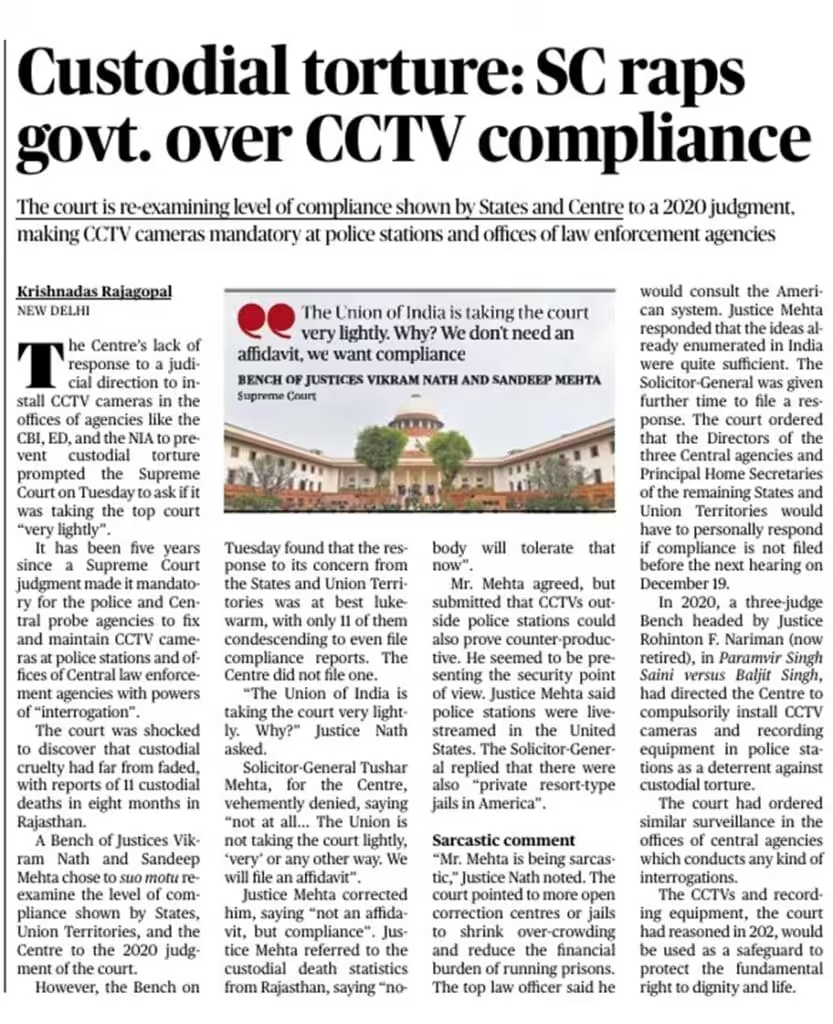
The Supreme Court sharply criticised the Centre and States for failing to comply with its 2020 judgment mandating installation of CCTV cameras in all police stations and offices of investigative agencies (CBI, ED, NIA, etc.). The Court observed that both the Union and States were taking the Court’s orders “very lightly.” Compliance review revealed poor and indifferent response, even five years after the order.
2020 Judgment (Paramvir Singh Saini vs Baljit Singh)
The SC had directed:
- Mandatory installation of CCTV cameras in:
- All police stations,
- Offices of central agencies with interrogation powers,
- Lock-ups, corridors, interrogation rooms, entry/exit points.
- CCTV footage to be preserved for 18 months.
- Purpose:
- Prevent custodial torture,
- Ensure transparency,
- Protect the fundamental right to dignity under Article 21.
Current Situation (2025)
- Alarming data: 11 custodial deaths in Rajasthan in eight months.
- Only 11 States/UTs submitted compliance reports — most were perfunctory.
- The Union government did not file any report.
UPSC Relevance:
Polity and Governance
UPSC PYQ:
Q. Though the Human Rights Commissions have contributed immensely to the protection of human rights in India, yet they have failed to assert themselves against the mighty and powerful. Analysing their structural and practical limitations, suggest remedial measures. (2021)
Custodial Torture:
Custodial torture refers to the deliberate infliction of physical or psychological pain on individuals who are detained or held in the custody of police or other authorities.
Type of Custody:
- Police custody — when a person is detained, arrested, or otherwise held by the police (in a police station, lock-up, or during transit).
- Judicial custody — when a person is lodged in a prison or jail while on trial or after conviction.
Both are the State’s responsibility, because the State controls the person’s movement, safety, and access to care.
Custodial Torture in India:
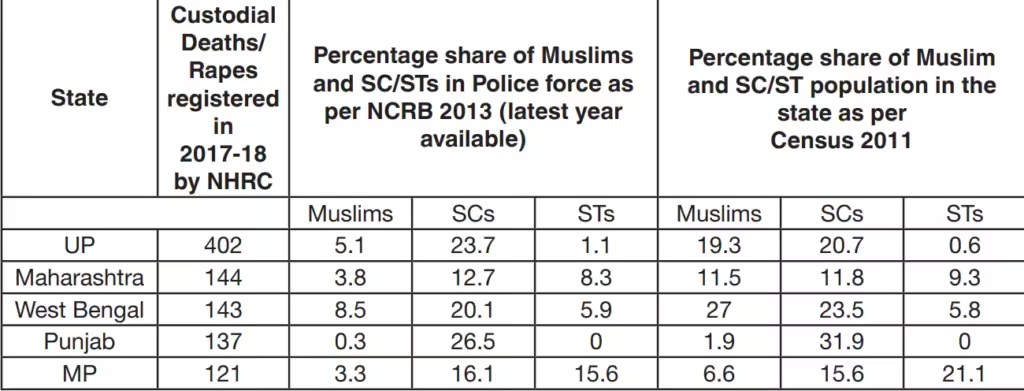
The National Human Rights Commission reported 2,152 deaths in judicial custody and 155 deaths in police custody up to 28 February 2022 (for the financial year 2021–22). The Union Home Ministry told Parliament that 4,484 cases of custodial deaths were reported over financial years 2020–21 and 2021–22.

Why custodial deaths happen?
- Weak discipline around arrest and detention
- Pressure to solve cases and reliance on confessions
- Health and mental-health gaps
- Cameras and audit trails that do not actually work
- Investigations that are not fully independent
SC Judgements:
- D. K. Basu case (1997): A checklist that every police station must follow during arrest and detention. Officers must wear identification; an arrest memo must be prepared; a relative or friend must be informed; entries must be made in the station diary; the arrested person must get medical examination and legal aid; and these rights must be displayed in police stations. These directions are binding across India.
- Joginder Kumar case (1994): Arrest is not automatic; it must serve a clear need. Police must record reasons and inform a relative or friend promptly.
- Arnesh Kumar case (2014): For many offences, police should prefer issuing a notice to appear instead of arrest. Reasons for arrest must be written down.
- Nilabati Behera case (1993): Constitutional courts can award compensation for violation of the right to life in custodial-death cases.
- People’s Union for Civil Liberties vs State of Maharashtra (2014): For alleged “encounter” deaths, there must be an independent investigation and a magisterial inquiry.
- Paramvir Singh Saini case (2020): Police stations and interrogation rooms must have cameras with audio, and footage must be preserved with proper oversight.
LEGAL PROVISIONS?
- The United Nations Convention Against Torture (UNCAT), which mandates a global prohibition on torture by monitoring governments and making them accountable, was signed by India in 1997, more than a decade after the Convention was adopted by the UN in 1984 (UNTC 1984).
- There are certain statutory and procedural provisions, most prominently Article 21 of the Constitution and Sections 330 and 331 of the Indian Penal Code (IPC), that address custodial violence and torture. However, these provisions have been found to be inadequate.
- Section 120 of Bharatiya Nyaya Sanhita (2023): It penalizes those who intentionally cause hurt or grievous hurt to extract confessions, information, through violence or coercion.
- Section 35 of Bharatiya Nagarik Suraksha Sanhita (BNSS, 2023): It mandates that arrests and detentions follow valid reasons, documented procedures.
- Section 22 of Bharatiya Sakshya Adhiniyam (2023): It invalidates confessions made under inducement, threat, coercion, or promise.
Law Commission of India: In its 273rd Report (2017), the Law Commission of India recommended ratification of UNCAT 1984, and enact a specific law to implement its provisions, highlighting the urgent need to criminalize torture.
CONCLUSION
Torture by police does not occur in isolation, but as a result of the absence of structural reform to hold state agencies accountable and apprise them of their primary duties as public servants. While ratification to the UNCAT and bringing in a new legislation for torture is a serious need, a lot more is required to address custodial violence comprehensively.