Cyber fraud complaints cross 12.7 lakh in six months, with over Rs 10,000 crore lost
Why in News?
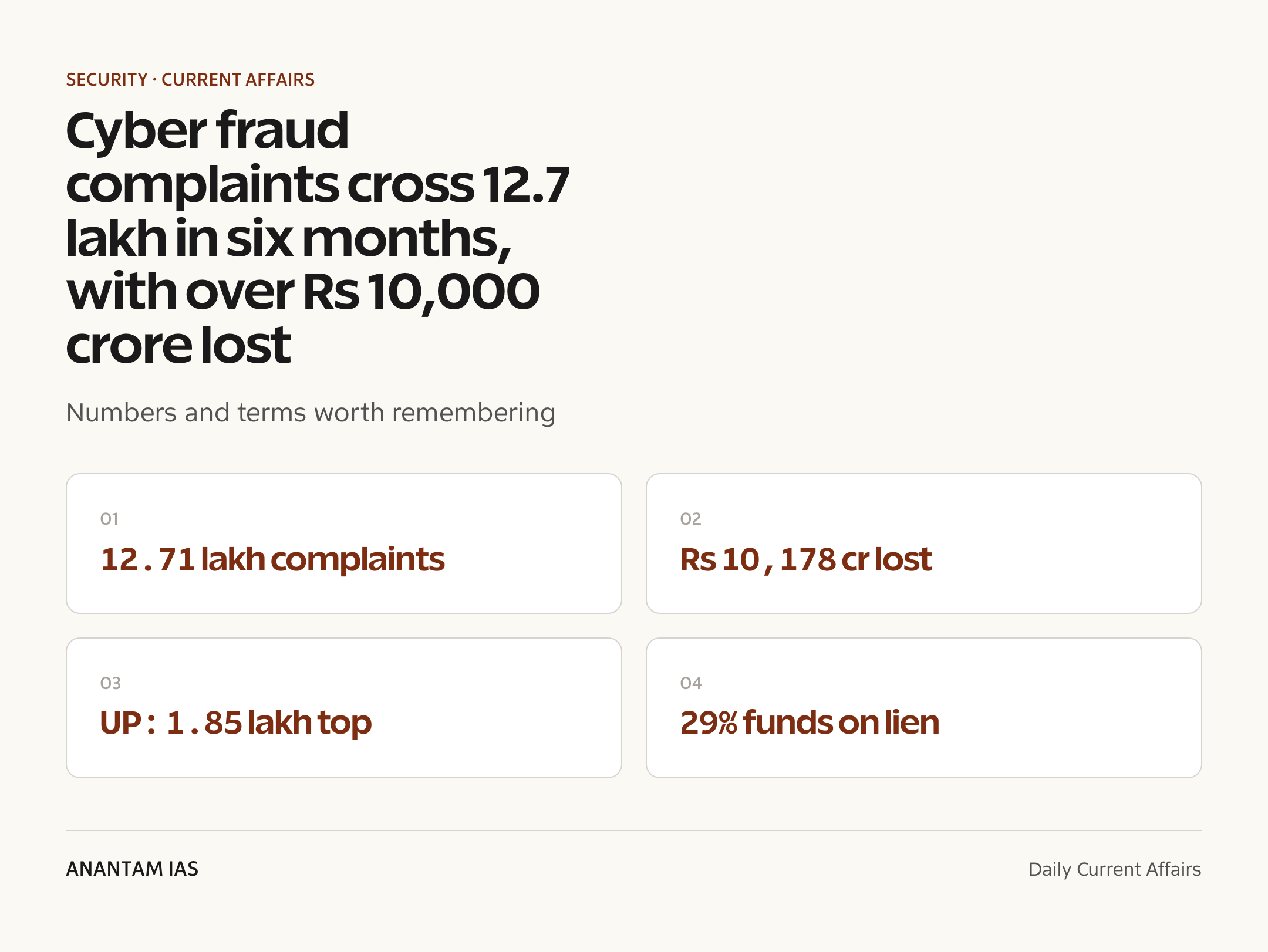
Data reviewed at a Union Ministry of Home Affairs meeting, reported by The Indian Express, shows India recorded more than 12.71 lakh financial cyber fraud complaints between 1 January and 30 June 2026, with victims reporting alleged fraudulent transactions worth over Rs 10,178 crore.
The half-yearly figure works out to roughly 7,000 complaints a day, or nearly Rs 56 crore reported lost each day, underlining how fast financial cybercrime is scaling across states.
The numbers put the spotlight back on India’s cybercrime-governance machinery, the reach of the National Cyber Crime Reporting Portal and 1930 helpline, and the persistent gap between money lost and money actually recovered.
For UPSC, the story sits squarely in GS Paper 3 internal security: it connects cyber threats, the role of the Indian Cyber Crime Coordination Centre (I4C), banking and RBI safeguards, and the legal frame of the IT Act, 2000 and the DPDP Act, 2023.
- 12.71 lakh complaints in six months (1 Jan to 30 Jun 2026); losses over Rs 10,178.97 crore.
- Uttar Pradesh led on complaint volume (1.85 lakh); Maharashtra saw the highest money lost (Rs 1,637.66 crore).
- Data discussed at a meeting chaired by senior MHA officials on cyber fraud and prevention.
- Only Rs 2,968.85 crore was placed under bank lien/hold, a lien rate of about 29 percent.
- Complaint drivers: online investment fraud, digital arrest scams, loan-app fraud, phishing, and impersonation.
The development matters in the context of:
- Financial cyber fraud complaints route through the Citizen Financial Cyber Fraud Reporting and Management System linked to the 1930 helpline.
- The nodal body is the Indian Cyber Crime Coordination Centre (I4C) under the Ministry of Home Affairs.
UPSC Relevance
Prelims Relevance
- I4C: nodal MHA body coordinating cybercrime response; runs the NCRP (cybercrime.gov.in).
- 1930: national cyber-fraud financial helpline for quick reporting of money loss.
- Citizen Financial Cyber Fraud Reporting and Management System: enables rapid freezing of defrauded funds.
- Digital arrest: scam where fraudsters impersonate police/agencies to extort victims via video call.
- Mule accounts: bank accounts used to layer and move stolen money.
- CERT-In: national nodal agency for cybersecurity incident response under MeitY.
- Chakshu / Sanchar Saathi: DoT platforms to report fraud communication and block suspect connections.
- IT Act 2000 and DPDP Act 2023: core statutes on cyber offences and personal-data protection.
- e-Zero FIR: converts high-value cyber-fraud complaints on NCRP into FIRs automatically.
- Lien/hold: temporary bank freeze on suspect funds pending investigation.
Mains Relevance
GS Paper 3
- Rising cybercrime as an internal-security and economic-security challenge; institutional response through I4C and NCRP.
- Money-recovery gap and the role of banks, RBI digital-payment safeguards, and mule-account crackdowns.
Essay
- Trust and technology: securing India’s digital public infrastructure
Background and Context
What the six-month data shows
The dataset, discussed at an MHA-chaired meeting, maps the scale and geography of financial cyber fraud in the first half of 2026.
- More than 12.71 lakh complaints between 1 January and 30 June 2026, with reported losses over Rs 10,178.97 crore.
- Uttar Pradesh topped complaint counts at 1.85 lakh, followed by Maharashtra (1.58 lakh), Karnataka (1.21 lakh), Gujarat (97,937), and Bihar (93,137).
- The next tier included Rajasthan (75,883), West Bengal (72,439), Delhi (64,496), Tamil Nadu (63,116), and Haryana (58,721).
- On money lost, Maharashtra led with Rs 1,637.66 crore, then Karnataka (Rs 1,097.37 crore), Tamil Nadu (Rs 897.79 crore), Uttar Pradesh (Rs 734.19 crore), and Gujarat (Rs 643.82 crore).
- Notably, Chandigarh (Rs 630.53 crore) and Telangana (Rs 614.18 crore) reported large losses despite smaller populations, hinting that high losses track digital-payment density, not just population size.
- Smaller units varied widely: Lakshadweep logged 37 complaints, Ladakh 174, Andaman and Nicobar 406, Mizoram 432, and Nagaland 455.
- The pattern shows financial cyber fraud is now a nationwide phenomenon, not confined to metros, cutting across large and small states alike.
Who investigates: I4C and the reporting portal
India’s cybercrime response is anchored in a dedicated coordination centre and a public reporting portal.
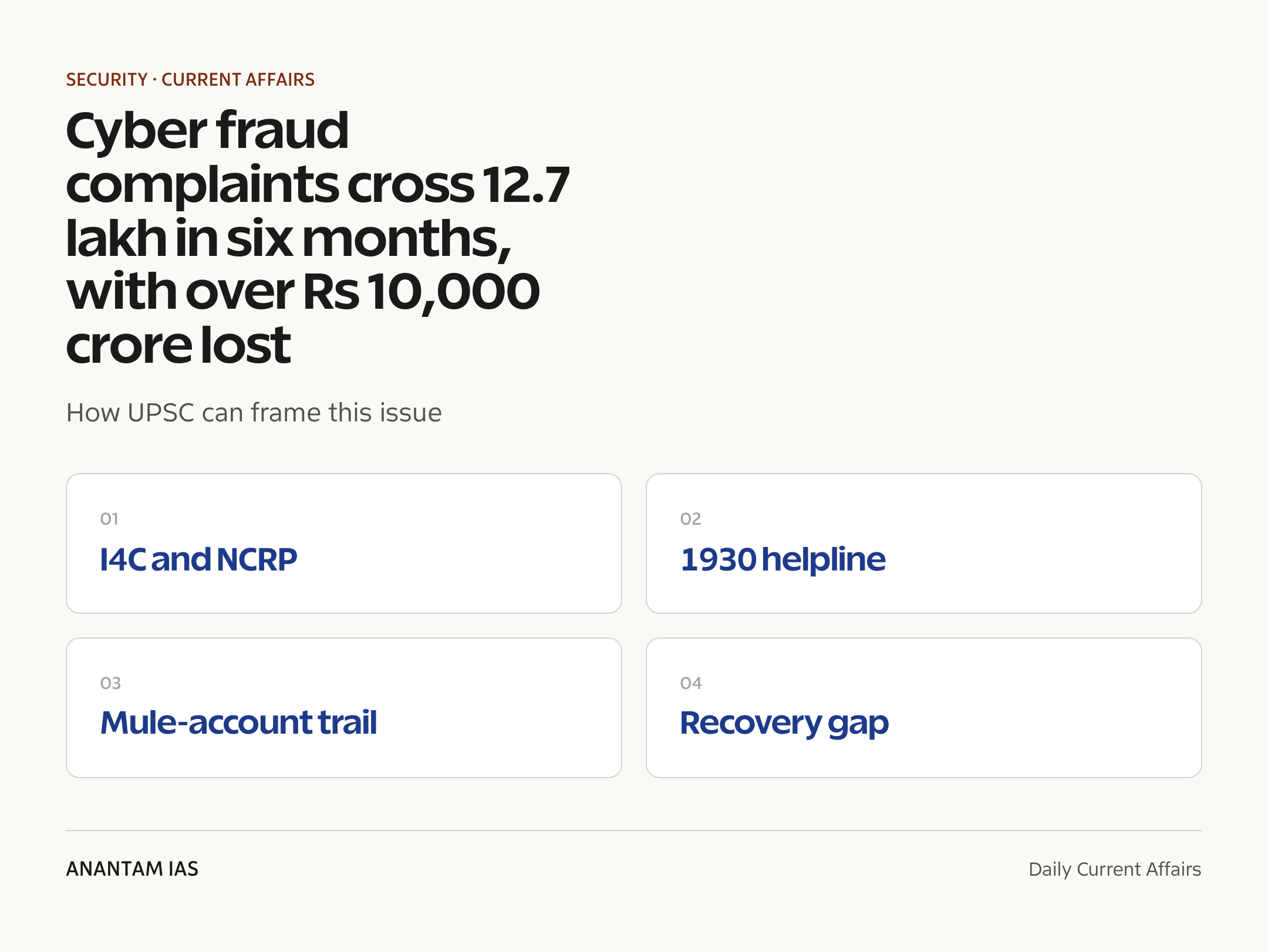
- The Indian Cyber Crime Coordination Centre (I4C), set up in 2018 under the Ministry of Home Affairs, is the nodal body coordinating cybercrime action across states and Union Territories.
- I4C works through seven verticals, including the National Cybercrime Threat Analytics Unit, the National Cybercrime Reporting Portal vertical, a forensic lab, a training and capacity-building arm, and an ecosystem-management unit.
- The National Cyber Crime Reporting Portal (NCRP) at cybercrime.gov.in lets citizens file complaints, especially on financial fraud and online offences against women and children.
- The 1930 helpline is the fast-response channel for reporting money loss so funds can be flagged before they are withdrawn.
- I4C also runs a Cyber Fraud Mitigation Centre and coordinates with banks, payment aggregators, telecom firms, and platforms to act on flagged accounts and numbers.
- Read more on how the state secures cyberspace in our note on internal security.
How money is frozen and recovered
Speed matters: the earlier a fraud is reported, the higher the chance banks can freeze the money in transit.
- Complaints on financial fraud flow through the Citizen Financial Cyber Fraud Reporting and Management System, which links the helpline to banks, wallets, and payment intermediaries in near-real time.
- When a victim calls 1930 or files on NCRP, a ticket flows to the relevant bank and beneficiary bank, which can place a lien or hold on the suspect amount before it is withdrawn.
- Of the 12.71 lakh complaints, 2.86 lakh were pushed for banking action and 2.70 lakh were taken up by banks under this system.
- Banks placed liens or holds on Rs 2,968.85 crore, an overall lien rate of about 29.17 percent of the reported loss, meaning roughly seven of every ten rupees escaped the freeze.
- The golden hour matters: the sooner a fraud is reported, the higher the chance of a successful freeze before money is layered onward.
- The rest often moves quickly through layers of mule accounts and is withdrawn via ATMs, wallets, or crypto, making recovery difficult once funds are cashed out.
The recovery gap over time
Longer-run figures show how little of the stolen money ever returns to victims.
- Between 2021 and May 2026, people reported cybercrime losses of about Rs 64,447 crore.
- Of this, roughly Rs 10,718 crore was frozen as a lien, but only about Rs 323 crore has been refunded to victims.
- The gap reflects delays in reporting, rapid fund layering, and the challenge of tracing money once it exits the formal banking rails.
- Officials have highlighted parallel wins, including funds saved through timely intervention and the rollout of e-Zero FIR for high-value cases.
Fraud types driving the surge
The complaint mix has shifted toward social-engineering scams that exploit fear and greed rather than technical hacking.
- Digital arrest scams: fraudsters posing as police, CBI, or customs keep victims on prolonged video calls, allege parcels or money-laundering, and extort payments under threat of arrest.
- Investment and trading fraud (often called pig-butchering): victims are groomed over weeks on fake apps and chat groups promising high returns before being drained.
- Loan-app fraud, phishing, and impersonation using fraudulent links circulated through messaging and social-media platforms.
- Many scams originate from organised networks, some operating from cross-border scam compounds in Southeast Asia, using trafficked workers to run the operations.
- Mule accounts and SIM fraud are central to the model: stolen money is routed through rented or fraudulently opened accounts before being cashed out.
- These are largely social-engineering crimes that exploit fear, greed, and urgency, which makes public awareness as important as technical defences.
The wider governance and legal frame
Cyber fraud sits at the intersection of policing, telecom regulation, banking safeguards, and data-protection law.
- The Information Technology Act, 2000 covers cyber offences (identity theft, cheating by impersonation, and hacking under Sections 66C, 66D, and 66), while cheating and forgery are also charged under the Bharatiya Nyaya Sanhita.
- The Digital Personal Data Protection Act, 2023 governs the handling of personal data, raising the stakes for institutions that leak data later used in targeted fraud.
- CERT-In under MeitY is the national nodal agency for cybersecurity incident response and issues directions on breach reporting.
- The Department of Telecommunications runs Sanchar Saathi and its Chakshu facility to report suspected fraud calls and messages and to block fraudulently obtained connections.
- The RBI has tightened digital-payment safeguards, including additional-factor authentication, transaction alerts, and cooling-off rules for new payees and beneficiaries.
- Regulators are also pushing banks to detect and freeze mule accounts faster through transaction-pattern monitoring and shared intelligence.
- See our related coverage of science and technology in governance.
Way Forward
Close the recovery gap
- Push faster bank action on 1930 alerts so liens are placed before funds are withdrawn.
- Strengthen the Citizen Financial Cyber Fraud Reporting and Management System with real-time bank coordination.
Choke the money trail
- Crack down on mule accounts through KYC audits, transaction-pattern monitoring, and quicker account freezes.
- Deepen RBI safeguards on digital payments and inter-bank data sharing on suspect accounts.
Prevention and awareness
- Scale public campaigns on digital arrest and investment scams, especially in high-volume states.
- Expand DoT tools like Chakshu and Sanchar Saathi to block fraud numbers and links early.
Capacity and coordination
- Build state cyber-cell capacity and forensic skills under I4C coordination.
- Improve cross-border cooperation to trace networks operating from outside India.
Conclusion
The six-month numbers are less a one-off spike than a signal that financial cyber fraud has become a structural internal-security and economic-security challenge for India.
With losses far outrunning recoveries, the real test is speed and coordination: faster reporting through 1930, quicker bank freezes, a sustained squeeze on mule accounts, and prevention that reaches citizens before the scam does.
UPSC Practice Questions
Prelims MCQ 1
With reference to India’s cybercrime framework, consider the following statements:
- The Indian Cyber Crime Coordination Centre (I4C) functions under the Ministry of Home Affairs.
- The National Cyber Crime Reporting Portal is operated at cybercrime.gov.in.
- The 1930 helpline is meant for reporting financial cyber fraud for quick action.
How many of the above statements are correct?
(a) Only one (b) Only two (c) All three (d) None
Answer: (c) All three
Explanation:
I4C is the nodal body under the MHA; the NCRP runs at cybercrime.gov.in; and 1930 is the dedicated financial cyber-fraud helpline enabling rapid freezing of funds. All three statements are correct.
Prelims MCQ 2
The term ‘mule account’, often seen in the context of cyber fraud, most appropriately refers to:
(a) A dormant bank account frozen by the RBI for KYC violations (b) An account used to receive and move fraudulently obtained money (c) A joint government account for refunding cyber-fraud victims (d) A test account maintained by banks for payment-system audits
Answer: (b) An account used to receive and move fraudulently obtained money
Explanation:
Mule accounts are used by fraud networks to layer and move stolen funds, making tracing and recovery harder. They are a key focus of cyber-fraud crackdowns.
UPSC Mains Questions
- Financial cyber fraud has emerged as a structural internal-security challenge in India. Examine the institutional response through I4C and the reporting portal, and suggest measures to close the wide gap between money lost and money recovered.
- Discuss how the rise of social-engineering scams such as digital arrest and investment fraud has changed the nature of cybercrime in India. What role can RBI digital-payment safeguards and DoT tools play in curbing them?
Source: The Indian Express.
Frequently Asked Questions
How many cyber fraud complaints did India record in the first half of 2026?
According to data reported by The Indian Express, more than 12.71 lakh financial cyber fraud complaints were recorded between 1 January and 30 June 2026, with reported losses of over Rs 10,178 crore.
Which state reported the most complaints and the most money lost?
Uttar Pradesh led on complaint volume with about 1.85 lakh, while Maharashtra recorded the highest money lost at around Rs 1,637.66 crore.
What is I4C?
The Indian Cyber Crime Coordination Centre is the nodal body under the Ministry of Home Affairs that coordinates India’s cybercrime response and runs the National Cyber Crime Reporting Portal at cybercrime.gov.in.
How does the 1930 helpline help fraud victims?
The 1930 helpline lets victims quickly report financial fraud so that banks, through the Citizen Financial Cyber Fraud Reporting and Management System, can place a lien or hold on the money before it is withdrawn.
Why is so little money recovered?
Fraudsters move money rapidly through layers of mule accounts. Between 2021 and May 2026, of about Rs 64,447 crore reported lost, only around Rs 323 crore was refunded to victims, showing how hard recovery is once funds exit the banking system.
What is a digital arrest scam?
It is a scam where fraudsters impersonate police or agencies, keep victims on a prolonged video call under threat of arrest, and extort money. It is among the fastest-growing cyber-fraud types in India.