Cyrtodactylus jayadityai: New Bent-Toed Gecko Discovered in Assam (2026)
Why in News?
In April 2026, scientists of the Zoological Survey of India (ZSI) formally described a new bent-toed gecko, Cyrtodactylus jayadityai, in the peer-reviewed journal Zootaxa. The species was collected from moist evergreen patches adjoining the Dibru-Saikhowa landscape in upper Assam and has been named in honour of a senior Indian herpetologist for his contributions to reptile taxonomy.
The paper adds yet another lineage to the already swollen Cyrtodactylus khasiensis species group and reinforces that Northeast India continues to be one of the least-catalogued yet most biodiverse regions in the tropical world. ZSI noted that the holotype and paratypes have been deposited in its National Zoological Collections in Kolkata.
The discovery lands at a moment when India is stress-testing its Seventh National Report to the Convention on Biological Diversity (CBD) and updating the National Biodiversity Strategy and Action Plan (NBSAP) 2024 with fresh baselines for endemic fauna.
UPSC Relevance at a Glance
| Dimension | Relevance |
|---|---|
| GS Paper | GS3 – Environment, Biodiversity, Conservation |
| Prelims | Cyrtodactylus genus; Indo-Burma hotspot; ZSI; Dibru-Saikhowa; IUCN Red List; CITES; WPA 1972 |
| Mains | Species discovery and conservation planning in Northeast India; EIA and biodiversity hotspots |
| Syllabus Tags | Biodiversity, Ecosystems, Environmental impact assessment |
Related reading on anantamias.com: /current-affairs/india-submits-7th-biodiversity-report-but-will-it-meet-its-2030-targets/, /current-affairs/iucn-world-congress/, /current-affairs/biosphere-reserves/.
Background and Context
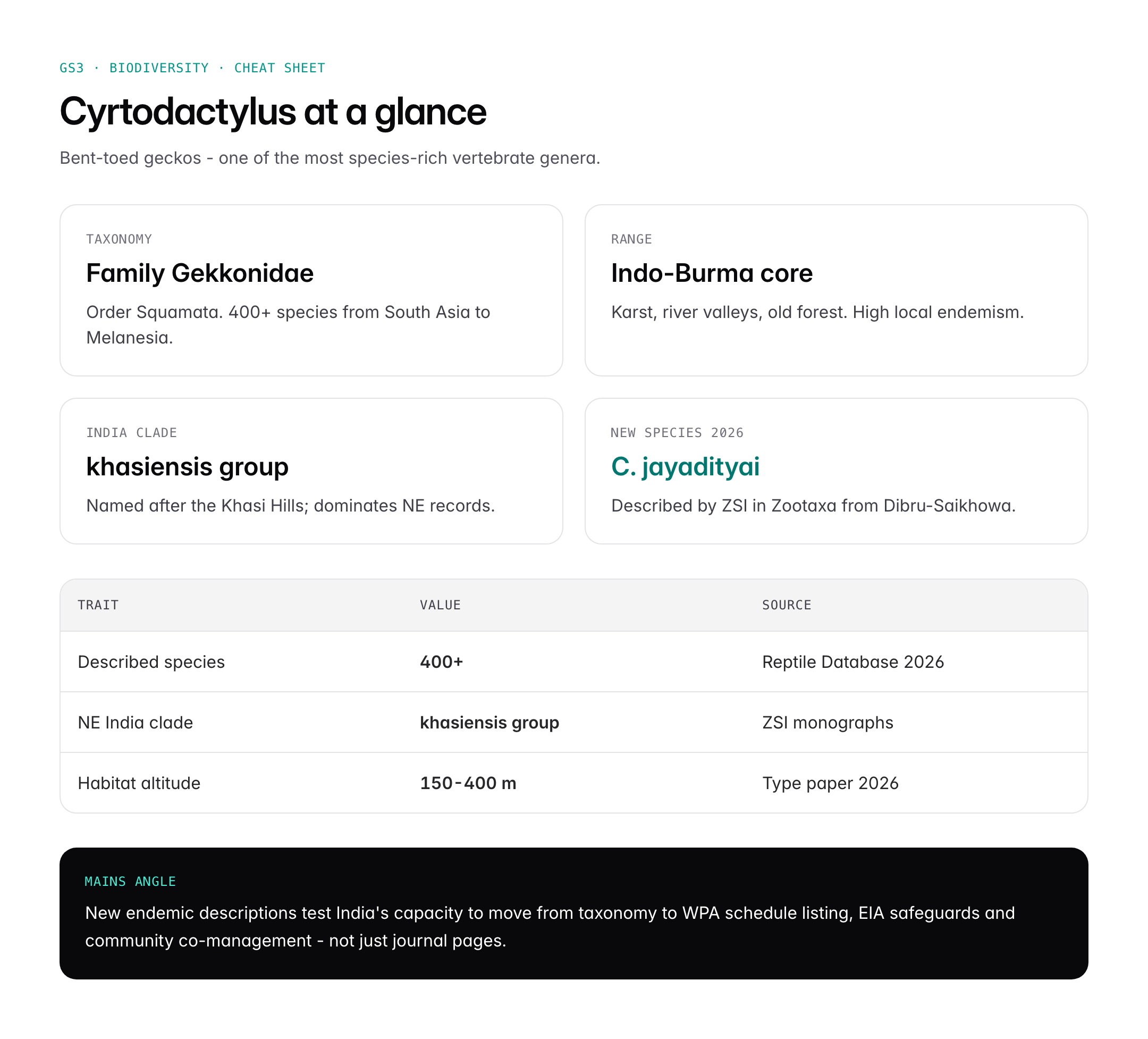
Cyrtodactylus, the bent-toed or bow-fingered geckos, is a radiation of nocturnal lizards distributed from South Asia through Southeast Asia to Melanesia. With over 400 accepted species as of 2026 (Uetz, Reptile Database), it is frequently listed among the most speciose vertebrate genera on earth, rivalled chiefly by Old World rodents and some cichlid fish lineages.
The group’s explosive diversification is linked to karst topography, river valley isolation and old forest cover – exactly the conditions that characterise the Indo-Burma Biodiversity Hotspot. Conservation International recognises Indo-Burma as one of 36 global hotspots, straddling Northeast India, Bangladesh, Myanmar, southern China and mainland Southeast Asia. The hotspot has already lost more than 95% of its original primary vegetation, making every undescribed taxon ecologically significant.
Within India, the khasiensis species group – named after the Khasi Hills of Meghalaya – is the dominant Cyrtodactylus clade. Between 2018 and 2026 alone, ZSI and academic partners have added more than a dozen species to this group from Assam, Meghalaya, Mizoram, Nagaland and Arunachal Pradesh. The addition of C. jayadityai continues that trajectory.
Dibru-Saikhowa, a floodplain mosaic of grasslands, semi-evergreen forest and wetlands between the Brahmaputra and Lohit rivers, was declared a Biosphere Reserve in 1997 and a National Park in 1999. It hosts feral horses, Gangetic dolphins, and a reptile assemblage that taxonomists have only begun to systematically survey.
Key terms readers should fix in memory: type locality (the place where the holotype was collected), holotype (the single specimen on which the species description rests), sympatric (species coexisting in the same area) and cryptic species (morphologically similar but genetically distinct lineages).
Key Findings
Diagnostic characters
- Cyrtodactylus jayadityai is a medium-sized gecko with a snout-vent length of roughly 80-95 mm.
- Diagnosed by a combination of tubercle rows, precloacal pore arrangement and a dorsal colour pattern of dark saddles bordered by pale bands.
- Differs from its closest congeners by a unique count of ventral scales and an unbroken nuchal loop on the neck.
- Molecular evidence from the ND2 mitochondrial marker supports its placement as a distinct lineage within the khasiensis group.
Ecology and habitat
- Collected at night from moss-covered boulders and tree trunks at altitudes between 150 and 400 m.
- Sympatric with at least two other Cyrtodactylus species, suggesting niche partitioning across microhabitats.
- The type locality sits within a mosaic of community forest and reserve forest, outside the core Dibru-Saikhowa National Park.
Naming and authorship
- The specific epithet jayadityai honours a veteran Indian herpetologist for his decades of work on South Asian reptiles.
- Authors include ZSI scientists from the North Eastern Regional Centre (Shillong) and the Herpetology Division (Kolkata).
- Publication in Zootaxa, a leading taxonomic journal, followed ICZN registration of the name.
Conservation status
- Not yet assessed by IUCN; authors recommend a preliminary Data Deficient tag pending range surveys.
- Likely to qualify for Schedule II of the Wildlife (Protection) Act, 1972 through a future MoEFCC notification, bringing it under legal protection.
- Not listed on any CITES appendix at present.
Why the find matters scientifically
- Confirms that the khasiensis radiation extends to the Brahmaputra floodplain edges, not just the Meghalaya-Mizoram ranges.
- Strengthens the case for revisiting protected area boundaries that still use 1990s-era species lists.
- Provides a fresh calibration point for divergence-time estimates within Cyrtodactylus.
Significance
- Strategic value for biodiversity diplomacy: Fresh endemic descriptions feed directly into India’s reporting under CBD’s Kunming-Montreal Global Biodiversity Framework (KM-GBF), including Target 3 (30 by 30) on area-based conservation.
- Policy leverage for Northeast conservation: The Ministry of Environment, Forest and Climate Change (MoEFCC) can use the discovery to justify continued funding of the NE-specific schemes under the Integrated Development of Wildlife Habitats (IDWH).
- Capacity signal: ZSI has described over 400 new taxa in the past five years (ZSI Annual Report 2024-25), reinforcing India’s standing as a tropical taxonomy powerhouse.
- EIA recalibration: Environmental Impact Assessment notifications for hydro and linear projects in upper Assam will now need to factor in a newly recognised endemic.
- Education and outreach: Names honouring Indian scientists counter the historical dominance of colonial-era binomials in Indian natural history.
- Ecotourism spillover: Dibru-Saikhowa already draws birders; new reptile records can seed a herpetology-focused eco-tourism circuit with revenue for local communities.
Concerns, Criticisms and Challenges
The discovery also exposes familiar tensions. First, taxonomic inflation – the splitting of populations into multiple species on thin morphological grounds – is an active debate within herpetology. Critics argue that without deeper genomic sampling, some “new” Cyrtodactylus lineages may collapse back into existing species, complicating Red List assessments.
Second, protection lags description. Schedule amendments under the Wildlife (Protection) Act, 1972 require a formal MoEFCC notification, and in practice newly described reptiles often wait years before being listed. During that interval, pet-trade poaching – documented for other Cyrtodactylus species by TRAFFIC – can threaten tiny populations.
Third, the type locality is outside the national park core. Community forests in Assam are governed by a patchwork of traditional rules, the Assam Forest Regulation, 1891, and village authorities. Absent clear co-management agreements with forest-dependent communities, conservation obligations may collide with customary rights.
Fourth, climate vulnerability is high. Bent-toed geckos are thermally sensitive; modelling by Wildlife Institute of India (WII) scientists suggests Cyrtodactylus ranges in the Eastern Himalaya may contract by 20-35% by 2070 under RCP 4.5. A species known only from one locality is one extreme weather event away from functional extinction.
Finally, there is the persistent under-funding of taxonomy. India trains very few professional herpetologists each year, and ZSI field stations have reported vacancies upwards of 30% in 2024 (Standing Committee on Science & Technology report). Without a cadre, even well-documented species fall out of surveillance.
Comparative Perspective
| Dimension | Cyrtodactylus jayadityai (2026) | Earlier NE Discoveries |
|---|---|---|
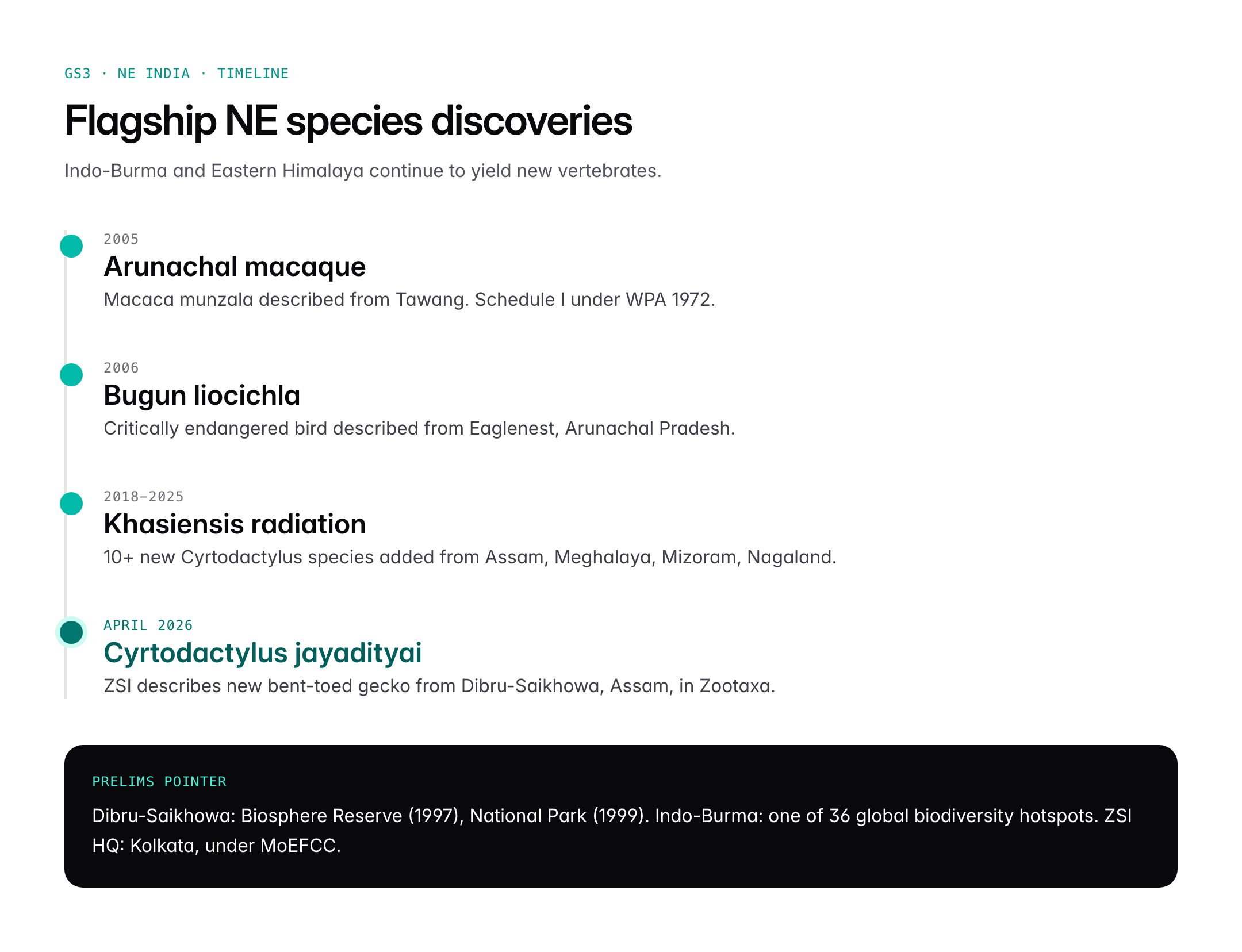
| Site | Dibru-Saikhowa, Assam | Bugun liocichla (2006, Eaglenest, Arunachal); Arunachal macaque (2005) |
| Host agency | ZSI + NE Regional Centre | BNHS, Nature Conservation Foundation, university teams |
| Legal protection | Pending WPA schedule listing | Bugun liocichla on Schedule I; Arunachal macaque on Schedule I |
| Hotspot | Indo-Burma | Eastern Himalaya + Indo-Burma |
| Threat profile | Habitat fragmentation, pet trade | Shifting cultivation, infrastructure, hunting |
Globally, Southeast Asian bent-toed gecko descriptions – from Vietnam’s karst and Myanmar’s Chin Hills – have averaged 15-25 new species a year since 2015 (Zootaxa bibliometrics). India’s relative count remains modest, underscoring room for scaled-up effort.
Way Forward
- MoEFCC should fast-track Schedule listing under WPA 1972 for newly described endemic reptiles via an annual omnibus notification.
- ZSI and WII must jointly initiate a Northeast Herpetofauna Baseline Mission using standardised transect protocols and eDNA sampling.
- State Forest Departments of Assam, Meghalaya and Arunachal Pradesh should integrate herpetological data layers into working plans and zonal management plans.
- National Biodiversity Authority (NBA) should update Access and Benefit Sharing (ABS) guidelines to ensure local communities are compensated when species are named from community forests.
- Ministry of Tribal Affairs must align Community Forest Resource (CFR) rights under the Forest Rights Act, 2006 with species-level conservation micro-plans.
- University Grants Commission (UGC) should seed at least ten additional herpetology PhD slots annually at NE universities.
- EIA 2006 notification should be amended to require a minimum reptile-amphibian survey window of one full monsoon cycle for projects in hotspots.
Conclusion
The description of Cyrtodactylus jayadityai is a small taxonomic event with a large policy shadow. It reminds the state that India’s biodiversity accounts remain provisional, especially in a Northeast that is simultaneously a global hotspot and an infrastructure frontier.
For the UPSC aspirant, the lesson is twofold. Species discovery is not a trivia event – it is a measurable indicator of scientific capacity, legal readiness and federal cooperation. Converting such findings into durable protection requires the slower work of notifications, community agreements and trained personnel, and that work is ultimately what distinguishes a biodiversity-rich country from a biodiversity-secure one.
Prelims Pointers
- Cyrtodactylus is among the most speciose vertebrate genera, with 400+ described species.
- C. jayadityai belongs to the khasiensis species group.
- Type locality is in the Dibru-Saikhowa landscape in upper Assam.
- Described by ZSI in Zootaxa, April 2026.
- Dibru-Saikhowa is both a Biosphere Reserve (1997) and a National Park (1999).
- Indo-Burma is one of 36 global biodiversity hotspots recognised by Conservation International.
- ZSI is headquartered in Kolkata, under MoEFCC.
- Wildlife Protection Act 1972 has six Schedules (post-2022 amendment: four schedules).
- CITES has three appendices: I, II, III.
- KM-GBF Target 3 is the 30 by 30 target.
- National Biodiversity Authority is the apex body under the Biological Diversity Act, 2002.
- EIA Notification 2006 governs project clearances in India.
Mains Practice Question
Q. “Every new species description in a biodiversity hotspot is also a test of state capacity.” In light of recent herpetological discoveries from Northeast India, examine the institutional architecture that converts taxonomic findings into durable conservation outcomes. (15 marks, 250 words)
Answer map:
- Taxonomy as capacity: role of ZSI, WII, universities; publication pipeline; funding gaps.
- Legal architecture: WPA schedules, CITES, EIA 2006, Biological Diversity Act 2002.
- Federal-community interface: CFR rights under FRA 2006, state forest departments, ABS rules; way forward.
Frequently Asked Questions
What is Cyrtodactylus jayadityai?
Cyrtodactylus jayadityai is a new bent-toed gecko species described in April 2026 by Zoological Survey of India scientists in the journal Zootaxa. It was collected from the Dibru-Saikhowa landscape in upper Assam and belongs to the Cyrtodactylus khasiensis species group, which dominates Northeast India’s bent-toed gecko fauna.
Why is Cyrtodactylus jayadityai in news?
The species was formally described in April 2026, adding to the growing list of reptile endemics from the Indo-Burma Biodiversity Hotspot. It reinforces Northeast India’s status as a herpetological frontier and feeds into India’s ongoing updates to the National Biodiversity Strategy and Action Plan and the 7th National Report to the CBD.
Where is the Dibru-Saikhowa landscape?
Dibru-Saikhowa is a floodplain mosaic in upper Assam, lying between the Brahmaputra and Lohit rivers. It was declared a Biosphere Reserve in 1997 and a National Park in 1999. It hosts feral horses, Gangetic dolphins, and a rich but under-surveyed reptile and amphibian assemblage.
What is the Cyrtodactylus genus?
Cyrtodactylus, or bent-toed geckos, is a nocturnal lizard genus with over 400 species, distributed from South Asia to Melanesia. It is one of the most species-rich vertebrate genera globally. Its diversification is linked to karst topography, river valley isolation and old forest cover, conditions typical of Indo-Burma.
What is the Indo-Burma Biodiversity Hotspot?
Indo-Burma is one of 36 global biodiversity hotspots recognised by Conservation International. It spans Northeast India, Bangladesh, Myanmar, southern China and mainland Southeast Asia. Over 95% of its primary vegetation has been lost, making every endemic species description ecologically significant for conservation planning.
Which legal frameworks apply to new Indian reptile species?
Protection for new reptile species flows from the Wildlife (Protection) Act, 1972, through MoEFCC schedule notifications. The Biological Diversity Act, 2002 and its access and benefit sharing rules cover research use. CITES governs international trade, while the EIA Notification 2006 shapes project-level safeguards.
How does this affect UPSC Prelims and Mains?
For Prelims, note the species name, Zootaxa, ZSI, Dibru-Saikhowa, and the khasiensis group. For Mains, the story illustrates GS3 themes on biodiversity hotspots, EIA safeguards, and state capacity in taxonomy. It pairs well with questions on KM-GBF Target 3 and on Northeast-specific conservation.
What are the main conservation concerns for the new species?
The gecko is known from a single locality, making it vulnerable to habitat fragmentation, climate shifts and pet-trade poaching. Schedule listing under WPA 1972 takes time, the type locality sits outside the national park core, and trained herpetologists are scarce. Community co-management and faster legal listing are key.