Defence Acquisition Council: AoN and Indigenisation
Why in News?
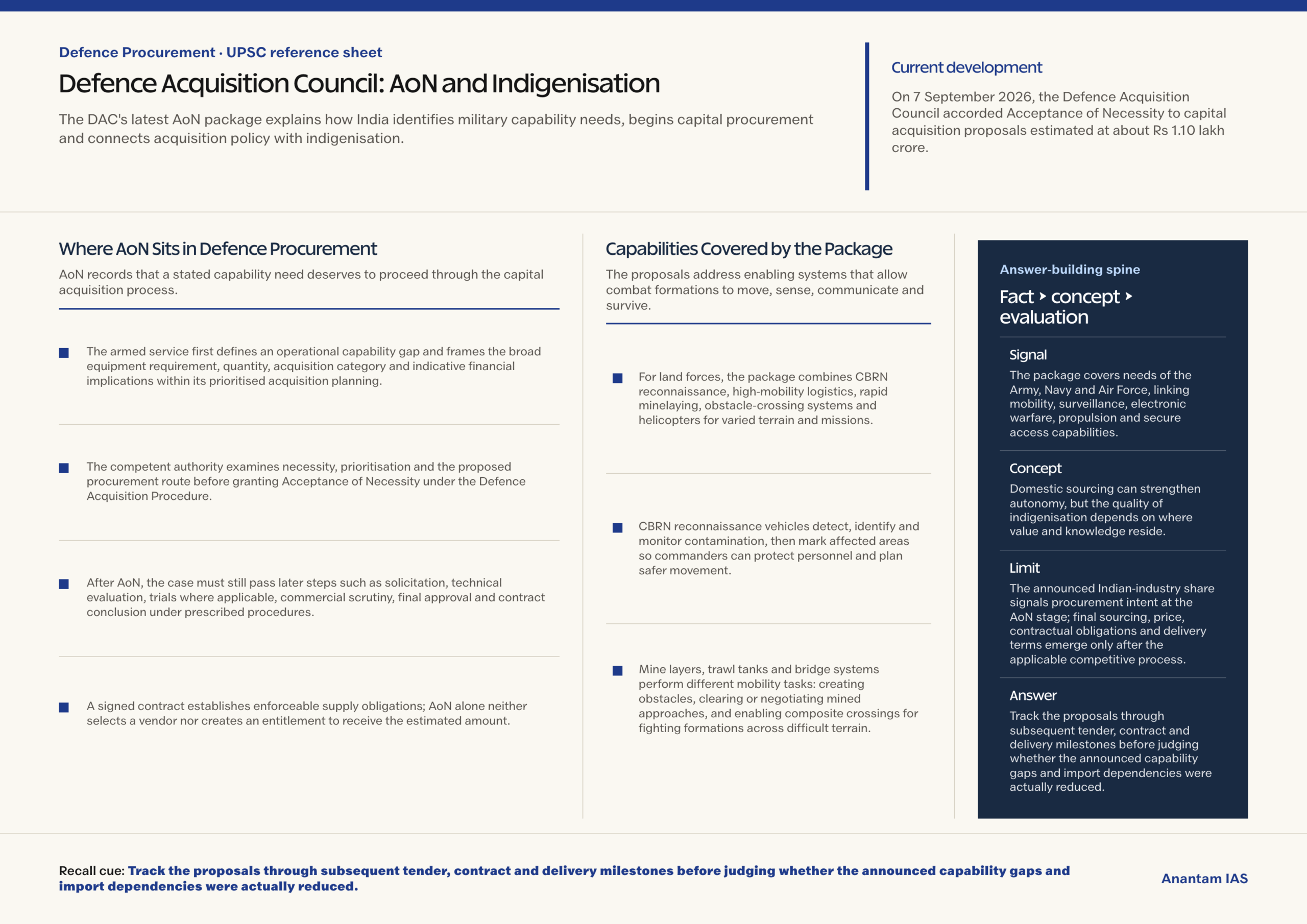
On 7 September 2026, the Defence Acquisition Council accorded Acceptance of Necessity to capital acquisition proposals estimated at about Rs 1.10 lakh crore.
- The package covers needs of the Army, Navy and Air Force, linking mobility, surveillance, electronic warfare, propulsion and secure access capabilities.
- The Ministry of Defence said approximately 98% of the procurements covered by the AoNs are intended to be sourced from Indian industry.
- The naval proposal includes domestic design and development followed by procurement of marine gas turbines, a critical warship-propulsion system.
- AoN is an in-principle administrative approval; it is not evidence that contracts were signed, money was spent, equipment was delivered or systems were inducted.
- Capital acquisition converts a military capability gap into a structured procurement case while balancing operational urgency, competition, technical assurance and lifecycle support.
- Indigenisation matters when domestic firms gain design knowledge, production depth and maintenance capacity, not merely when the final supplier is located in India.
- Aspirants should separate an approval milestone from procurement outcomes and evaluate later stages before claiming that capability gaps have been closed.
UPSC Relevance
Prelims Relevance
- DAC: the Ministry of Defence’s apex decision-making body for major capital acquisition proposals.
- AoN: in-principle administrative approval of the necessity for an acquisition proposal.
- DAP 2020: the procedure governing capital acquisition for the armed forces and Coast Guard.
- Buy (Indian-IDDM): the highest-priority procurement category under DAP 2020, centred on indigenous design, development and manufacture.
- CBRN reconnaissance: detection, identification, monitoring and marking of areas contaminated by chemical, biological, radiological or nuclear agents.
- Electronic warfare: military use of the electromagnetic spectrum, including jamming hostile radar emissions.
Mains Relevance
GS Paper 3
- Defence modernisation, internal security preparedness and the relationship between procurement reform and operational capability
- Indigenous defence manufacturing, critical technology absorption and resilient military supply chains
GS Paper 2
- Institutional accountability, transparent procurement and legislative oversight of public expenditure
Essay
- Strategic autonomy requires institutions that turn technological ambition into reliable domestic capability.
Background and Context
Where AoN Sits in Defence Procurement
AoN records that a stated capability need deserves to proceed through the capital acquisition process.
- The armed service first defines an operational capability gap and frames the broad equipment requirement, quantity, acquisition category and indicative financial implications within its prioritised acquisition planning.
- The competent authority examines necessity, prioritisation and the proposed procurement route before granting Acceptance of Necessity under the Defence Acquisition Procedure.
- After AoN, the case must still pass later steps such as solicitation, technical evaluation, trials where applicable, commercial scrutiny, final approval and contract conclusion under prescribed procedures.
- A signed contract establishes enforceable supply obligations; AoN alone neither selects a vendor nor creates an entitlement to receive the estimated amount.
- Delivery, inspection, acceptance and induction occur after contracting, so a capability gap remains operationally relevant until usable systems enter service with training, spares and support arrangements.
Capabilities Covered by the Package
The proposals address enabling systems that allow combat formations to move, sense, communicate and survive.
- For land forces, the package combines CBRN reconnaissance, high-mobility logistics, rapid minelaying, obstacle-crossing systems and helicopters for varied terrain and missions.
- CBRN reconnaissance vehicles detect, identify and monitor contamination, then mark affected areas so commanders can protect personnel and plan safer movement.
- Mine layers, trawl tanks and bridge systems perform different mobility tasks: creating obstacles, clearing or negotiating mined approaches, and enabling composite crossings for fighting formations across difficult terrain.
- For naval aviation, Arudhra radars are intended to replace air-route surveillance radars, while domestic marine gas-turbine development targets dependence in warship propulsion.
- Air-force proposals include a ground-based multipurpose jammer for hostile radars and an RFID-based secure-access system replacing paper identity cards, passes and permits.
Indigenisation: Intent, Depth and the Exam Trap
Domestic sourcing can strengthen autonomy, but the quality of indigenisation depends on where value and knowledge reside.
- The announced Indian-industry share signals procurement intent at the AoN stage; final sourcing, price, contractual obligations and delivery terms emerge only after the applicable competitive process.
- DAP 2020 gives priority to Buy (Indian-IDDM), which rewards indigenous design and development alongside prescribed indigenous-content requirements.
- Other Indian procurement categories can involve different combinations of domestic vendors, indigenous content, foreign technology and local manufacture; an Indian order is not automatically IDDM.
- Meaningful autonomy requires control over critical subsystems, intellectual property, testing, spares, upgrades and maintenance, because final assembly without technological depth can preserve external dependence during crises.
- Domestic procurement can shorten support chains and build scale, but weak competition, delayed trials, quality failures or uncertain orders can raise costs and postpone operational readiness.
Way Forward
Convert Approval into Usable Capability
- Publish realistic procurement milestones and disclose stage-wise progress without revealing operationally sensitive specifications.
- Use open, testable performance requirements and competitive trials so domestic preference does not dilute reliability or soldier safety.
- Measure indigenisation through verified design ownership, domestic value addition, critical-component availability and lifecycle support, not vendor nationality alone.
- Synchronise acquisition with training, infrastructure, ammunition, maintenance and interoperability so delivered platforms become deployable capability.
Conclusion
- AoN is best understood as the administrative starting signal for a justified procurement case, not as proof of contracting, expenditure, delivery or induction.
- In a Mains answer, connect faster acquisition with competition, technical assurance and deeper domestic capability; strategic autonomy depends on all four working together.
- Track the proposals through subsequent tender, contract and delivery milestones before judging whether the announced capability gaps and import dependencies were actually reduced.
UPSC Practice Questions
Prelims MCQ 1
With reference to Acceptance of Necessity in Indian defence procurement, consider the following statements:
- It is an in-principle administrative approval for an acquisition proposal.
- It by itself constitutes a binding supply contract with the selected vendor.
- The September 2026 package indicated that approximately 98% of the procurements would be from Indian industry.
How many of the above statements are correct?
(a) Only one (b) Only two (c) All three (d) None
Answer: (b) Only two
Explanation:
Statements 1 and 3 are correct. AoN permits a proposal to proceed in principle, but vendor selection and contract conclusion require subsequent procurement stages.
Prelims MCQ 2
Which one of the following best describes the Defence Acquisition Council?
(a) A parliamentary committee that audits completed defence contracts (b) A regulator that licenses every private defence manufacturer (c) The apex Ministry of Defence body considering major capital acquisition proposals (d) A military command responsible for joint combat operations
Answer: (c) The apex Ministry of Defence body considering major capital acquisition proposals
Explanation:
The DAC is the Ministry of Defence’s apex decision-making body for major capital acquisitions; it is not a parliamentary audit body, licensing regulator or operational command.
UPSC Mains Questions
- Acceptance of Necessity is only the beginning of defence acquisition. Explain the major governance and capability challenges between approval and induction.
- Defence indigenisation must be measured by technological depth rather than domestic assembly alone. Discuss with reference to procurement policy and strategic autonomy.
Sources: PIB, Ministry of Defence and Department of Defence Production, Defence Acquisition Procedure 2020.
Frequently Asked Questions
What is Acceptance of Necessity in defence procurement?
Acceptance of Necessity is the competent authority’s in-principle administrative approval that a stated defence capability need may proceed through the prescribed capital acquisition process.
Does AoN mean that a defence contract has been signed?
No. AoN does not select a vendor, conclude a contract, complete expenditure, confirm delivery or establish that equipment has entered operational service.
What did the Defence Acquisition Council approve in September 2026?
It accorded AoN to proposals spanning land mobility, CBRN reconnaissance, obstacle crossing, helicopters, naval surveillance and propulsion, electronic warfare and secure-access systems.
Why is the marine gas-turbine proposal important?
Marine gas turbines are critical warship-propulsion systems. Domestic design, development and subsequent procurement can reduce dependence on foreign vendors and strengthen lifecycle support capacity.
How should defence indigenisation be evaluated?
Evaluate design ownership, indigenous content, critical-component supply, testing capability, intellectual property, maintenance, upgrade freedom and reliable delivery, rather than counting domestic orders alone.