Nuclear Hydrogen: India’s world-first Cu-Cl thermochemical plant at Kalpakkam
Why in News?
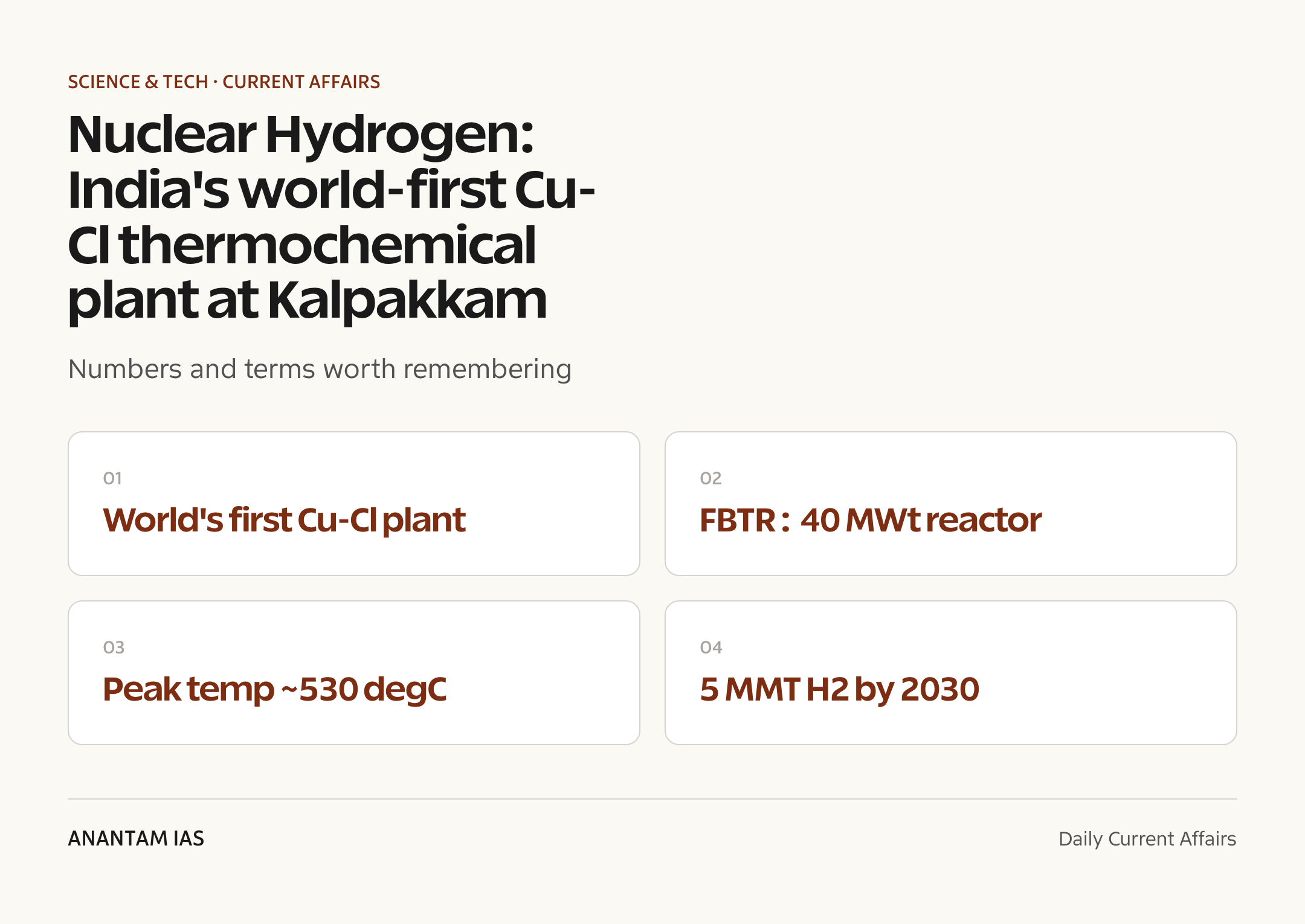
In late June 2026, the Department of Atomic Energy (DAE) inaugurated the world’s first hydrogen production facility based on the Copper-Chlorine (Cu-Cl) thermochemical cycle, using nuclear process heat drawn from the Fast Breeder Test Reactor (FBTR) at Kalpakkam, Tamil Nadu. PIB confirmed the plant is a technology demonstrator built jointly by BARC and IGCAR.
It is the first time anywhere that a reactor’s heat has been coupled to the Cu-Cl process to split water into hydrogen, marrying India’s three-stage nuclear programme with its clean-hydrogen ambitions.
- Facility commissioned at the Indira Gandhi Centre for Atomic Research (IGCAR), Kalpakkam, by the Department of Atomic Energy.
- Heat source is the 40 MWt FBTR, a sodium-cooled fast reactor that first went critical on 18 October 1985.
- The Cu-Cl cycle was developed indigenously by Bhabha Atomic Research Centre (BARC), Mumbai.
- Engineering, fabrication, installation, testing and commissioning were a joint BARC-IGCAR effort.
- Described by DAE as a technology demonstrator to validate nuclear-powered hydrogen at lab-to-pilot scale.
The development matters in the context of:
- Links nuclear energy to the National Green Hydrogen Mission goal of 5 MMT of green hydrogen a year by 2030.
- Adds a third, carbon-free pathway (alongside electrolysis and steam reforming) to make hydrogen at industrial scale.
- Showcases the strategic payoff of India’s long-running fast-reactor and thorium roadmap beyond just electricity.
UPSC Relevance
Prelims Relevance
- Copper-Chlorine (Cu-Cl) cycle — hybrid thermochemical-electrolytic water splitting, max temperature ~530 degC.
- FBTR — 40 MWt sodium-cooled fast reactor at Kalpakkam; critical 1985; plutonium-uranium carbide fuel.
- IGCAR — set up 1971; lead centre for fast-reactor R&D under DAE.
- BARC — premier nuclear research institute, Mumbai.
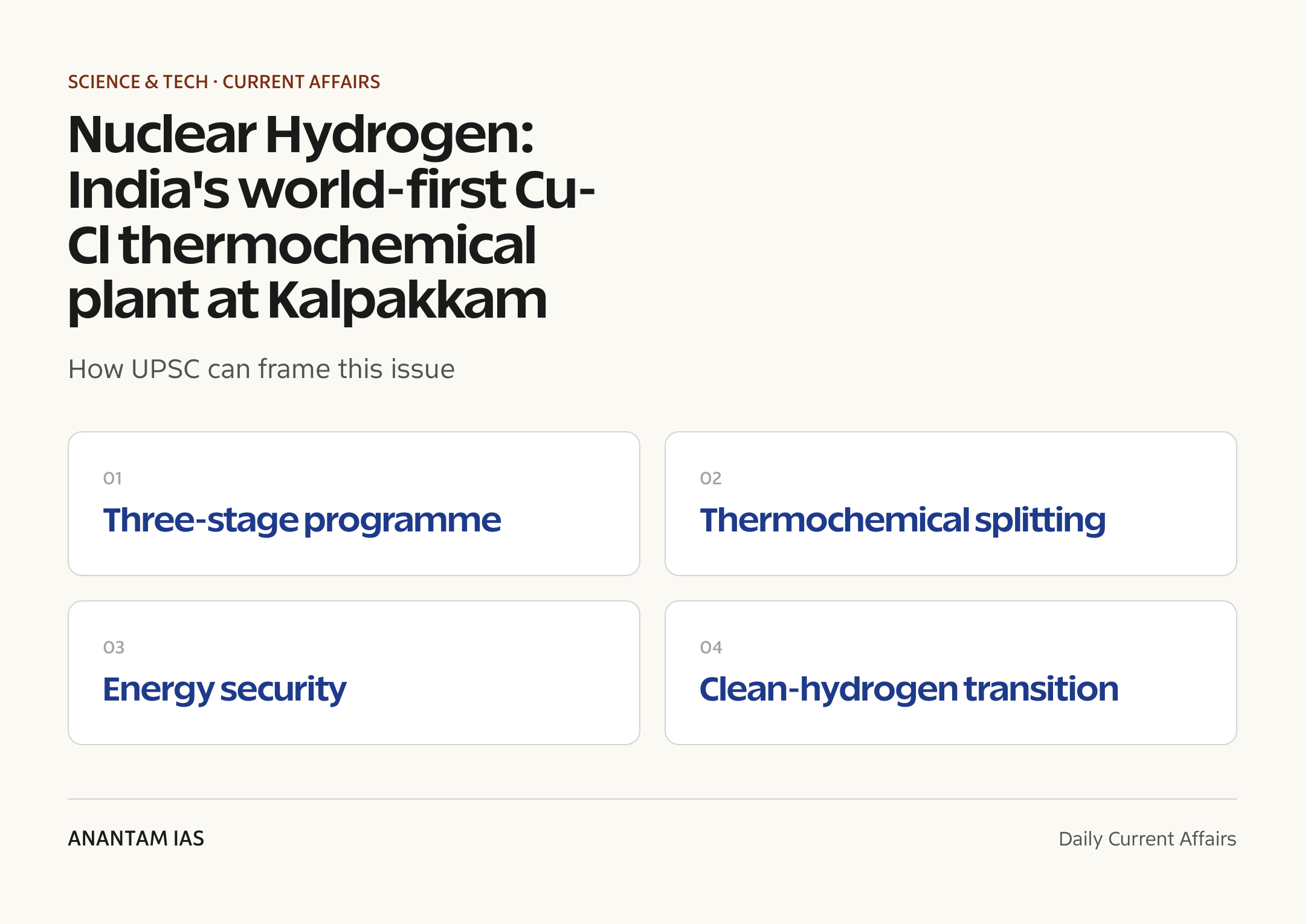
- Three-stage nuclear programme — PHWR to FBR to thorium-U233 reactors.
- PFBR — 500 MWe Prototype Fast Breeder Reactor, the Stage-II flagship at Kalpakkam.
- National Green Hydrogen Mission — outlay Rs 19,744 crore; 5 MMT target by 2030.
- Colour codes of hydrogen — green (renewables), grey (fossil), and the new nuclear-derived (pink/red) route.
Mains Relevance
GS Paper 3
- Indigenous technology and energy security — how fast-reactor heat unlocks fossil-free hydrogen.
- Achievements of Indians in science and technology — the three-stage programme and the Cu-Cl demonstrator as a case study in self-reliance.
Essay
- Science as a means to energy independence and a clean-energy transition.
- Self-reliance and the long arc of patient, mission-mode public R&D.
Background and Context
What was inaugurated, and by whom
A first-of-its-kind pilot that turns reactor heat into clean hydrogen.
- The Department of Atomic Energy inaugurated the plant at IGCAR, Kalpakkam in late June 2026.
- PIB describes it as the world’s first hydrogen facility on the Copper-Chlorine thermochemical cycle driven by nuclear process heat.
- The heat is tapped from the FBTR, in operation for over four decades.
- Built as a technology demonstrator — the aim is to prove the engineering, not yet to produce at commercial volume.
- It caps years of process development, design, fabrication and commissioning by BARC and IGCAR working together.
The science of the Copper-Chlorine cycle
A hybrid loop that splits water using heat plus a little electricity, recycling all its copper and chlorine.
- Thermochemical water splitting uses a sequence of chemical reactions, driven by heat, to break water into hydrogen and oxygen — no direct electrolysis of water at high voltage.
- The Cu-Cl cycle is a four-step hybrid: it mixes thermochemical reactions with one electrolysis step.
- Its big advantage is a relatively low peak temperature of about 530 degC — well within what a fast reactor’s coolant can supply, unlike rival cycles that need 800-900 degC.
- Copper and chlorine compounds act as recyclable intermediaries; the net reaction is simply water in, hydrogen and oxygen out.
- Lower temperature plus higher thermodynamic efficiency make Cu-Cl one of the most promising routes for nuclear-coupled hydrogen.
Why the FBTR is the right heat source
India’s veteran fast reactor doubles as a clean, high-grade heat supply.
- The FBTR is a 40 MWt, sodium-cooled, loop-type fast breeder reactor at Kalpakkam, modelled on France’s Rapsodie.
- It went critical on 18 October 1985, making India the seventh nation able to build and run a breeder reactor.
- Fast reactors deliver heat at temperatures suited to thermochemical cycles, and that heat is carbon-free.
- Coupling it to hydrogen production turns a research reactor into a working bridge between fission and fuels.
- The same Kalpakkam complex hosts the 500 MWe PFBR, the next big step of the fast-reactor line.
Fit with the three-stage nuclear programme
Homi Bhabha’s roadmap was always about leveraging India’s thorium — and now its heat.
- Stage I — Pressurised Heavy Water Reactors burn natural uranium and breed plutonium.
- Stage II — Fast Breeder Reactors use plutonium-based fuel and breed more fissile material, the role played by FBTR and PFBR.
- Stage III — advanced reactors exploit India’s vast thorium reserves via the uranium-233 route.
- Hydrogen from fast-reactor heat shows Stage-II assets earning their keep beyond power generation.
- It strengthens the case for treating nuclear as a platform for process heat, not only electricity.
Why it matters for the clean-energy transition
A fossil-free way to make hydrogen at scale plugs a real gap.
- Most hydrogen today is grey hydrogen, made from natural gas with heavy CO2 emissions.
- Nuclear-coupled Cu-Cl hydrogen emits no greenhouse gases and runs around the clock, unlike intermittent solar-powered electrolysis.
- It can decarbonise hard-to-abate sectors — fertilisers, refining, steel — that need molecular hydrogen, not just electrons.
- It complements the National Green Hydrogen Mission (Rs 19,744 crore outlay, 5 MMT by 2030) by adding a non-renewable, low-carbon pathway.
- It cuts reliance on imported fossil feedstock, a clear energy-security gain.
Caveats and the road from pilot to plant
A demonstrator proves a concept; scale, cost and safety still have to be earned.
- This is a technology demonstrator, far from commercial throughput.
- Cu-Cl chemistry involves hydrochloric acid and corrosive intermediates, demanding tough materials and careful handling.
- Coupling chemical plant to a reactor raises safety, siting and regulatory questions.
- Economics versus cheap electrolyser-plus-renewables routes remains to be proven at scale.
- Scaling from a single reactor to a fleet supplying hydrogen will take sustained engineering and capital.
Way Forward
Scale and validate
- Run the demonstrator long enough to gather efficiency, durability and safety data before any scale-up.
- Develop corrosion-resistant materials for the HCl-bearing steps of the cycle.
Integrate with national missions
- Position nuclear hydrogen as a complementary track within the National Green Hydrogen Mission.
- Map demand from fertiliser, refining and steel clusters that could absorb reactor-made hydrogen.
Build the ecosystem
- Frame regulatory norms for reactor-coupled chemical plants through the atomic energy regulator.
- Encourage academia-industry partnerships to drive down costs and transfer the technology.
Conclusion
The Kalpakkam plant is a small pilot with an outsized signal: India can turn its hard-won fast-reactor expertise into clean fuel, not only clean power. By pairing the FBTR with BARC’s indigenous Cu-Cl cycle, the Department of Atomic Energy has shown a credible, carbon-free route to hydrogen that few countries can attempt.
The hard work now is scaling from a demonstrator to economically viable plants and integrating this pathway with the wider hydrogen economy. If that succeeds, the three-stage nuclear programme will have delivered an unexpected dividend, fortifying both energy security and the clean-energy transition.
UPSC Practice Questions
Prelims MCQ 1
With reference to the Copper-Chlorine (Cu-Cl) cycle recently in the news, consider the following statements:
- It is a thermochemical process used to split water into hydrogen and oxygen.
- It requires a peak operating temperature of around 530 degrees Celsius.
- It was developed indigenously by the Bhabha Atomic Research Centre.
How many of the above statements are correct?
(a) Only one (b) Only two (c) All three (d) None
Answer: (c) All three
Explanation:
The Cu-Cl cycle is a hybrid thermochemical water-splitting process with a peak temperature near 530 degC, developed indigenously by BARC; all three statements are correct.
Prelims MCQ 2
The Fast Breeder Test Reactor (FBTR), used as the heat source for the new hydrogen facility, is located at:
(a) Tarapur, Maharashtra (b) Kalpakkam, Tamil Nadu (c) Kudankulam, Tamil Nadu (d) Kakrapar, Gujarat
Answer: (b) Kalpakkam, Tamil Nadu
Explanation:
The FBTR is a 40 MWt sodium-cooled fast reactor at the Indira Gandhi Centre for Atomic Research, Kalpakkam, Tamil Nadu; it first went critical in 1985.
UPSC Mains Questions
- India’s three-stage nuclear programme was conceived for electricity. Examine how coupling fast-reactor heat to a thermochemical hydrogen cycle expands the programme’s strategic value and contributes to energy security.
- Discuss the technological and economic challenges in scaling up nuclear-coupled hydrogen production from a demonstrator to commercial plants, and suggest how it can complement the National Green Hydrogen Mission.
Source: PIB, Department of Atomic Energy.
Frequently Asked Questions
What was inaugurated at Kalpakkam?
The Department of Atomic Energy inaugurated the world’s first hydrogen production facility based on the Copper-Chlorine thermochemical cycle, using nuclear process heat from the Fast Breeder Test Reactor at IGCAR, Kalpakkam. It is a technology demonstrator built jointly by BARC and IGCAR.
What is the Copper-Chlorine cycle?
It is a four-step hybrid thermochemical cycle that uses heat plus one electrolysis step to split water into hydrogen and oxygen. Its peak temperature is only about 530 degC, and the copper and chlorine compounds are recycled, leaving water as the only net input.
Why use nuclear heat instead of electricity?
Fast reactors supply high-grade, carbon-free heat continuously. Driving the chemical reactions directly with reactor heat can be more efficient than first making electricity and then running electrolysis, and it produces hydrogen without greenhouse-gas emissions.
What is the FBTR?
The Fast Breeder Test Reactor is a 40 MWt, sodium-cooled fast breeder reactor at Kalpakkam. It went critical on 18 October 1985 and has served as a testbed for fast-reactor fuels, materials and sodium-coolant technology for over four decades.
How does this link to the three-stage nuclear programme?
Fast reactors are the second stage of India’s three-stage programme, which moves from PHWRs to fast breeders to thorium-based reactors. Using FBTR heat for hydrogen shows Stage-II assets delivering value beyond electricity generation.
How does it support the National Green Hydrogen Mission?
The Mission, with a Rs 19,744 crore outlay, targets 5 MMT of green hydrogen a year by 2030. Nuclear-coupled Cu-Cl hydrogen adds a fossil-free, round-the-clock pathway that complements renewable-powered electrolysis and cuts dependence on imported feedstock.